
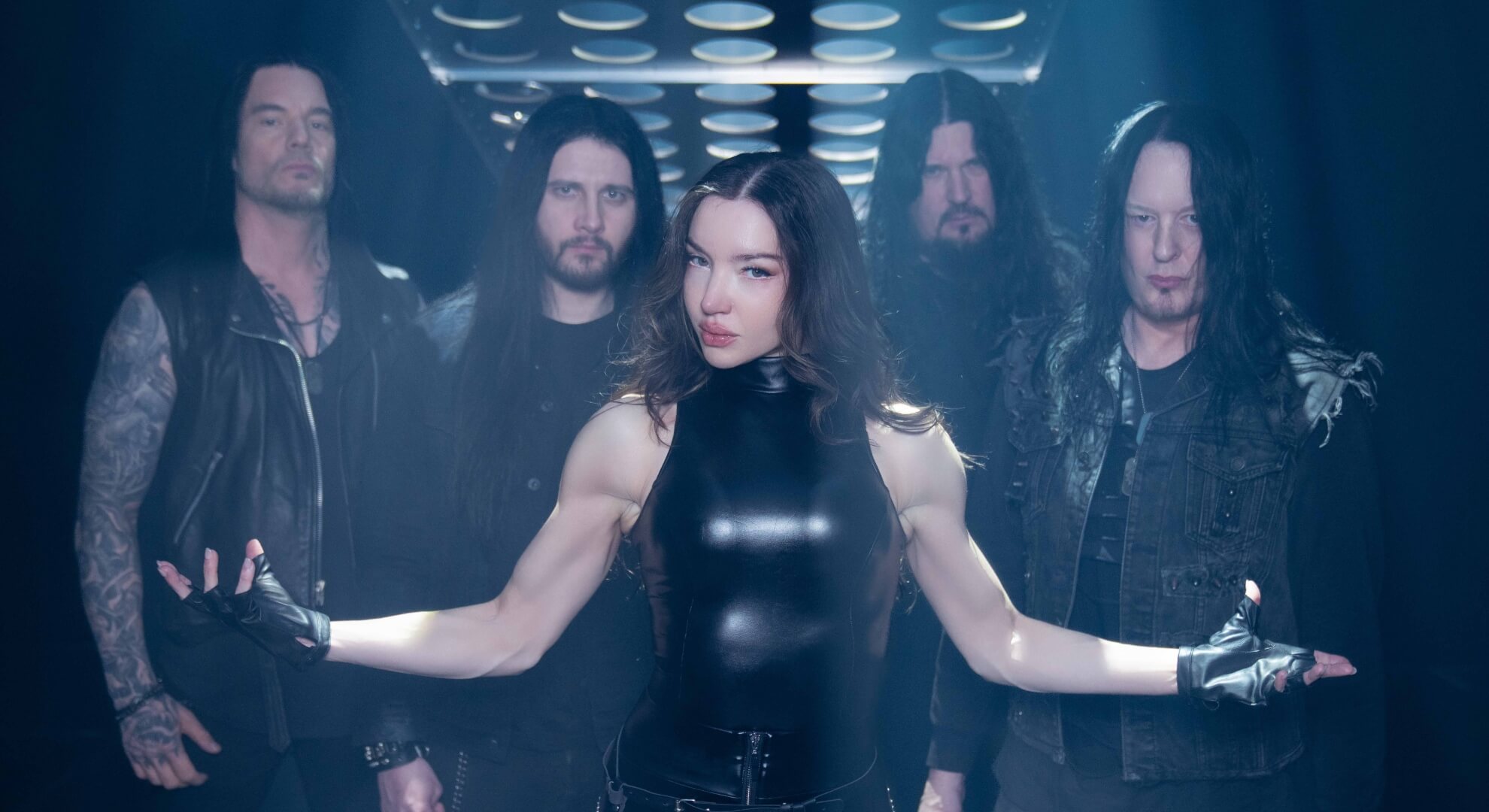


At Dongsan Live in Beijing, on March 27, 2026, a band stepped onstage with a vocalist its audience had never seen perform a single note on its behalf. The occasion was Arch Enemy’s first live show with Lauren Hart, formerly of the Los Angeles metal act Once Human — the band’s third frontwoman in twelve years, and the third vocalist whose arrival was announced without any public explanation of why the previous arrangement had ended. The same night, several time zones to the west, former Megadeth guitarist Kiko Loureiro was preparing a post for Instagram.
Loureiro’s post placed two audio clips side by side: one from his own 2024 composition ‘Talking Dreams,’ one from ‘To The Last Breath,’ the single Arch Enemy had released on February 19 to introduce Hart to their audience.1 Its caption, addressed to Arch Enemy’s account, read: “Just helping to promote the new song by @archenemyofficial… you’re welcome.”2 Within the week, Loureiro and his attorney had formally advanced a copyright infringement claim against the band.3
Arch Enemy was formed in Halmstad, Sweden, in 1995 by guitarist Michael Amott and vocalist Johan Liiva, and has released twelve studio albums across three decades. Angela Gossow joined as vocalist in November 2000 and, by her own public account, stepped down in March 2014 to assume the band’s management role.4 Alissa White-Gluz replaced Gossow the same week and remained Arch Enemy’s frontwoman through four studio albums before the band announced her departure on November 23, 2025, eight days after their final European tour date.5
The announcement offered brief thanks and no explanation. The band limited or disabled comment responses across its social media accounts in the immediate aftermath.6 Hart was confirmed as White-Gluz’s replacement in February 2026, and ‘To The Last Breath’ followed days later. The Loureiro claim arrived five weeks after that.
The Loureiro Copyright Dispute
Loureiro — known internationally for his nine-year tenure with Megadeth and, before that, as a founding member of the Brazilian progressive metal act Angra — posted his Instagram comparison without advance notice to Arch Enemy or their management.7 The specific point of contention was a melodic phrase in ‘To The Last Breath’ that Loureiro contended bore a non-coincidental resemblance to a passage in ‘Talking Dreams,’ released on his 2024 solo album ‘Theory of Mind.’ Multiple press outlets confirmed within days that Loureiro and his attorney had formally advanced a copyright infringement claim.8
Gossow’s public response, posted in the comments of Loureiro’s Instagram post, characterized the dispute as professionally beneath expectation. “To be honest, I’d never heard Kiko’s music before,” she wrote. “So, three notes are the same? Well, I guess that happens quite often in music. I have heard a lot of Arch Enemy notes in other songs but would never accuse the other band of plagiarism.”9 “Respectfully, the management team, who are used to dealing with this type of allegation and prefer to handle things carefully.”
Amott’s first response, in the same comment thread, was playful: “Thanks, brother! Looks like I should pay more attention to your solo work! See you at Bangers Open Air!” Both Arch Enemy and Angra are scheduled to headline consecutive nights at the Bangers Open Air festival in São Paulo on April 25 and 26, 2026. After legal counsel formally entered the matter, Arch Enemy released an official statement accompanied by a video of 2022 demo recordings: “Anyone familiar with our creative process knows that we document extensively. Demos, drafts, and iterations are part of how we build our sound, and in this case, that documentation unquestionably establishes the timeline.”10
Amott’s accompanying statement addressed Loureiro directly: “Hey Kiko, sorry to disappoint you and your lawyer, but as you can see and hear, I had the melody back in 2022 already, two years before you released your song. Any similarities are purely coincidental. Enjoy the video and good luck with your music, I will continue to not listen to it. Cheers!”11 If the 2022 date of the recordings is confirmed, the melody in question predates Loureiro’s composition by two years.
How the 2018 Photography Dispute Unfolded
The 2026 dispute did not arise in a vacuum. In June 2018, concert photographer and attorney J. Salmeron photographed Arch Enemy at the FortaRock festival in Nijmegen, the Netherlands, and subsequently discovered that Thunderball Clothing — a company that sponsored White-Gluz and produced her onstage costumes — had reposted his image of the vocalist to promote its products.12 His watermark remained visible in the reposted image. Salmeron contacted Thunderball requesting either his standard licensing fee of €500 or, as a reduced settlement, a €100 donation to the Dutch Cancer Foundation.
Thunderball forwarded his correspondence to Arch Enemy’s management. Gossow, not Thunderball, responded. Her message characterized the contact as a misunderstanding and invoked the band’s cooperative relationship with photographers, writing that those who cover concerts “generally appreciate having their work shown as much as possible.”13 The reply made no reference to Salmeron’s copyright ownership or the commercial nature of Thunderball’s use of the image.
Gossow’s email then went further. As documented in Salmeron’s published account, the full message informed him that he was “not welcome anymore to take pictures of Arch Enemy performances in the future, at festivals or solo performances,” and stated: “I have copied in the label reps and booking agent who will inform promoters — no band wants to have photographers on site who later send such threatening correspondence to monetise on their images.”14 The email concluded with a note that the band’s members had been copied, “so they know about you in the future.”
Salmeron published the full correspondence in December 2018. The account reached the front page of Reddit within hours and was read by nearly one million people on the photography website Petapixel, according to Salmeron’s own January 2019 follow-up.15 Five days after the story broke, Thunderball Clothing — the company whose repost had initiated the dispute — announced its closure, its owner citing the intensity of the public backlash.
After the story went viral, Gossow issued a public statement on Facebook in which she directly contested the scope of the action she had taken. “The claim I had him blacklisted with all agents, festivals etc is false,” she wrote. “I did inform my circle of people I do not want him in the Arch Enemy photo pit again. I did not ask any promoters, festivals, magazines or whoever to ban him.”16 This statement is in direct conflict with the text of Gossow’s own email, which explicitly stated she had copied label representatives and a booking agent and directed that promoters be informed.
The 2009 Precedent and the Broader Pattern
Salmeron’s January 2019 follow-up identified an earlier incident. On December 22, 2009, Dutch photographer Anouk Timmerman had contacted Angela Gossow’s official website to request the removal of photographs reposted from her Flickr account without authorization.17 Timmerman sent no legal correspondence, requested no payment, and sought only the removal of the images. She, too, was subsequently banned from future Arch Enemy photography.
Following the publication of Salmeron’s account, Metal Blast — the publication that first broke the story — received verified emails from additional photographers who had experienced comparable treatment: rights assertions made to Arch Enemy management, met with show bans.18 The identities of these photographers were not published, but Salmeron confirmed their correspondence had been verified.
Salmeron also noted an internal inconsistency in Arch Enemy’s position. While Gossow was publicly arguing that photographers should be grateful for the exposure their work received by being reposted, Arch Enemy was simultaneously enforcing its own intellectual property with standard industry rigor: an upload of the band’s track ‘The World is Yours’ to YouTube was, in Salmeron’s documented account, flagged as infringing immediately.19 The band enforced its own rights through the standard mechanisms while characterizing a photographer’s enforcement of his rights as an act of harassment.
Vocalist Transitions and Management Opacity
The pattern of managed opacity extends to how Arch Enemy communicates internally significant decisions. Both vocalist transitions in the band’s modern era — Gossow’s exit in 2014 and White-Gluz’s in 2025 — were announced without explanation, processed through brief joint statements, and followed by restricted comment environments.20 White-Gluz, in a February 2026 interview with Germany’s Metal Hammer magazine, described the split as “definitely difficult” without addressing its causes: “When you spend that many years with something, it becomes a huge part of your life and identity,” she told the publication.21
The same management approach has shaped Arch Enemy’s handling of its instrumental lineup. Guitarist Jeff Loomis joined the band in late 2014, following the dissolution of Nevermore, the group with which he had spent twenty years as a primary songwriter. He departed at the end of 2023 after nine years, having received no songwriting credits across his two studio albums with the band — ‘Will to Power’ (2017) and ‘Deceivers’ (2022).22
Amott acknowledged in a 2018 interview that he had “always written most of the music” and did not want to “change the sound of the band too much,” adding that the band’s sound “started around my songwriting and my ideas, and those continue to be the most dominant ones.”23
Creative Decline and the Blood Dynasty Question
‘Wages of Sin’ (2001) — Gossow’s debut — is widely regarded as the band’s creative benchmark. ‘Blood Dynasty’ (2025), the twelfth studio album and the last to feature White-Gluz, arrived with promotional statements from Amott describing it as the band’s most ambitious work to date.24
Published reviews across established metal outlets reflected a divided reception, consistent with a pattern that has accompanied each Arch Enemy release since ‘Khaos Legions’ (2011), when the metal press last identified the band operating at creative peak.25
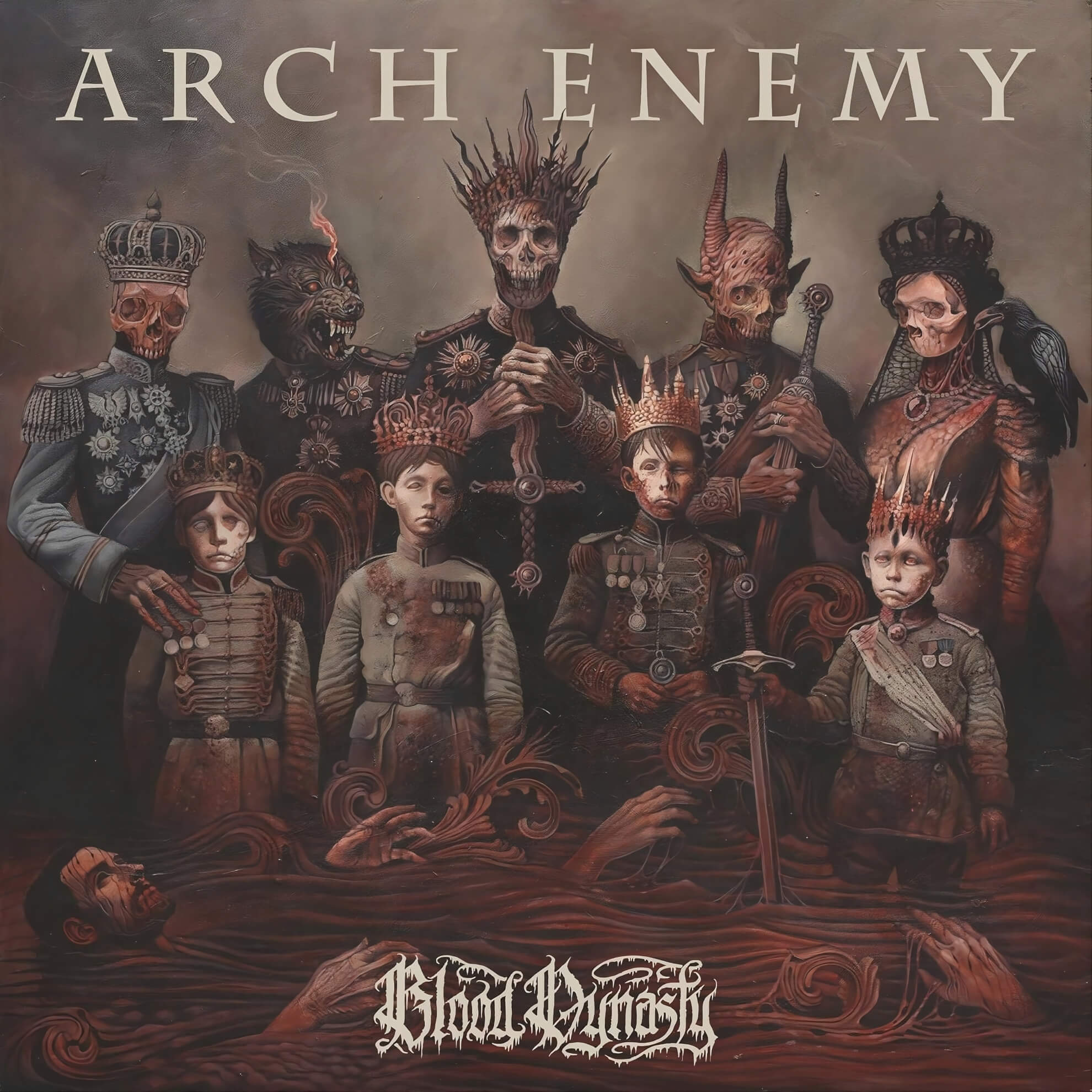
The album’s cover artwork generated a specific controversy before release. When ‘Blood Dynasty’ was announced in October 2024, its densely detailed image — depicting multiple armored figures encrusted with jeweled ornamentation — prompted immediate public speculation that it was artificially generated.26
The painter, Alex Reisfar, addressed the question directly in a published interview: the work was hand-painted on a 24-by-24-inch canvas, completed over eight weeks between July 1 and late August 2024.27 The speculation itself — and the fact that it required a published artist statement to settle — reflects how thoroughly the band’s brand has become susceptible to assumptions of institutional corner-cutting.
What the Evidence Does and Does Not Establish
Arch Enemy’s defense in the Loureiro matter is specific and testable. The 2022 demo recordings either predate ‘Talking Dreams’ or they do not, and the dating and authenticity of those recordings are questions a legal proceeding is equipped to evaluate.28 The band’s position — that any similarity is coincidental and that its melody predates Loureiro’s by two years — is not implausible in a genre built on a shared harmonic vocabulary. If the evidence holds, the copyright claim does not.
The 2018 photography dispute presents a different evidentiary picture. Gossow’s own email established that she informed label representatives and a booking agent and directed that promoters be notified — language that goes substantially beyond declining to renew a photo pit pass.29 Her subsequent public denial of this scope contradicts the documented text of the email. Both the email and the denial are part of the public record.30
Arch Enemy was correct on the narrow factual point that neither the band nor White-Gluz posted Salmeron’s photograph in a commercial context.31 The documented criticism of the management response concerns what happened after that point: the decision to treat a copyright notice addressed to a third party as the basis for industry-wide notification and a permanent photo pit ban. That decision, and the contradiction between the email that enacted it and the public statement that denied its scope, is part of the record.
What Seventeen Years Establish
Three documented incidents across seventeen years establish a consistent pattern in how Arch Enemy’s management responds to rights challenges from third parties. In 2009, a photographer who asked for the removal of unauthorized images was banned from future performances. In 2018, a photographer-attorney who asserted copyright over his own work and requested a minimal charitable settlement was banned from future performances; management notified label representatives and a booking agent; and a subsequent public denial contradicted the documented text of the original email. In 2026, a formally advanced copyright infringement claim from a professional musician represented by legal counsel received the same institutional response: public dismissal, then escalation.
Whether Arch Enemy’s timeline evidence will resolve the Loureiro claim in the band’s favor is for the legal process to determine. What the documented record establishes independently of that outcome is that the same management philosophy — assert institutional authority publicly, involve industry intermediaries, and offer no private path to resolution — has governed the band’s response to every rights challenge in the record. One material limitation of this investigation is that the 2022 demo recordings have not been independently authenticated; their verification will substantially determine the outcome of the copyright claim.
Arch Enemy’s response to Kiko Loureiro included 2022 demo recordings as evidence of original creation — documentation that most bands do not make public during a rights dispute. Does that level of process transparency change how you weigh the band’s response, and would the same standard of documentation and transparency have produced different outcomes in the 2009 or 2018 photography disputes?
References
- Arch Enemy and Century Media Records, announcement of Lauren Hart as vocalist and release of ‘To The Last Breath,’ February 19, 2026. As documented by Wikimetal, ‘Who Is Lauren Hart, the New Vocalist of Arch Enemy?,’ February 19, 2026. ↩︎
- Kiko Loureiro, Instagram post, March 27, 2026. Caption and audio-visual comparison documented by Blabbermouth.net (see reference 10 above) and Chaoszine, ‘Arch Enemy vs Kiko Loureiro: The Plagiarism That’s Heating Up the Scene,’ April 4, 2026. ↩︎
- Chaoszine (reference above) and Theprp.com, ‘Arch Enemy’s Michael Amott Fires Back at Kiko Loureiro’s Recent Copyright Infringement Claim,’ April 3, 2026. ↩︎
- Angela Gossow, departure statement, March 17, 2014. As reproduced by Arch Enemy’s official announcement and documented in Angela Gossow, Wikipedia. ↩︎
- Arch Enemy, official statement on Alissa White-Gluz departure, November 23, 2025; Alissa White-Gluz, personal statement, November 23, 2025. Both as documented by Loudwire, ‘Arch Enemy Part Ways with Singer Alissa White-Gluz, Statements Issued,’ November 23, 2025. ↩︎
- Comment-disabling noted by Loudwire (reference 5 above) and Loadedradio.com, ‘Breaking: Alissa White-Gluz Splits Arch Enemy After 11 Years,’ November 24, 2025. ↩︎
- Kiko Loureiro tenure with Megadeth: Blabbermouth.net, ‘Kiko Loureiro on Decision to Leave Megadeth,’ January 10, 2024. Loureiro Instagram post: documented by Chaoszine (reference 3 above). ↩︎
- Chaoszine (reference 3 above); Theprp.com (reference 3 above); Lambgoat, ‘Arch Enemy Shoot Down Kiko Loureiro’s Copyright Infringement Claims,’ April 4, 2026. ↩︎
- Angela Gossow, comment on Kiko Loureiro’s Instagram post, March 27–28, 2026. Full text reproduced by Blabbermouth.net, ‘Arch Enemy Shoots Down Kiko Loureiro’s ‘Copyright Infringement’ Claim,’ April 3, 2026. ↩︎
- Arch Enemy official statement, April 3, 2026, including demo recording video. Full text reproduced by Blabbermouth.net (reference above). ↩︎
- Michael Amott, personal statement, April 3, 2026. Full text reproduced by Blabbermouth.net (reference above). ↩︎
- J. Salmeron, ‘How I Got Banned from Photographing the Band Arch Enemy,’ Petapixel, December 26, 2018. ↩︎
- J. Salmeron, Petapixel (reference 12 above); Gossow’s first email to Salmeron reproduced therein. ↩︎
- Angela Gossow, email to J. Salmeron, summer 2018. Full text with screenshots reproduced in J. Salmeron, ‘How I Got Banned from Photographing the Band Arch Enemy,’ Petapixel, December 26, 2018. ↩︎
- J. Salmeron, ‘Reflections on Hate and Some Answers for Arch Enemy,’ Metal Blast, January 14, 2019. ↩︎
- Angela Gossow, Facebook statement, December 29–30, 2018. Full text reproduced by Loudwire, ‘Angela Gossow Defends Banning Photographer From Arch Enemy Shows,’ December 31, 2018. ↩︎
- J. Salmeron, Metal Blast (reference 15 above). Documents the Timmerman incident of December 22, 2009. Cross-referenced by PitchMark, ‘Photographer Becomes Arch Enemy for Going After Copyright Offenders.’ ↩︎
- J. Salmeron, Metal Blast (reference 15 above). Verified additional photographer correspondence received after publication. ↩︎
- J. Salmeron, Petapixel (reference 12 above). Documents Arch Enemy’s enforcement of its own copyright on YouTube. ↩︎
- Arch Enemy departure statements for Gossow (2014) and White-Gluz (2025). Gossow: documented in reference 4 above. White-Gluz: documented in reference 5 above. Comment restriction: documented in reference 6 above. ↩︎
- Alissa White-Gluz, interview with Germany’s Metal Hammer magazine. As reported by Blabbermouth.net, February 16, 2026. ↩︎
- Jeff Loomis, departure statement, December 30, 2023; Guitar World, ‘Arch Enemy Part Ways with Guitarist Jeff Loomis,’ January 2, 2024 (confirms absence of songwriting credits). ↩︎
- Michael Amott, interview with iheartguitarblog.com, 2018, as reproduced in Blabbermouth.net, ‘Arch Enemy Splits with Guitarist Jeff Loomis,’ December 30, 2023. ↩︎
- Michael Amott, promotional statements regarding ‘Blood Dynasty.’ As reproduced in Alex Reisfar, interview with Heaviest of Art, ‘Behind the Cover: Arch Enemy — Blood Dynasty,’ March 12, 2025, and Nuclear Blast, ‘Arch Enemy Announce Their 12th Studio Album Blood Dynasty,’ October 4, 2024. ↩︎
- Angry Metal Guy, review of Arch Enemy — ‘Blood Dynasty,’ March 28, 2025. ↩︎
- MetalSucks, ‘Arch Enemy Unveil Their New Album Blood Dynasty and Its Awesome Cover Art,’ October 4, 2024. ↩︎
- Alex Reisfar, interview with Heaviest of Art (reference 24 above). ↩︎
- Arch Enemy official statement, April 3, 2026 (reference 10 above). ↩︎
- J. Salmeron, Petapixel (reference 12 above). Gossow email full text. ↩︎
- J. Salmeron, Petapixel (reference 12 above); Angela Gossow, Facebook statement (reference 16 above). ↩︎
- Arch Enemy and Alissa White-Gluz statements, December 27–28, 2018, as reproduced by Theprp.com, ‘Concert Photographer Reveals How He Got Blacklisted by Arch Enemy,’ December 27, 2018. ↩︎

Leave a Reply