


A Bandcamp new-release notification in January 2026 pointed me toward a band I did not know: Cries of Blood, listed as Bogotá-founded and Montreal-based, releasing their debut full-length after more than a decade of activity. What held my attention was not the record itself but the sequence: a five-track EP in 2013, a compilation slot in 2016, a three-band split in 2018, and then ‘Ominous Perception’ in January 2026. That is not silence. It is the outline of a band working out, across two countries and two very different metal scenes, exactly what kind of record they intended to make.
The case I want to make is a specific one. ‘Ominous Perception’ is the most formally complete expression yet of what Bogotá-rooted blackened death metal sounds like when it is allowed to develop its orchestral ambitions fully — and the band’s migration to Montreal was not incidental to that result but structurally necessary to it.
What Bogotá Built
Cries of Blood was founded in Bogotá in 2012. The original lineup operated within the city’s underground extreme metal circuit, which has always been distinct from the Medellín Ultra Metal tradition. The Medellín scene of the 1980s — Parabellum, and Reencarnación — dominates international discussions of Colombian extreme metal, and its influence on the Norwegian black metal movement has been well established in academic scholarship.1
Bogotá’s extreme metal inheritance is different: more technically oriented, more directly shaped by European and North American death metal currents, and inclined toward precision rather than the raw primitivism that defined Ultra Metal.
The original EP, ‘My Philosophy,’ produced at SoundTech Studios in Bogotá and released in July 2013, positions the band inside that formation. Its five tracks move fast and directly: palm-muted tremolo riffing deployed with the blunt percussive clarity of death metal. ‘Vana Predicación,’ the EP’s Spanish-language track, makes the clearest early statement — riff patterns that make no concessions to melody, vocal phrasing locked to the guitar’s rhythmic logic.
By 2016, ‘Bloody Hammer of Messiah’ had appeared on the double-CD Colombian compilation ‘True Metal Subversion 6’ (Green Revolution Productions), and the 2018 split ‘Coalición Metal Colombia,’ shared with Licantropía and Encounter Truth, confirmed the band’s standing within the national underground. These releases operated within the tight Colombian distribution network that scholars of Latin American metal have identified as the primary framework through which independent acts maintain visibility without external infrastructure.2
The Architect and the Relocation
The band relocated to Montreal in 2019. Of the original Bogotá lineup, Julian — now Julian Apophis — is the one who carried the project forward, reconstituting the ensemble entirely with Quebec-based musicians. The current formation — Yves Godbout on vocals, Julian Apophis on lead guitar, Sylvain “The Wizard” on rhythm guitar, Remy Loubert on bass and backing vocals, Dani Rod on drums and orchestration — is Colombian-Canadian in both its composition and its sound.
Julian is the primary composer. The riff material at the base of ‘Ominous Perception’ is his: ideas he began developing as a teenager in Colombia and carried intact through the relocation and the pandemic. Dani Rod, who handles both drumming and orchestrations, translated Julian’s melodic directives into the orchestral layer that defines the album’s sound. The full-length is, in one sense, the product of a single compositional vision held under considerable pressure for a very long time.
Montreal’s extreme metal scene is dominated by technical death metal — a tradition running from Gorguts and Cryptopsy through to Beyond Creation and Augury — and the city carries a distinct grammar of extreme instrumental precision. What Julian brought from Bogotá was something that scene could not supply: the raw, direct, confrontational energy of the Colombian blackened tradition. That transaction is what ‘Ominous Perception’ documents.
The Record in Detail
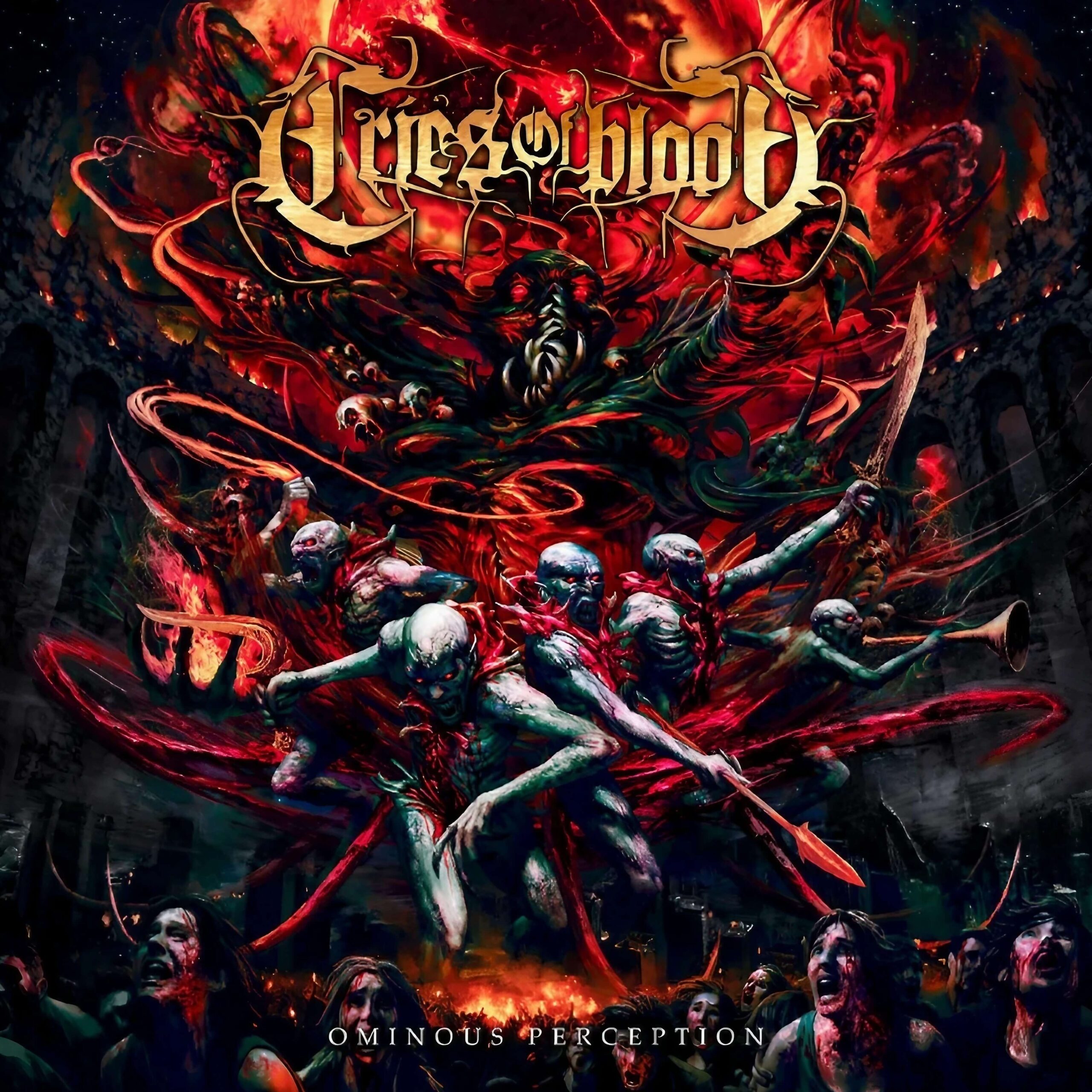
‘Ominous Perception’ runs 44 minutes across ten tracks. The album’s conceptual frame is misanthropic: a narrative of human destruction shaped by Lovecraftian cosmic horror and, beneath that, by Colombia’s ongoing armed conflict — a context that has given the country’s extreme metal tradition its particular relationship to violence as aesthetic material.3
‘Shadows Prevail’ opens after a brief instrumental and makes the album’s most direct technical death metal argument: Loubert’s bass lines carry harmonic independence from the guitars in the manner the Montreal technical tradition favors, and the orchestral line arrives as a third melodic voice rather than decoration.
‘Proclamation (The Call of Death)’ develops this with riff structures that open and close around tempo shifts rather than cycling through repeated patterns. Both tracks argue that the band’s Bogotá foundation has been genuinely augmented by the technical precision the Montreal context enables — not dissolved by it.
The title track, ‘Ominous Perception,’ is the album’s formal center. Godbout’s delivery here is the most uncompromising on the record — the black metal phrasing at its most direct, the orchestration disciplined and brief. It inherits the confrontational approach of the 2013 EP, translated upward in precision without losing the underlying tension.
Then ‘Malédiction Profane’: the album’s most important track, written entirely in French, and the one Julian identifies as the clearest statement of what Cries of Blood is. The decision to write in French is deliberate geographic placement — Quebec’s French-language culture is the environment the band now inhabits, and setting their most ambitious composition in that language rather than English or Spanish is a choice about belonging.
The Behemoth-influenced dynamic of the track — the oscillation between orchestral grandeur and abrupt, percussive brutality — frames the band’s two cultural inheritances as a productive tension rather than a contradiction. This is where what is Colombian about the band and what is Montréalais about the band are simultaneously and fully legible.
The album closes with a re-recorded ‘Eternal Revenge,’ expanded from its three-minute 2013 form. The riff material is unchanged; the orchestral layer now functions as a structural participant rather than an afterthought. It closes the record as a statement of continuity: here is where the band began, and here is what that beginning was actually capable of.
Why This Record, at This Moment
The Northern Death tour, which carried the band through Canada and Colombia after the album’s release, demonstrated something the record alone establishes only in part: the Bogotá formation was legible to audiences in both cities as a distinct approach, not as an imitation of the European symphonic tradition.
What Cries of Blood has produced is the first full-length record by a band that held two very different musical cultures in a single form without conceding either. That is a harder thing to do than it appears on paper, and the record makes it audible.
The Work and Its Terms
I came to ‘Ominous Perception’ through routine discovery and stayed because the argument the record makes is one I had not encountered in quite this form before. The album is not a flawless debut — its pacing in the middle section occasionally slows the tension the opening tracks build — but its central formal claim is clear and consistently maintained: that the blackened death metal tradition Bogotá produced is capable of absorbing orchestral and technical elaboration without becoming something else.
‘Malédiction Profane’ is, for me, the argument at its most precise. It asks the listener to hear Colombian brutality, French-language Quebec, and European symphonic death metal as a single coherent thing — not a fusion but a convergence. I find that case more compelling each time I return to the record.
What Cries of Blood has produced, after fourteen years across two continents, is evidence of what the Colombian extreme metal tradition is capable of when given the material conditions to develop. That is enough.
‘Malédiction Profane’ is written in French and is the track Julian Apophis identifies as the clearest statement of what Cries of Blood is — but the band’s compositional identity is rooted in Bogotá and the Colombian blackened tradition. Does a band’s key self-defining track need to be written in the language of its origin, or is the decision to compose in the language of the adopted city itself a statement about where the music now belongs?
References
- Varas-Díaz, Nelson. ‘Decolonial Metal Music in Latin America.’ London: Intellect, 2021. pp. 14–20. ↩︎
- González Hernández, José Omar. ‘Appropriating the Extreme: Interculturality and the Decolonization of the Image in Extreme Metal in México and Colombia.’ Metal Music Studies 7, no. 1 (2021). ↩︎
- Palacios, Marco. ‘Between Legitimacy and Violence: A History of Colombia, 1875–2002.’ Translated by Richard Stoller. Durham: Duke University Press, 2006. pp. 198–205. ↩︎

Leave a Reply