

Kabuki actors and crews preparing a production of Yotsuya Kaidan have historically observed a specific ritual precaution unavailable to any other property in the Japanese theatrical canon: a visit, before rehearsals begin, to the Tokyo gravesite believed to belong to the historical woman behind its central onryō. The custom persists across nearly two centuries of stage, film, and television productions, sustained by a documented reputation for accidents and misfortune befalling companies that skip it.
That reputation belongs to a story now relocated to fourteenth-century England, adapted by a filmmaker whose two prior features have spent a combined near-decade accumulating a specific kind of cinephile devotion.
The Toronto International Film Festival’s Midnight Madness section, itself housed in a venue with its own well-documented ghost stories, gives the transposition its World Premiere on September 11th, 2026, inside the fifty-first edition of the festival.
The Onryō Crosses the Channel
‘The Face of Horror’ is written and directed by Anna Biller, working for the first time from source material she did not originate wholesale. The screenplay is loosely adapted from Yotsuya Kaidan, the 1825 kabuki play written by Tsuruya Nanboku IV that has been filmed more than thirty times since Japanese cinema’s silent era and remains, by wide critical consensus, the most influential ghost narrative the country has produced.
The play centers Oiwa, a wife poisoned and disfigured by her husband Iemon so that he may marry a wealthier woman, who returns as an onryō, a vengeance-driven revenant, to destroy him and everyone connected to his betrayal. The onryō is a specific category within the broader taxonomy of Japanese supernatural belief, distinguished from other yōkai by the intensity of the grievance that anchors it to the world of the living.1
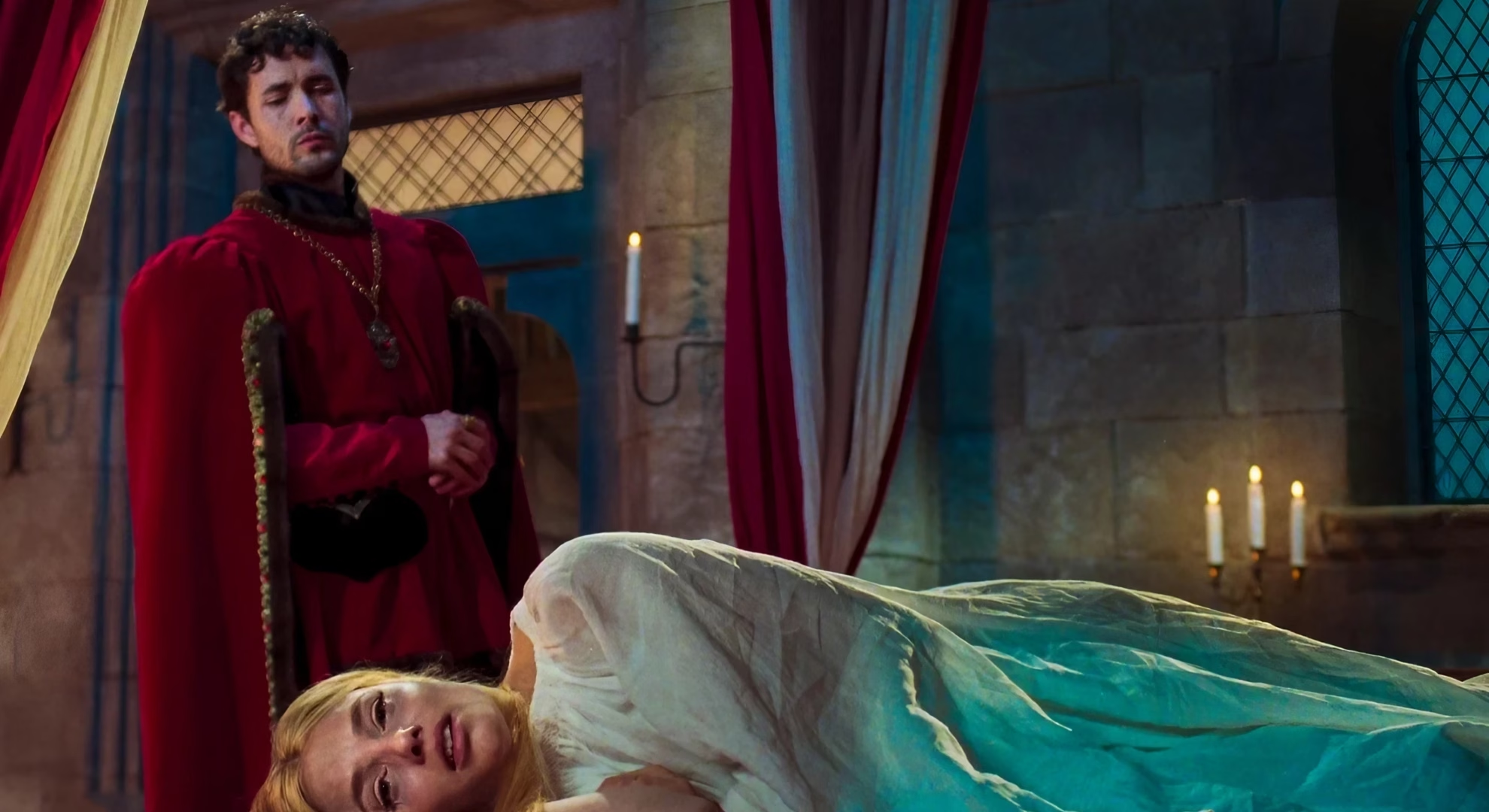
Biller’s adaptation retains the mechanism while relocating the geography entirely. In her version, Eleanor, a woman failed first by her husband’s adultery and then by the tragedy his treachery sets in motion, dies and returns as a vengeful spirit to pursue Edward Carnifex, the knight who betrayed her, and the new bride he intended to replace her with.
The transposition of a specifically Japanese revenant tradition into a Western medieval gothic register is not without precedent in the broader history of horror adaptation, but it is unusual for a filmmaker whose reputation rests on original screenplays to draw so directly on a single, named foreign source rather than a diffuse genre inheritance.
What Biller keeps from the kabuki original is the narrative’s structural logic of betrayal answered by disfigurement answered by annihilation, rather than any specific cultural iconography of the onryō itself.
Biller’s Long Return to the Screen
The filmmaker arrives at Midnight Madness having built her reputation on exactly two prior features across nineteen years. ‘Viva’ (2007), an original erotic melodrama set against a stylized version of the sexual revolution, established the essential terms of Biller’s method: total authorial control over set design, costume, and often original music, deployed in the service of a deliberately artificial visual register drawn from mid-century Hollywood and European art cinema rather than any strain of contemporary naturalism.

‘The Love Witch’ (2016) extended that method into horror-adjacent territory more directly, following a woman who uses spellcraft to attract men who inevitably die from the intensity of her affection, rendered in a saturated Technicolor pastiche that functioned simultaneously as loving homage and pointed critique of the genre conventions it borrowed.
The film became a fixture on repertory and specialty screens well beyond its initial release, building the kind of durable cult standing that accrues slowly rather than through any single commercial benchmark.
Ten years separate ‘The Love Witch’ from ‘The Face of Horror,’ a gap the trade press covering the new film’s Prague production has consistently framed as a defining fact of the filmmaker’s career rather than an incidental detail. The interval places Biller’s return within a familiar pattern among directors whose formal ambitions and insistence on hands-on control over every visual element of a production do not accelerate financing on the timelines available to more conventionally commercial filmmakers.
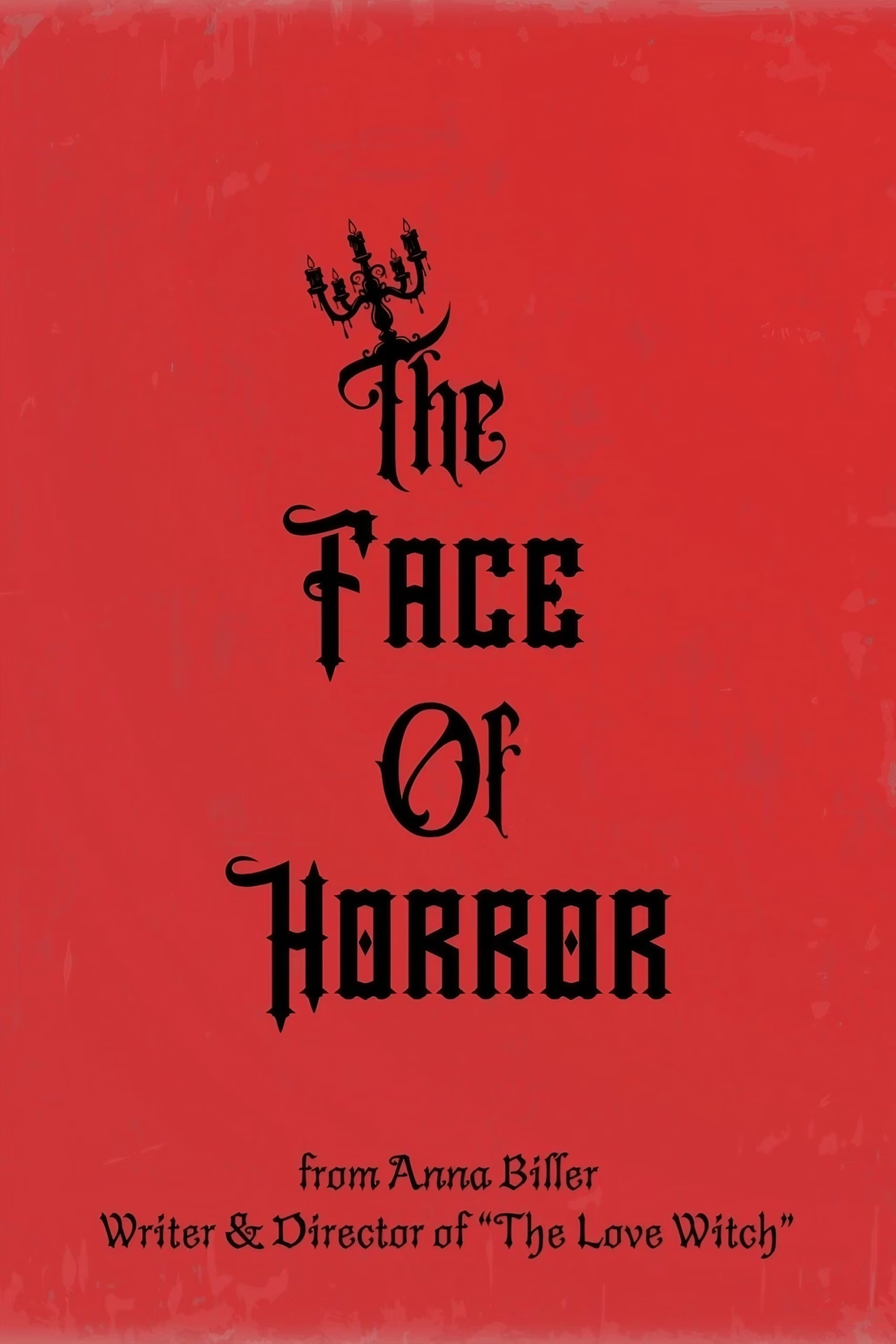
Advance descriptions of ‘The Face of Horror’ from its producer characterize it as a continuation of the Technicolor-inflected visual language ‘The Love Witch’ established, applied now to a larger production scale and an explicitly gorier register than either of Biller’s prior features attempted.
Prague, Color, and the Crew
Principal photography on ‘The Face of Horror’ took place in Prague through the summer of 2025. The film is produced by Biller alongside Mike Goodridge and James Bowsher for Good Chaos, with Sirena Film servicing the production in the Czech Republic.
Cinematographer M. David Mullen returns to Biller’s work for the third time, having shot both ‘Viva’ and ‘The Love Witch,’ making him the single collaborator whose visual fingerprint runs continuously across the director’s entire feature filmography. Gabriel Andrés Gallegos composes the score, a departure from Biller’s prior practice of writing and recording her own music for both previous features.
The principal cast is led by Kristine Froseth as Eleanor and Jonah Hauer-King as Edward Carnifex, with Ellie Bamber, Leo Suter, Bella Heathcote, and Ben Radcliffe completing the ensemble. Producer Mike Goodridge described the finished film as “a bigger, bolder, even more ferociously entertaining film designed for the big screen,” positioning it explicitly against the scale of Biller’s two prior, more modestly budgeted productions.
Embankment Films handles worldwide sales on the production, with WME Independent co-representing domestic rights. A theatrical or streaming distributor for wide release had not been confirmed at the time of publication. The film runs 120 minutes, according to early festival and database listings; an official running time had not been confirmed through festival program materials at the time of publication, and no rating had yet been assigned.
Midnight Madness and Its History
The fifty-first Toronto International Film Festival runs September 10th through 20th, 2026, and its Midnight Madness section, curated by Peter Kuplowsky, delivers ten late-night selections spanning ten countries of production. The section opens on September 10th with Joshua Giuliano’s ‘River,’ with Duncan Jones’s comic adaptation ‘Rogue Trooper’ bringing the slate to its close later in the run.
‘The Face of Horror’ screens the following night, September 11th, as its World Premiere, positioning Biller’s return within a section whose institutional identity has formed specifically around the kind of formally ambitious, audience-driven genre film that struggles for a comfortable seat within a festival’s more conventional prestige programming.
Midnight Madness was introduced at the thirteenth Toronto festival in 1988 and has functioned in the decades since as the festival’s dedicated venue for cult, horror, and midnight cinema, distinct from the awards-oriented programming that defines Toronto’s broader public reputation.
That institutional distinction matters for how ‘The Face of Horror’ arrives. A film built around an explicitly gothic, explicitly gory register, adapted from source material with its own documented cursed reputation, finds its most natural home within a section whose programming history has consistently rewarded formal excess over prestige restraint.
The Royal Alex and Its Ghosts
Midnight Madness screenings take place at the Royal Alexandra Theatre, a National Historic Site opened in 1907 and recognized as the oldest continuously operating legitimate theatre in North America.
The venue has carried a documented reputation among staff, performers, and local ghost-tour operators as a haunted building for decades, with recurring accounts centered on an apparition nicknamed the flyman, said to interfere with the rigging system above the stage, and a reported sighting of performer Al Jolson in the audience during a 1997 production.
Festival press covering this year’s Midnight Madness lineup has consistently described the Royal Alexandra as the section’s “allegedly haunted” home, a framing that predates this year’s program and applies to the venue generally rather than to any single film screening there.
The coincidence, in a section that does not select its venue on a film-by-film basis, is nonetheless a specific one for ‘The Face of Horror’ particularly. A story whose Japanese source material carries a documented reputation for haunting the people who stage it now premieres inside a theater whose own reputation for haunting predates the festival by seven decades, in a section whose late-night ritual of a full house waiting for the stroke of midnight has its own established relationship to audience superstition and shared unease.
A Curse Returns to the Stage
What ‘The Face of Horror’ tests, arriving at Midnight Madness after Biller’s decade away from features, is whether a directorial method grounded in exacting control over color, costume, and set design can carry a larger production scale without losing the specific artificiality that made ‘The Love Witch’ a durable object of cult attention rather than a passing festival curiosity.
The film’s source material has survived nearly two centuries of adaptation precisely because its central mechanism, betrayal answered by transformation and revenge, translates across cultural and historical settings with unusual ease. Biller’s medieval relocation is the latest attempt to prove that portability, tested now before the specific audience Midnight Madness has spent decades cultivating and inside a building with a long-standing reputation for keeping its own ghosts close.
Given that the kabuki tradition behind ‘The Face of Horror’ carries a well-documented history of misfortune striking productions that stage it without observing its protective customs, how do you weigh a film built on a genuinely cursed narrative property premiering inside a venue with its own seven-decade reputation for the supernatural?
Tourism Partnership
We reach an audience that travels with intention — drawn to documented history, dark heritage, and the cultural weight of the places they seek out. If you operate tours, cultural experiences, accommodation, or heritage sites aligned with that ethos, we would like to hear from you. We consider partnerships with tour operators, travel agencies, hostels, hotels, museums, and any organization whose work engages seriously with dark tourism, gothic culture, or historical travel. We do not promote services we cannot stand behind editorially. Reach us through our Contact page.
Reference
- Michael Dylan Foster, ‘The Book of Yokai: Mysterious Creatures of Japanese Folklore,’ expanded 2nd ed. (Oakland: University of California Press, 2024). ↩︎


Leave a Reply