

A statue that predates the Spanish invasion of Mexico by centuries does not, in the documented history of the country’s ongoing campaign against looted antiquities, simply return home and go quiet. Case files kept by Mexico’s Instituto Nacional de Antropología e Historia since 2018 record thousands of objects recovered from private collections and auction houses across Europe and North America, each one carrying a specific ritual function that outlived the empire that first claimed it as spoils.
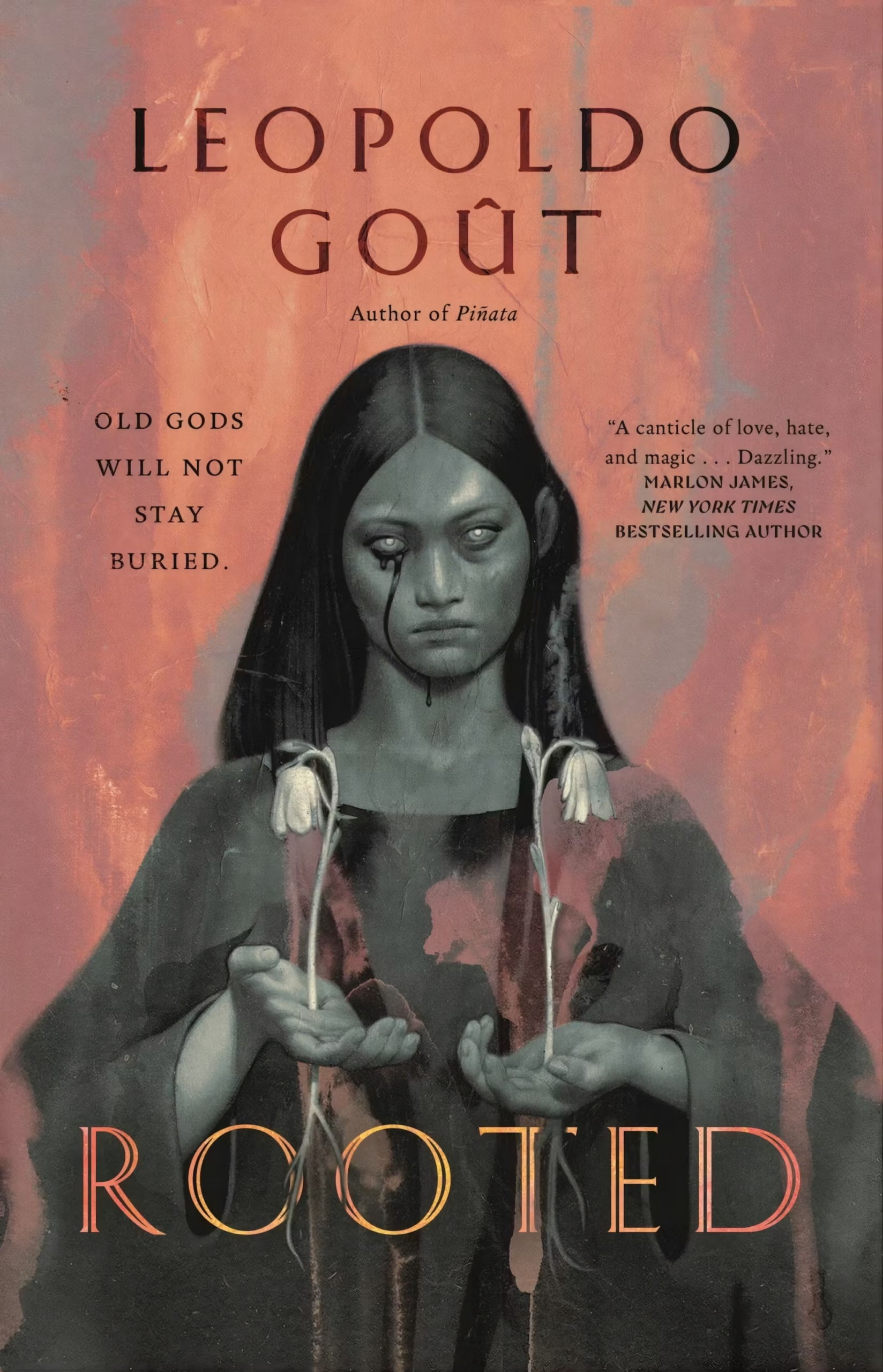
Leopoldo Goût’s second horror novel for Tor Nightfire, ‘Rooted,’ opens at the ceremonial end point of exactly that kind of case, and treats an artifact’s homecoming as the start of a family reckoning rather than its resolution.
‘Rooted’ reaches hardcover shelves on September 15th, 2026, in a 288-page standalone edition from Tor Nightfire, the horror imprint within Tor Publishing Group, carrying the ISBN 978-1-250-78152-9.
According to the publisher’s confirmed synopsis, the novel follows Aurora, a successful art lawyer who has returned to Mexico City to mark the completion of a repatriation case involving a statue of an Aztec deity referred to throughout as the Flayed One. The city she finds does not match the one she left. Her sense of the streets around her begins to fracture, her family’s private history surfaces alongside the recovered object’s public one, and the statue itself proves unwilling to remain a settled matter of restitution.
A Lawyer Returns to Mexico City
Aurora’s profession gives ‘Rooted’ a structural device many haunted-object narratives skip past: the labor of bringing a sacred artifact home is itself part of the story, not a piece of backstory disposed of before the first chapter.
According to the publisher’s confirmed synopsis, Aurora arrives in Mexico City to mark the successful conclusion of the repatriation case that returned the statue of the Flayed One, and to care for an ailing mother, layering a private homecoming onto a professional one already framed as a celebration.
That framing does not survive the opening chapters. The confirmed synopsis describes Mexico City as unrecognizable to Aurora despite her memory of it, her sense of the surrounding streets beginning to fracture, and her family’s private history surfacing alongside the statue’s public one. The novel’s stated turn ties the recovered object’s history directly to hers, rather than treating it as an external threat that happens to a family it never previously touched.
The Flayed God of Renewal
The deity at the center of Aurora’s case is not an invention. Xipe Totec, generally rendered as the Flayed Lord or the Flayed One, was among the significant gods of the Aztec pantheon, associated with fertility, agricultural renewal, and the springtime shedding that precedes new growth.
Worship of the god centered on Tlacaxipehualiztli, a multi-day ceremony during which captives were sacrificed and flayed, and priests wore the resulting skins for 20 days in a ritual documented within decades of the Spanish invasion by the Franciscan missionary Bernardino de Sahagún, whose Florentine Codex remains the primary written source for the god’s rites and their symbolic connection to maize shedding its husk before germination.1
Archaeological confirmation of that documented worship came in 2019, when researchers with Mexico’s National Institute of Anthropology and History identified the first known temple built specifically for Xipe Totec, at the Ndachjian-Tehuacan site in the state of Puebla, complete with paired sacrificial altars and stone sculptures of the god wearing the sacrificial skin associated with his rites.
That combination of a sixteenth-century written record and a twenty-first-century excavated temple gives ‘Rooted’ a deity whose documented history precedes the novel by roughly five centuries, distinguishing its central mythological figure from horror fiction’s more common practice of assembling a composite or invented dark god from scattered folkloric fragments.
A Campaign to Bring Objects Home
The repatriation case that opens ‘Rooted’ has a documented real-world counterpart. Since 2018, Mexico’s federal government has pursued the recovery of looted pre-Hispanic and colonial-era artifacts under the campaign Mi Patrimonio No Se Vende, coordinated between the Ministry of Culture, the Ministry of Foreign Affairs, and the Instituto Nacional de Antropología e Historia.
The effort has recovered thousands of objects through diplomatic requests, formal complaints against auction houses attempting to sell pre-Columbian pieces abroad, and voluntary returns from private collectors in Europe and North America who came to understand, often through the campaign’s public messaging, that the pieces in their possession were never legally theirs to keep.
Aurora’s case, as described in the publisher’s confirmed synopsis, follows that documented pattern closely enough to read as a specific instance of it rather than an invented legal fiction. The statue of the Flayed One occupies the same category of object the real campaign has targeted repeatedly: a named pre-Hispanic deity’s likeness, removed from Mexico at some point in the object’s history, and returned through the kind of institutional and legal process Aurora’s profession represents.
‘Rooted’ does not require its reader to accept an invented mechanism of restitution to make its opening premise plausible; the mechanism already exists, and has already returned thousands of comparable pieces.
The Cursed Object in Fiction
The plot of a foreign or sacred object returning from its point of origin to punish those connected to its removal has a documented lineage within horror fiction, most thoroughly traced through the British mummy-curse tradition that followed nineteenth-century Egyptian excavation.
Roger Luckhurst’s cultural history of that tradition locates its central engine in a specific colonial relationship: British archaeologists, collectors, and museums removed Egyptian antiquities and human remains from their original context, and a popular fiction quickly formed around the idea that the objects, or the dead they belonged to, exacted a delayed revenge on the outsiders who had disturbed them.
Writers including H. Rider Haggard and Arthur Conan Doyle worked variations on that structure across the late nineteenth and early twentieth centuries, with the foreign archaeologist or collector cast as both trespasser and eventual victim.2
‘Rooted’ inverts the position that tradition assigns its central figure. Aurora is not a foreign archaeologist disturbing a tomb outside her own culture; she is a Mexican lawyer whose professional work returned a Mexican deity’s likeness to Mexican soil, and the novel’s stated horror runs through her own family rather than through an outside party punished for theft already completed.
Where the mummy-curse story punishes the act of removal, the confirmed premise of ‘Rooted’ locates its danger inside the act of return itself, and inside a family history the statue’s homecoming appears to reactivate rather than settle.
From Piñata to a New Reckoning
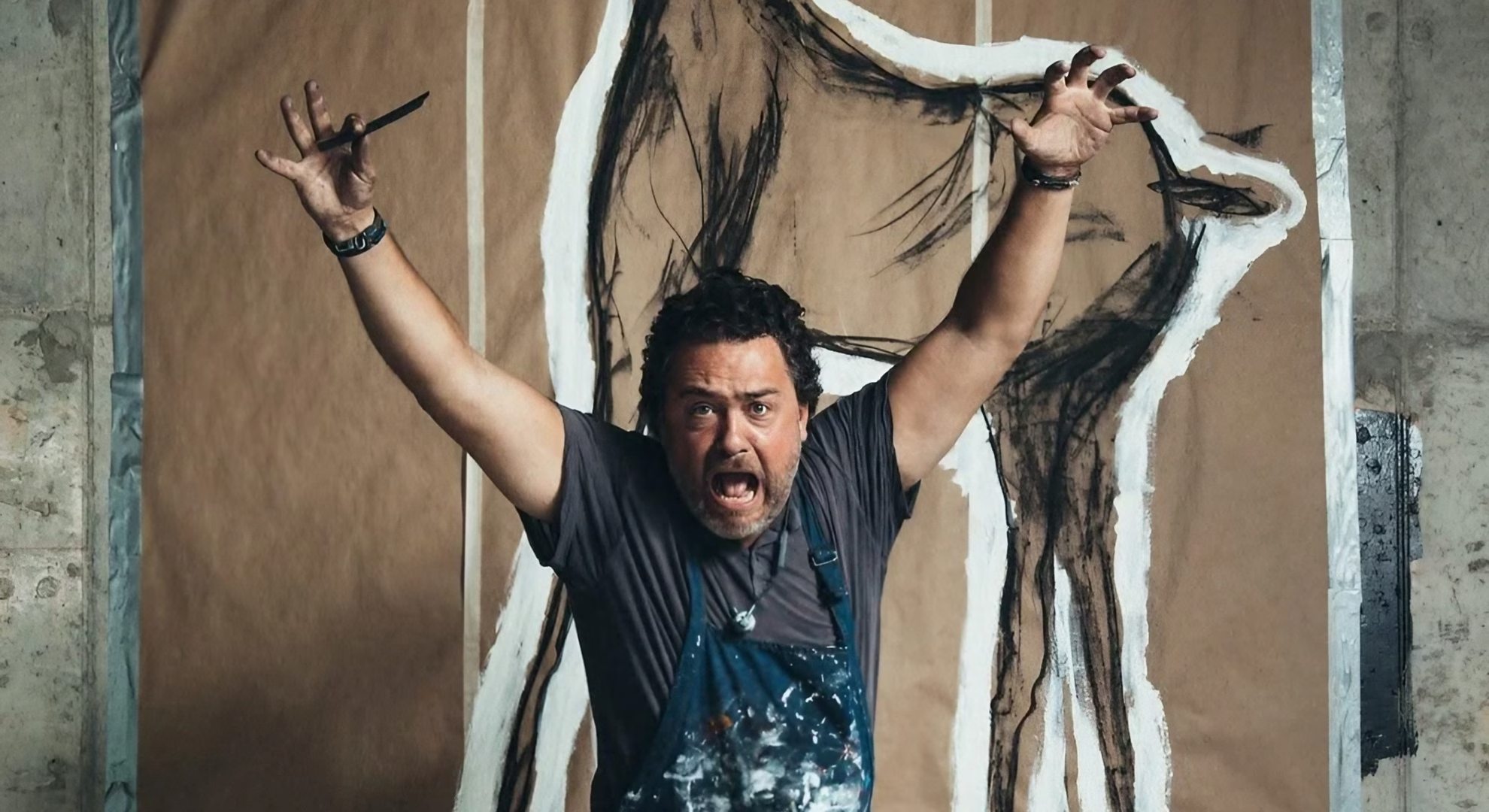
Goût’s path to ‘Rooted’ runs through more than one medium. Born in Mexico City and trained at Central Saint Martins School of Art in London, he built a career across sculpture, painting, and film and television production before his first published novel, ‘Ghost Radio,’ appeared in 2008.
A young-adult trilogy beginning with ‘Genius’ followed between 2016 and 2018, and in 2022 he co-authored ‘Monarca’ with filmmaker Eva Aridjis, an illustrated novella tracing a Mexican-American girl’s transformation into a monarch butterfly across the species’ migration route, built from Mexican folklore rather than invented fantasy.
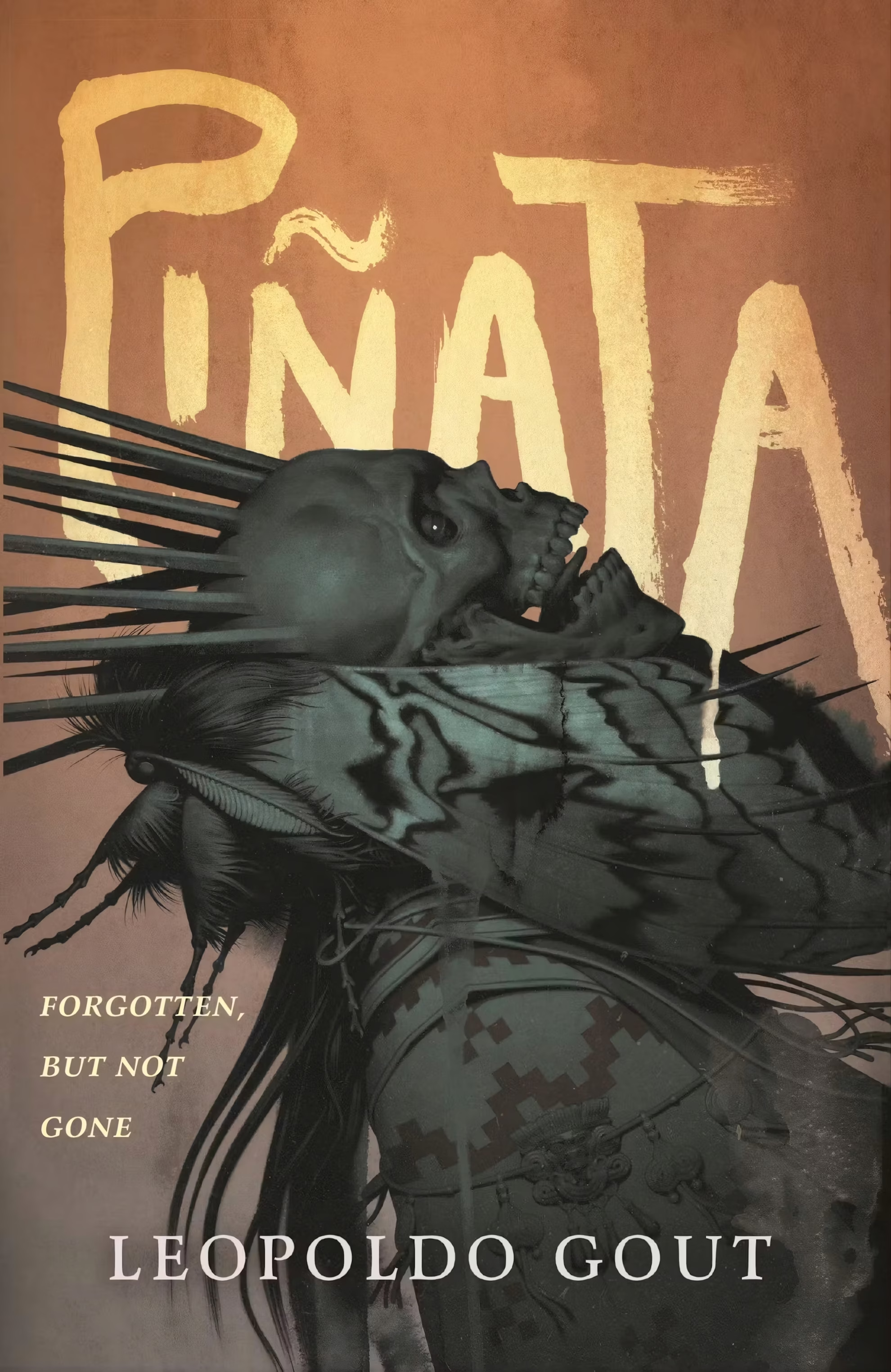
‘Piñata,’ Goût’s first horror novel for Tor Nightfire, followed in 2023: a possession narrative in which a mother supervising the renovation of a Mexican abbey inadvertently unearths centuries-old artifacts that follow her family back to New York.
‘Rooted’ returns to related material, an unearthed pre-Hispanic object, a family carrying its consequences forward, a Mexican setting giving way to disorder, but relocates the entire structure inside Mexico City itself and anchors the disturbance to a named historical deity and a documented restitution campaign rather than an unspecified stash of artifacts.
The Restitution That Reopens
What ‘Rooted’ proposes, on the terms of its confirmed premise, is that restitution and disturbance are not opposite outcomes of the same case but two names for the same unfinished process. Mexico’s repatriation campaign treats the return of an object like the Flayed One’s statue as a closed file, a piece recovered and delivered into the custody of institutions built to preserve it.
Goût’s novel takes that closing gesture and asks what a family connected to the object, rather than the institution processing it, actually inherits at the moment the file is marked resolved. That question sits outside the colonial-archaeologist framework the mummy-curse tradition established a century ago, and inside a specifically Mexican relationship to a specifically Mexican god, whose documented worship long precedes any fiction built around him.
Whether Aurora’s case within ‘Rooted’ ultimately reads as a caution against treating restitution as complete, or as an argument that some inheritances cannot be settled through any legal process at all, is a question the finished novel will answer for itself on September 15th, 2026.
Given that Mexico’s real repatriation campaign has recovered thousands of objects without the supernatural consequence ‘Rooted’ imagines for its single statue, what does grounding a horror novel’s premise in a documented restitution program change about how a reader is likely to receive its central threat?
References
- Bernardino de Sahagún, ‘Florentine Codex: General History of the Things of New Spain,’ ‘Book 2: The Ceremonies,’ trans. Charles E. Dibble and Arthur J. O. Anderson (Santa Fe: School of American Research; Salt Lake City: University of Utah Press, 1981), 1–5. ↩︎
- Roger Luckhurst, ‘The Mummy’s Curse: The True History of a Dark Fantasy’ (Oxford: Oxford University Press, 2012), 153–183. ↩︎



Leave a Reply