

In 1929, a razor blade opened across a woman’s eye in the first minutes of ‘Un Chien Andalou,’ and audiences understood that the rational order of seeing was no longer safe. Luis Buñuel and Salvador Dalí had made derangement into a method — a deliberate assault on the sense that organizes the world into coherence. The image remains among the most exact statements of what Spanish surrealism set out to do.
Nearly a century later, a masked collective from Seville pursues the same wager in sound rather than film. On July 10th, 2026, Pylar release ‘Delyrio’ through Cavsas, the extreme imprint of the Canadian-founded label Cyclic Law, and the record treats delirium not as a breakdown but as a way of knowing.
A Masked Collective From Seville
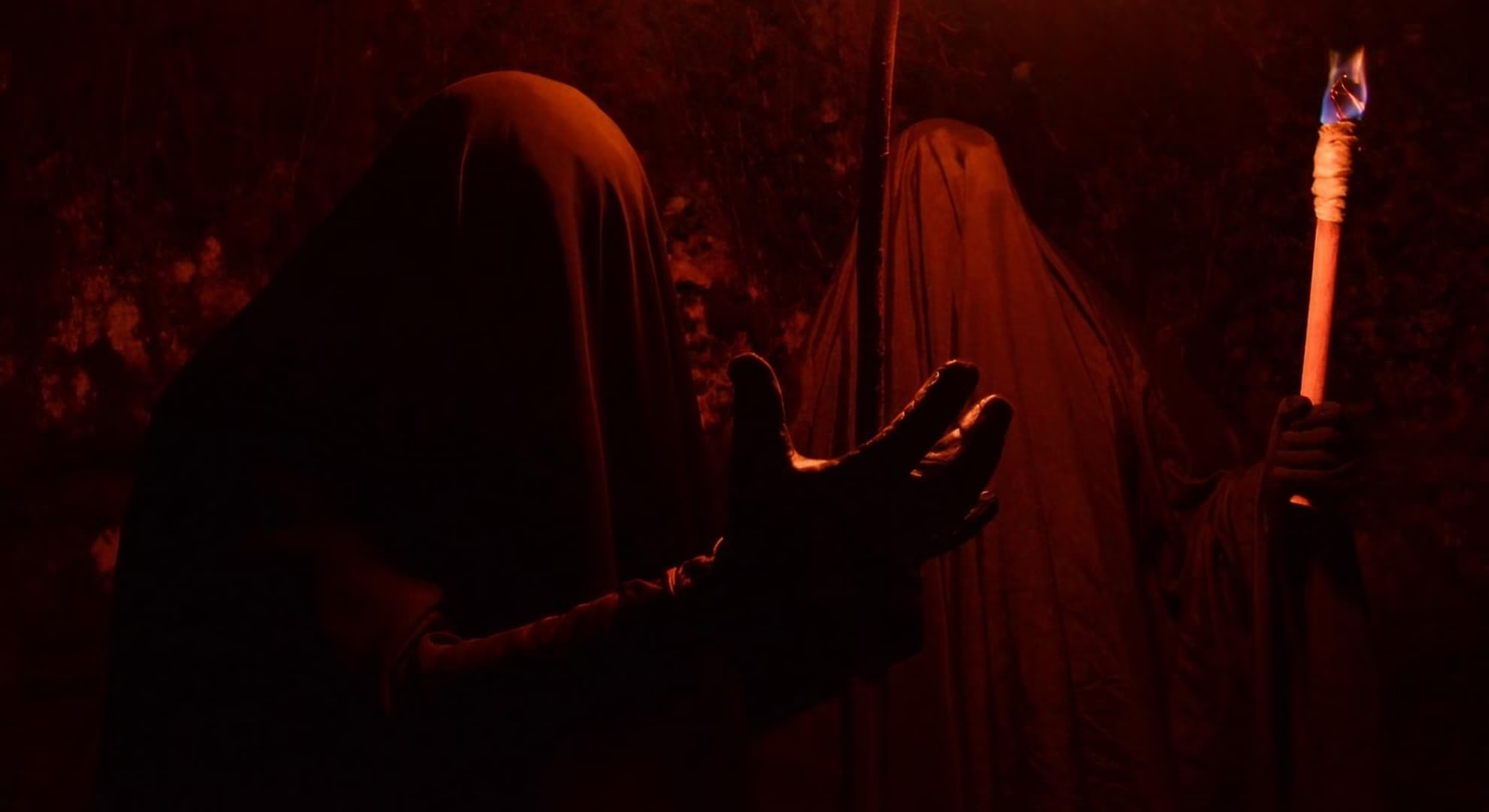
Pylar took shape in Seville in 2012 as a collective of masked figures, described in the band’s own materials as hierophants, shamans, and druids drawn from the ranks of Orthodox and Blooming Látigo.
Onstage they cover their faces and move through their concerts as ceremonies, invocations meant to wake what they call tellurian forces long dormant. The disguise is not theater in the ordinary sense; it is a condition of the work.
That posture places the collective inside a long Spanish current in which derangement works as a deliberate strategy rather than an accident of temperament. The provocations of Buñuel and Dalí, the fevered Romanticism of Gustavo Adolfo Bécquer in the eighteen-sixties, and the experimental undergrounds that persisted through decades of cultural suppression all treated the unsettling of reason as a serious method.1 Pylar extends that current directly, transposed into the register of extreme sound.
From Cosmic Horror to a Final Cycle
The path to ‘Delyrio’ runs through more than a decade of records that treat time and structure as materials to be bent. The debut, ‘Poderoso se alza en my’ (2013), announced the collective on the Seville label Knockturne Records and drew early praise from Julian Cope. A sequence of albums followed, culminating in a trilogy — ‘Horror Cósmyco’ (2019), ‘Abysmos’ (2021), and ‘Límyte’ (2023) — that pursued cosmic horror and existential collapse across long, unbroken pieces.
‘Delyrio’ opens what the band describes as its final album cycle, the first movement of an ending rather than a continuation. Where the trilogy traced an abyss, this record sets its remaining certainties aside and gives itself over to delirium as its only organizing force. The shift is one of intent rather than degree, a narrowing toward pure dislocation.
The Law of Salazar
Guiding ‘Delyrio’ is a conceptual device the band names the Law of Salazar, credited on the record to the member Bar-Gal. It is described as a mechanism of radical perspective displacement, a means of deforming the primordial language of metal until familiar coordinates give way. The frame draws on speculative realism and philosophical fiction — the writings of Reza Negarestani, Amy Ireland, and the theoretical currents around the Cybernetic Culture Research Unit.
This scaffolding is not new to the collective. On ‘Límyte’ their vocalists intoned texts by the experimental writer Francisco Jota-Pérez alongside fragments from Negarestani’s ‘Cyclonopedia,’ the cult work of philosophical horror. The displacement Pylar pursues carries a ritual logic, closer to the passage a ceremony performs than to any literary conceit — a deliberate move from one order of reality into another.2
In practice the device turns the record against its own genre. The blast, the riff, and the drone remain, but they are dislodged from the grammar that usually gives them meaning, so that the familiar machinery of extreme metal reads as something stranger and less certain of itself.
Two Movements Now Audible
Two of the album’s four movements are public before release. ‘Apoteosis,’ the opening piece, arrived with a teaser in late May, and ‘Enajenación’ surfaced in the days before the record, together forming the only portion of ‘Delyrio’ a listener can assess directly.
Discussing their method on the previous record, the collective described privileging “textures as a primary symbol” over conventional structure, promoting atmosphere above rhythmic or melodic incident. That principle governs what is audible here: sound accumulates rather than resolves, and weight gathers through duration instead of arriving at a climax.3
Against the touchstones the band itself names — Swans, Oranssi Pazuzu, Teitanblood — the two movements position ‘Delyrio’ toward density and dissolution rather than force alone. The complete record had not been released at the time of writing, and the two unheard movements remain outside any fair assessment.
La Mina and the Alchemical Master
Pylar produced and composed ‘Delyrio’ themselves, and the record was recorded, mixed, and mastered at a facility the credits call only La Mina, by an unnamed figure the band designates the Alchemical Master, its sixth heretical member. The press materials wrap the session in myth, situating it in imagined Atlantean territory.
Behind that mythology sits a real room. La Mina Studios in Seville has served as the documented home of the collective’s recordings across its career, the space where earlier Pylar albums were tracked and mixed by the engineer Raúl Pérez.
The identity of the Alchemical Master on this record could not be confirmed through official sources at the time of publication. What the room’s history establishes is a continuity of method — the same Seville space, the same treatment of the studio as an instrument of transformation rather than a neutral point of capture.
Found by Those Who Go Searching
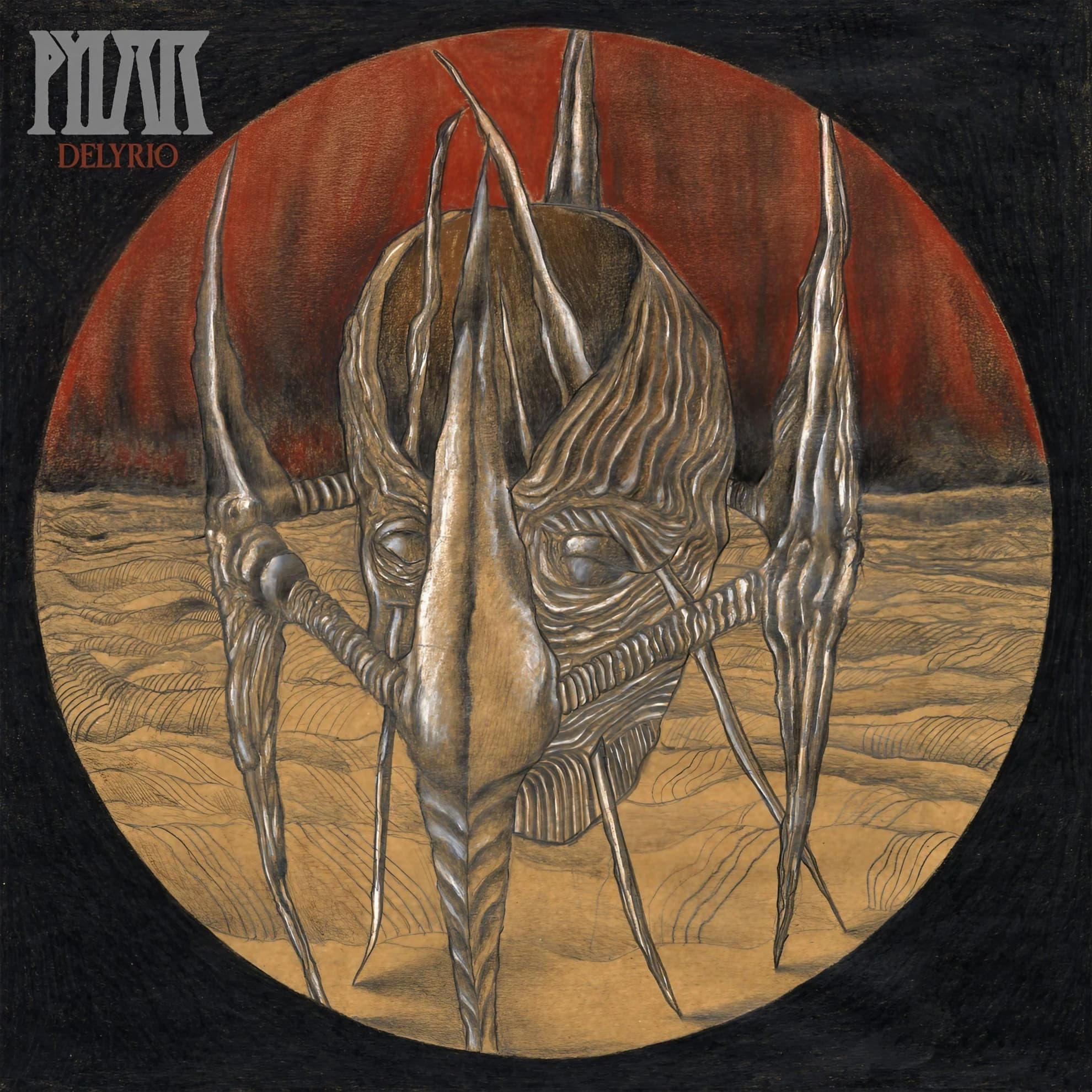
‘Delyrio’ reaches its audience the way Pylar’s records always have, through the direct channels of the underground rather than the open marketplace. Cavsas, the extreme imprint of the Canadian-founded, now France-based label Cyclic Law, issues the album — four movements across roughly 38 minutes — on a limited six-panel digisleeve compact disc and a vinyl pressing of 200 copies, half on marbled red and orange, half on black, alongside a digital edition sold through Bandcamp.
Music this uncompromising rarely travels by automated recommendation. The avant-garde has always defined itself against sanctioned forms and the institutions that circulate them, and ‘Delyrio’ belongs to that refusal in its distribution as much as in its sound.4 It is found by listeners who go looking, in a small-pressing economy where a physical import can represent a real sacrifice against local wages, and where scarcity filters the audience down to the committed.
That is the condition Pylar has always worked within, and it is the one ‘Delyrio’ enters now — a record made for people who accept the search as part of the encounter.
A Cartography of the Absolute
‘Delyrio’ arrives on July 10th, 2026, as the opening of an ending — the first movement of the last cycle a restless collective has allowed itself. After more than a decade spent bending time and sense into shapes that resist resolution, Pylar proposes delirium not as failure but as a discipline, a way of seeing that the ordinary order of things cannot reach.
That proposition will find its audience where this music has always found it, among the listeners who go looking, in the underground that treats difficulty as a promise rather than a barrier. Whether the two unheard movements sustain the method the first two set in motion is a question only the full record can answer, and it answers to an audience that was never waiting to be told what to hear.
When a record treats delirium as a method of knowing and reaches you only if you go looking for it, what do you recognize first — the specific Spanish current of derangement it emerges from, or the shape of a mind coming apart that needs no translation at all?
References
- C. B. Morris, ‘Surrealism and Spain 1920–1936’ (Cambridge: Cambridge University Press, 1972), 24–29. ↩︎
- Mircea Eliade, ‘The Sacred and the Profane: The Nature of Religion,’ trans. Willard R. Trask (New York: Harcourt, Brace & World, 1959), 20–25. ↩︎
- Salomé Voegelin, ‘Listening to Noise and Silence: Towards a Philosophy of Sound Art’ (New York: Continuum, 2010), 41–46. ↩︎
- Peter Bürger, ‘Theory of the Avant-Garde,’ trans. Michael Shaw (Minneapolis: University of Minnesota Press, 1984), 47–54. ↩︎

Leave a Reply