


What Tartarus Press issued in editions of three hundred copies apiece between 2010 and 2021 has now been gathered into a single paperback from Titan Books, a publisher with a documented track record in dark fantasy and horror fiction reaching back through its international catalog.
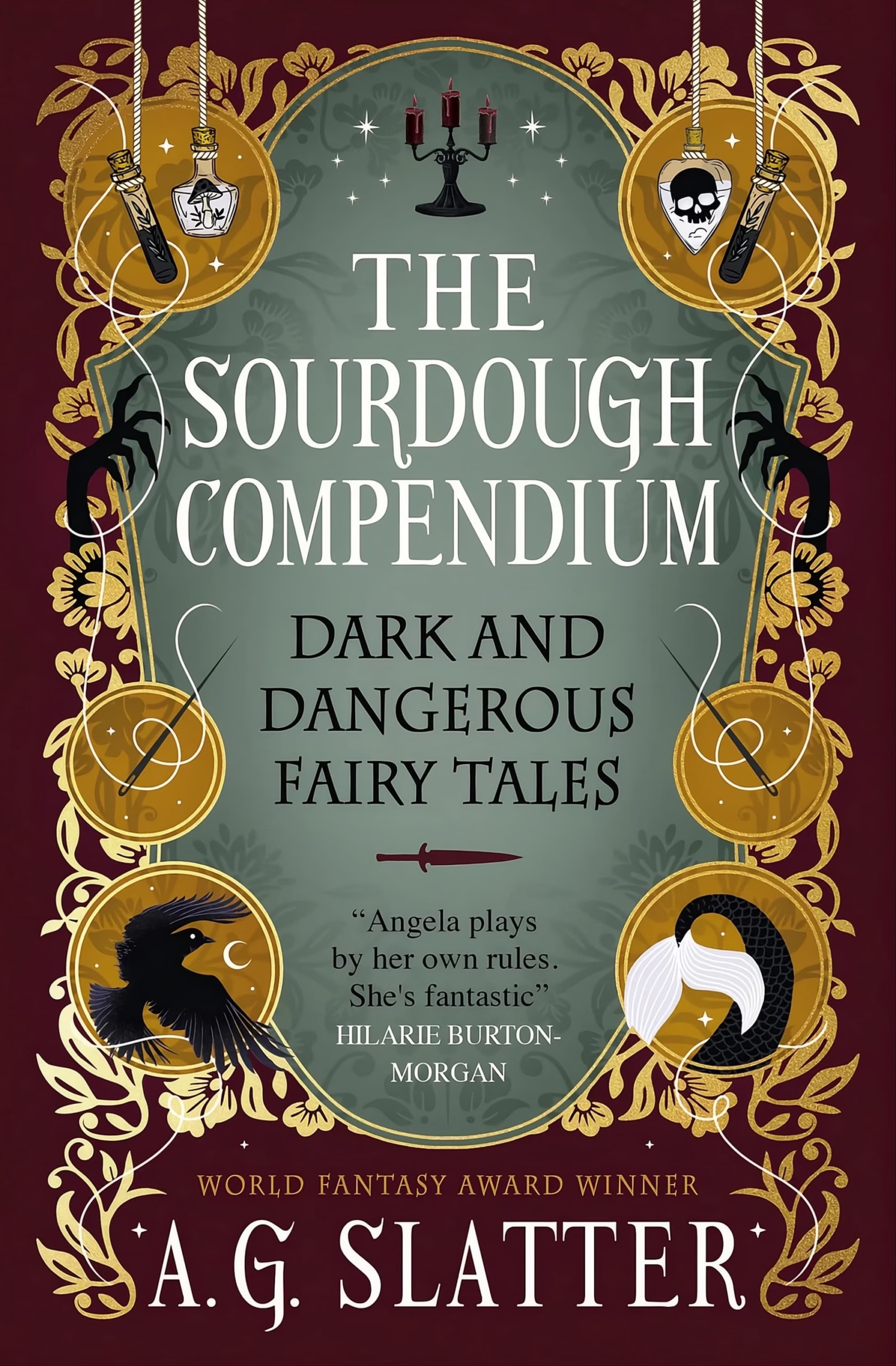
‘The Sourdough Compendium: Dark and Dangerous Fairy Tales,’ published on June 9th, 2026, collects the three mosaic short fiction sequences by A.G. Slatter — the pen name of Australian author Angela Slatter — that constitute the narrative and thematic foundation of everything she has built in the Sourdough universe: the long series of novels now extending to five volumes, the novellas, and the interconnected world that runs through all of it.
The three component volumes — ‘Sourdough and Other Stories’ (Tartarus Press, 2010), ‘The Bitterwood Bible and Other Recountings’ (Tartarus Press, 2014), and ‘The Tallow-Wife and Other Tales’ (Tartarus Press, 2021) — have been out of reach for most readers since the limited Tartarus editions sold through.
What was available to scholars and collectors at the margins of the used-book market is now available in a trade paperback of 688 pages, priced and formatted for general readership.
A World Built in Mosaic
The structural logic of the Sourdough collections is not the logic of a conventional short story collection, in which individual pieces stand independent of one another. Slatter employs the mosaic form: stories that share a world, characters who reappear across decades within the fictional chronology, events in one tale that alter the weight of what was said in an earlier one.
The cathedral-city of Lodellan and its rural surroundings constitute a secondary world with its own documented history, its own persistent families, its own system of witchcraft and folk religion that is neither benevolent nor safely supernatural.
Within ‘The Sourdough Compendium,’ coffin-makers resist their own murderous impulses while burying the dead, poison girls are apprenticed to the art of marital assassination, seamstresses negotiate with mermaids, and a plague maiden holds the fate of the world’s upper and lower registers in her deliberate hands. These are not stories that reach for horror through shock; they reach for it through consequence.
Debt, inheritance, the cost of bargains entered in desperation — the mechanics are the mechanics of the old fairy tale, stripped of the reassurance that the Brothers Grimm and Perrault introduced in their literary redactions of oral material.1
The Fairy Tale’s Original Violence
The literary dark fairy tale as a vehicle for female agency has a traceable line of descent. The oral material from which the Brothers Grimm compiled their collections contained infanticide, dismemberment, and punishment that the 1812 first edition softened and subsequent editions softened further; Angela Carter’s ‘The Bloody Chamber’ (1979) recovered that original violence for literary feminist ends, making Carter the pivotal figure in the tradition Slatter extends.2
What distinguishes the Sourdough project from Carter is the commitment to internal world consistency. Carter worked with canonical texts — ‘Bluebeard,’ ‘Little Red Riding Hood,’ ‘The Tiger’s Bride’ — refracted through her own literary sensibility. Slatter builds original narrative material within a world she invented and then populates across more than ten years of work.
The recurring families, the Little Sisters of St. Florian, the specific geography of Lodellan — these constitute a world whose internal logic earns the fairy-tale register rather than borrowing it from recognizable sources.
From Tartarus to Titan
Tartarus Press — the North Yorkshire small press founded by Rosalie Parker and R.B. Russell, with a catalog rooted in classic supernatural fiction and a particular commitment to limited edition production — issued the three Sourdough collections over eleven years as physical objects of considerable quality. Each was limited to a small print run, illustrated, and produced with the care for material form that defines the Tartarus list.
‘Sourdough and Other Stories’ was a finalist for the World Fantasy Award for Best Collection in 2011; ‘The Bitterwood Bible and Other Recountings’ won that award in 2014; ‘The Tallow-Wife and Other Tales’ was again a finalist in the same category.
The transition from Tartarus to Titan is a transition from a press whose operating model resembles the limited-edition horror small press tradition to a publisher with international distribution and the marketing capacity to reach readers who will never have encountered the Tartarus imprint.
Slatter herself acknowledged on her website that the time had come for a “much more widely available mass-market edition.” What was an object for the knowledgeable becomes, with this compendium, a text for anyone willing to enter it.
Slatter’s Award Record
The critical recognition the Sourdough work has received over its documented publication history is extensive and specific. The 2014 World Fantasy Award for Best Collection for ‘The Bitterwood Bible’ is the award’s highest recognition in its category; the 2012 British Fantasy Award for Best Short Story, for ‘The Coffin-Maker’s Daughter’ — a story from the Sourdough world — acknowledged the individual work that the collection format contains.
The 2022 Shirley Jackson Award for Best Novella, for ‘The Bone Lantern,’ a novella set in the same universe, confirmed that recognition of Slatter’s work extended past the first wave of collection releases. Multiple Aurealis Awards across the career, including wins for both individual stories and collections, complete a picture of recognition that is both international and Australian.
Slatter’s short fiction has appeared in ‘The Mammoth Book of New Horror,’ ‘The Year’s Best Dark Fantasy and Horror,’ and ‘The Best Horror of the Year,’ positioning her within the mainstream dark fiction anthological tradition that runs from Ellen Datlow’s annual surveys outward.
The award history and anthology presence together constitute a career record that the ‘Compendium,’ as a gathering of its foundational texts, now makes newly accessible as a single argument.
The Novels and Their Source
For readers who encountered Slatter through the novels published under the A.G. Slatter byline — ‘All the Murmuring Bones’ (Titan Books, 2021), ‘The Path of Thorns’ (2022), ‘The Briar Book of the Dead’ (2023), ‘The Crimson Road’ (2024), and ‘A Forest Darkly’ (2025) — ‘The Sourdough Compendium’ is the source material.
The novels are set in and around the world the collections founded; the families, locations, and recurring mythological structures of the longer-form fiction derive their sense of earned depth from the accumulated weight of stories told across the three earlier volumes.
There is a specific reading experience available in encountering the compendium before the novels: the reader builds the world from its components, story by story, and arrives at the novels with the knowledge of how that world was assembled. The reverse — novels first, then the short fiction — is not a lesser experience, but it is a different one: the compendium then reads as an act of excavation, recovering the original stratum beneath the novels’ polished surfaces.
What the Prose Does
A.G. Slatter’s prose in the Sourdough collections works in a register that is adjacent to but distinct from contemporary dark literary fiction. The diction runs toward the formal without becoming archaic; the sentences carry syntactical subordination that implies a narrator who has seen a great deal and is choosing, with some care, how much to disclose.
The witches, assassins, and supernatural figures who populate these stories are rendered with practical specificity — they live in rooms with furniture, they work at trades, they sustain the material conditions of an imagined world — and that specificity of the quotidian is what earns the moments of genuine darkness when they arrive.
The mosaic structure amplifies this. A character who appears briefly in an early story returns in a later one with a history the reader now possesses; a bargain sealed in ‘Sourdough and Other Stories’ has consequences in ‘The Bitterwood Bible’ that reconfigure what was read years earlier.
The complete compendium makes the full extent of that structural planning visible in a way no individual volume could. Reading three collections across their original publication timeline is a different act from reading them in sequence within a single bound object.
Dark Verse and the Fairy-Tale Record
The dark fairy tale occupies an unusual position within dark literature: it operates as fiction, but its narrative materials — the punishments, the bargains, the specific cruelty of what certain stories visit upon their characters — derive from documented oral tradition that predates the literary form by centuries.
The violence in Slatter’s Sourdough world is not violence invented for genre effect; it is violence derived from the accumulated record of what communities believed happened at the margins of their world, what they feared their daughters might encounter, what they understood power and desire to cost.
That historical grounding is what gives the best of this material its force on the page.
The Archive Now Open
Three limited editions issued over eleven years, available until they sold through and then increasingly difficult to obtain, have become a 688-page paperback from a publisher with international reach.
‘The Sourdough Compendium’ does not alter the work contained within it — the stories are what they were when Tartarus issued them — but it alters who can reach them, and in altering access it alters the critical record.
The World Fantasy Award, the British Fantasy Award, the Shirley Jackson Award attached to adjacent work in the same universe: these are recognition for a body of writing that most readers could not obtain. That condition ends June 9th, 2026.
The dark fairy tale tradition Slatter extends from Carter’s 1979 intervention has produced no shortage of individual collections in the intervening decades. What it has produced less frequently is a secondary world sustained across multiple volumes and then expanded into a series of novels with the kind of internal consistency the Sourdough universe demonstrates.
‘The Sourdough Compendium’ is the record of how that world was built, in the form in which building it began: story by story, bargain by bargain, in a city that was never named after anywhere that actually existed but that reads, on every page, as somewhere entirely real.
Among the three mosaic sequences gathered in ‘The Sourdough Compendium,’ which — the foundational ‘Sourdough and Other Stories,’ the World Fantasy Award–winning ‘Bitterwood Bible,’ or the more recent ‘Tallow-Wife’ — do you regard as the most fully realized articulation of Slatter’s dark fairy-tale logic, and what specific qualities in her prose or narrative structure inform that judgment?
References
- Jack Zipes, ‘The Irresistible Fairy Tale: The Cultural and Social History of a Genre’ (Princeton: Princeton University Press, 2012), 1–23. ↩︎
- Angela Carter, ‘The Sadeian Woman and the Ideology of Pornography’ (London: Virago, 1979), 3–19. Carter’s critical account of the rehabilitated violence in the fairy tale tradition underpins the argument advanced here. ↩︎




Leave a Reply