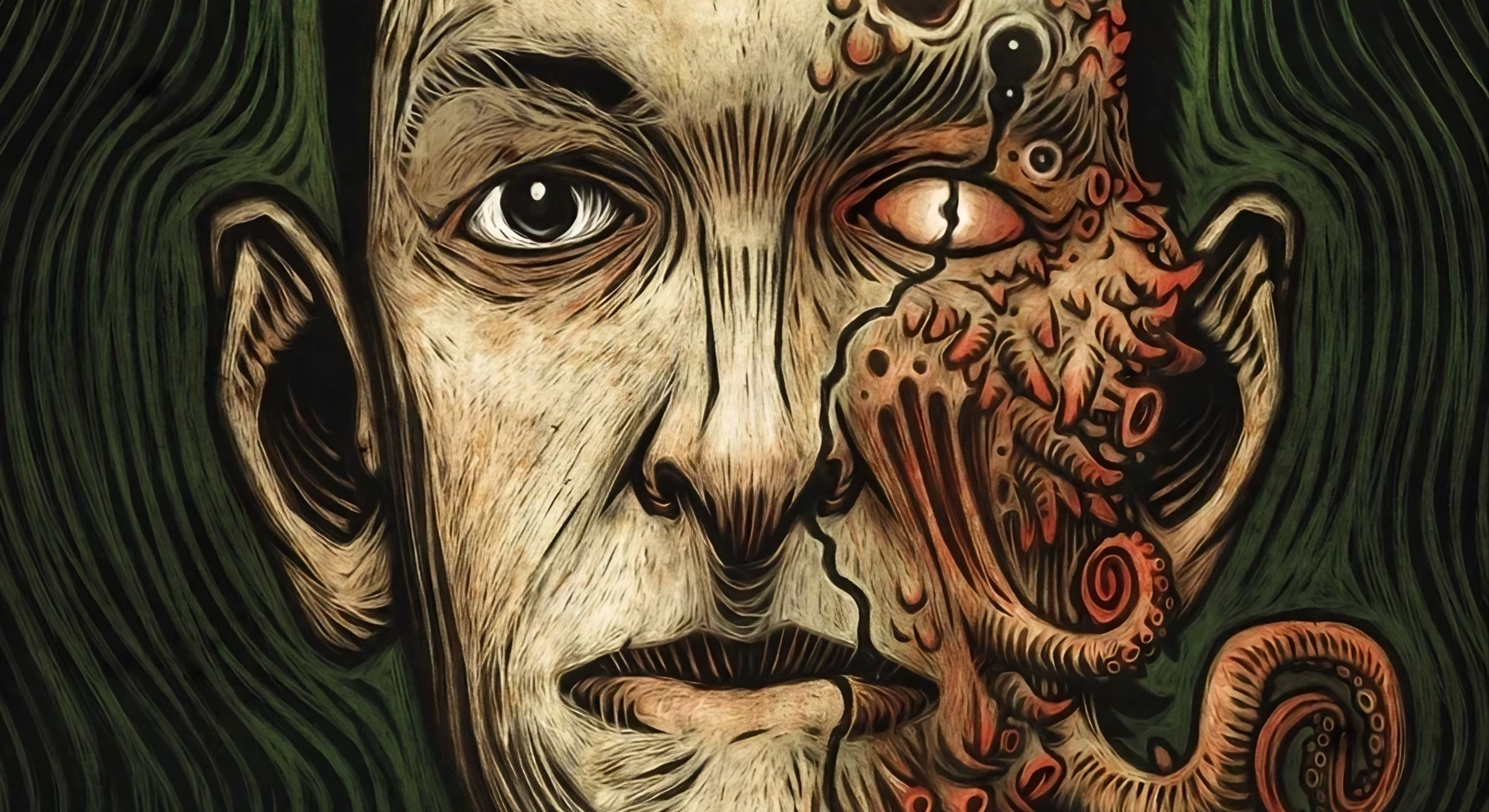


Spanish readers have met these three books one at a time, from November 29th, 2023 to April 15th, 2026, each in the same oversized format and each carrying the pictures of a single artist. On November 11th, 2026, Minotauro, the Grupo Planeta imprint, places all three in one slipcase as ‘Estuche Abismo Lovecraft.’
The case holds ‘La sombra sobre Innsmouth,’ ‘El morador de las tinieblas,’ and ‘Dagón y otros relatos,’ stories by H. P. Lovecraft illustrated by Tomás Hijo, in three hardcovers with dust jackets, 64 pages each, 192 pages in all, measuring 26 by 35 centimeters.
The set belongs to the Minotauro Ilustrados collection and collects editions already published rather than commissioning new work. Its news is that a body of illustrated work now exists as a single object, and that the object poses an old question about Lovecraft with unusual directness.
The Contents of the Case
‘La sombra sobre Innsmouth’ came first, on November 29th, 2023, followed by ‘El morador de las tinieblas’ on November 27th, 2024, and by ‘Dagón y otros relatos’ on April 15th, 2026, which the publisher’s own copy describes as the close of Hijo’s triptych.
The ‘Dagón’ volume gathers three stories of different weights: the sea-floor revelation of ‘Dagon,’ written in July 1917; the gallery of canvases in ‘Pickman’s Model,’ written in 1926; and the fragment ‘Azathoth,’ begun in June 1922 and first printed in 1938.
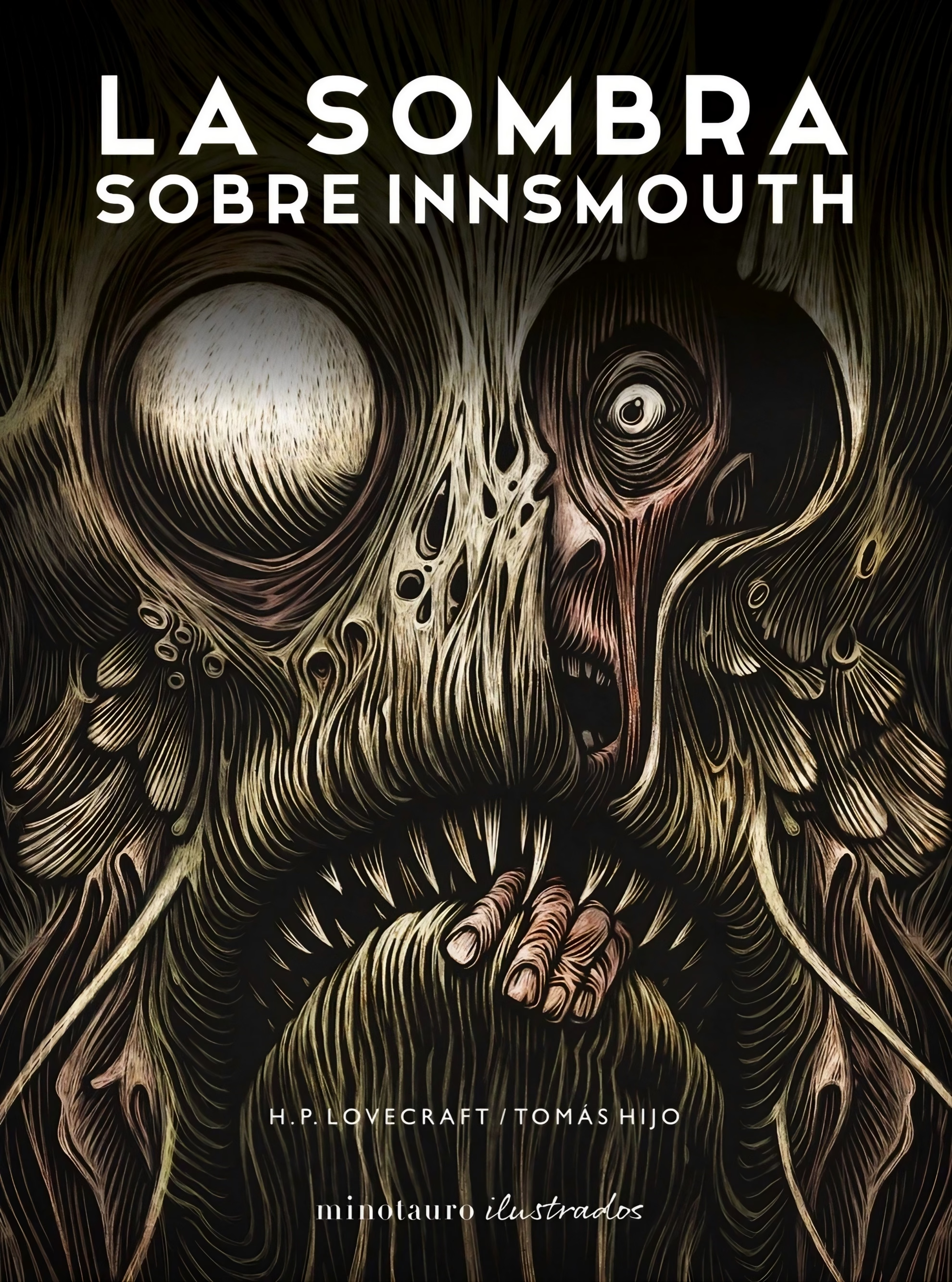
‘The Shadow over Innsmouth’ was written in November and December 1931, and ‘The Haunter of the Dark,’ the source of ‘El morador de las tinieblas,’ between November 5th and 9th, 1935, the last original story Lovecraft wrote; it appeared in ‘Weird Tales’ in December 1936.1 The case therefore spans 18 years of Lovecraft’s writing.
Daniel Casado Rodríguez translated the two later volumes, and the boxset’s listing credits him as translator of the set without naming a second translator; the 2023 ‘Innsmouth’ volume had carried a translation credit to Jaume Muñoz.
The source tradition is the American pulp weird tale of the 1920s and 1930s, written for magazines such as ‘Weird Tales’ in a formal, heavily qualified prose that Spanish must carry in its own syntax. Casado has not been documented discussing his choices for these volumes, so how his Spanish treats that register is a matter for a reader holding the English beside it.
Pickman and the Painted Thing
Two of the three source stories are about artists confronting what they cannot place on a canvas or a page. ‘Pickman’s Model’ follows Richard Upton Pickman, a Boston painter whose canvases are so exact in their horror that he loses his place in the Boston Art Club, and the publisher’s copy for the ‘Dagón’ volume names the story’s “lienzos blasfemos,” its blasphemous canvases.
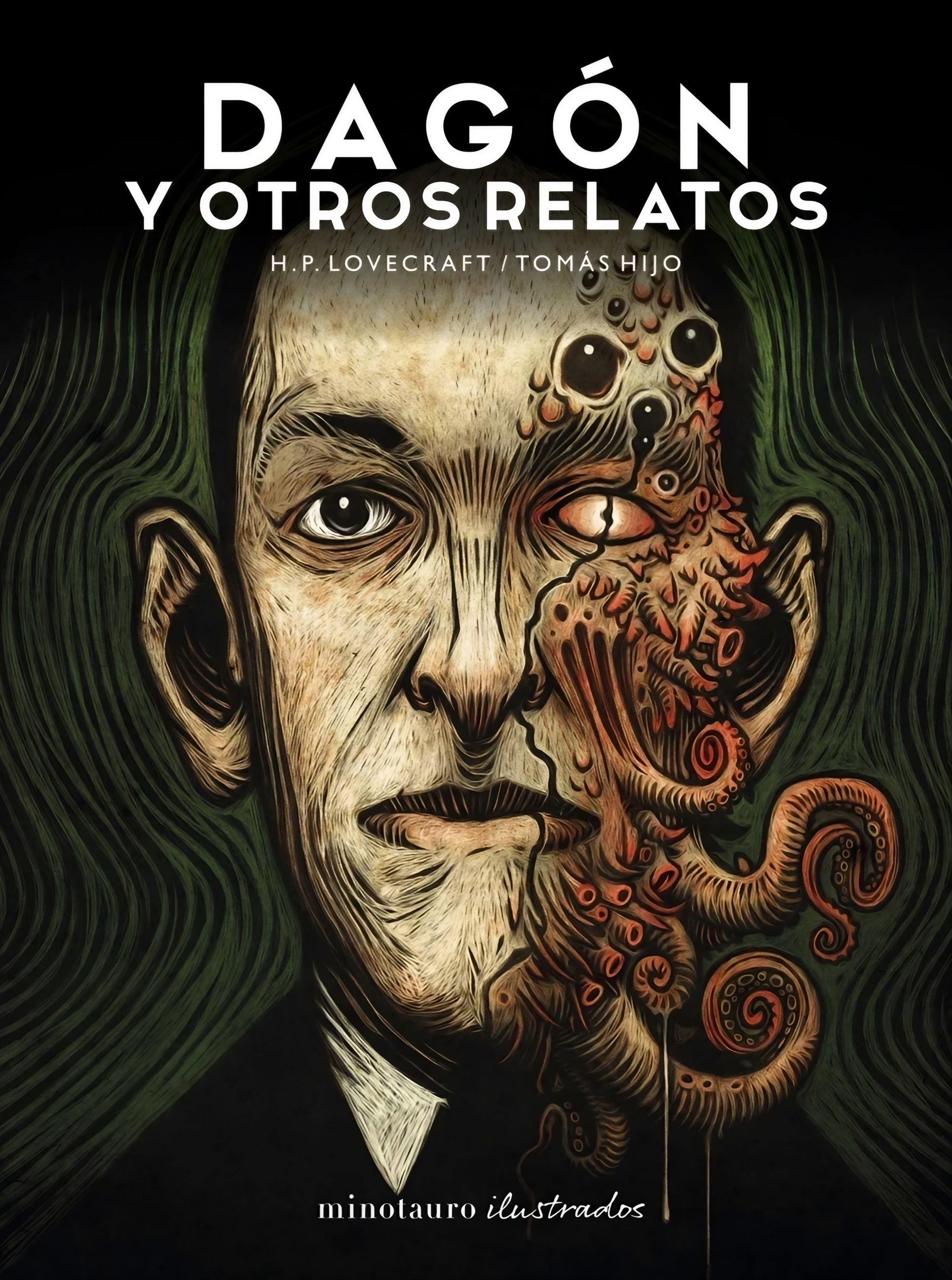
In ‘The Haunter of the Dark,’ Robert Blake is a young writer and painter in Providence whose own “tales and pictures” already seem linked to the dark church he watches from his window on Federal Hill.
Blake is also a portrait. Robert Bloch had killed off a Lovecraft-like character in his own story ‘The Shambler from the Stars,’ printed in ‘Weird Tales’ in September 1935, and Lovecraft answered by writing a Bloch-like writer to his death and dedicating the tale to him. The second volume in the case therefore illustrates a story built from an exchange between two working horror writers.
The pairing sharpens a contradiction the publisher itself names. Its press sheet praises Hijo’s ability to carry “criaturas innombrables,” unnameable creatures, into visual language.
Lovecraft’s fiction keeps returning to the failure of description, and he gave one story the title ‘The Unnamable,’ written in September 1923 and printed in ‘Weird Tales’ in July 1925. ‘Azathoth’ puts the problem in its starkest form: Lovecraft left it as a fragment, so whoever illustrates the ‘Dagón’ volume supplies a picture where the author supplied only an opening.
Hijo and the Engraved Line
Hijo was born in Salamanca in 1974 and has illustrated about 100 books for publishers in several countries, writing a few himself on legend and folklore.

His credits include illustrations for the 2021 film ‘Nightmare Alley,’ the ‘Tarot del Toro’ of 2020, made in collaboration with Guillermo del Toro, a ‘Lord of the Rings’ tarot in 2022, and a ‘Dark Crystal’ tarot in 2023; the ‘Dagón’ copy adds work with del Toro on his recent ‘Frankenstein’ and with the director Rodrigo Cortés. At Minotauro he had already illustrated several works by Carlos Sisí.
Two accounts of his technique sit side by side. The publisher’s biography calls engraving his principal technique and says his graphic work belongs to private collections around the world.
In a podcast conversation published on May 8th, 2024, the program’s summary of Hijo’s own explanation drew a finer line: his tarot decks are made from engravings, while the Lovecraft illustrations imitate the engraver’s work with scrupulous care. The same conversation calls the ‘Innsmouth’ volume a difficult commission, since Lovecraft’s creatures are always hard to visualize, and says Hijo planned the book’s layout himself so that the page would favor his line. The interior of that volume is listed with color ink for the text, a detail that treats the page as a designed surface rather than a text block with plates.
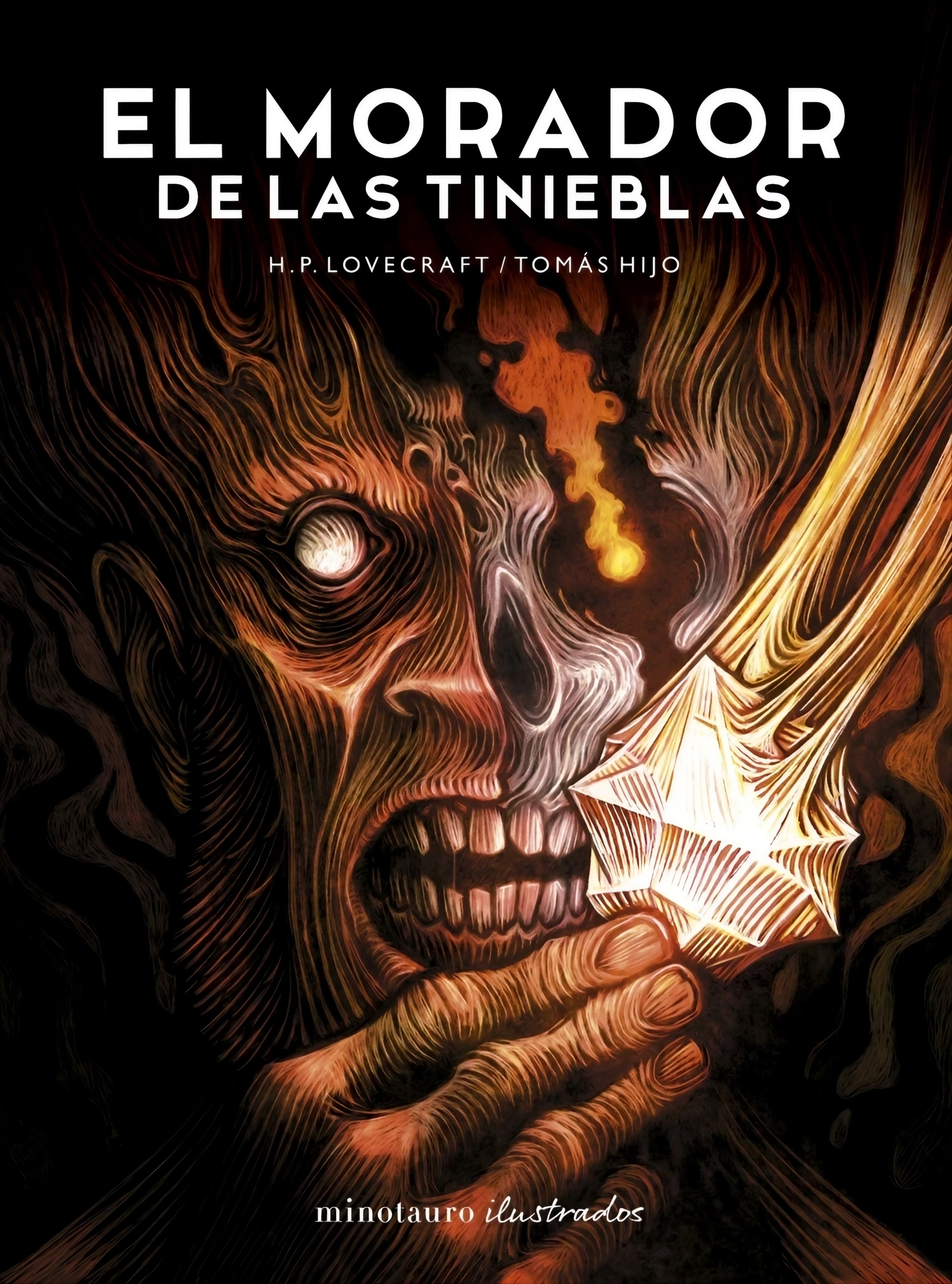
Engraving renders shadow through accumulated lines rather than blended tone, and a line-made image shows its own making.
For a writer whose narrators insist they cannot describe what they saw, that visible labor gives the picture a documentary posture, the look of a plate in an antiquarian volume, rather than the glow of an apparition.
That is this publication’s reading of the technique, and it suits a story whose narrator reaches ‘Innsmouth’ on an antiquarian tour.
Drácula in the Tinted Edge
The Lovecraft set has a recent companion in the same imprint. Minotauro published ‘Drácula’ by Bram Stoker, illustrated by Hijo, on June 25th, 2025, as a luxury hardcover with tinted edges and a ribbon marker, and describes the volume as fully illustrated by him.
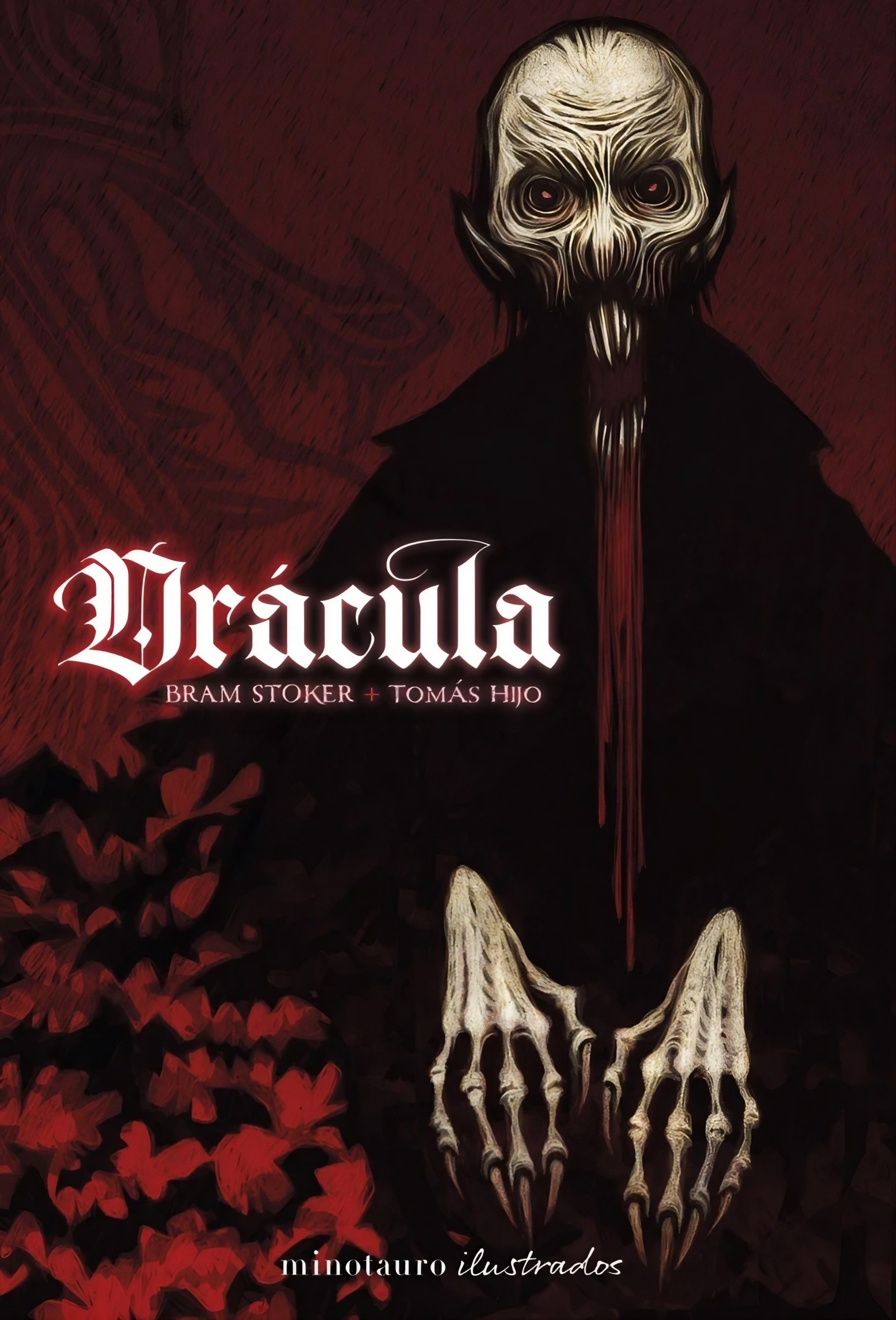
Stoker supplies what Lovecraft withholds. In the second chapter, Jonathan Harker records the Count’s face in an inventory: aquiline features, massive eyebrows, a heavy mustache, pointed ears, sharp white teeth, and hair growing in the palms of his hands.
An illustrator of ‘Drácula’ answers a text that has already drawn the figure, and the risk lies in contradicting it or in flattening it into a costume. A Lovecraft illustrator has no such specification to follow, which is why the earlier book is the easier precedent and the boxset the harder test.
Frankenstein in the Same Hand
Minotauro published ‘Frankenstein’ by Mary Shelley, translated by José C. Vales and illustrated by Hijo, on September 24th, 2025, in its Minotauro Ilustrados collection.
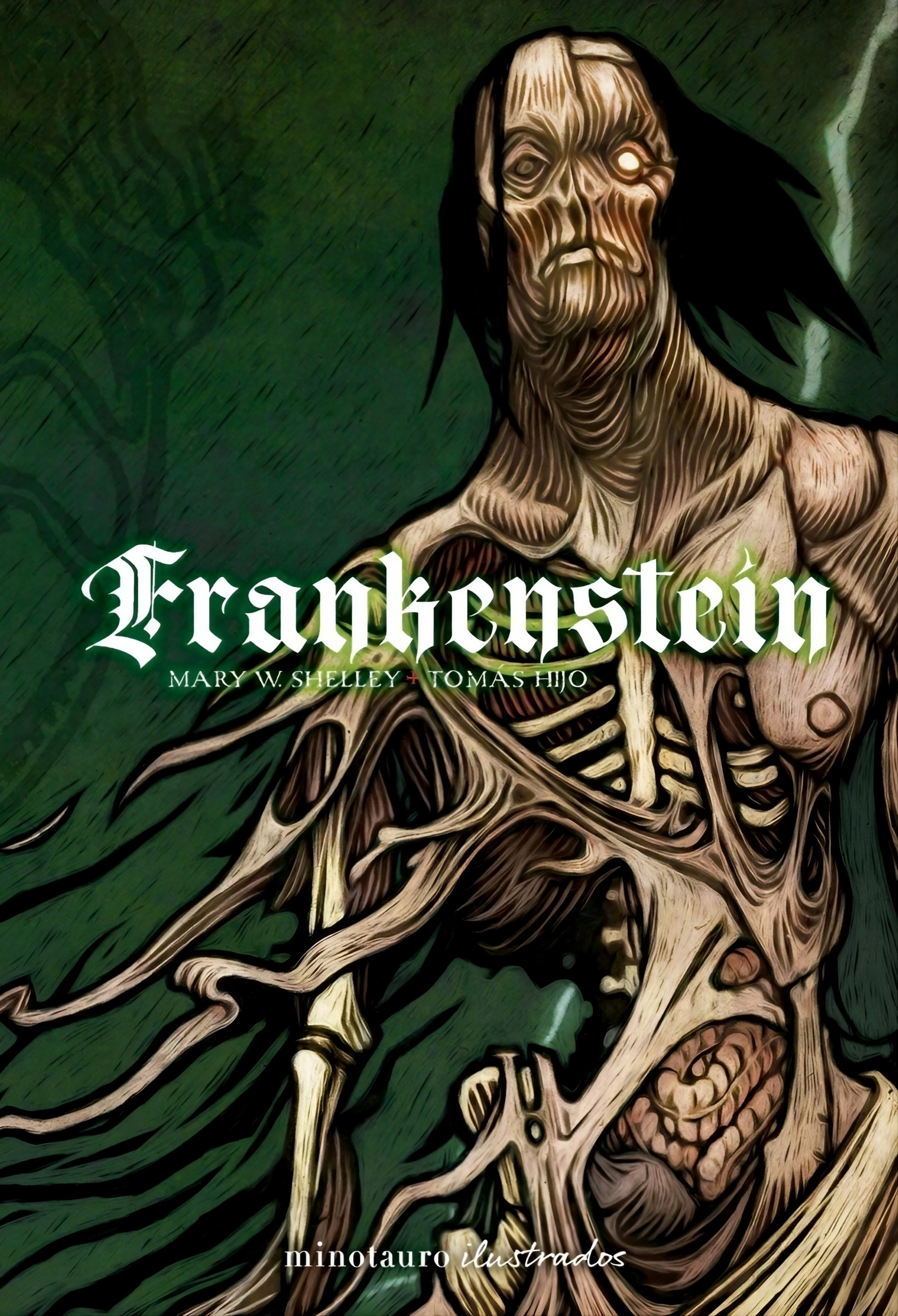
Shelley is more exact than her reputation suggests. In the fifth chapter of the 1818 text, Victor Frankenstein sets down the creature’s yellow skin stretched over muscle and artery, lustrous black hair, watery eyes, and straight black lips.
That passage has been drawn and filmed for two centuries, and Hijo’s later work with Guillermo del Toro on his ‘Frankenstein’ places him inside that history of images. Set beside ‘Drácula’ and the Lovecraft volumes, the three books give Minotauro a sequence in which a single illustrator meets a monster described in detail, a monster described in part, and a monster whose narrators refuse to describe it.
Utpatel’s 1936 Woodcuts
The first appearance of ‘The Shadow over Innsmouth’ between covers was itself an illustrated book. Visionary Publishing Company of Everett, Pennsylvania, issued it in 1936 with four full-page illustrations by Frank A. Utpatel, woodcuts by an artist who corresponded with Lovecraft.
Of about 400 copies printed, only about 200 were bound, and it remained the only book of Lovecraft’s fiction published in his lifetime. In ‘Weird Tales’ that same December, Virgil Finlay produced the first of his Lovecraft illustrations, for ‘The Haunter of the Dark,’ the story now carried by the second volume in the case.
Two print traditions therefore frame the Minotauro set: a woodcut-illustrated book from the last months of Lovecraft’s life, and pen-and-ink magazine drawing from the pulp that first printed most of these stories. Hijo’s engraved idiom returns the ‘Innsmouth’ story to a print tradition kindred to the one in which it first appeared between covers.
The Abyss in the Title
‘Abismo’ is the publisher’s word for the set; no Lovecraft story carries it. It works as a shared register. The ‘Dagón’ volume is described through “profundidades abisales,” abyssal depths, the ‘Innsmouth’ synopsis closes on the sea as a source of ancestral horrors, and the ‘Dagón’ copy sends the reader to ‘Azathoth’ at “el centro mismo del caos infinito,” the very center of infinite chaos.
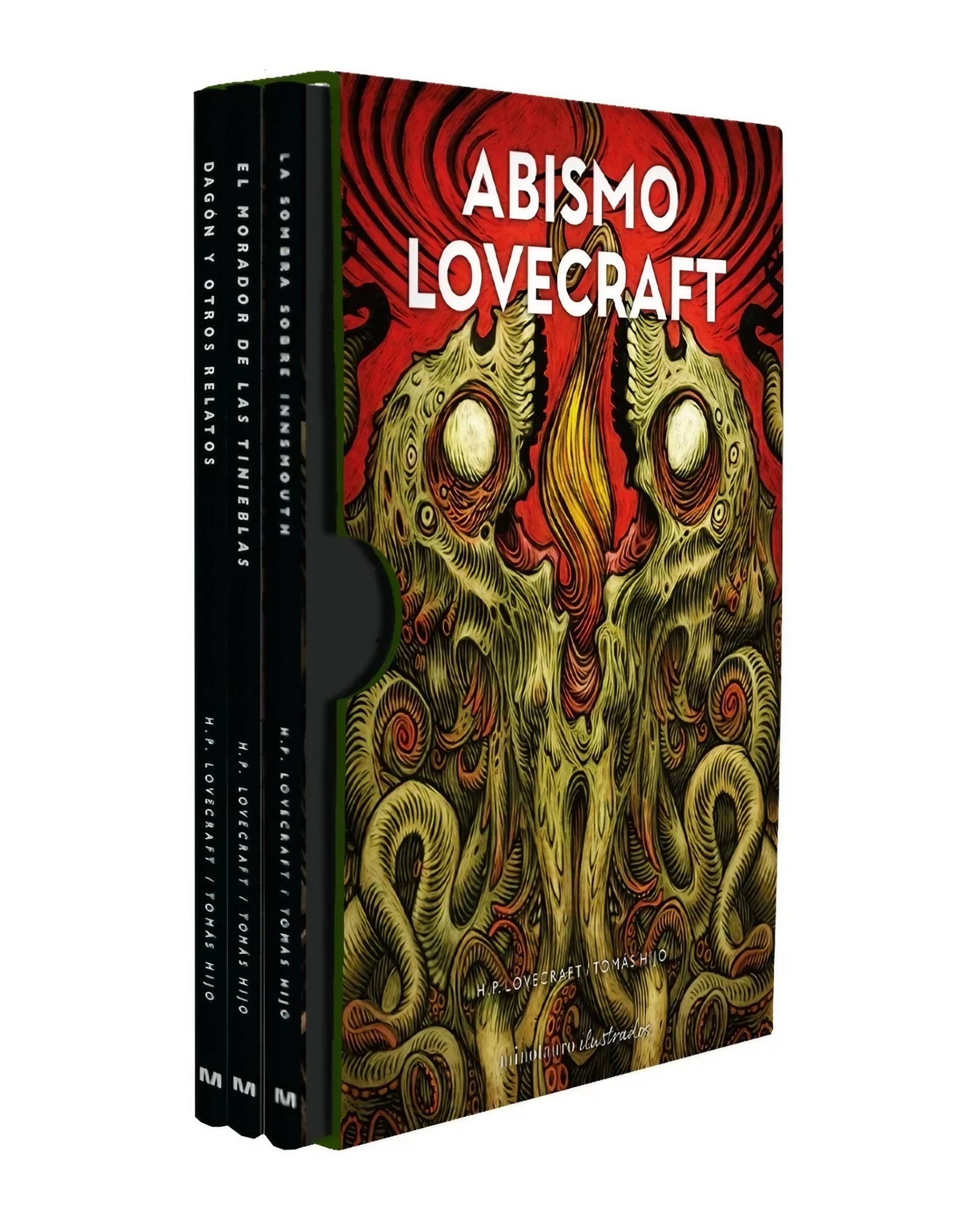
The Spanish word covers the ocean floor and the cosmic void at once, and the set uses that double meaning to link three stories Lovecraft wrote years apart.
An Edition That Commits
A single artist’s hand across 18 years of Lovecraft’s stories makes the problem of depiction concrete in a way that one illustrated volume cannot. Lovecraft’s first book was illustrated, his magazine appearances were illustrated, and the Argentine response to him declined to illustrate at all; Hijo’s three volumes place a Spanish-language, engraving-based answer beside each of those precedents.
The slipcase does not settle the dispute between showing and withholding. It does assemble, in one object, the evidence from which a reader can judge.
When a Lovecraft creature first took visible form for you, in a pulp reprint, a game, a film, or an engraving like Hijo’s, did the picture replace the one your reading had already made, and which story’s creature has resisted every illustration you have seen?
References
- H. P. Lovecraft, ‘The Haunter of the Dark,’ ‘Weird Tales,’ December 1936 (dedicated to Robert Bloch), Project Gutenberg eBook 73233. ↩︎


Leave a Reply