

On the title page of the book that Melchior and Gaspar Trechsel printed in Lyon in 1538, the Trechsel printer’s mark sets a three-headed figure on a pedestal, with serpents and globes below it and an open book above it bearing the Greek command to know oneself, and the device carries the motto “Usus me genuit,” which translates to “use gave birth to me.”
The motto has drawn far less commentary than the 41 woodcuts that follow it, which art historians have cataloged as Hans Holbein the Younger’s design and Hans Lützelburger’s cutting, and which historians of religion have studied as Reformation polemic. Yet the motto names what the book actually did.
‘Les simulachres & historiées faces de la mort’ took the danse macabre, a procession painted on cemetery walls for crowds to walk past, and broke it into separate pages that a single reader could open, compare, and return to. Between the Lyon quarto and the London reprints of the 1790s, the printed ‘Dance of Death’ never left circulation, and that unbroken run of editions, copies, and commentaries is the stretch of the macabre’s history that each field claiming it has left to the others.
A Book Between Three Disciplines
The 1538 book has never lacked attention; the attention has been divided according to what each discipline wanted from it. The oldest line of commentary is connoisseurship.
Austin Dobson’s introductory note to the 1903 Scott-Thaw reprint, a fair summary of the antiquarian tradition behind it, spent its pages establishing that the designs were Holbein’s and the cutting Lützelburger’s, recorded the inference that a Basel form-cutter named Hans had died before June 1526 with the series unfinished, and dismissed everything printed after the woodcuts as “makeweight” appendices of a didactic character.1
Twentieth-century art history refined the attributions and the dates without changing the frame. When the National Gallery of Art gathered Holbein specialists in Washington in November 1997, the essays on the woodcuts in the resulting volume, Peter Parshall’s among them, examined the ‘Dance of Death’ in light of the political and theological pressures of Basel in the 1520s.2 The images were the object; the book that carried them was packaging.
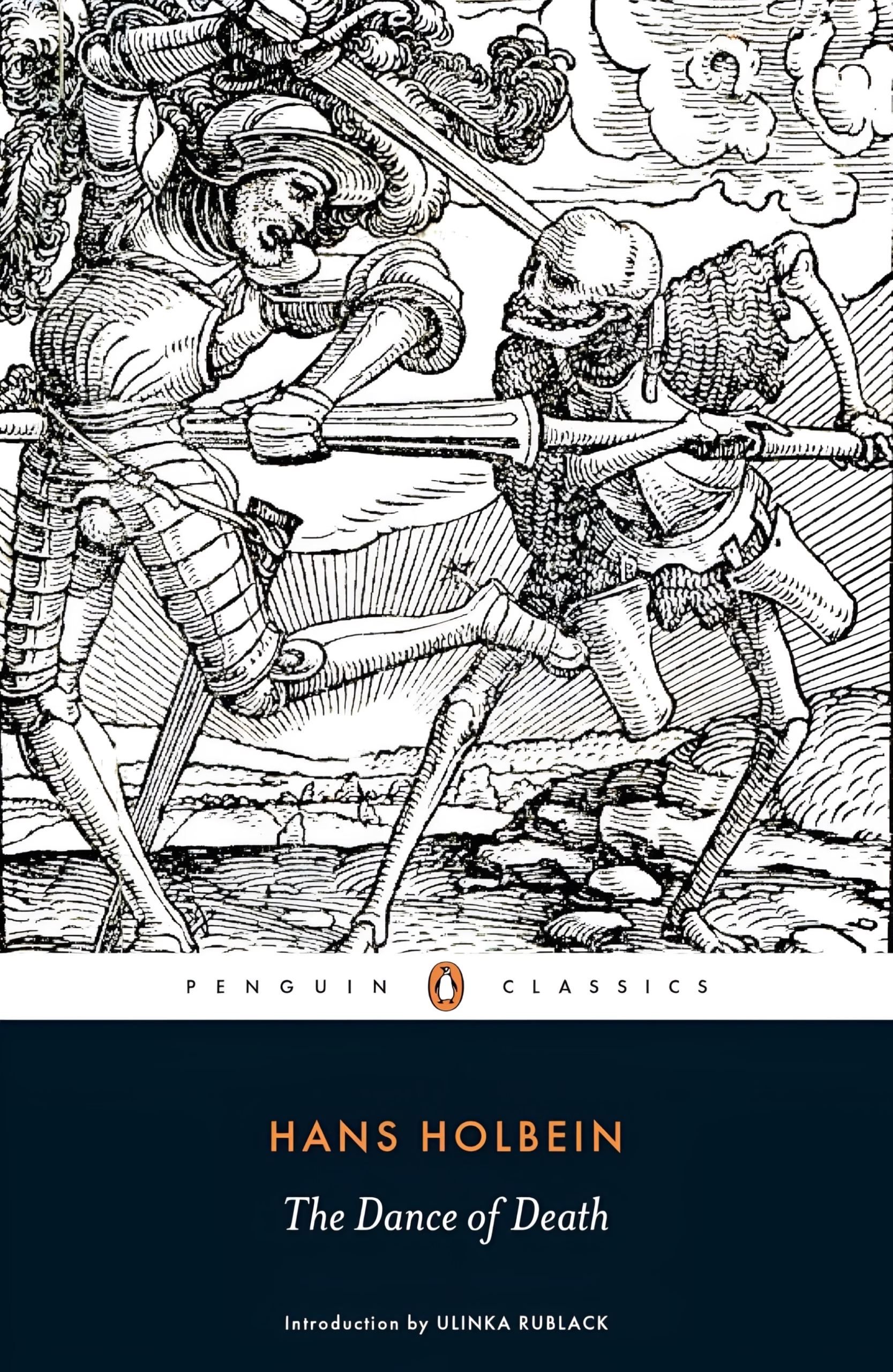
Historians of religion took up the words the connoisseurs set aside, but for a different purpose. Natalie Zemon Davis’s 1956 study placed the Lyon editions and the men who produced them inside the religious conflicts of the city’s Reformation.3
Marianne Carbonnier-Burkard extended that inquiry in 2020, identifying among the anonymous texts added to the 1542 Frellon edition material drawn from Lutheran authors such as Urbanus Rhegius, from Reformed writers including Heinrich Bullinger, and from the antitrinitarian Michael Servetus, and characterizing the result as an evangelical art of dying brought into a Catholic market for readers who kept their convictions private.4
This scholarship reads the book’s texts closely, but it asks who wrote them and which church they served. It does not ask what the format did to the experience of looking at death.
Medievalists, for their part, have treated Holbein as an ending. Elina Gertsman’s ‘The Dance of Death in the Middle Ages,’ now the standard study of the theme, presents the late medieval dance as a public, performative image that drew a beholder standing before a wall into an active, bodily encounter, and it confines Holbein to a short epilogue looking ahead to the motif’s sixteenth-century transformation.5
Maja Dujakovic’s dissertation on French Danse macabre books carried attention into print, arguing that the editions issued in Paris, Lyon, Troyes, and Geneva after Guyot Marchant’s first Paris edition of 1485 were inventive works rather than replicas of the destroyed mural at the Cemetery of the Holy Innocents. Her study closes in the 1530s, on the eve of the Trechsel edition.6
Gothic studies begins on the far side of the interval. The field’s standard reference accounts date Gothic fiction from Horace Walpole’s ‘The Castle of Otranto’ in 1764,7 and Carol Margaret Davison’s ‘The Gothic and Death,’ presented by its publisher as the first study devoted to that subject across the centuries, sets its range from the mid-eighteenth century to the present.8
Laid end to end, these literatures leave a precise period unclaimed. Art history stops at the blocks, religious history at the confessional texts, medieval studies at the wall, and Gothic studies opens in the 1760s. Between 1538 and the London reprints of the 1790s, the printed ‘Dance of Death’ was continuously available, and the question none of these fields frames is what that circulating book trained its readers to do.
From Cloister Wall to Quarto Page
‘The Innocents cycle,’ painted in 1424 and 1425 on a cloister wall of the principal cemetery of Paris, presented the danse macabre as a procession. Living figures arranged by rank, from pope and emperor downward, alternated with dead partners who led them along the wall, and verses beneath each pair gave both parties a voice.
Its audience was whoever walked the cloister, and its order was fixed in plaster. Marchant’s 1485 edition moved this procession into print, but it kept the procession’s logic: paired figures, exchanged verses, and a sequence that pointed back to a real wall in a real city.
Holbein’s series abandoned the procession entirely. Designed in Basel in the mid-1520s and cut by Lützelburger on small blocks, the scenes survive in proof impressions bearing German titles, pulled years before any book existed, and they refer to no wall at all. No one in them dances in a chain.
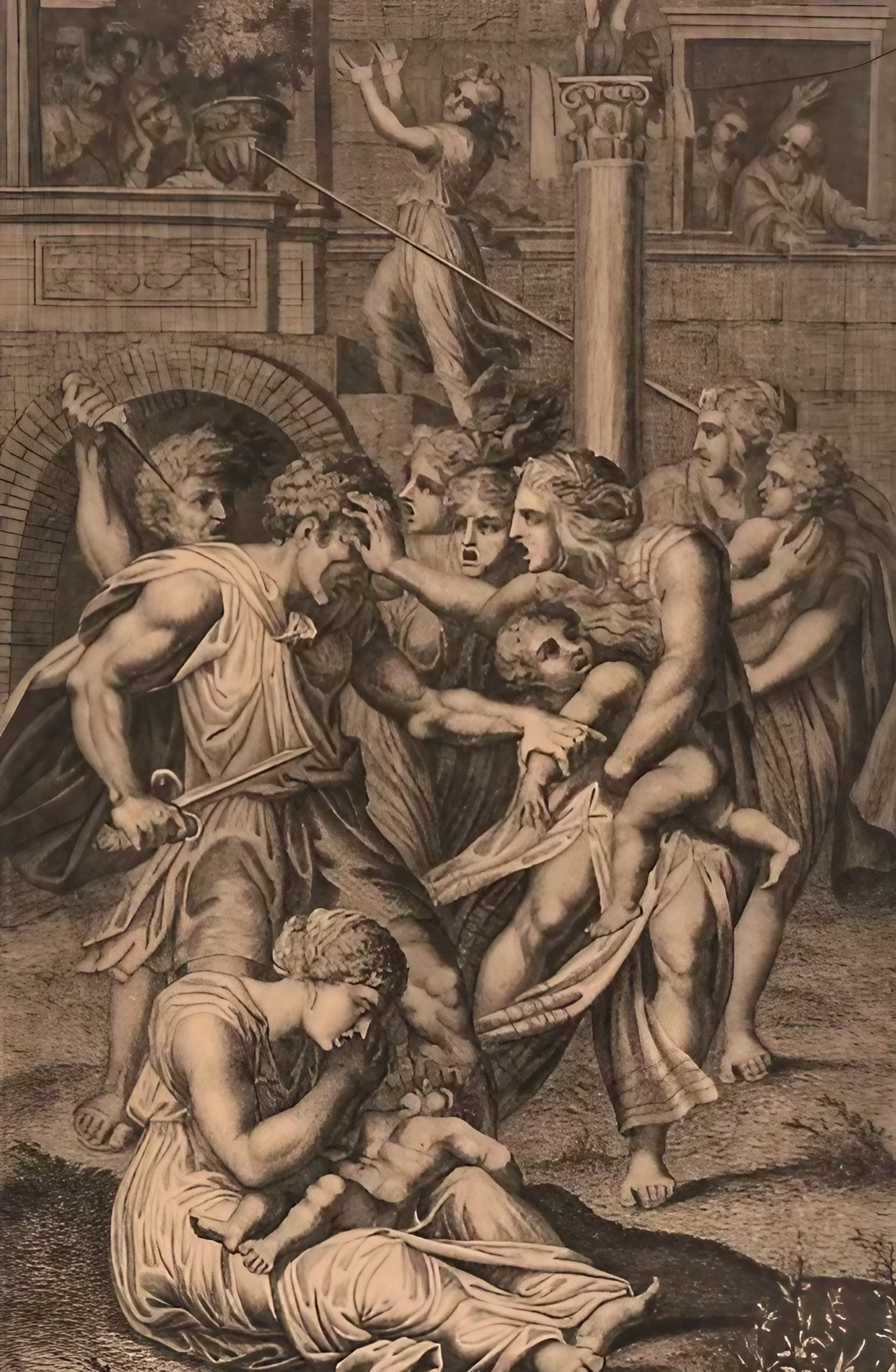
Each victim is caught alone in a setting proper to his or her station: the Bishop led away at sunset from his flock, the Merchant seized among newly landed bales, the Ploughman finishing the last furrow as Death runs beside his horses, the Young Child taken from a cottage hearth while the meal is being prepared. The macabre leaves the cemetery and enters the counting house, the bedchamber, the field, and the kitchen.
The Lyon book that finally carried these images opened with a death of its own. Its dedicatory epistle, addressed to Jehanne de Touszele, abbess of the convent of Saint-Pierre in Lyon, and generally attributed to Jean de Vauzelles, lamented the passing of the man who had “imagined” such elegant figures, a phrase that commentators since the nineteenth century have applied to the cutter rather than to Holbein, who lived until 1543.
The title page set the terms of use. Beneath the title, the printer’s mark shows a three-headed figure on a pedestal, with two serpents and two globes below and, above the figure, an open book inscribed ‘ΓΝΩΘΙ ΣΕΑΥΤΟΝ,’ the Greek injunction to know oneself; the device carries the motto “Usus me genuit.”9
Before a single cadaver appears, the reader is told that the volume is an instrument of self-examination and that it exists to be used.
Scenes, Scripture and Quatrains
The Morgan Library’s copy of the first edition preserves the order in which a sixteenth-century reader met this material: title, dedication, a prose meditation titled ‘Diverses tables de mort, non painctes, mais extraictes de l’escripture saincte’ (various pictures of death, not painted but drawn from holy scripture), then the 41 woodcuts, each headed by a Latin passage from the Bible and closed by a French quatrain, then four explanatory tracts.10
The authorship of the French verse remains unsettled; catalogers have credited it variously to Gilles Corrozet, to Vauzelles, and to the humanist Nicolas Bourbon. The structure itself is not in doubt, and it is the structure that changed the experience. Every opening asks for three acts in sequence: reading scripture in the learned language, looking at a picture, and reading a vernacular verse that turns both toward the person holding the page.
The Pope supplies the pattern. Above the image stands Joshua’s ‘Moriatur sacerdos magnus’ (let the high priest die), joined to a verse from the Psalms that hands his office to another. The woodcut shows a papal coronation in which one Death stands at the Pope’s side and a second, wearing a cardinal’s hat, mingles with the attendants. The quatrain then addresses its reader directly: “Qui te cuydes immortel estre” (you who believe yourself immortal) will be dispatched, and “Vng aultre aura ton Euesché” (another will have your bishopric).
The Cardinal’s scene is headed by Isaiah’s woe against those who justify the wicked for a bribe, and the picture shows the prelate handing a letter of indulgence to a rich man as Death lifts the hat from his head. The Physician receives the gospel taunt Medice, “cura teipsum” (physician, heal thyself) while Death leads in a patient beyond his skill.
The medieval dance had been a dialogue. On the Innocents wall and in Marchant’s pages, the dead summoned and the living answered, protesting, bargaining, lamenting. Holbein’s victims are silent. Scripture speaks about them and the quatrain speaks past them, in the second person, to whoever turns the leaf.
The Ploughman’s verse closes on “Voicy la Mort qui te conuie” (here is Death, who summons you), a line that addresses the depicted laborer and the reader with the same pronoun. The book does not stage a conversation for the reader to overhear; it delivers the summons into the reader’s own hands.
The final woodcut makes the instruction explicit. The Escutcheon of Death, a coat of arms charged with a skull, is headed by Ecclesiasticus, “Memorare nouissima, & in æternum non peccabis” (remember your last end, and you will never sin), and its quatrain reads “Si tu ueulx uiure sans peché / Voy ceste imaige a tous propos” (if you wish to live without sin, look upon this image at every moment).
A painted wall could be passed on the way to a grave or a market. This page ends the series by prescribing its own repetition, asking to be reopened as a daily exercise. The motto on the title page and the verse on the last woodcut frame the volume as a practice rather than a spectacle.
The woodcuts also changed what Death looks like. The figure is rarely a clean skeleton. It is a withered, partly fleshed cadaver that borrows its victims’ clothes and roles: a cardinal’s hat at the papal coronation, a jester’s motley to drag away the Queen, a sacristan’s duty walking ahead of the Priest who carries the sacrament, a hag’s guise to snuff the altar candles while the young Nun turns from her prayers toward a lute-playing lover, a wreath of flags while hauling the Abbess by her scapular.
Death in this book is a mimic, a dead body performing the living. That figure, a corpse rehearsing the identities of those it takes, is one the later Gothic would place at its center.
Smaller Formats, Closer Readers
The book’s publishing history shows the format moving toward the hand. Francis Douce’s 1833 survey of the Lyon series records the first edition as a quarto and shows the Frellons reissuing it in 1542 both in French, as a duodecimo with the ‘Medecine de l’ame’ and other consolatory texts appended, and in a Latin version carrying verses by Georg Aemilius.
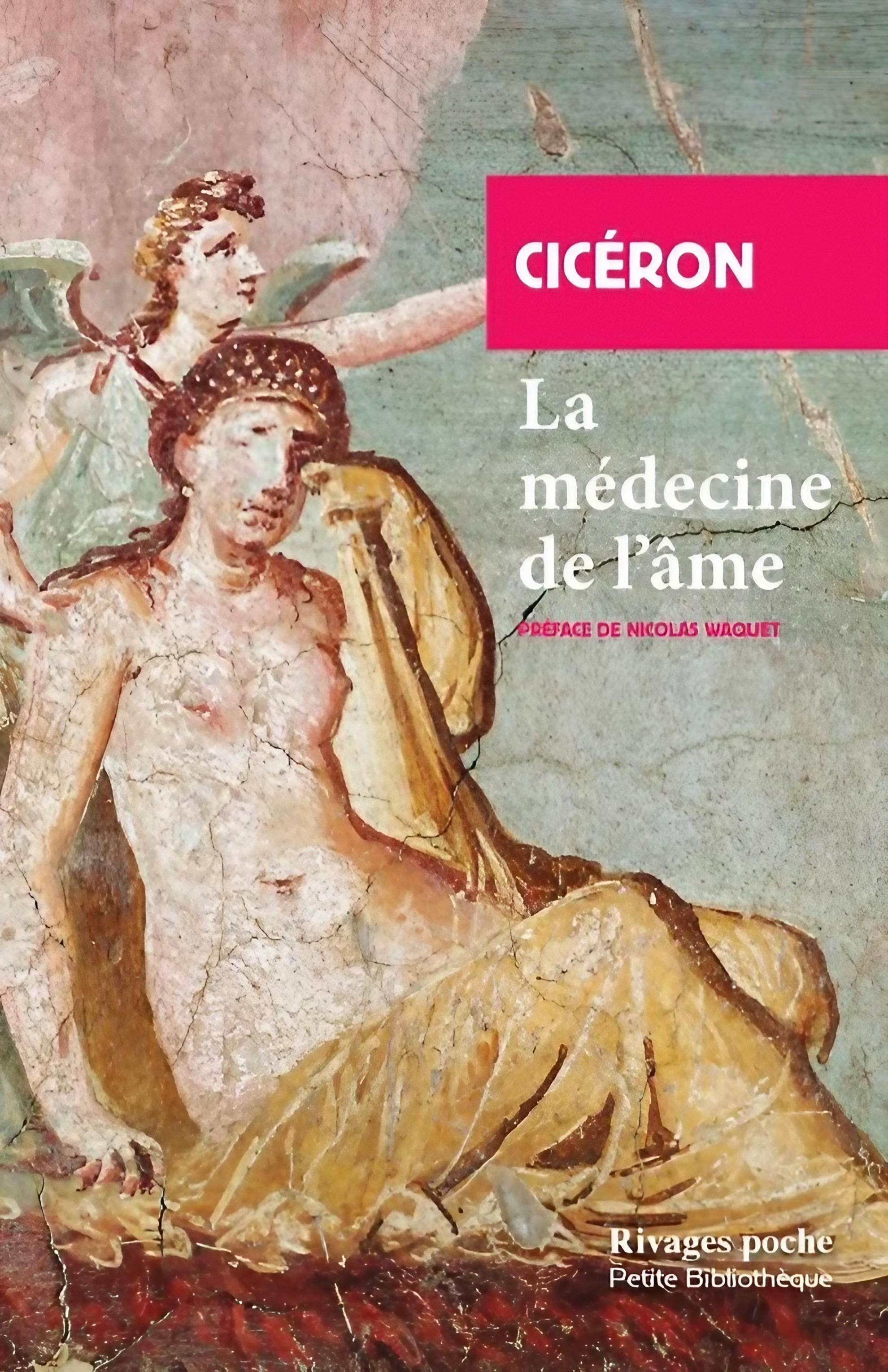
Further editions followed in 1545, 1547, 1549, 1554, and 1562, the later ones enlarged with new cuts of ‘The Soldier,’ ‘The Gamester,’ ‘The Drunkard,’ ‘The Fool,’ ‘The Robber,’ ‘The Blind Man,’ ‘The Waggoner,’ and ‘The Beggar.’.11 The series grew while the book shrank.
A copy of the 1547 Frellon edition at the Morgan Library, retitled ‘Les images de la mort’ and enlarged by 12 figures, is an octavo 15 centimeters tall that binds the woodcuts together with the ‘Medecine de l’ame,’ a form for consoling the sick, and sermons on mortality and patience attributed to Cyprian and John Chrysostom.12
Censorship confirms that the book was understood as something people read rather than merely admired. The Faculty of Theology at the University of Paris condemned the Lyon ‘Dance of Death’ in 1551, judging that it mocked the morals of the clergy and of every secular estate.13
The Carbonnier-Burkard findings explain part of the theologians’ alarm, since the appended texts carried Protestant devotion under an anonymous cover, but the condemnation also registers the danger of a satire that traveled in pockets and could be opened behind closed doors. A wall painting could be whitewashed. A duodecimo had to be hunted.
Death as a Private Practice
The significance of this material lies in the change it produced in the relation between the macabre and its audience. Gertsman’s medieval beholder stood before a public image and moved along it in company. The reader of the Lyon book sat alone with it, controlled its pace, and could turn back. That control altered how the satire worked.
On the cloister wall, rank was leveled by sequence, with every estate taking its place in a single line. In the book, rank is leveled by format. The Pope and the Ploughman occupy identical blocks on identical pages, and a reader who turns from one to the other performs the comparison the moral requires. Leveling becomes an act the reader carries out with the fingers.
The book also coupled instruction with delight, and its title advertised the coupling. “Les simulachres & historiées faces de la mort promised images,” was as elegantly portrayed as they were ingeniously imagined, and it placed that promise of aesthetic pleasure before any word of doctrine.
The appended treatises supplied consolation; the woodcuts supplied the fascination of skilled horror, small enough to require close looking and crowded with detail that rewarded return. The book thus taught a double habit, contemplating death for the soul’s good while taking pleasure in the craft of its depiction, and that doubled appetite is the one on which later Gothic reading would depend.
None of this is visible to a discipline that studies only the designs, only the confessional texts, only the medieval wall, or only fiction after 1764. The habit exists in the run of editions, in the shrinking formats, in the provenance marks of copies handled for generations, and in the instructions the book gave about its own use.
It is a phenomenon of reception spread across two and a half centuries, and it is exactly the phenomenon that the partitioning of scholarship has left without a home.
Hollar, Bewick and Douce in London
The habit crossed into English print through a chain of copies. Wenceslaus Hollar etched 30 of Holbein’s designs in 1651, and his plates outlived him.
In 1794 the London bookseller James Edwards issued them again with an anonymous essay, ‘On the Dance of Death,’ now known to be by the antiquary Francis Douce, and appended John Lydgate’s fifteenth-century ‘Daunce of Machabree,’ set in what the trade called gothic type.14
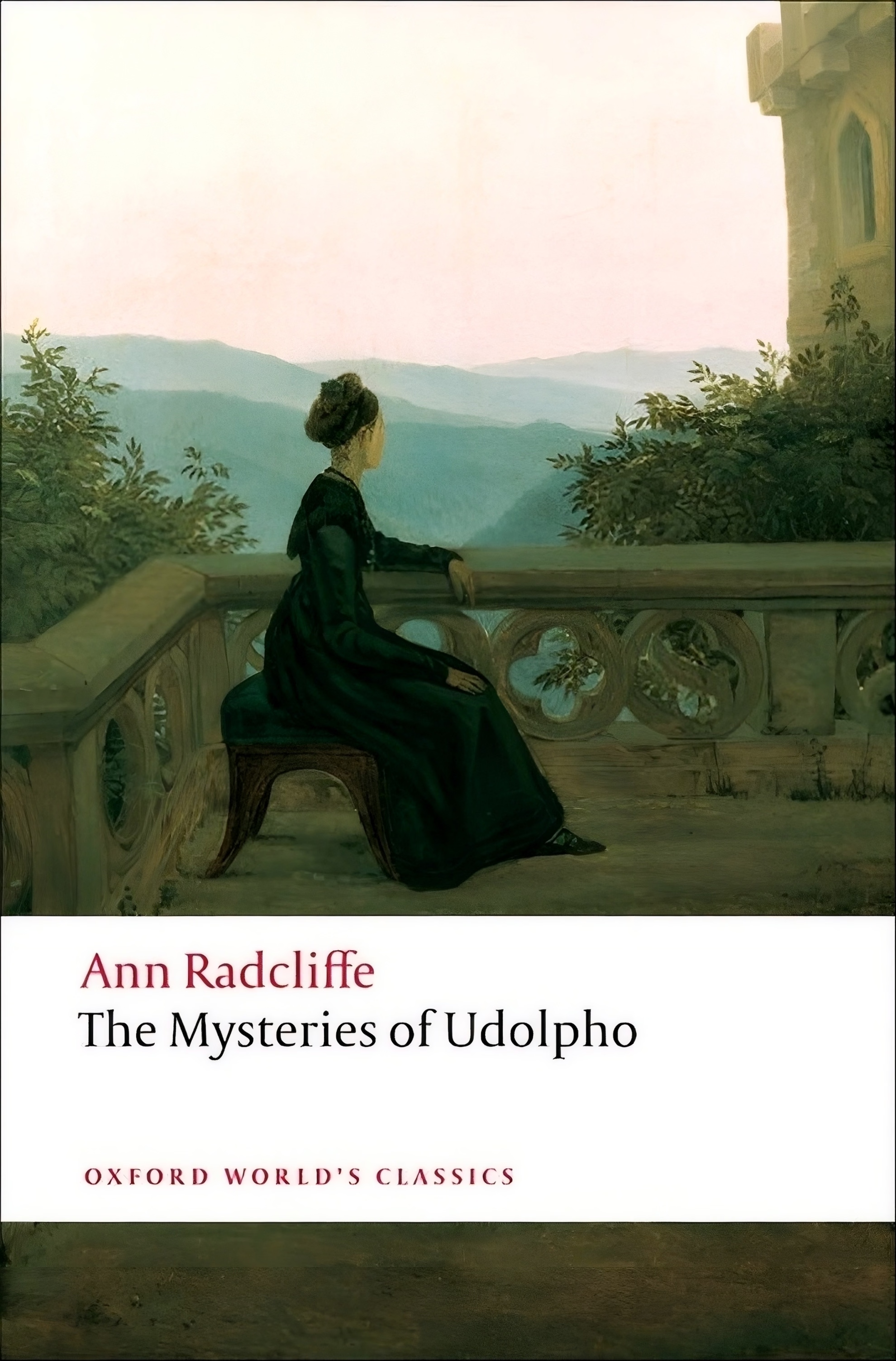
Douce’s essay opened by locating the theme in the dark ages of “monkish bigotry and superstition,” a phrase that recast Holbein’s Catholic Europe in the vocabulary of English Protestant antiquarianism. The edition appeared in the same year as Ann Radcliffe’s ‘The Mysteries of Udolpho’ and two years before Matthew Lewis’s ‘The Monk.’
Five years earlier, the London bookseller T. Hodgson had published ‘Emblems of Mortality,’ with a preface dated March 24th, 1789, by John Sidney Hawkins and cuts by John Bewick, younger brother of Thomas Bewick, copied from the Latin Lyon edition of 1547 with figures added from the French edition of 1562.
The title page described the cuts as imitations of a painting in the Dominican cemetery at Basel and announced the book as intended for the information of the curious and the instruction and entertainment of youth; a Newcastle reissue around 1810 retitled it ‘The Dance of Death.’15 The misattribution is telling. By the late eighteenth century the printed sequence had circulated so long that English editors credited it to a wall, folding a book tradition back into a story about monuments even as they addressed it to the young as a book.
Douce’s mature work closed the circuit. His 1833 volume, issued by William Pickering with new wood engravings after the Lyon cuts, joined a full dissertation on the theme to a catalog of the Lyon editions and their copies, and its blocks were still being printed for English-language readers in the first years of the twentieth century.
From Hollar’s plates of 1651 to Douce’s blocks of 1833, English readers could meet Holbein’s deaths as a book rather than as a rumor of distant walls, and in the late 1780s and 1790s they could do so in competing versions, including David Deuchar’s etchings of 1788 alongside the Bewick cuts and the Hollar reissue.
Toward the Gothic Body
The claim that follows is narrower than influence. No document examined here shows that Radcliffe or Lewis owned the Hollar plates or the Bewick cuts. What the record does show is that the London trade kept Holbein’s anticlerical deaths in print, in competing editions, through the same seasons that produced the first wave of Gothic fiction, and that the editors who issued them framed the material in the same anti-monastic idiom the novels used.
Lewis’s monk falls through lust and pride inside a religious house; Holbein’s Abbot is hauled off clutching his breviary, his Abbess dragged by her scapular, his Nun distracted from the altar by a lover with a lute while Death puts out the candles. The corrupt religious house as a scene of mortal terror had been a staple of the printed macabre for two and a half centuries before it became a staple of the novel.
The Gothic decades also revived the series format itself. Between April 1st, 1814, and March 1st, 1816, Rudolph Ackermann issued Thomas Rowlandson’s ‘The English Dance of Death’ at a rate of three hand-colored aquatints a month, each a scene of contemporary English life interrupted by Death, accompanied by William Combe’s verses and a couplet beneath the image.16
Image above, verse below, one victim per scene, consumed in installments at home: the formula is the Lyon page translated into the serial publishing of Regency London. The reading habit the 1538 book proposed had become a subscription.
The deepest continuity concerns the body. Kelly Hurley’s account of the fin-de-siècle Gothic identifies its defining figure as the abhuman, a body losing its stable human identity and in the process of becoming something else.17
Holbein’s Death anticipates that figure in printed form. It is neither a living person nor a tidy emblem of bones but a decaying body that keeps changing costume and office, impersonating cardinal, jester, sacristan, and hag. The reader trained by the Lyon pages learned to look closely, in a small frame and repeatedly, at a degraded body that would not stay one thing.
When the Gothic later made the unstable, mimicking corpse its central horror, it addressed readers whose print culture had been rehearsing that act of looking since 1538.
The Skeleton on the Reading Desk
The danse macabre did not pass from cathedral wall to Gothic novel by a leap across two and a half centuries. It traveled in a book, and the book told its readers how to use it: know yourself, look upon this image at every moment, turn the page and set the Pope beside the Ploughman.
The scholarship that divides the 1538 volume among art historians, historians of religion, medievalists, and Gothicists has each time kept the part it needed and set aside the rest, and the part set aside is the reader.
Restoring that reader takes nothing from Holbein’s draftsmanship or from the confessional drama of Lyon. It adds a history of practice in which the printed macabre became something people did privately, repeatedly, and with pleasure, long before the Gothic novel gave that practice its name and its readership.
If the habit of meeting death alone, page by page, began with a small Lyon book rather than with the Gothic novel, which of your own encounters with the macabre on paper would you now trace back to Holbein’s 41 scenes?
References
- Austin Dobson, introductory note to Hans Holbein, ‘The Dance of Death’ (New York: Scott-Thaw Company, 1903), 5–21. ↩︎
- Peter Parshall, ‘Hans Holbein’s Pictures of Death,’ in ‘Hans Holbein: Paintings, Prints, and Reception,’ ed. Mark Roskill and John Oliver Hand, Studies in the History of Art 60 (Washington, DC: National Gallery of Art; New Haven: Yale University Press, 2001). ↩︎
- Natalie Zemon Davis, ‘Holbein’s Pictures of Death and the Reformation at Lyons,’ Studies in the Renaissance 3 (1956): 97–130. ↩︎
- Marianne Carbonnier-Burkard, ‘Luthériens et autres hérétiques à Lyon, dans la ‘danse des morts’ des frères Frellon (1542),’ Revue d’histoire du protestantisme 5, no. 1 (2020): 89–118. ↩︎
- Elina Gertsman, ‘The Dance of Death in the Middle Ages: Image, Text, Performance, Studies in the Visual Cultures of the Middle Ages 3’ (Turnhout: Brepols, 2010). ↩︎
- Maja Dujakovic, ‘Death and the Illustrated Book: Printers, Experimentation and the Reinvention of the Danse Macabre, 1485–c.1530s’ (PhD diss., University of British Columbia, 2015). ↩︎
- Jerrold E. Hogle, ‘Introduction: The Gothic in Western Culture,’ in ‘The Cambridge Companion to Gothic Fiction,’ ed. Jerrold E. Hogle (Cambridge: Cambridge University Press, 2002), 1–20. ↩︎
- Carol Margaret Davison, ed., ‘The Gothic and Death, International Gothic Series’ (Manchester: Manchester University Press, 2017). ↩︎
- Hans Holbein the Younger and Hans Lützelburger, ‘Les simulachres & historiées faces de la mort, autant elegamment pourtraictes, que artificiellement imaginées’ (Lyon: Melchior and Gaspar Trechsel, 1538), Francis A. Countway Library of Medicine copy, digitized by the Internet Archive. ↩︎
- Morgan Library and Museum, catalog record for ‘Les simulachres & historiées faces de la mort’ (Lyon: Melchior and Gaspar Trechsel, 1538), accession PML 2112. ↩︎
- Francis Douce, ‘The Dance of Death Exhibited in Elegant Engravings on Wood, with a Dissertation on the Several Representations of That Subject’ (London: William Pickering, 1833). ↩︎
- Morgan Library and Museum, catalog record for ‘Les images de la mort, aux quelles sont adioustées douze figures’ (Lyon: Jean Frellon, 1547), accession PML 196064. ↩︎
- Bridwell Library, Southern Methodist University, ‘Holbein, Dance of Death,’ in the online exhibition ‘Heresy and Error,’ item BRA0001. ↩︎
- Francis Douce, ‘The Dance of Death, Painted by H. Holbein, and Engraved by W. Hollar’ (London: James Edwards, [1794]). ↩︎
- John Sidney Hawkins, ed., ‘Emblems of Mortality: Representing, in Upwards of Fifty Cuts, Death Seizing All Ranks and Degrees of People,’ cuts by John Bewick (London: T. Hodgson, 1789). ↩︎
- John Sidney Hawkins, ed., ‘Emblems of Mortality: Representing, in Upwards of Fifty Cuts, Death Seizing All Ranks and Degrees of People,’ cuts by John Bewick (London: T. Hodgson, 1789). ↩︎
- William Combe and Thomas Rowlandson, ‘The English Dance of Death, 2 vols.’ (London: R. Ackermann, 1815–16), issued in 24 monthly parts, 1814–16; see also Wellcome Collection, catalog note to print 32707i. ↩︎


Leave a Reply