


Most vampire fiction passes over the practical question of how a newly made vampire is fed. A bite or a bloodied exchange completes the transformation, and the creature walks the night fully formed. Caitlin Starling’s ‘Milkteeth’ is organized around that skipped interval. Michael Joseph, the Penguin imprint, publishes the hardcover in Britain on October 22nd, 2026, under the ISBN 978-0-241-84418-2, and St. Martin’s Press issues the American edition two days earlier, on October 20th, 2026. That edition runs 304 pages.
The publisher’s synopsis introduces Beatrice, a broodmother: a vampire responsible for nursing newly made fledglings through the first years of their unlife. She nests in an abandoned, isolated warren of office space beneath her patron’s skyscraper and raises two fractious fledglings. When she takes on a third, her own ravenous hunger strains her, and her body begins to change into something more monstrous still. She courts a mortal who might be able to make sense of that body, and the connection threatens the secrecy of her coven.
The American edition’s synopsis identifies the mortal as an obstetrician-gynecologist and adds that Beatrice begins to crave flesh, a hunger it calls anathema to vampires. The cover artist and the editor of the UK edition had not been confirmed at the time of publication.
A Title From the Nursery
A milk tooth is the first of the two sets of teeth a child grows, shed in childhood to make room for the permanent set. The title therefore joins two images that rarely share a page, the infant and the predator’s fang. Starling had not given a documented account of the title’s origin at the time of publication, so the reading offered here is this publication’s own.
What she has put on record is a set of questions. In a post written for World Breastfeeding Week, she described the book as a response to the idea of vampires who must breastfeed, then asked if the baby vampires are literal babies and if Dracula was a broodmother, and raised the history of human wet nursing. She did not answer those questions in the post, and none of them is treated here as settled.
A Cover in Blood and Blue
The jacket takes a familiar image of devotion and sets it bleeding. Its ground is a tightly cropped painting in the manner of the Old Master Madonna and Child: a woman’s face lowered over an infant’s head, a blue mantle filling the right of the frame, a red garment at the lower edge, and the fine cracking of aged varnish visible across both faces.
Blood runs down from the top edge in thick, glossy streaks, crossing the child’s brow and the first word of the title, so that the red lies over the painted surface rather than belonging to it.
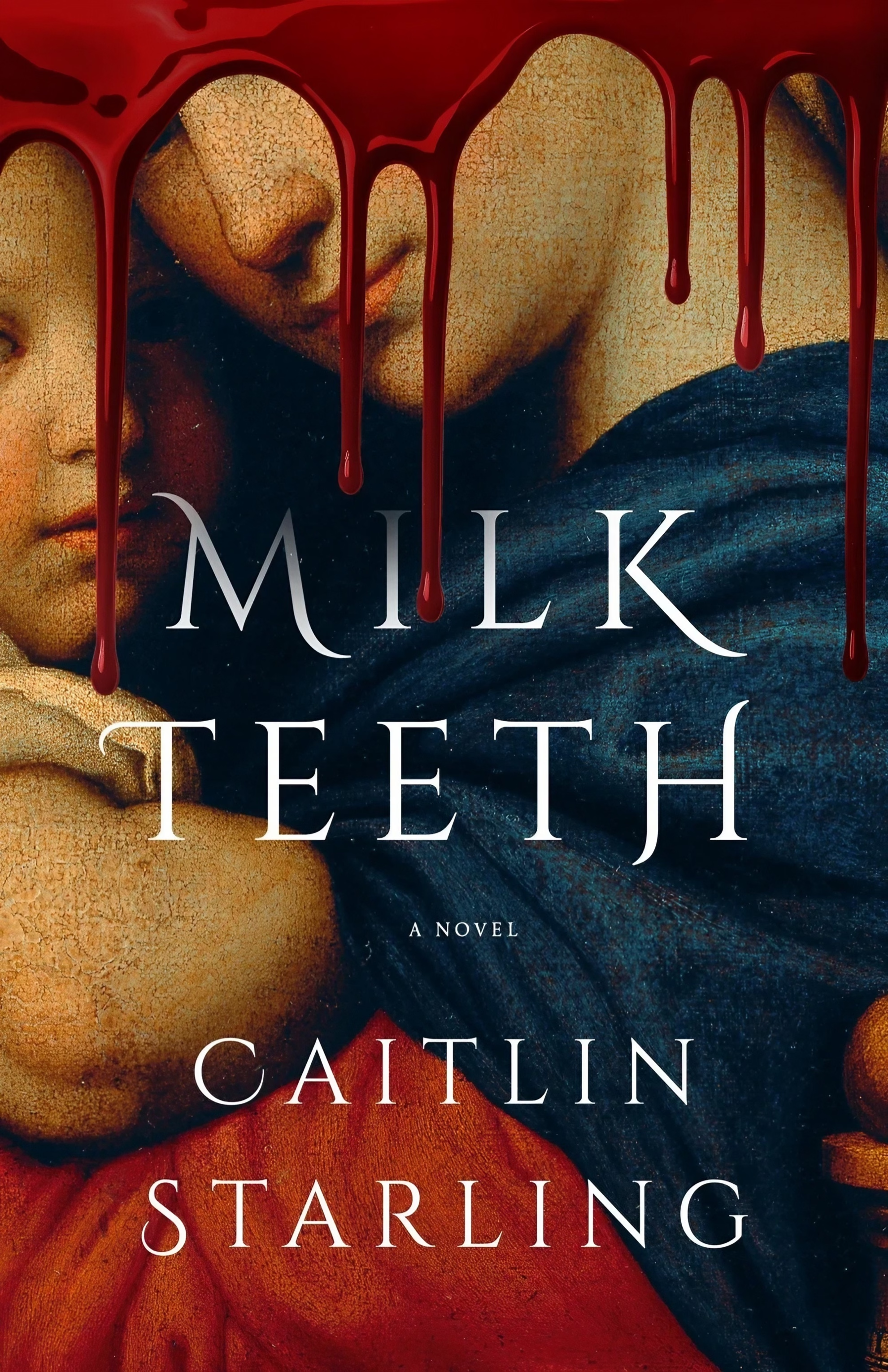
That layering carries the cover’s argument. The cracked pigment is old and dry, the red is wet and recent, and the two never merge: a present-day horror has been laid over a devotional image, much as the novel places its vampire nursery in office space beneath a modern skyscraper. The tradition the painting quotes also bears on the title.
Western art has long pictured the nursing Virgin, the Maria lactans, as maternal feeding in its most familiar form. This crop does not show a feeding, but the tradition it recalls includes one, and the blood supplies the second half of the title, the tooth, to an image already organized around the first, the milk.
The typography keeps the title’s two halves apart. The jacket sets “MILK” above “TEETH” in tall white capitals, the first word shaded toward silver, with the legend “A Novel” in small type beneath, and the author’s name closes the jacket in the same white capitals. The compound that the title joins into one word is split across two lines, so that the reader meets the infant before the fang. The source painting had not been confirmed at the time of publication.
The Count and the Nursery
Stoker’s ‘Dracula’ (1897) already contains a feeding scene that reads as nursing. The Count opens a wound at his chest and compels Mina Harker to drink from it. In Stoker, the image is a violation, one episode inside a hunt, and the narrative moves on from it. The synopsis for ‘Milkteeth’ takes the same transaction and turns it into labor: Beatrice’s work is the nursing itself, the years of care, the management of two hungry charges and then a third.
Starling has not said that Stoker’s scene is a source; her post only names Dracula in connection with the broodmother idea. The point for the genre’s lineage is narrower and does not depend on her intentions. The vampire is no longer defined by what she takes but by what she must supply, and the feeding scene becomes a duty with a bodily price.
The Vampire as Medical Case
The vampire entered the European record as a problem for officials and physicians. In 1725, in the Serbian village of Kisilova, which lay within territory the Habsburg monarchy had held since 1718, villagers told an imperial provisor named Frombald that a recently dead man, Peter Plogojowitz, had risen from the earth and killed nine people. The grave was opened about two and a half months after the burial, and Frombald’s report noted blood pooled in the corpse’s mouth.1
A second incident, in Medveđa on the Western Morava, began in 1727 and produced the better-known report of the two: Johann Flückinger’s ‘Visum et Repertum,’ published in 1732. After that publication, a canon of vampire documents from the military frontier took shape, with Frombald’s Kisilova report and Flückinger’s text at its core.2 Both describe the same procedure: a body is opened, read for signs, and judged.
Starling has not named these reports as a source, and the parallel drawn here is this publication’s own. It rests on a structural point. The earliest documented vampire is a body under inspection, its condition read for evidence of what it has been doing. A novel in which the vampire seeks out a mortal to explain her own changing body returns the creature to that original position, with one difference: the patient speaks, and chooses her inspector.
A Career Across Genres
Starling describes her own bibliography as spanning besieged castles, alien caves, and haunted hospitals. The caves belong to her first novel, ‘The Luminous Dead’ (Harper Voyager, 2019), which was a finalist for the 2019 Bram Stoker Award for Superior Achievement in a First Novel and, according to her UK publisher, was also nominated for a Locus Award.

A gothic tale, ‘Yellow Jessamine,’ followed from Neon Hemlock in 2020, and ‘The Death of Jane Lawrence’ from St. Martin’s Press in 2021; Titan Books issued the UK paperback of the latter on September 20th, 2022.
The vampire is not new to her work. ‘The Land of Milk and Honey,’ her novella in the audio-first collection ‘Walk Among Us’ (Harper Voyager, 2020), belongs to the ‘Vampire: The Masquerade’ tabletop role-playing property, and the publisher describes it as a story in which ideals and ethics collide with appetite on a blood farm.
‘Last to Leave the Room’ followed in 2023 and ‘The Starving Saints,’ the castle novel, in 2025. ‘Milkteeth’ is therefore her return to the vampire outside a licensed game setting, and the first of her novels to put the creature at its center.
The Road From Graceview
St. Martin’s Press published ‘The Graceview Patient,’ Starling’s immediately preceding novel, in hardcover on October 14th, 2025, at 304 pages.
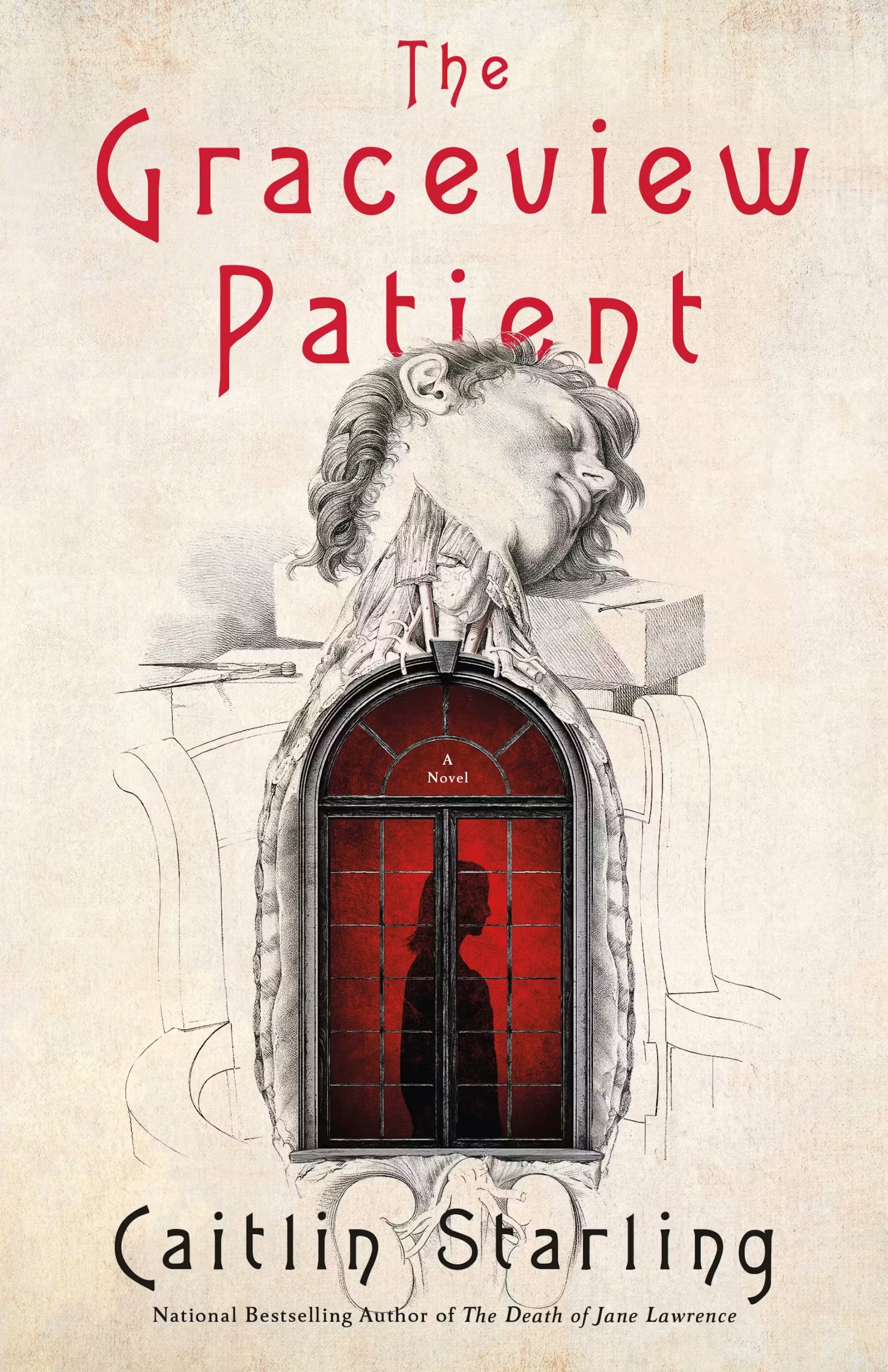
Its protagonist, Margaret, lives with a rare autoimmune condition that has left her isolated and in pain, and she accepts a fully paid-for place in an experimental medical trial at Graceview Memorial. She will live in the hospital as a full-time patient while her immune system is nearly destroyed and then regenerated. As her body fails, she senses something sinister spreading through the hospital and cannot tell what is real from what is medication-induced delusion.
The two novels share a specific preoccupation. In ‘The Graceview Patient,’ an institution takes charge of a body that no longer behaves as its owner expects. In ‘Milkteeth,’ as the publisher describes it, the transformation comes from within, and Beatrice goes looking for the expert rather than being enrolled by one.
The synopsis also sets out an escalation in which each risk sits on top of the last: two fledglings become three, hunger becomes bodily change, and concealment becomes dependence on a mortal confidant. The step from the hospital ward to the vampire’s nursery is shorter than the change of genre suggests.
A Nursery Under the Tower
The documented history of the vampire begins with bodies laid open for officials to read, and the fiction that followed spent two centuries moving the creature away from that table and toward the drawing room and the bedroom. ‘Milkteeth’ turns back toward it: a vampire whose body is a problem to be explained, whose labor is the care of the newly made, and whose secrecy depends on the people she cannot afford to trust.
The feeding that Stoker staged once, as an act of domination, becomes in Starling’s premise a daily duty. For readers tracing the vampire through its long record of anxiety about bodies, that is a specific reorientation, set out in the publisher’s own synopsis.
Which vampire novels or stories have made the care of the newly made, rather than the hunt, their central subject, and which of them deserve this publication’s attention beside ‘Milkteeth’?
References
- Michael Pickering, ‘Vampires, Ottomans, and the Specter of Contagion: The Intersectionality of Fear on the Periphery of the Habsburg Monarchy,’ in ‘Fear in the German-Speaking World, 1600–2000’ (2020), citing the 1725 report of the imperial provisor Frombald, Haus-, Hof- und Staatsarchiv, Vienna. ↩︎
- Álvaro García Marín, ‘Analysis of a 1725 Report of Vampirism in Kragujevac,’ Journal of Vampire Studies 1, no. 2 (2021): 137–64, on the 1725 Frombald report as part of the early canon. ↩︎


Leave a Reply