
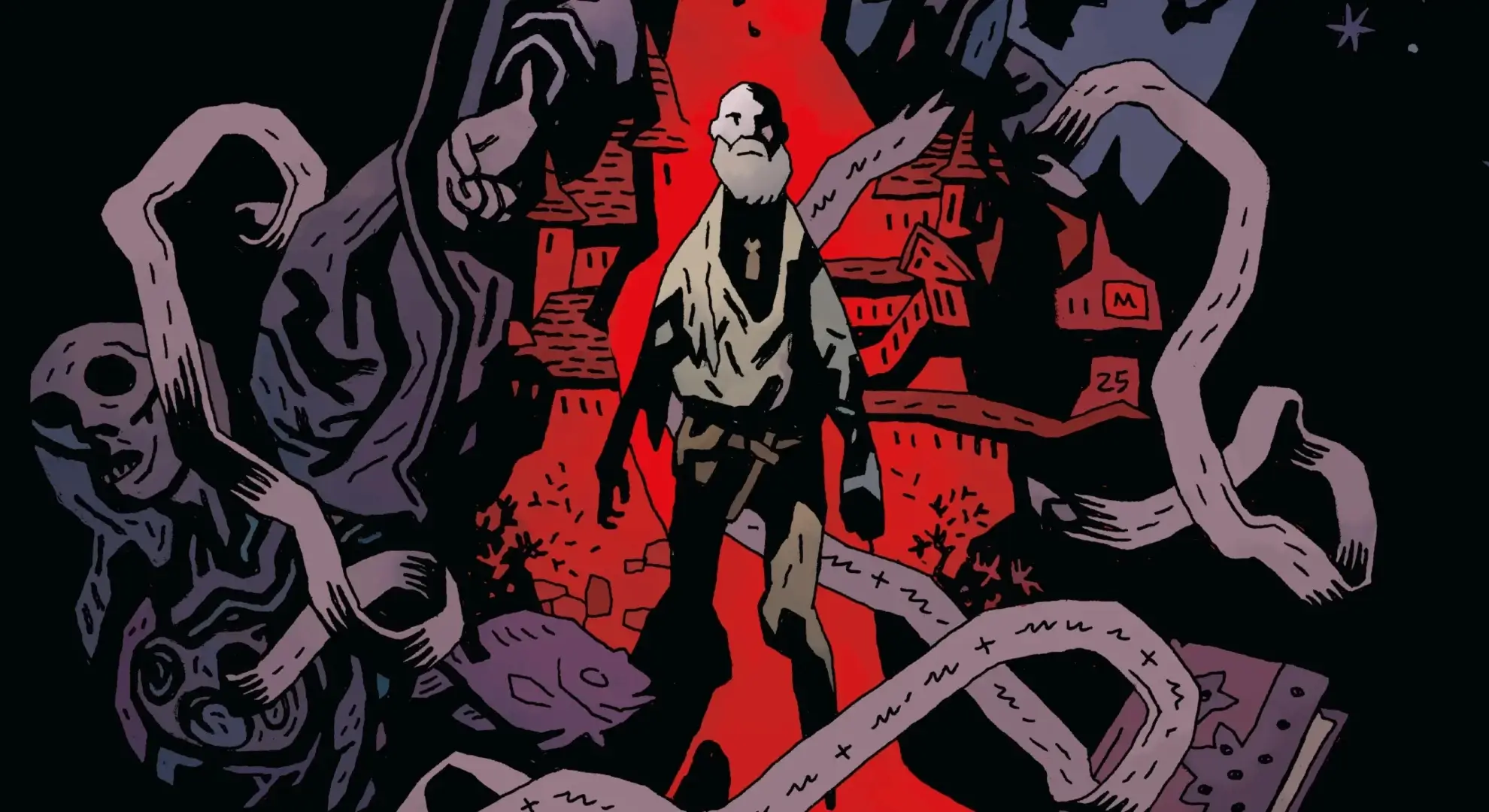


The graphic novel tradition that draws on folk horror and theological dread—Moebius’s metaphysical wanderers in ‘The Incal,’ Enki Bilal’s apocalyptic mythologies in the Nikopol trilogy—has always understood that legend is not decoration. It is the medium through which particular civilizations make suffering legible. When a cartoonist of Mike Mignola’s standing turns away from a universe he has managed for more than three decades to build something new from folktale materials, the question is not whether the work will be technically accomplished. The question is whether the departure is genuine.
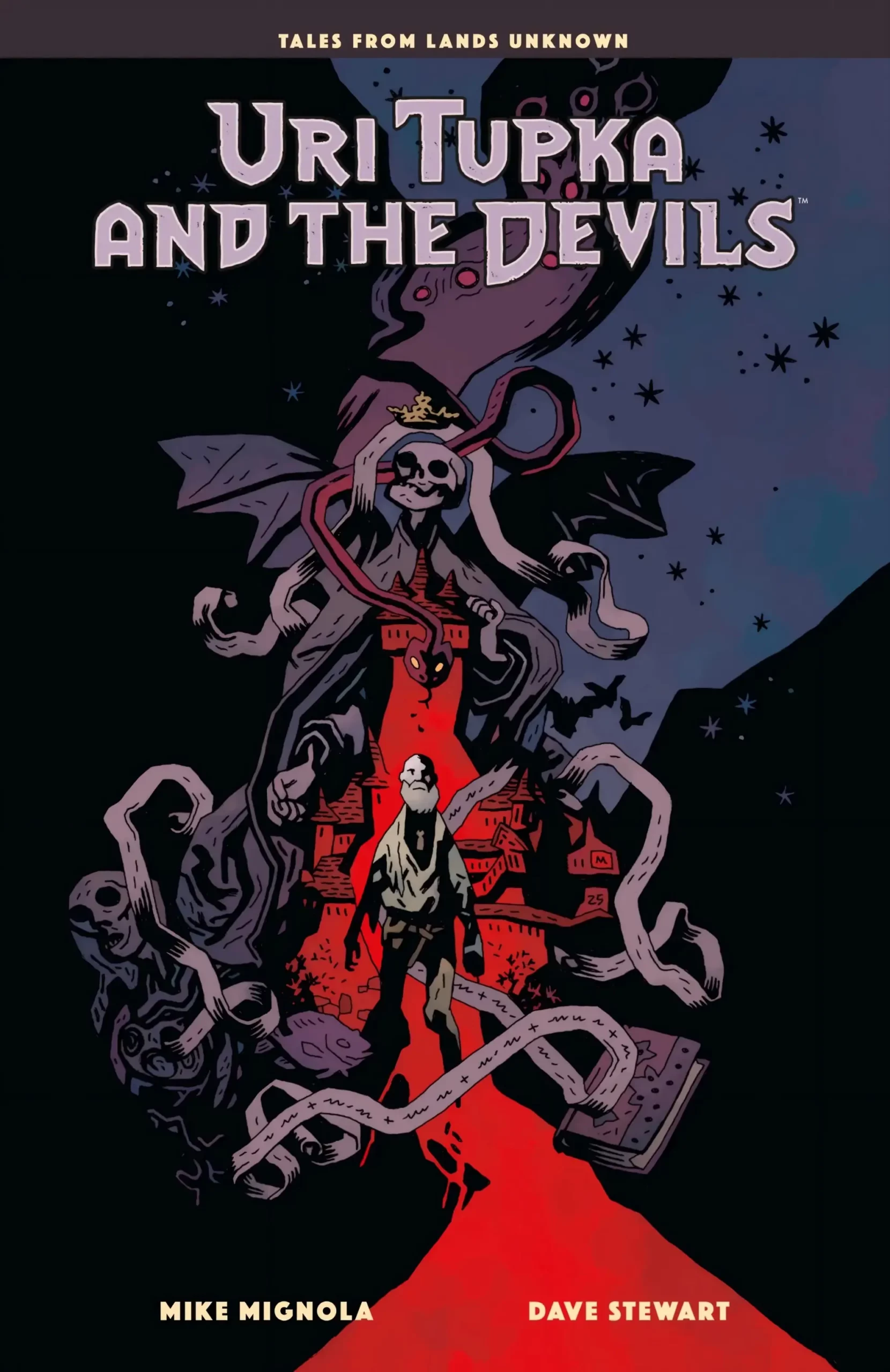
‘Uri Tupka and the Devils: Another Story from Lands Unknown’—written, drawn, and covered by Mignola, with colors by Dave Stewart and lettering by Clem Robins—is the third book in the ‘Lands Unknown’ universe that Mignola has been developing since 2025 alongside cartoonist Ben Stenbeck. It arrives from Dark Horse Comics on November 16, 2026 as a 104-page hardcover original graphic novel.
The first volume, ‘Bowling with Corpses and Other Strange Tales from Lands Unknown’ (2025), established the setting through an anthology structure: eight folklore-derived stories that built a world saturated with dread and theological ambiguity, and which earned a Bram Stoker Award nomination. The second book, ‘Uri Tupka and the Gods’ (March 2026), introduced the central protagonist and committed Mignola to sustained narrative focus within that world.
The book is the direct duology companion to that volume. Uri Tupka—heretic, theologian, wanderer—having learned what there is to know of the gods, now pursues a harder question: the truth about the darkness that preceded creation, and what that darkness means for a humanity that must live inside it.
The announced premise places him in a Baron’s castle whose library holds books beyond even his capacious and restless imagination, each night of reading bringing new clarity that threatens to consume him. That is a premise in which the library becomes the site of epistemological violence—knowledge not as consolation but as danger.
The Lands Unknown and Its Critical Precedents
The ‘Lands Unknown’ project belongs to a specific tradition within comics that uses folkloric structure to generate philosophical weight rather than mere atmosphere. ‘The Incal’ (Jodorowsky and Moebius, Les Humanoïdes Associés, 1980–1988) built its narrative around a pilgrim figure advancing through systems of cosmic meaning that recede as he approaches them.
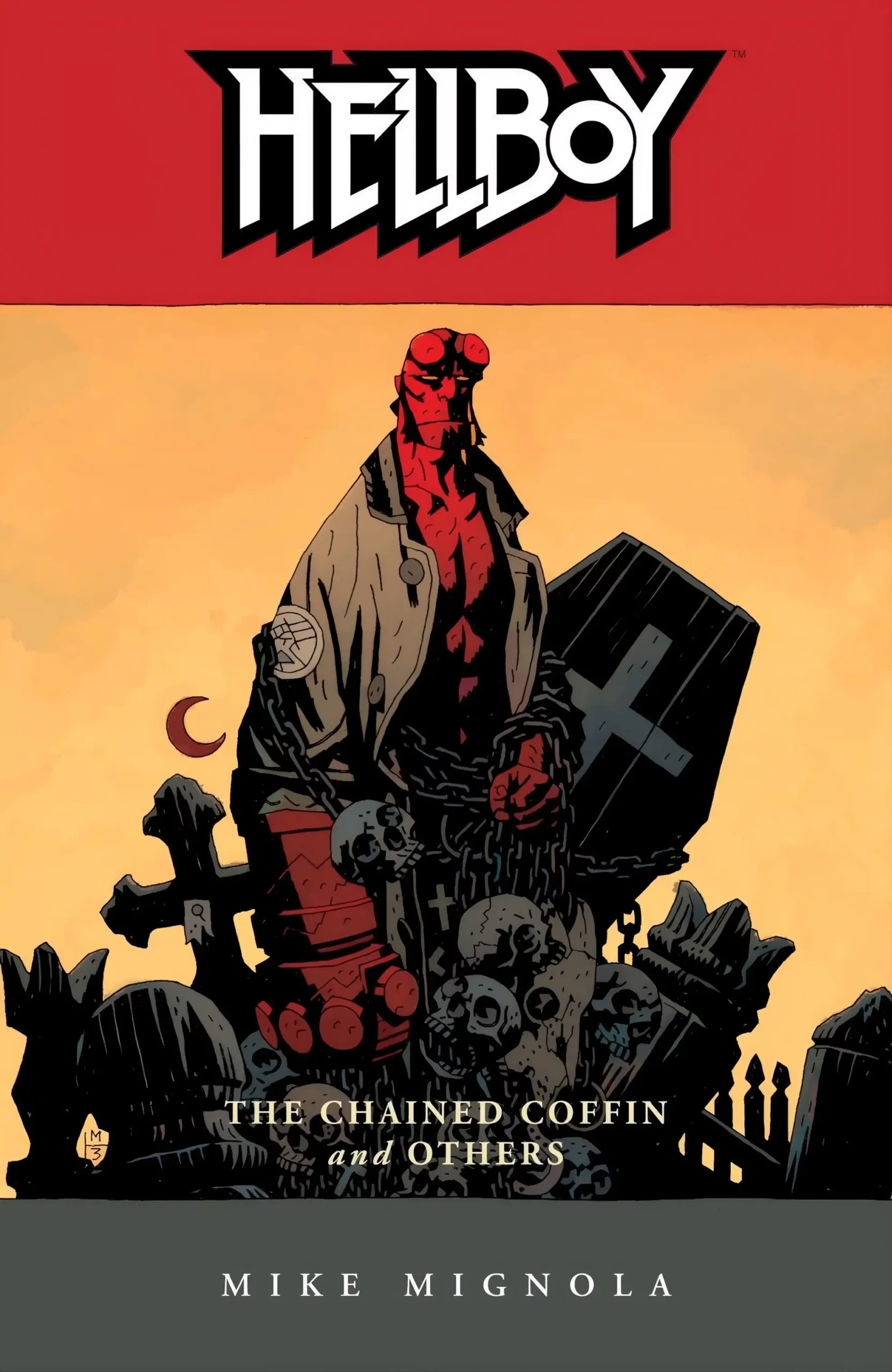
Within Mignola’s own prior work, volumes such as ‘The Conqueror Worm’ (Dark Horse, 2001) and ‘The Chained Coffin and Others’ (Dark Horse, 1996) used folkloric structure to produce that kind of philosophical friction. What separates the Lands Unknown books from those precedents is the deliberate elimination of genre machinery: no parapsychological agency, no institutional framework, no contemporary anchor. Uri Tupka moves through a world that operates entirely on the internal logic of legend, which is a more exposed formal choice.
The closest precedent for that specific commitment may be Jack Vance’s literary fantasy fiction of the 1950s and 1960s, whose elegant, pre-modern worlds operated by their own coherent philosophical rules without the reassurance of a contemporary reference point. Comics has rarely attempted that degree of self-containment at the OGN level. The ‘Lands Unknown’ project is, among other things, an argument that the form can sustain it.
What the Black Page Already Knows
Mignola’s visual practice is so thoroughly established that each new solo work tests whether that practice can be renewed from within. His chiaroscuro method—solid black shapes carved by light, form implied rather than rendered, spatial depth suggested by selective absence—creates an effect that critics of the Hellboy series have consistently noted: what has been removed from the page feels more present than what remains.
In the ‘Lands Unknown’ books, that method is transferred to an explicitly pre-modern world without the genre touchstones that previously anchored it. There are no overcoats, no agency credentials, no anachronistic wisecracking. What that demands of the visual work is that the chiaroscuro itself must carry the cosmological argument the narrative makes: that darkness is not the absence of light but the condition in which certain truths become visible.
A sequence from ‘Uri Tupka and the Gods’ demonstrates what that looks like in practice. In the volume’s encounter with a tomb of unspeakable horror, Mignola’s panel grid expands and then contracts not through dramatic escalation but through a narrowing of the white field: the light that defines Tupka’s figure diminishes across sequential panels until, in the final image, he is almost entirely absorbed by black, only the pale oval of his face and one extended hand preserved in light.
The sequence communicates not event but epistemological state—the experience of confronting something the available categories of understanding cannot process. The forthcoming volume is, by the terms of its own announced premise, one whose entire narrative takes place inside that state. If the visual method is adequate to the theological weight of what is being dramatized, the book’s 104 pages will feel more expansive than that count suggests.
Stewart’s Amber Against the Encroaching Cold
Dave Stewart has colored Mignola’s work across the full arc of the Hellboy series and into the ‘Lands Unknown’ volumes, and the collaboration has produced one of the most consistent and arguable chromatic practices in contemporary graphic novel publishing. Stewart’s palette for Mignola operates on a specific thermal logic: warm ochres and amber-browns establish the historical distance of a pre-modern world, signaling the human and familiar; intrusions of cold violet and deep indigo mark the presence of forces operating outside that world’s explanatory categories. Color, in this system, performs the theological argument the narrative makes rather than illustrating it.
In the ‘Lands Unknown’ books, that distinction is sharpened by the folkloric setting, which eliminates modern visual noise and allows the palette’s argument to register without interference. A castle full of books that threatens to unmake its reader is exactly the kind of space this palette is designed to make legible: the amber of the library by candlelight gives way, night by night, to the violet of what the books contain. Whether Stewart calibrates that transition gradually or reserves it for discrete narrative ruptures will determine how much of the book’s theological argument is carried by color rather than word.
The Theologian as Gothic Protagonist
Uri Tupka as a figure belongs to the tradition of the seeker-protagonist in horror fantasy whose narrative function is not to defeat the uncanny but to be changed by contact with it. The closest precedent within Mignola’s own prior universe is the occult scholar figure that recurs across the Hellboy auxiliary volumes—Sir Edward Grey, Johann Kraus—but those characters operated within institutional frameworks that partially mediated their encounters with the unknown. Tupka has no such mediation. He is a heretic by designation, which means the established theological framework of his world has already failed to contain his questions before the story begins.
The castle of a Baron holding books beyond imagination is a variant of the Gothic library as site of forbidden knowledge—a figure with a documented history from Matthew Lewis’s ‘The Monk’ (1796) through Umberto Eco’s ‘The Name of the Rose’ (1980) and into Jorge Luis Borges’s influence on the literary fantastic. Mignola’s version, drawn rather than written, subjects that figure to the pressure of his visual method: what cannot be put into words may yet be put into a panel shape.
Mignola has described the book as one in which Tupka changes shape, tumbles through his own inner workings, and “take[s] a pretty savage beating”—a description that suggests the castle’s philosophical danger will be rendered through the body as much as through the mind. That is a formal decision with consequences: physical transformation in a Mignola graphic novel is always a sign that the categories of the self are insufficient to what the self has encountered.
What It Asks of the Form
As an original graphic novel, ‘Uri Tupka and the Devils’ is free of the formal pressures that serial publication imposes. No issue-ending cliffhanger, no month-long gap between installments, no reader-orientation requirement at the opening of each chapter.
The 104-page count—compact by contemporary graphic novel standards, and identical to the page count of ‘Uri Tupka and the Gods’—suggests that Mignola has calibrated each volume for a specific density rather than a specific duration.
The preceding volume organized its narrative as a series of vignettes framed by an inn scene, a picaresque structure that allowed encounters with dragons, giants, and a tomb to accumulate without requiring sustained psychological continuity between them. The announced premise for ‘Uri Tupka and the Devils’ is spatially constrained by contrast—a single castle, a single library, consecutive nights—which signals a move toward gothic enclosure rather than picaresque accumulation.
That structural shift carries critical implications. Enclosure in a Gothic tradition places pressure on the protagonist’s interiority in ways that a traveling narrative does not. Mignola’s visual practice, with its reduction of background detail and its reliance on figure-shadow relationship, is well suited to the exterior encounter—the pilgrim road, the monstrous meeting.
Whether it can sustain the interiority that gothic enclosure demands is the formal question the book poses before it has answered it. The answer will depend on how Mignola handles the panel border when the threat is not a creature but a page of text.
The Question the Page Must Answer
The ‘Lands Unknown’ project has established that Mignola, working without the weight of a long-running shared universe, produces work of unusual formal discipline and philosophical ambition. ‘Uri Tupka and the Devils’ carries the specific burden of a duology conclusion: it must resolve not the narrative of a theologian in a castle but the deeper question the preceding volume posed—what knowledge of origins does to a mind constitutionally incapable of accepting the limits of human understanding.
That is not a question a synopsis can answer. It is one that only the page, its specific black shapes, its specific carving of light and warm color into cold, can address in the terms the work has established.
If Mignola’s visual method is adequate to the theological weight of the premise he has announced, the book will stand as the most formally demanding work of his ‘Lands Unknown’ project and among the more serious works of genre graphic novel fiction to appear in 2026. The theologian has found the gods. What he finds in the dark before them is the book’s only remaining argument.
In the ‘Lands Unknown’ books, folkloric horror functions as a philosophical mode rather than as atmosphere—a tool for making theological questions feel urgent and embodied. Does that formal choice produce a more durable emotional effect than the monster-as-menace structure of traditional horror comics, or does it risk making the stakes feel abstract when the narrative turns toward the cosmic?
Leave a Reply