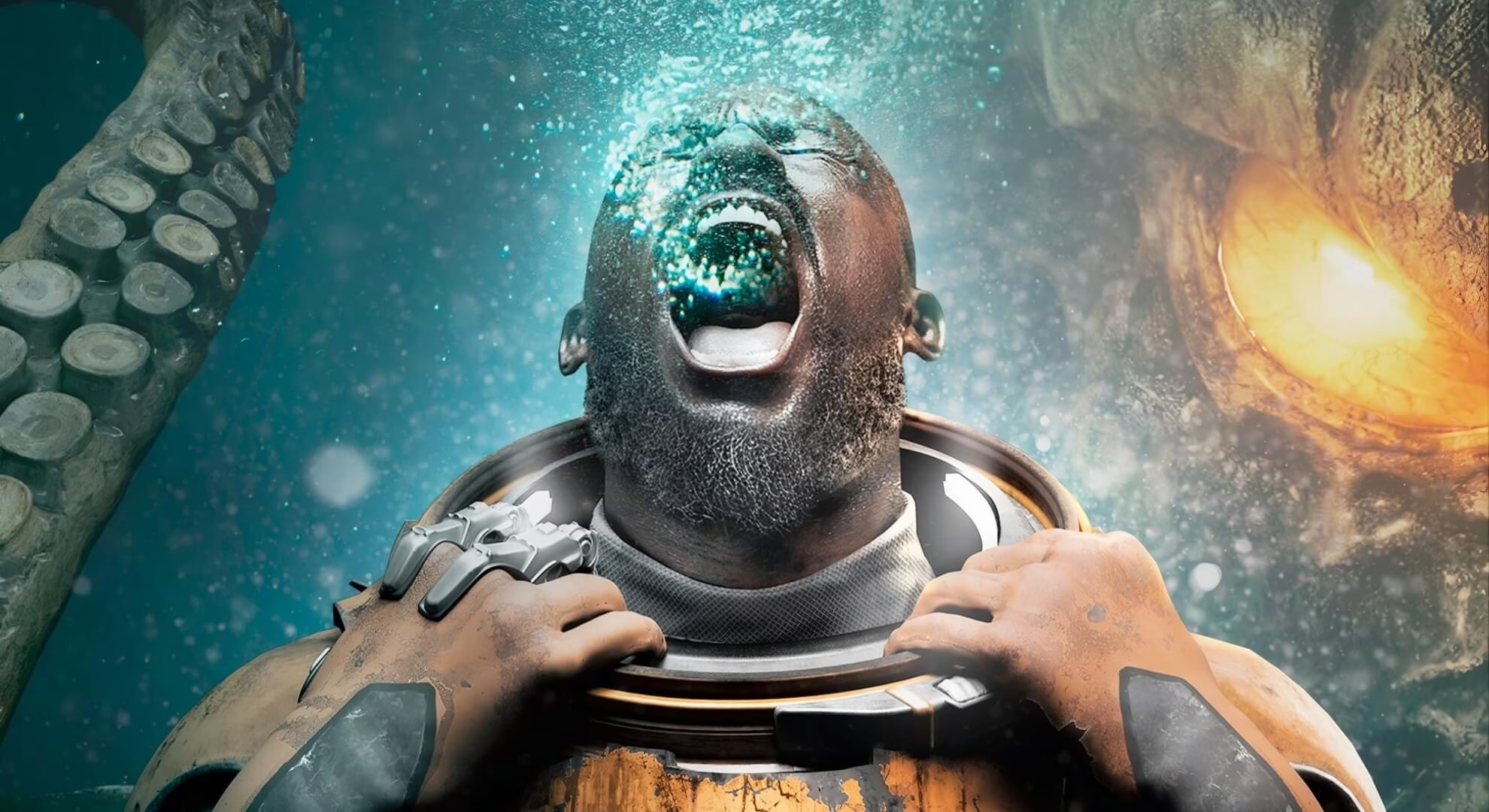


Sandy Petersen’s 1981 tabletop rulebook for ‘Call of Cthulhu,’ published by Chaosium, introduced a mechanical proposition that video game horror would not reach for another two decades: that sanity itself was a resource, depletable through contact with the incomprehensible, governed by probability and choice. That proposition — that the correct response to cosmic horror is not a raised weapon but a degraded mind — has remained the foundational challenge for every credible interactive engagement with H.P. Lovecraft’s fiction.
The video game record on that challenge is mixed at best. Headfirst Productions’ ‘Call of Cthulhu: Dark Corners of the Earth’ (2005) translated the Arkham aesthetic into first-person survival horror at the cost of significant technical instability. Silicon Knights’ ‘Eternal Darkness: Sanity’s Requiem’ (Nintendo, 2002) remains the most formally inventive console sanity system in the medium’s history, deliberately engineering interface-level deceptions to simulate psychological destabilization. Frictional Games’ ‘SOMA’ (2015) produced the genre’s most serious engagement with aquatic dread.
Each of those games identified the same problem and arrived at a partial solution. Now, with Big Bad Wolf’s ‘Cthulhu: The Cosmic Abyss’ launching its public demo on Steam on April 10, 2026, and scheduling its full release for April 16 across PC, PS5, and Xbox Series X|S, the Bordeaux-based studio presents the most production-resourced attempt at Lovecraftian horror gaming in years.
Big Bad Wolf and the Horror Pivot
Big Bad Wolf was founded in 2014 in Bordeaux by Thomas Veauclin, Fabrice Granger, and Sylvain Sechi, all veterans of Ubisoft and Cyanide. The studio’s two prior releases — ‘The Council’ (Focus Entertainment, 2018) and ‘Vampire: The Masquerade – Swansong’ (Nacon, 2022) — established a consistent identity: narrative role-playing structured around investigation, character-driven branching choices, and consequences that persist across chapters.
Neither title was a horror game in the strict genre sense. ‘The Council’ was a historical conspiracy narrative set at a late-eighteenth-century private island gathering; ‘Vampire: The Masquerade – Swansong’ situated its investigation mechanics within the World of Darkness’ supernatural political thriller. Horror was ambient in both. ‘Cthulhu: The Cosmic Abyss’ represents the studio’s first explicit commitment to the genre.
Big Bad Wolf sits within the Nacon publishing group, which has co-published the studio’s two prior releases and is publishing ‘Cthulhu: The Cosmic Abyss.’ Game Director Tommaso Sergi has described the title as the studio’s most ambitious project to date, noting that where earlier Big Bad Wolf games made gameplay serve narrative, here the narrative serves gameplay — a philosophic inversion that represents a meaningful design commitment.
Noah, the Ancile, and the 2053 Frame
The game is set in 2053, in a near-future in which occult events have become sufficiently documented that a covert Interpol division — the Ancile — has been established to manage them. The protagonist, Noah, is an Ancile agent dispatched to the Pacific Ocean to investigate the disappearance of a crew working for a deep-sea mining corporation, Ocean-I, whose drilling operations in the Pacific abyss have awakened something beneath the seabed. That investigation, by narrative design, leads to R’lyeh.
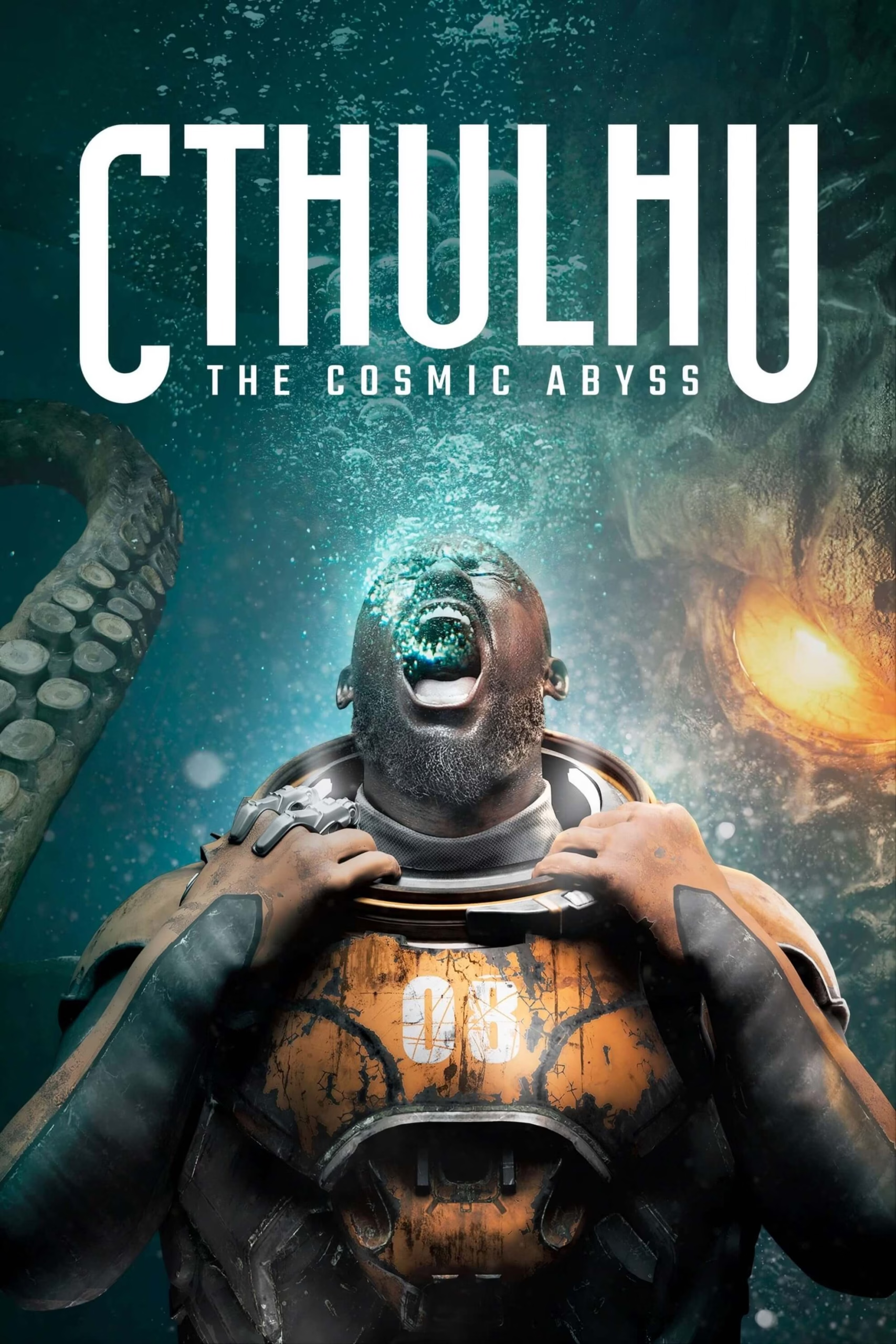
The 2053 frame is the game’s most consequential premise decision. The Mythos’ original power was inseparable from the early-twentieth-century world Lovecraft’s protagonists inhabited — one in which the incomprehensible remained hidden precisely because the instruments for finding it did not yet exist. Advancing that world to a near-future equipped with sonar technology, AI systems, and global occult-monitoring infrastructure changes what the horror is required to argue.
Preview coverage from early 2026, including hands-on reports from Gamereactor and GameSpew, suggests the studio has used the temporal displacement productively. The framing positions Noah’s descent as one in which familiar institutional systems have already failed and the incomprehensible has definitively outpaced the agencies designed to contain it — a premise that reframes the Mythos’ core dread for a world that already accepts the supernatural as a documented category.
Investigation Without Combat
‘Cthulhu: The Cosmic Abyss’ has no combat system. Noah cannot fight the entities he encounters in R’lyeh; survival requires reading each creature’s behavioral patterns and navigating around them. Sergi, in an interview published by Netto’s Game Room, described the design philosophy as making “the environment feel like a predator, making every investigation feel like a fight for survival.”
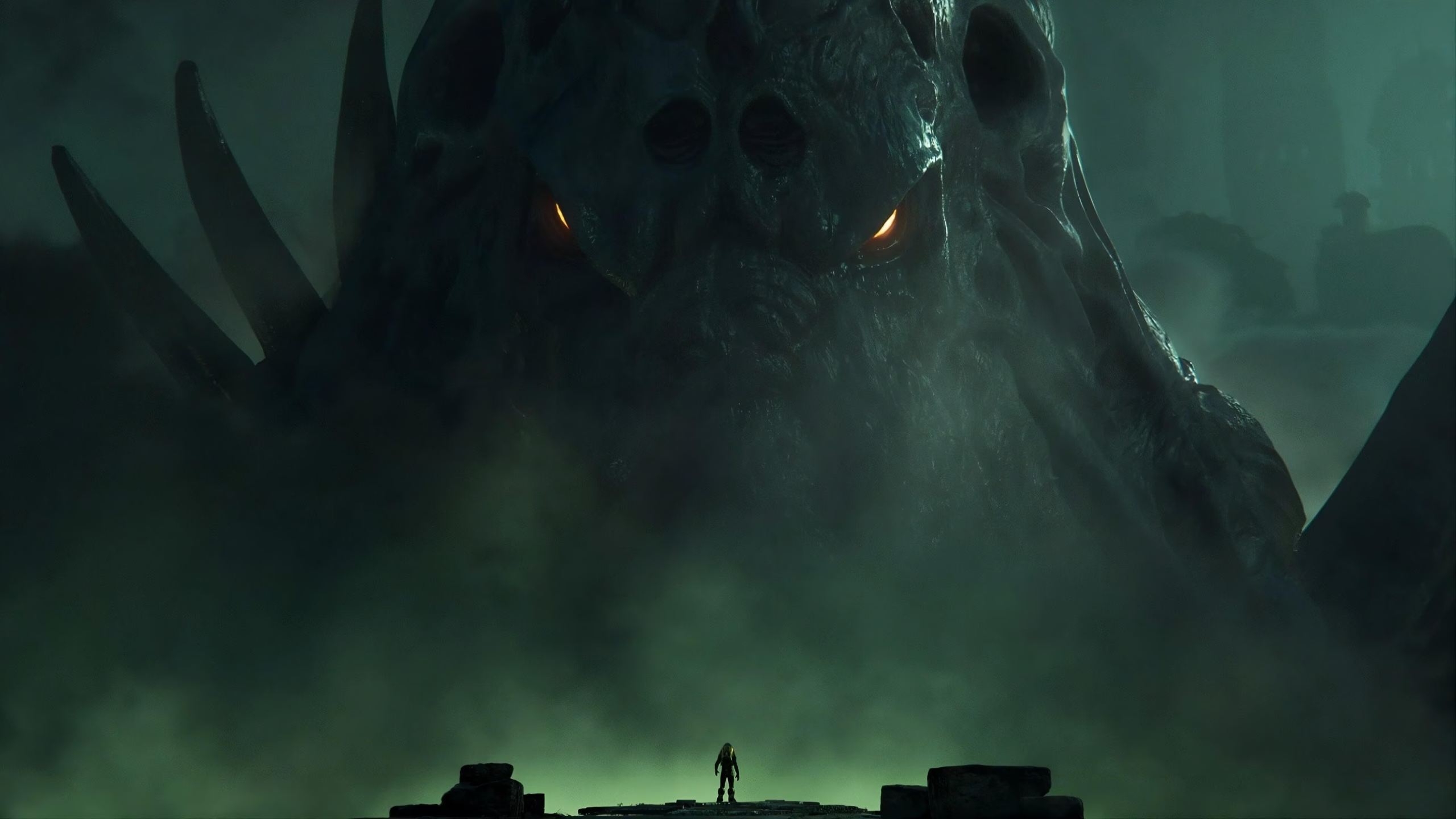
Noah’s toolkit is built for investigation: a sonar for tracking material composition through environments, a clue-analysis system that populates a deduction board, interrogation mechanics for NPCs, and KEY — an AI companion integrated into Noah’s cognitive interface. The design references Sergi cited are instructive: ‘Outer Wilds’ (Mobius Digital, 2019) and ‘The Forgotten City’ (Modern Storyteller, 2021) for investigation design, and ‘Dishonored 2’ (Arkane Studios, 2016) for alternative routes to objectives.
That vocabulary sits closer to Petersen’s original tabletop ‘Call of Cthulhu’ — in which investigators survived through information-gathering and avoidance rather than combat effectiveness — than to the action-adventure tradition that has shaped most video game Lovecraft adaptations. For the first-person camera approach, which is a first for Big Bad Wolf, Sergi cited ‘Cyberpunk 2077,’ ‘Resident Evil 7,’ and ‘Resident Evil Village’ as technical references.
The Corruption System and Its Predecessors
The sanity mechanic is the point at which any new Lovecraftian horror game faces its most documented design tradition. Petersen’s 1981 tabletop rulebook formalized sanity as a declining numerical resource, depleted by Mythos encounters and managed through character decisions.
Silicon Knights’ ‘Eternal Darkness: Sanity’s Requiem’ (Nintendo GameCube, 2002) translated this into console hardware with perhaps the medium’s most inventive sanity implementation — one that manufactured false save-file deletions, muted the television, and broke the fourth wall to simulate the player’s own destabilization.
Frictional Games subsequently built a PC horror tradition around sanity mechanics with ‘Amnesia: The Dark Descent’ (2010), before producing ‘SOMA’ (2015), in which the sanity concept dissolved entirely into the game’s existential argument about consciousness. In ‘Cthulhu: The Cosmic Abyss,’ sanity is tracked through a Corruption meter. Extended contact with Cthulhu’s presence degrades Noah’s perception, generates hallucinations, and — according to official pre-release materials — shapes narrative outcomes in later chapters.
Replenishment comes through harvesting bioluminescent fungal growths distributed through the environment, formally linking the sanity system to the exploration loop. That structural choice is meaningful: it makes sanity management a traversal problem rather than a purely reactive one, requiring the player to plan routes through R’lyeh with resource acquisition in mind.
Whether the full game’s system achieves the formal depth of ‘Eternal Darkness’ cannot be confirmed from demo-based preview coverage, but the stated commitment to sanity as a determinant of narrative outcome rather than mere visual distortion suggests a more substantive engagement than most of the genre’s prior video game entries.
R’lyeh and the Underwater Horror Tradition
‘SOMA’ (Frictional Games, 2015) remains the definitive achievement in aquatic horror game design: a game in which the Pathos-II research station’s absolute depth, its physical severance from any reachable surface, produced a quality of entrapment that its existential horror themes demanded.
‘Subnautica’ (Unknown Worlds, 2018) — not a horror game by genre designation, but one that operates as survival horror through environmental design — demonstrated that the deep ocean’s absolute darkness and pressure could sustain dread without any explicit monster encounter.
The location of R’lyeh makes the underwater setting a formal necessity rather than a stylistic choice. Lovecraft’s original conception of the sunken city in ‘The Call of Cthulhu’ (1928) depended on its inaccessibility, its non-Euclidean spatial logic, and its emergence only under conditions of geological catastrophe.
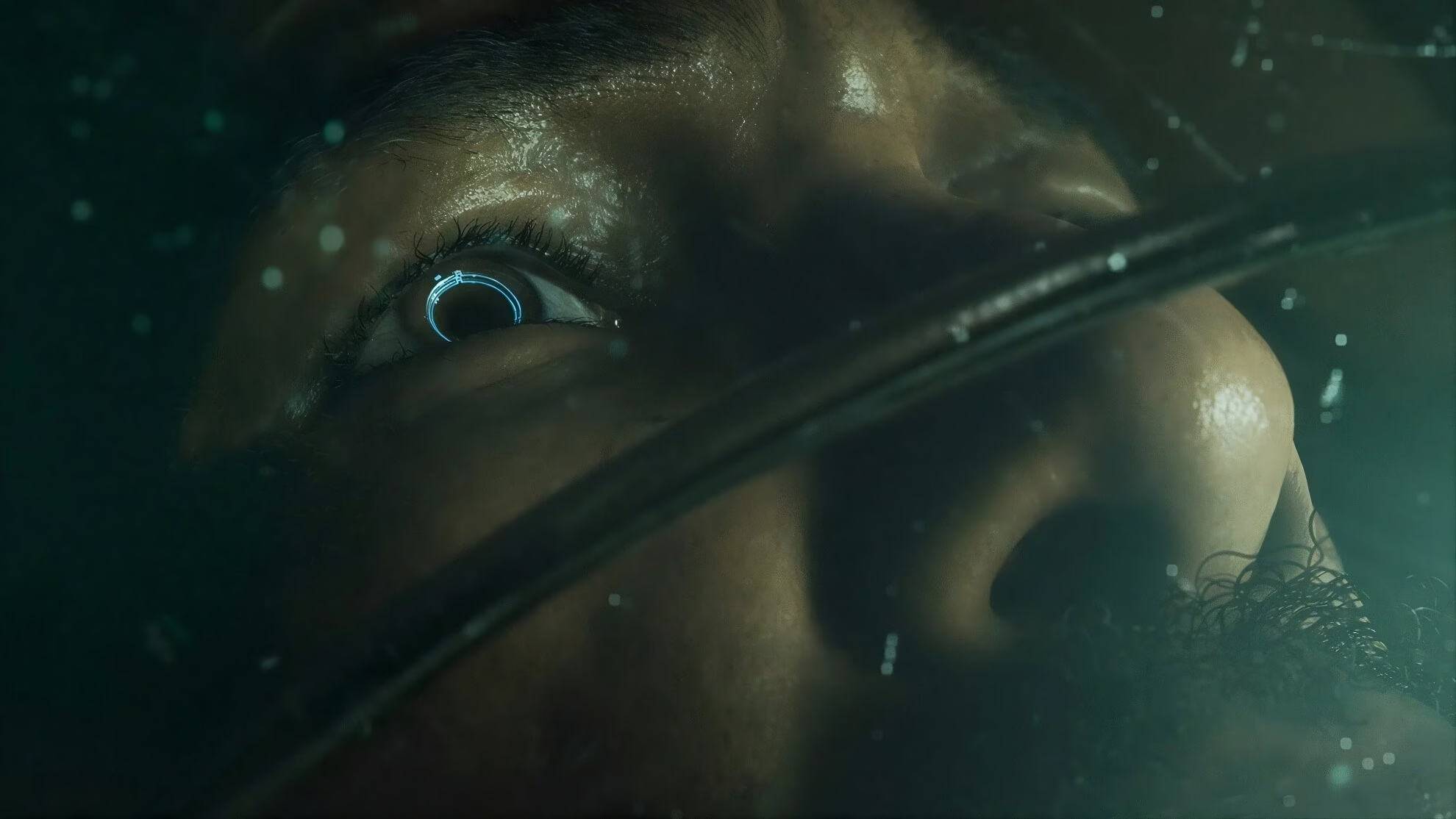
Placing an interactive protagonist within those ruins — navigating corridors designed for entities whose dimensions do not correspond to human spatial reasoning — represents a design challenge that goes well beyond standard environment construction.
Preview reports from multiple outlets describe the Unreal Engine 5-powered environments as formally disorienting, with spatial geometry that departs from standard level design conventions. The studio’s description of the city as a “labyrinthine aquatic prison” for Cthulhu positions R’lyeh not merely as a horror backdrop but as a designed space whose spatial rules become part of the puzzle logic — a commitment to the source material’s specific architectural dread that ‘Dark Corners of the Earth’ and ‘The Sinking City’ (Frogwares, 2019) each approached but neither fully realized.
Demo Live, Release Five Days Out
The public demo, available on Steam from April 10 through the game’s release date of April 16, 2026, covers the complete first episode and the opening section of the second.
Players can encounter the sanity system, the investigation mechanics, the KEY companion, and the early chapters of Noah’s descent before the full game’s launch. The demo was released as part of the Lovecraftian Days festival on Steam, an annual showcase for Mythos-adjacent gaming.
Nacon has priced the standard edition at COP 181,964 (approximately USD 49.99) across all platforms. A Deluxe Edition, priced at COP 218,364 (approximately USD 59.99), includes an original scenario for the ‘Arkham Horror’ tabletop roleplaying game, titled ‘Descent,’ set within the game’s fiction. That cross-media inclusion is unusual in the Mythos gaming space and acknowledges the tabletop tradition from which the game’s sanity mechanic descends as an active concern for the anticipated audience.
An original soundtrack composed by Nicolas Garcia, with cello contributions from Tina Guo, is available independently. ESRB and PEGI ratings had not been formally confirmed at the time of publication; Steam descriptors include Gore and Violent among the game’s tags, and preview materials confirm blood and body horror content. Spanish language localization status for the PC release had not been confirmed at the time of this report.
The playable demo that opened on April 10 arrives at a moment when the Mythos gaming space has contracted around two poles: the small-scale indie approach of titles like ‘Dredge’ (Black Salt Games, 2023), which built a broad audience through genre-adjacent horror and mechanical accessibility, and the rarer commitment of a production with the publisher support and engine resources that ‘Cthulhu: The Cosmic Abyss’ has secured. Big Bad Wolf’s prior catalog positioned the studio as competent in investigative narrative and branching choice — neither qualification is sufficient for the specific design demands of Lovecraftian horror.
The Mythos requires a game to make incomprehensibility a sustained mechanical experience rather than a narrative backdrop. Whether Big Bad Wolf has developed, across three productions, the specific design fluency that requirement demands — and whether its Corruption system, its combat-absent avoidance design, and its R’lyeh level geometry are sufficient to carry the argument — is precisely what the next five days of demo play will begin to answer.
Sandy Petersen’s 1981 tabletop ‘Call of Cthulhu’ established sanity as the game’s central mechanical resource — a design decision that shaped every subsequent engagement with the Mythos across both tabletop and digital media. Do you think ‘Cthulhu: The Cosmic Abyss’ and its Corruption system advance that tradition meaningfully, or does the video game medium’s inherent demand for player agency make the tabletop sanity mechanic fundamentally difficult to translate into interactive form?


Leave a Reply