

In the final hours of May 29th, 1453, as Ottoman cannon fire breached the Theodosian Walls for the first time in their thousand-year history, the last emperor of Byzantium refused the terms of surrender and disappeared into the street fighting. Constantine XI Palaiologos died somewhere in the collapse; his body was never conclusively identified.
The city he died defending had sustained, for more than a millennium, the conviction that God would not permit its fall — that the New Rome, baptized Christian and entrusted with the custody of the Eastern Church, carried a providential guarantee no earthly army could override. On that Tuesday morning, the guarantee expired.
The theological problem that followed — why would God withdraw protection from the civilization He had chosen? — produced, in the Greek Orthodox tradition, a penitential answer: the city had fallen because its people had strayed from true faith. The catastrophe was divine punishment, administered through an instrument the tradition named Satan not as adversary but as executor of judgment.
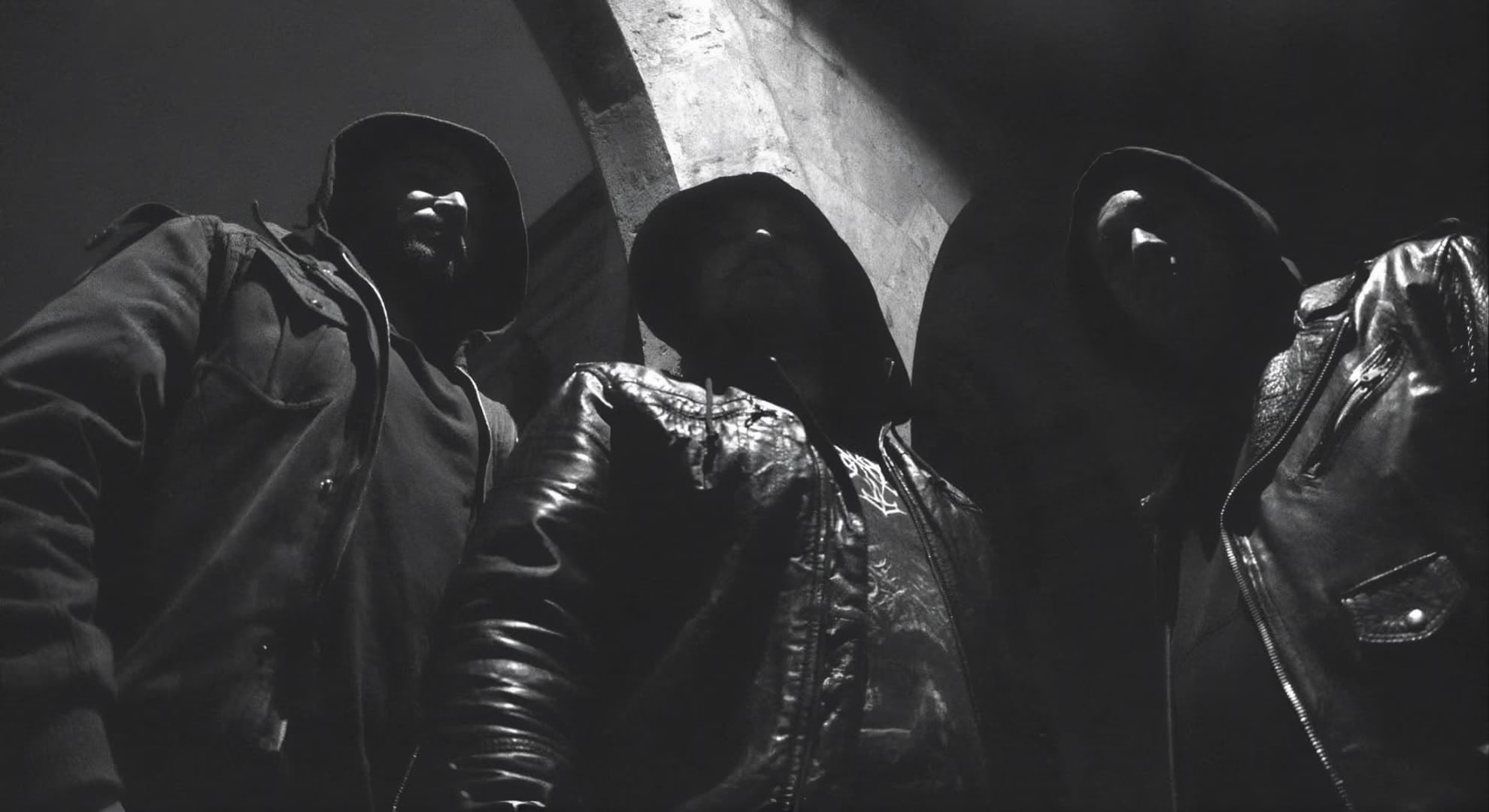
Into that specific framework of guilt, abandonment, and cosmic reckoning, the Athens black metal project Ambrotos has built its second full-length album, ‘Atrocious Chants,’ due July 13th, 2026, through a co-release by Satanath Records and WP Productions.
Atoms, Cosmology, and Now God
Ambrotos — the name drawn from the Ancient Greek ἄμβροτος, meaning immortal or belonging to the gods — formed in Athens in 2017. The project’s foundational premise was immediately distinctive within the Hellenic black metal tradition, and distinctly philosophical in orientation.
Where the dominant strand of Greek extreme metal had engaged with pre-Christian mythology, occultism, or the antichristian stance the genre inherited from the Norwegian second wave, Ambrotos turned to pre-Socratic philosophy: the surviving textual fragments of thinkers who predated Socrates by a century or more and who had attempted, through natural-philosophical reasoning rather than theological doctrine, to account for the structure of the cosmos.
Their debut self-titled EP arrived in 2018, followed by ‘Cosmic Annulus’ in 2019. Both established the intellectual seriousness with which the project approached its subject matter. The full-length debut, ‘Transcendental Mastery,’ released on April 13th, 2022, through Satanath Records and co-released by The End of Time Records and Yahuar Mallcu Records, was built explicitly on the surviving fragments of Empedocles, Heraclitus, and Anaximander.
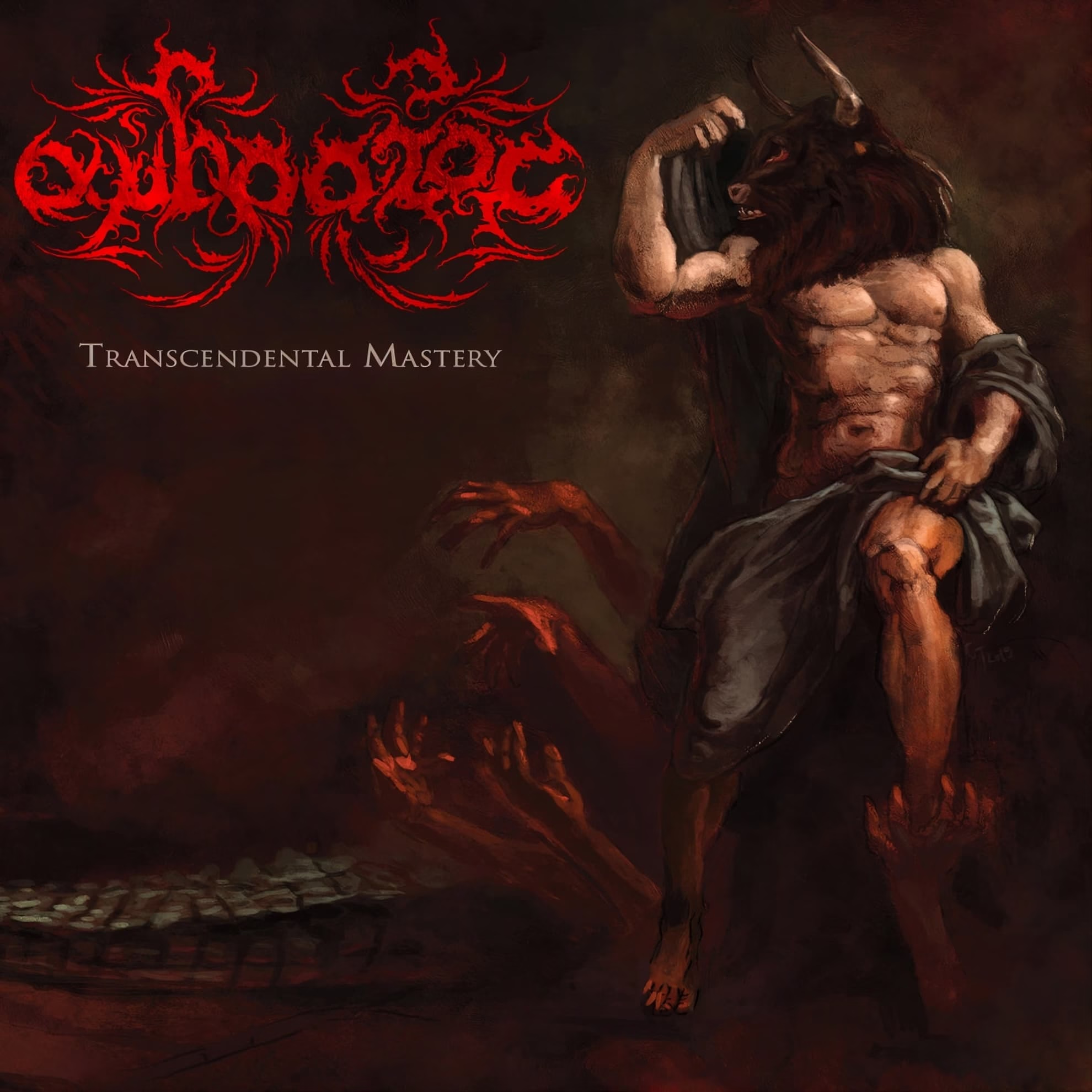
Its cover depicted Empedocles’ cosmological model; its compositions ranged from atmospheric passages to technical and raw black metal, the lyrics drawing directly from the philosophers’ own documented thought. Produced by George Nerantzis — mixed and mastered in Athens — the record established the project’s position within the international underground with recommendations to audiences familiar with Rotting Christ and the broader Hellenic tradition.
The pivot from pre-Socratic cosmology to Byzantine eschatology is less discontinuous than it might appear. Both domains confront the same fundamental problem: how does the cosmos hold together, and what happens when it catastrophically fails to? The pre-Socratics posed that question in natural-philosophical terms — fire, water, the apeiron, the Logos.
The Byzantine theologians posed it in providential ones. The fall of Constantinople forced the second tradition to answer the same question under conditions of empirical disproof so total, so public, and so permanent that no theological response has fully closed the wound.
The Executor of Judgment
‘Atrocious Chants’ is structured as a concept record. Its official documentation places the figure of Satan at its center — but the Satan it invokes is not the Miltonic adversary who rebels against God and tempts humanity toward a parallel sovereignty. The Byzantine theological tradition, which is the specific intellectual context this record inhabits, distinguished carefully between Satan’s role as prosecutorial agent of divine judgment and the Romantic adversarial figure Western metal has predominantly inherited.1
In the Byzantine penitential reading of 1453, Satan functions as the instrument through whom God’s punishment is administered on those who were meant to be His chosen and have forfeited that standing. The catastrophe is not a cosmic rebellion. It is a cosmic settlement of accounts.
That theological register is specific to the Greek Orthodox inheritance and largely absent from the Western Christian traditions that most extreme metal’s imagery draws on. To frame the fall of the last Roman city through it is to engage with a strand of Christian thought that has never fully entered the metal genre’s theological vocabulary — not because the genre has avoided religious themes, but because it has predominantly worked through the Latin and Protestant theological inheritance that came westward with Romanticism rather than the Greek one that stayed in place and watched the city fall.
The ten confirmed track titles map the album’s conceptual arc with precision: ‘Atrocious Chanting,’ ‘Thy Messengers,’ ‘Saint and Sinner,’ ‘Plague,’ ‘From Hyenas to Daemons,’ ‘Strategos,’ ‘The Age of Torture,’ ‘Horned Gods,’ ‘The Black One,’ and ‘Satan Triumphant.’ The title ‘Strategos’ — the Greek term for the Byzantine administrative and military commander of a territorial theme — anchors the historical argument in institutional specificity.2
This is not a medieval allegory applied to the present. It is the specific vocabulary of Byzantine governance and military collapse examined in its own terms, within the register of extreme music.
The opening title, ‘Atrocious Chanting,’ carries a second resonance that rewards attention. The Byzantine liturgical chant tradition — one of the primary cultural institutions the fall of Constantinople disrupted and in subsequent centuries suppressed — was among the most sophisticated sacred music systems the Christian world had produced.
To open a record about that catastrophe with a track named after corrupted or atrocious chanting is to register the destruction of the cultural form alongside the political one: the sacred sound of the city turned atrocious by the moment of its loss.
The Single and Its Evidence
Two advance tracks were publicly available at the time of publication: ‘Thy Messengers,’ the album’s first single, and ‘The Age of Torture,’ premiered on June 3rd, 2026, as the second. The track occupies the album’s seventh position — past the halfway mark of a ten-track sequence — and its placement within the announced running order suggests a record structured as a sustained narrative of accumulation.
The theological framework would be established in the opening tracks; the historical specificity arrived at through the middle sequence; the eschatological conclusions deferred to the record’s final third, where ‘Horned Gods,’ ‘The Black One,’ and ‘Satan Triumphant’ close what ‘Atrocious Chanting’ initiated.
In its audible character, ‘The Age of Torture’ positions the album within the Hellenic black metal tradition as Ambrotos has consistently inhabited it — melodically present and compositionally deliberate, with a vocal approach that works across the genre’s established registers without reducing itself to surface reproduction.
The track title names a documented historical condition: the looting of Constantinople in the days following May 29th, 1453, the enslavement of a substantial portion of its surviving population, and the systematic dismantling of an ecclesiastical infrastructure that had defined Greek Orthodox cultural identity for over a millennium. The track does not treat these events as atmosphere. It treats them as the subject.
Athens to Mexico City
The production chain of ‘Atrocious Chants’ is a document of the international underground’s current working geography. The album was pre-produced at Alamos Studios in Athens between 2022 and 2024 — the same facility credited on the debut’s pre-production phase — before being recorded between 2023 and 2025 and then engineered, mixed, and mastered by Leonardo Delgado at Thunderstorm Studio in Mexico City.
Delgado’s background encompasses formal training in audio engineering and composition in Mexico City, and his studio work spans extreme metal production within the Latin American underground. The prior album’s final stages were handled entirely in Athens by George Nerantzis, whose documented credits include work with Abbath and Dark Funeral.
The choice to send ‘Atrocious Chants’ to a Mexican studio for its final form represents a structural change in the record’s production geography: a Greek album about a Byzantine catastrophe finished in a city that was itself the capital of a civilization the Spanish crown dismantled in 1521, thirty years after the fall Ambrotos is addressing. The parallel is not argued by the band. It does not need to be.
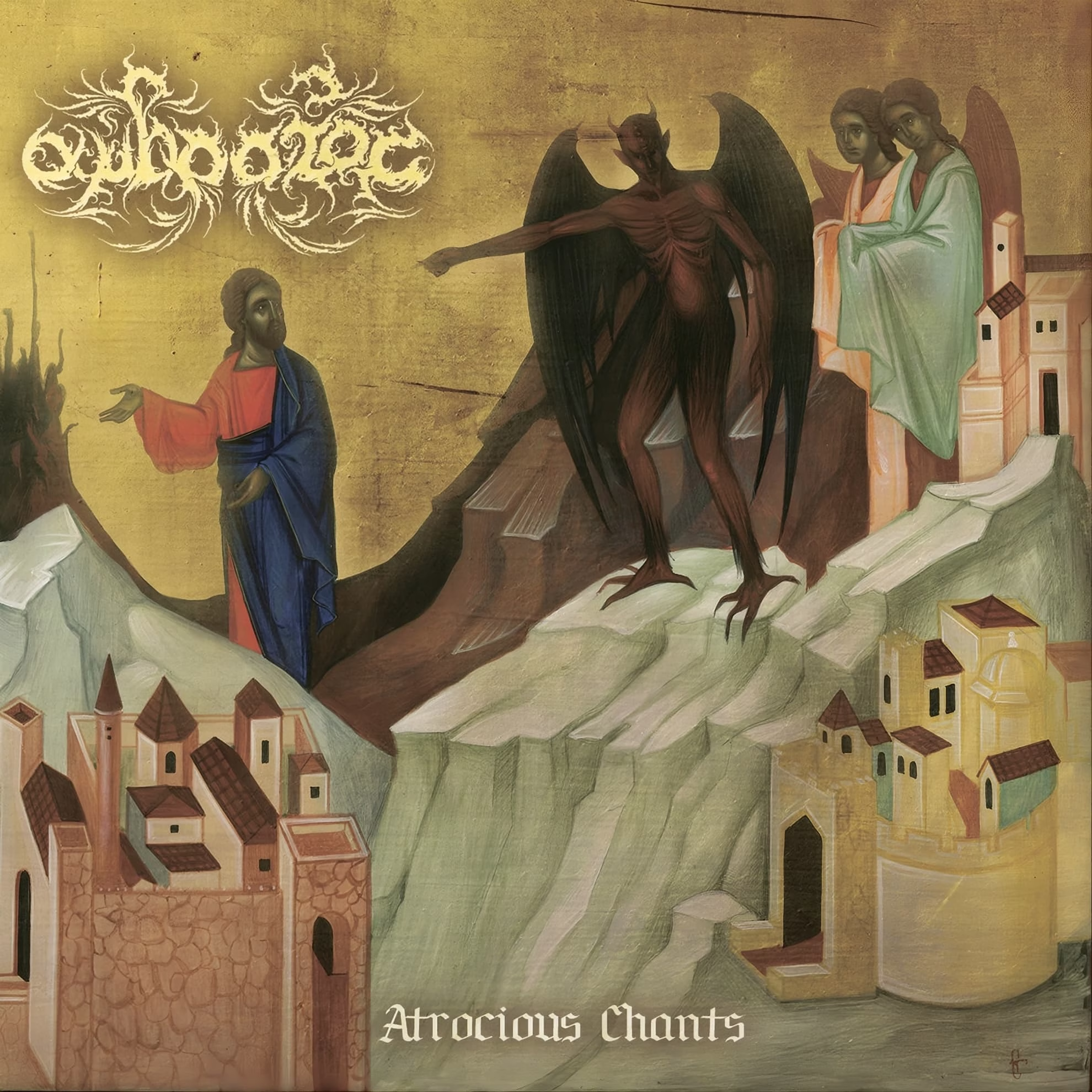
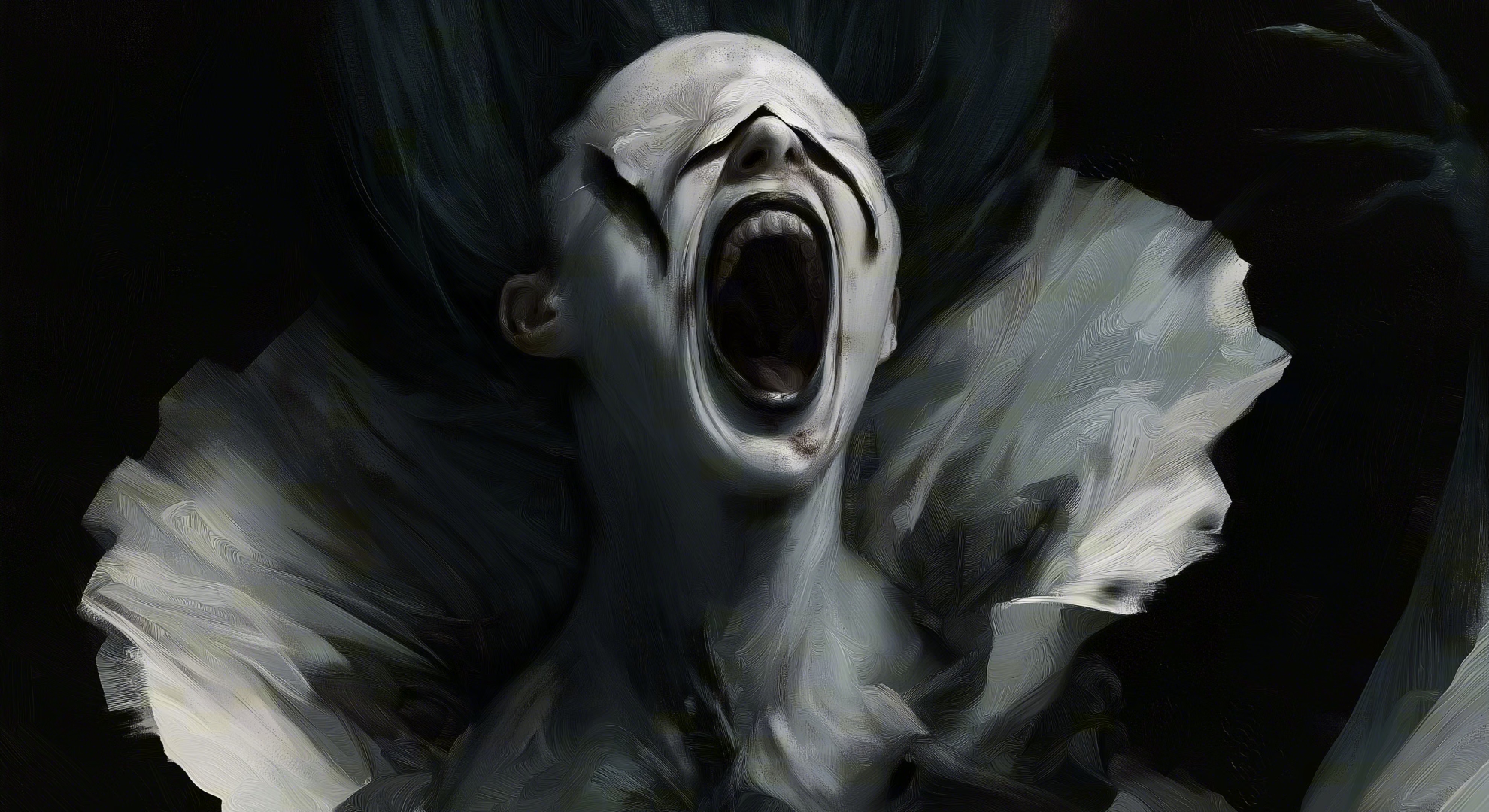
The cover painting is by Athens-based painter Fanis Goulis, working within the Byzantine icon tradition — gold ground, hierarchical figuration, the Satan-Christ confrontation placed above a walled city rendered in the flattened perspective of medieval icon painting. The image does not merely illustrate the album’s subject. It performs it: the visual conventions of Byzantine sacred art turned to frame a record that treats the moment those conventions were subordinated to a different power.
The Hellenic Tradition It Deepens
Ambrotos operates within a Greek black metal tradition that is among the most formally coherent of any national extreme metal scene. Rotting Christ, founded in Athens in 1987, and Varathron, formed in Larissa the following year, established a sonic vocabulary that combined the Norwegian second wave’s rawness with a Mediterranean melodic sensibility and a sustained engagement with pre-Christian Greek religion and the occult traditions that survived the Christianization of the ancient world.3
What distinguished the Hellenic tradition from its Scandinavian contemporary was a different relationship to antiquity — not as nationalist romanticism, but as genuine cultural inheritance, mediated through the Eastern Orthodox Church and the unbroken presence of the Greek language from the pre-Socratics through the Byzantine centuries and into the present.
For Ambrotos to move from pre-Socratic philosophy to Byzantine theology is not a departure from that inheritance but a deeper entry into it. The same cultural continuity that runs from Empedocles through Plato, through the Fathers of the Church, through the Byzantine chroniclers, and into the Orthodox liturgical tradition is the unbroken thread that makes this thematic pivot internally coherent rather than arbitrary.
The band is not borrowing Byzantine aesthetics from outside. It is turning within its own documented cultural inheritance toward a chapter that the Hellenic extreme metal tradition has, until now, left largely untouched.
The Hellenic tradition’s documented capacity for formally ambitious conceptual work — its willingness to engage with historical and philosophical material in sustained lyrical frameworks, its melodic richness, and its less dogmatic relationship to the genre’s rawness conventions — is precisely what ‘Atrocious Chants’ requires.
A record organized around a sustained theological argument about a specific historical catastrophe needs a tradition that can hold that argument across ten tracks without compressing it into slogan or spectacle.
Satanath and the Underground Circuit
Satanath Records, the Georgian label that has co-released every Ambrotos recording since the debut album, has built one of the more geographically dispersed catalogs in the underground extreme metal world. Its releases encompass acts from Greece, Ireland, Peru, Germany, Cyprus, Italy, the United Kingdom, and beyond, distributed through international shipping and through the Bandcamp infrastructure that functions as the primary direct-access point for underground releases outside the mainstream streaming ecosystem.
The ‘Atrocious Chants’ co-release with WP Productions of the Netherlands extends that distribution network westward into continental Europe’s established extreme metal market.
The format is a jewel box CD, limited to 500 copies, with a 12-page booklet. Pre-order is available through the Satanath Records Bandcamp page. That physical format — small pressing, booklet included, direct Bandcamp access — is the standard configuration of the international underground’s collector distribution logic: enough copies to reach dedicated listeners in multiple markets, a booklet that rewards close reading of the lyrics, and a digital access point for audiences whose local markets make import costs prohibitive.4
The Weight That Does Not Close
Nine years after its formation, and four years after a debut that established its intellectual credentials within the international underground, Ambrotos arrives at the most formally ambitious subject it has yet attempted. The fall of Constantinople on May 29th, 1453, is not merely a historical event available for appropriation as metal imagery. It is the moment at which a civilization’s foundational theological claim — that God would protect His chosen city — was falsified by an empirical fact of such totality that the tradition has never fully absorbed it.
The penitential response it generated — the fault lies with the people, not the promise — produced a theology of collective guilt whose resonances ran through Greek Orthodox thought for centuries, and whose unresolved character makes it available to music in a way that settled history is not.
‘Atrocious Chants’ arrives on July 13th, 2026, through Satanath Records and WP Productions. For the international underground audience that will encounter it through Bandcamp pre-orders and the collector circuits the label has built across multiple continents, it offers something the genre rarely delivers with this degree of historical precision: a sustained theological argument about a catastrophe that changed the shape of the Christian world, conducted in the sonic tradition of the civilization that experienced it, finished in a studio on another continent that has its own account of civilizational rupture to reckon with.
Whether the full sequence sustains the structural ambition its announced architecture implies, July 13th will answer. The premise alone has not been attempted before.
To those who value extreme music for its capacity to formally manifest grief, institutional collapse, and theological disillusionment: how does a black metal concept album centered on the fall of Constantinople confront you? Is it experienced as historical exposition, as eschatological art, or as a structural evolution that the genre has yet to name?
References
- Cyril Mango, ‘Byzantium: The Empire of New Rome’ (London: Weidenfeld and Nicolson, 1980), 201–207. On the theological self-understanding of the Byzantine state and the providential logic underpinning its claim to divine protection. ↩︎
- Jonathan Shepard, ed., ‘The Cambridge History of the Byzantine Empire c. 500–1492’ (Cambridge: Cambridge University Press, 2008), 788–794. On the administrative structure and military governance of the late Byzantine Empire, including the strategos system in its final phase. ↩︎
- Anthony Kaldellis, ‘Hellenism in Byzantium: The Transformations of Greek Identity and the Reception of the Classical Tradition’ (Cambridge: Cambridge University Press, 2007), 42–48. On the continuity and transformation of Greek cultural identity across the Byzantine centuries and its relationship to classical inheritance. ↩︎
- Stephen Graham, ‘Sounds of the Underground: A Cultural, Political and Aesthetic Mapping of Underground and Fringe Music’ (Ann Arbor: University of Michigan Press, 2016), 54–60. On the distribution logic of underground music labels and the collector communities they sustain across international markets. ↩︎

Leave a Reply