
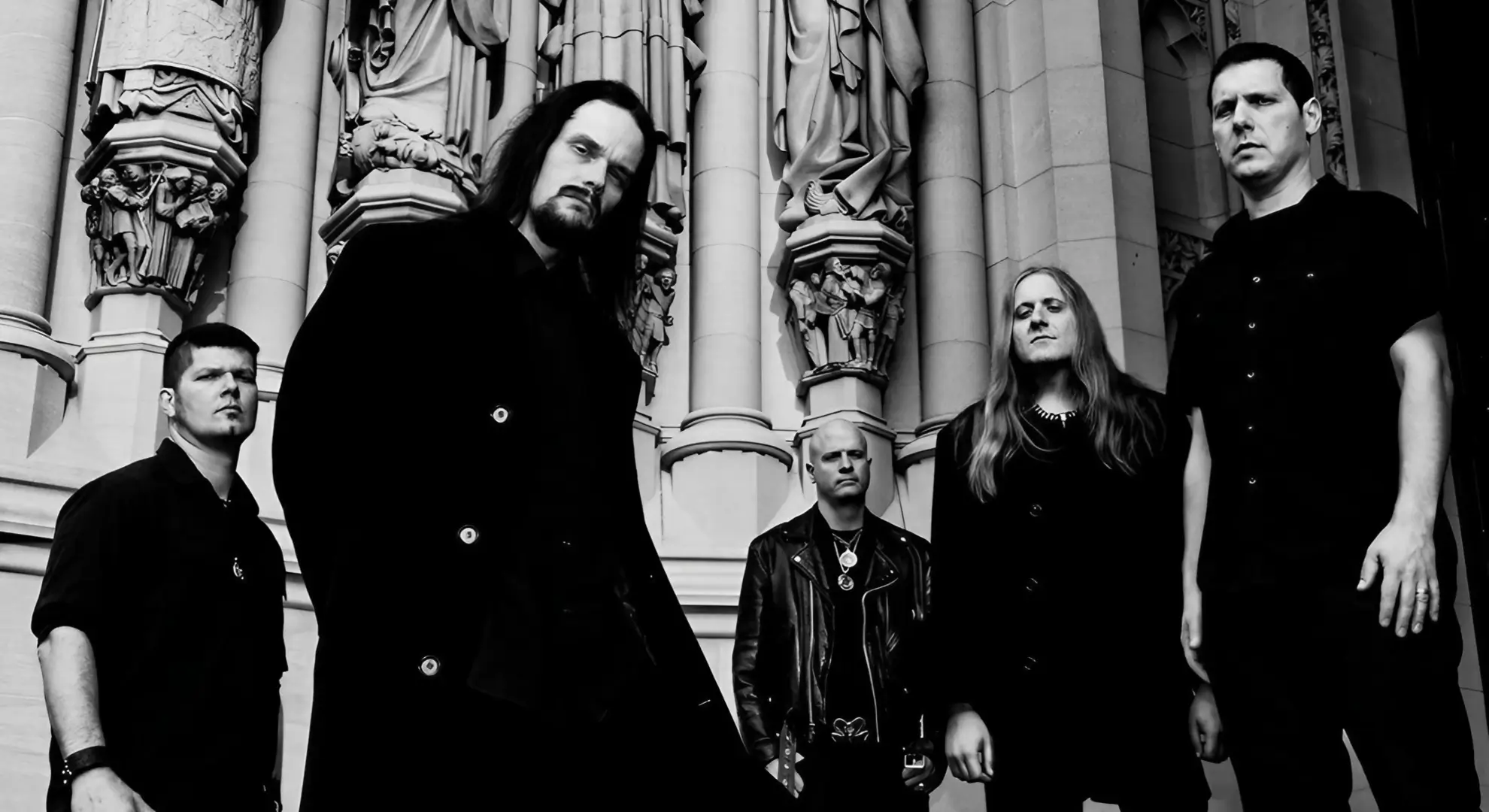


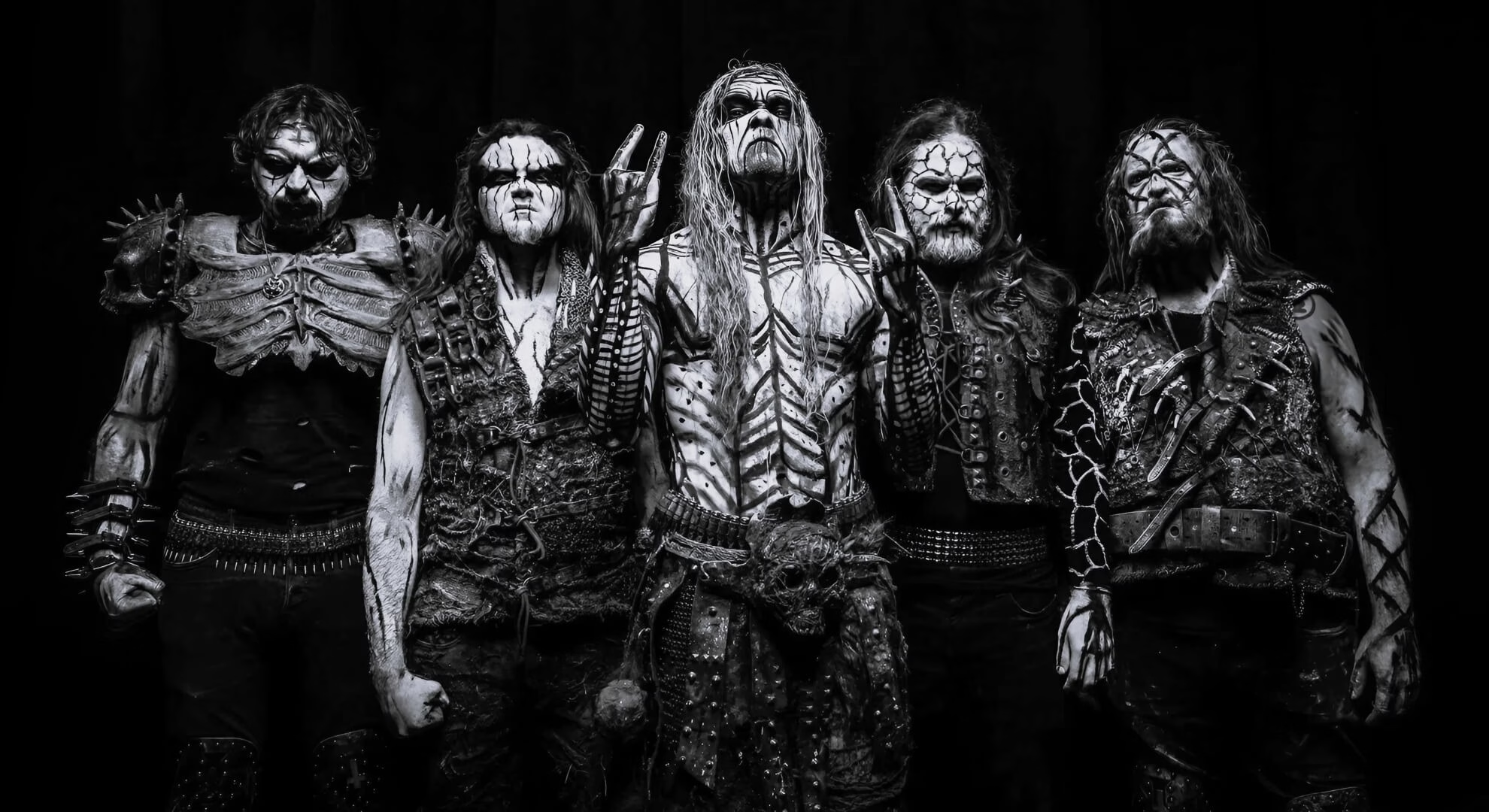
For three decades, the New Jersey-based quintet Evoken has been a pillar of the American funeral doom scene, composing long, arduous pieces that are at once punishing and strangely beautiful. Their music acts as a kind of temporal distortion, using extreme slowness, heavily down-tuned guitars, and cavernous vocals to pull the listener from the frantic pace of modern life into a state of deep contemplation. Vince Verkay, the band’s drummer and a founding member, said in an interview that he uses the band as a vessel for his own “anger and depression,” and hopes listeners find a similar “solace” in the sound.
Now, after a seven-year silence, Evoken is preparing to release its seventh full-length album, ‘Mendacium,’ on October 17. For the band’s cloistered but dedicated following, the announcement marks a significant event. The new work promises to be one of their most severe yet: a deliberate and uncompromising exploration of psychological and spiritual collapse.
Evoken: A North American Book of the Dead
This deliberate regression to an earlier sound is not the act of a band repeating itself, but of a mature artistic entity making a profound statement about its own identity. It is a choice that can only be understood in the context of Evoken’s long and unwavering artistic journey.
The band’s story begins in Lyndhurst, New Jersey, in 1992, under the name Funereus. After brief periods as Asmodeus, the members settled on the name Evoken in 1994, a name taken from a song by the seminal Finnish funeral doom band Thergothon. This choice of name was a declaration of intent, aligning them from their earliest days with the very progenitors of this nascent, extreme form of music.
Their 1998 debut album, ‘Embrace the Emptiness,’ immediately established them as a formidable presence, a band that expertly bridged the gap between the established forms of doom death metal and the even slower, more atmospheric nascent style of funeral doom. But it was the two albums that followed which would cement their reputation and become the sonic touchstones to which ‘Mendacium’ is now being compared.
‘Quietus’ (2001) and ‘Antithesis of Light’ (2005) are considered by many to be masterpieces of the genre, works of almost unbearable weight and suffocating atmosphere. They are meticulously constructed voyages into darkness, where dissonant melodies, cavernous production, and John Paradiso’s inhumanly deep vocals combine to create a sound that is both terrifying and hypnotic. These albums were not just collections of songs; they were fully realized worlds of despair.
In the years that followed, with albums like ‘A Caress of the Void’ (2007) and ‘Atra Mors’ (2012), the band continued to refine and explore their sound, never straying from their grim purpose. Their most recent work before the current one, ‘Hypnagogia,’ represented a new kind of exploration. It was their first official concept album, a harrowing narrative set in the mind of a dying soldier in the trenches of World War I, and it saw the band incorporating more melodic and experimental passages, including a startlingly clean choral section in one song, “Ceremony of Bleeding.” It was the sound of a band pushing at the edges of their self-imposed boundaries.
The announcement of ‘Mendacium,’ therefore, is so compelling because it is a direct and forceful response to that period of experimentation. It is a conscious rejection of any move toward accessibility, a doubling down on the harshest, most oppressive elements of their sound. After three decades of building their cathedral of gloom, Evoken has decided to return to the foundation, to re-examine the stones that gave the structure its terrifying integrity and to build something even darker upon them.
The Bulletin
Subscribe
Subscribe today and connect with a growing community of 613,229 readers. Stay informed with timely news, insightful updates, upcoming events, special invitations, exclusive offers, and contest announcements from our independent, reader-focused publication.
A Prayer in Eight Parts: The Austerity of ‘Mendacium’
The new album, ‘Mendacium,’ is built on an ambitious and austere concept. Its narrative follows an elderly Benedictine monk in the fourteenth century who is confined to his room by a wasting illness. As his physical suffering robs him of sleep, his steadfast devotion is tested by the appearance of a “hideous entity” that seems to emerge from a tear in reality itself. The central question of the story is whether the monk’s torment is the work of an external demon or a projection of his own disintegrating mind.
This psychodrama is structured around the eight canonical hours of the “Divine Office,” the cycle of prayer that has ordered monastic life for centuries. The track titles—‘Matins,’ ‘Lauds,’ ‘Prime,’ ‘Terce,’ ‘Sext,’ ‘Nones,’ ‘Vespers,’ and ‘Compline’—lend an ancient piety to the album. But the framework is ironic: a structure meant to provide spiritual solace is used here to chronicle its complete unraveling. Each prayer marks not a step toward comfort but a deeper descent into torment.
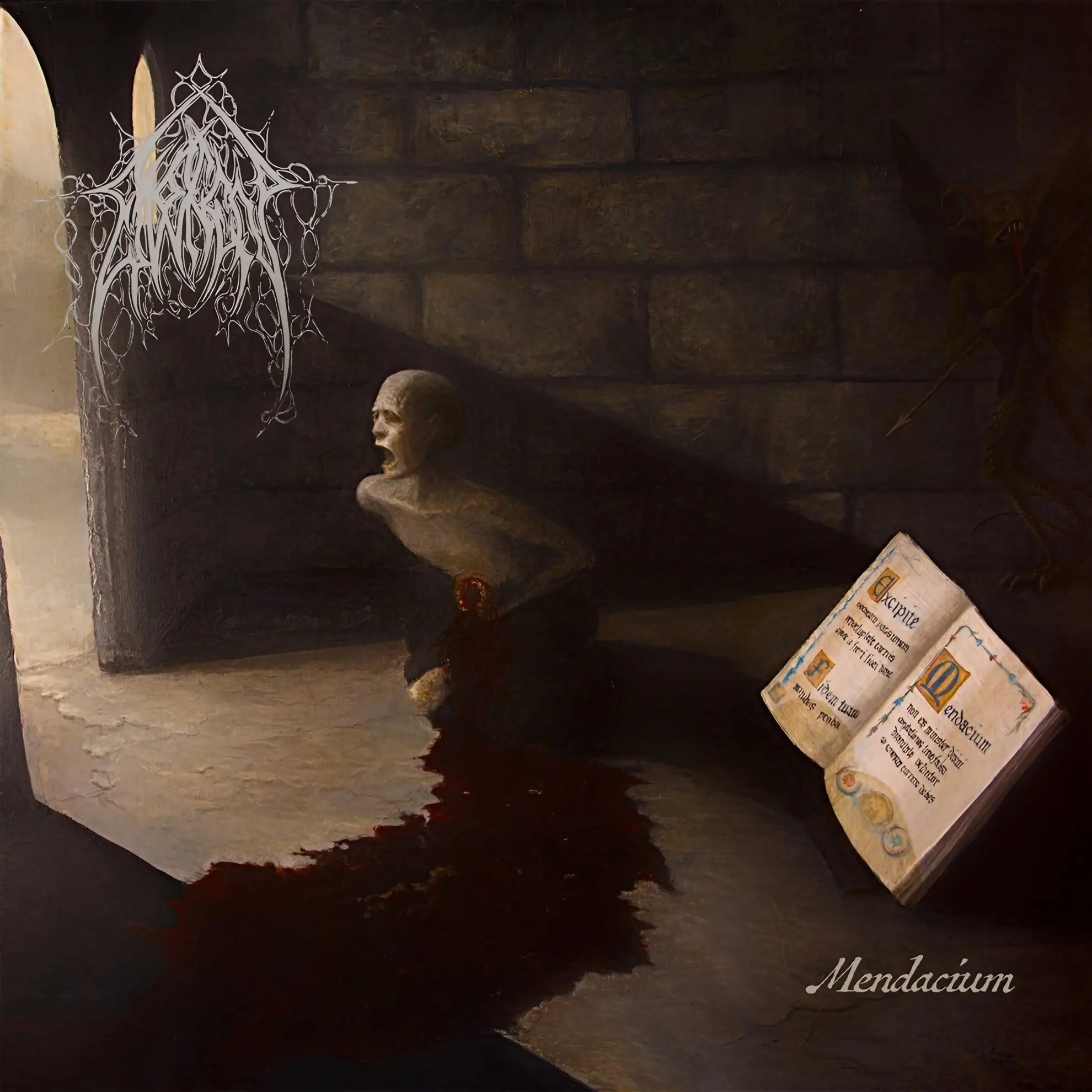
The tension between the album’s form and its content is its primary engine. The title, ‘Mendacium’—Latin for “lie” or “falsehood”—implies that the foundation of the monk’s world is a deception. His faith is rendered a potential fiction, his reality thrown into question.
A quote from Seneca, shared by the band with the album’s announcement, sharpens the point: “Religion is regarded by the common people as true, by the wise as false, and by rulers as useful.” The album is therefore not just the story of a crisis of faith, but a sonic exploration of a world where the sacred has become profane.
To realize this vision, Evoken made a decisive sonic choice. The band’s previous album, ‘Hypnagogia’ (2018), had a more melancholic and arguably more accessible sound. With ‘Mendacium,’ they have returned to the “monumental dirge-like dread and woeful catacombic and disharmonious heaviness” of their earlier, formative works, specifically ‘Quietus’ (2001) and ‘Antithesis of Light’ (2005).
To that end, the band reunited with the producer Ron “Bumblefoot” Thal, the engineer who helped shape the sound of those two definitive albums. The stated goal, the band said, was to create a “sepulchral heaviness saturated in ambience,” making it the most powerful recording of their career.
The First Toll: A Glimpse into ‘Matins’
The first piece of evidence for ‘Mendacium’’s austere vision is its opening track and lead single, ‘Matins.’ The song, an audio release just shy of ten minutes, is the first of the canonical hours, the prayer that begins the monastic day. The choice to introduce the album with this piece is a masterstroke of thematic irony. A prayer for the morning, a time associated with light and renewal, is rendered as an exercise in “unremitting darkness,” a sound described by one observer as a pure “abyss.”
The music itself is a slow, methodical descent. It is the sound of the album’s promise being fulfilled: a monumental, dirge-like dread that offers no quarter. The band’s own statement on the track is characteristically cryptic: “‘Matins’ is a peek into a reality.”
The reality it reveals is the one at the album’s conceptual heart—a world where the rituals of faith are hollow, where the first prayer of the day is not an ascent toward grace but the first step in a torturous cycle of suffering. It immediately establishes that for the monk at the story’s center, there will be no dawn. The first toll of the bell is a summons to despair, the opening salvo in an album-length exploration of a faith that has become a prison.
A Geography of Despair: Forging a Scene in a Land of Speed
For the uninitiated, the sound of funeral doom metal can be a punishing listen. A subgenre defined by its glacial tempos and dirge-like compositions, its stated goal is to evoke a sense of profound dread, plumbing the depths of human suffering, grief, and fear. Yet for a small but devoted global following, the music offers not misery, but a form of catharsis.
In this controlled environment of extreme sound, adherents find a strange solace, a place to confront emotions often suppressed in daily life. Studies on the psychological effects of extreme music support this paradox, suggesting that for fans, it provides a powerful outlet for processing anger that can lead to an increase in positive emotions. The music, according to one academic paper, creates a space for “the ponderous, measured and reflective life in metal.”
The severity of Evoken’s music is made all the more stark by its geographical origins. Funeral doom was, by most accounts, born in Finland in the early to mid-1990s, with bands like Thergothon and Skepticism setting the template. The European expression of the genre often drew from the gothic and romantic sensibilities of British bands like Paradise Lost and My Dying Bride, frequently employing funereal keyboards and a kind of poetic, melancholic atmosphere.
North America, a culture predicated on speed, optimism, and forward momentum, was and remains infertile ground for a musical form defined by its opposite qualities. The North American tradition of doom metal, stretching back to pioneers like Pentagram and Saint Vitus, had its own distinct character, as did the country’s particularly brutal strain of death metal, exemplified by bands like Autopsy and Winter.
When Evoken emerged, they did not simply import the Finnish sound. They forged a hybrid, an articulation of despair that felt distinctly North American. They, along with a very small handful of contemporaries like Rigor Sardonicous, are consistently cited as the architects of the North American scene.
Their music married the glacial tempos and atmospheric ambitions of their European forebears with the sheer, punishing sonic weight and visceral aggression of North American death metal. The result is a sound that is often less ethereal and more physically crushing, a despair that feels less like a ghostly haunting and more like the slow, inexorable pressure of a collapsing building.
It is a sound that exists in profound opposition to its cultural surroundings, a monument to slowness in a land obsessed with velocity. As such, it has always been destined to exist on the margins, a “tiny little subgenre” for a “reclusive” but dedicated audience that has no interest in commercial acceptance.
Conclusion
As the release date of October 17, 2025, approaches, the anticipation within the band’s devoted following is palpable. A new album from Evoken is an event, and so too are their live performances. The band does not tour in the conventional sense; their appearances are rare and carefully chosen, which only enhances their cult status.
A performance at the Maryland Deathfest in Baltimore this past May was a pilgrimage for many. Accounts of their live shows describe an attempt to meticulously recreate the immersive, suffocating atmosphere of their recordings, with audiences often standing in rapt silence, eyes closed, completely absorbed by the sound. These are not concerts in the typical sense; they are communal rituals of endurance and introspection.
And that, ultimately, is the purpose of this difficult, demanding music. The story of the tormented monk in ‘Mendacium’ is an allegory for a universal human experience: the confrontation with despair in isolation. Against a backdrop of perpetual distraction, manufactured comfort, and relentless positivity, Evoken offers something far more challenging and, perhaps, more valuable.
Their music does not offer an escape from the darkness. It creates a vast, resonant, and strangely beautiful space in which to face it. It is an art form that validates the reality of suffering and, in doing so, provides the profound solace that can only come from knowing one is not entirely alone in the void. It is a radical act of empathy disguised as a symphony of dread. The congregation gathers not for entertainment, but for a shared, difficult, and ultimately affirming communion.
Support
Independent
Journalism
Fund the voices Behind Every Story
Every article we publish is the product of careful research, critical reflection, and stringent fact-checking. As disabled individuals, we navigate this work with unwavering dedication, poring over historical records, verifying sources, and honing language to meet the highest editorial standards. This commitment continues daily, ensuring a consistent stream of content that informs with clarity and integrity.
We invite you to support this endeavor. Your contribution sustains the work of writers who examine their subjects with depth and precision, shaping narratives that question assumptions and shed light on the overlooked dimensions of culture and history.
Donations are processed through an in-kind sponsorship model powered by Paymattic—a secure, reliable donations plugin that enables direct support for our ongoing editorial work.
Leave a Reply