

For most of the twentieth century, the physical remove of the Australian continent set the terms on which its music met the rest of the world. A record pressed in Melbourne reached a listener in Oslo or São Paulo weeks late, if at all, carried by post and word of mouth rather than by proximity. Distance there was not a metaphor; it was a condition that shaped what got made and how far it could travel.
Extreme metal turned that condition to its advantage. The isolation that once slowed Australian music to a crawl became, by the nineties, part of why the country produced some of the most uncompromising heavy bands on earth, answerable to no nearby scene and no local expectation. It is from inside that inheritance that a Melbourne trio prepares its second full-length under a name borrowed from the oldest bargain in European letters.
‘Parable of the Sewer,’ the second album by Faustian, is released on July 24th, 2026, through the English label Apocalyptic Witchcraft. It follows a self-released 2023 debut and reframes three musicians better known for death metal inside the grammar of old-school black metal.
The Distance the Music Had to Cross
The remove that defined Australian cultural life has a name in the country’s own historiography. The historian Geoffrey Blainey argued that sheer distance — from Europe, from markets, from one settlement to the next — was the single force that most shaped Australian development.1 Heavy music inherited that geography wholesale.
What travels out of Australia has always had to be worth the freight. The severe death-metal and blackened bands that carried the country’s name into the global underground, Portal among them, did so by being too extreme to ignore rather than by being conveniently near. Faustian belongs to that same logic, even as it turns from death metal toward a colder idiom.
A Black Offshoot of a Death Machine
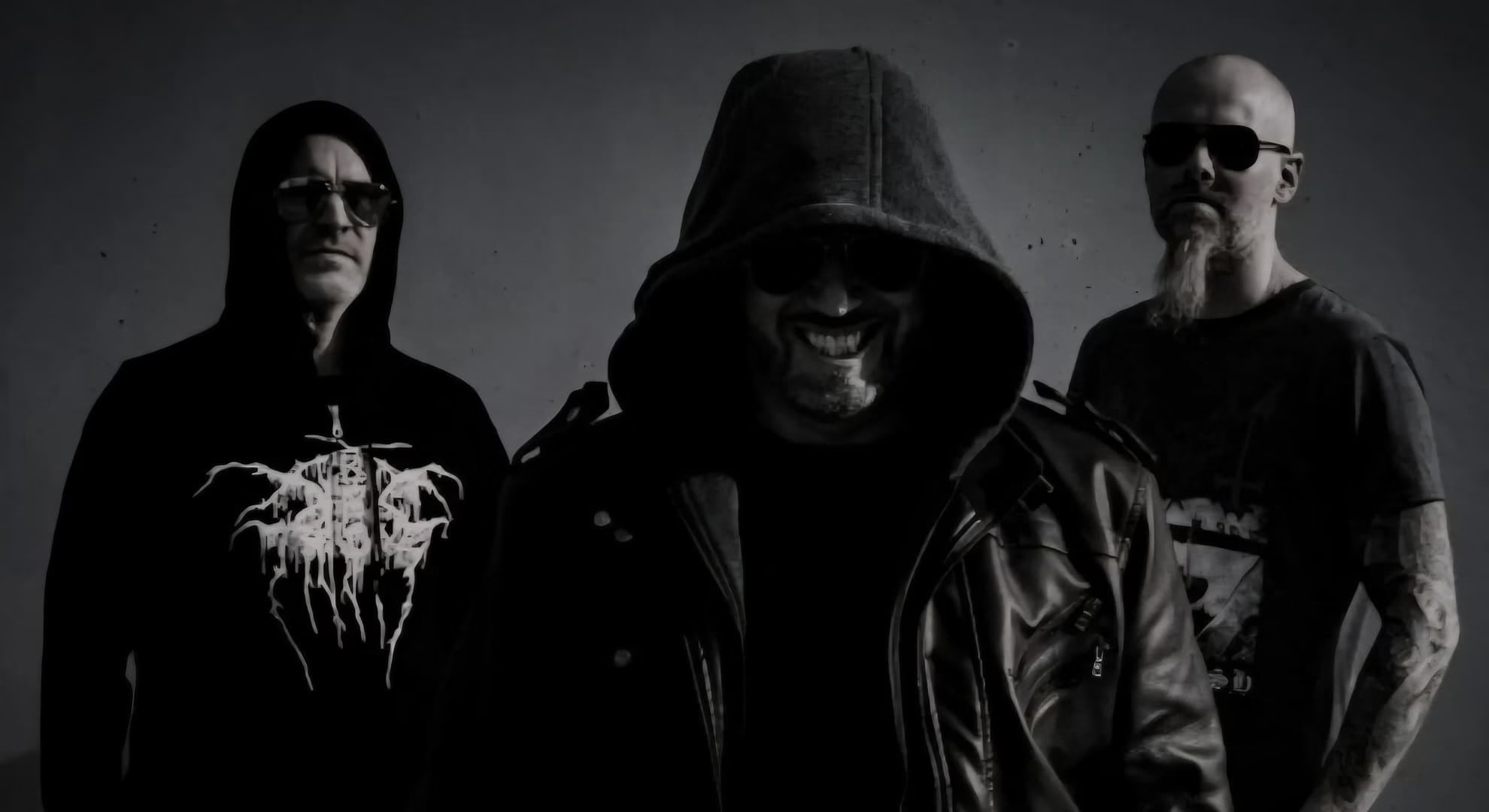
Faustian is the black-metal work of three men whose usual trade is violence of a different kind. Bassist and vocalist Sam Bean, guitarist Matt Wilcock, and drummer Dave Haley are the core of Werewolves, the Australian death-metal band whose output has run at an almost punishing rate. Between them they also hold credits in The Berzerker, The Amenta, Abramelin, The Antichrist Imperium, and Psycroptic.
Scholarship on extreme metal has long insisted that its severity is a considered aesthetic rather than mere noise, a form whose extremity is the point and not a failure of craft. Michelle Phillipov made that case directly, treating death metal as a music that rewards close attention on its own terms.2 The members of Faustian have spent two decades inside that proposition.
The band framed its own purpose in blunt contrast to the parent group. As Wilcock put it, “if the Werewolves aesthetic is violence, then Faustian’s is fear and horror.” The distinction is not cosmetic. Where Werewolves pursues speed and force, Faustian pursues dread.
That intent produced ‘We Come As Angels,’ seven tracks self-released on November 25th, 2023, and recorded across the shutdowns of 2021 and 2022. It circulated without a label, on the strength of the players’ names. ‘Parable of the Sewer’ is the first Faustian record to reach the wider underground through an established imprint.
The Benchmark Set in Scandinavia
Faustian measures itself against a specific tradition, and names it without hedging. Bean described the ambition in terms any second-wave listener would recognize: “If Werewolves is us trying to compete with ‘Panzer Division Marduk,’ then Faustian is our attempt to outdo ‘Anthems To The Welkin At Dusk.’” The reference points are Marduk’s velocity and Emperor’s grandeur, both Scandinavian, both drawn from the nineties.
That the aim is stated in Nordic terms is itself the point. The idea of the North — frostbitten, severe, remote — has functioned less as a place than as an aesthetic promise that black metal bands the world over reach toward. Karl Spracklen has written about how metal reimagines place and identity around exactly that kind of imagined geography.3
For an Australian band, the gesture carries a particular charge. Wilcock has cited Marduk and Satyricon as touchstones; Bean leans toward Anaal Nathrakh and Portal; Haley toward the oldest, most frostbitten Immortal. The record reaches for a Scandinavian severity from the opposite pole of the globe, and does not pretend the distance away.
Two Singles and Their Evidence
Two tracks preceded the album. ‘Broken Better,’ issued first with a visualizer, was the band’s opening statement of mood; ‘I Curse You’, released next with a lyric video, doubles as the album’s opening track.
The pair sets the record’s terms without exhausting them. ‘Broken Better’ points toward the slower, more suffocating end of the band’s range, while ‘I Curse You’ positions the album’s front edge as fast and unrelenting. Together they suggest a sequence built on the alternation of dread and assault rather than a single register held throughout.
Production and mixing credits for ‘Parable of the Sewer’ had not been confirmed through official sources at the time of publication, and the recording studio was likewise unnamed in the available materials. What is confirmed is the shape of the release: eight tracks, running from ‘I Curse You’ to the closing ‘The Rot Shall Inherit The Earth.’
The Sewer and the Rot
The album’s governing image is filth, decay, and what survives in the dark beneath a city. Titles such as ‘Cephalophore,’ ‘We Do Not Use Names Here,’ and ‘Tenements (Only The Wicked Walk In Circles)’ point toward a world of ruin and profane secrecy rather than the folkloric cold of the Nordic tradition it admires.
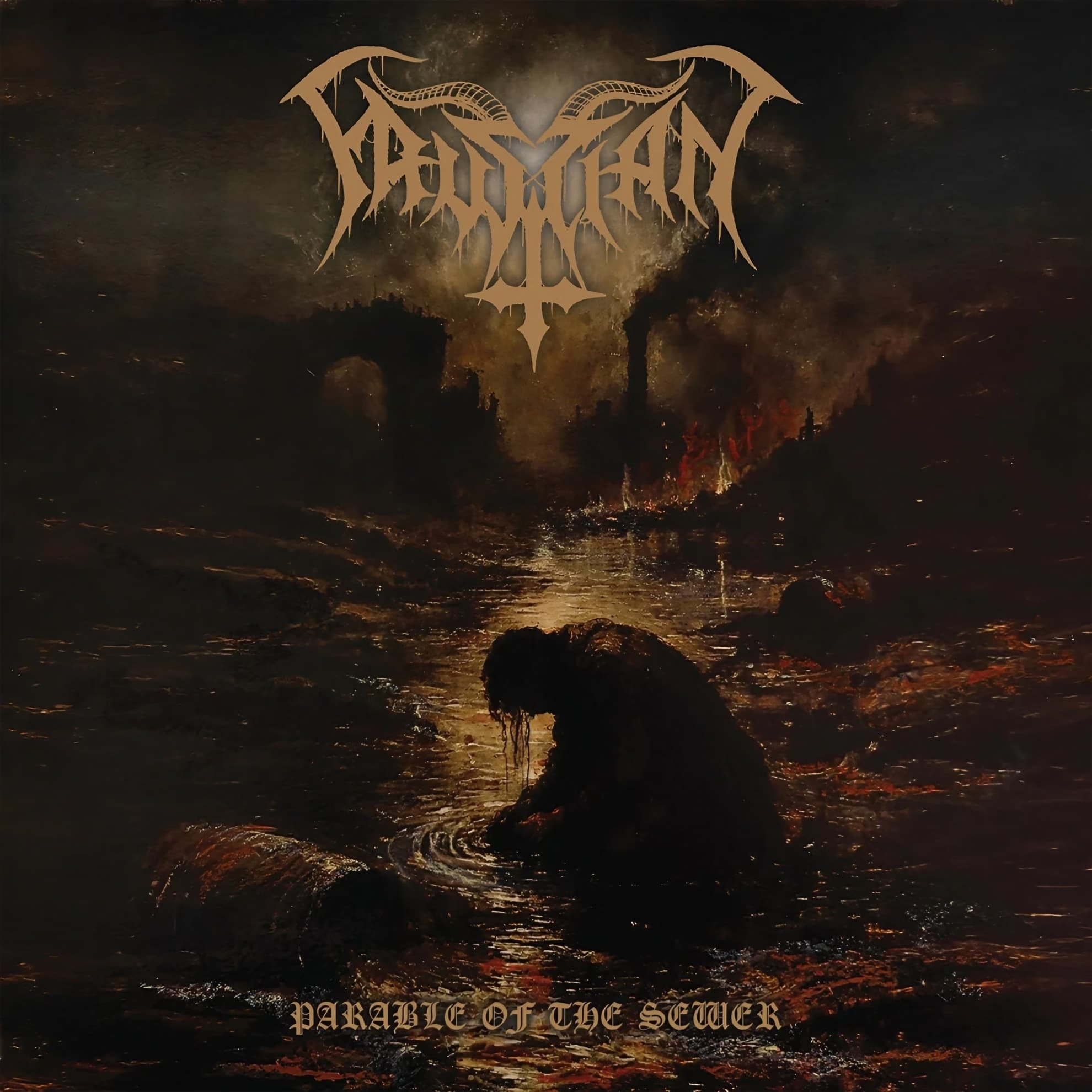
That preoccupation has a long theoretical pedigree. Julia Kristeva located horror in the abject — the waste, the corpse, the filth the self expels in order to remain a self — and argued that what disgusts us marks the border of the human.4 A record named for a sewer and closing on ‘The Rot Shall Inherit The Earth’ works that border deliberately.
The blasphemy that runs through the band’s stated themes belongs to the same order. Faustian treats occult and profane imagery not as decoration but as the material the songs are made from.
The Underground It Reaches
Apocalyptic Witchcraft, the English independent founded in 2015 that now issues the band’s work, sits on the far side of the world from Melbourne. The arrangement suits a record whose reach was always going to depend on the network a label provides rather than on local proximity.
‘Parable of the Sewer’ is offered on limited splatter vinyl, digipak compact disc, cassette, and digital download, with direct sale through Bandcamp. For the international underground that follows Australian extreme metal, the physical formats are the point of contact, and the cost of importing them tends to select for the committed rather than the casual listener.
The Horror They Set Out to Make
Faustian began as the darker sideline of a band already known for going too far. On ‘Parable of the Sewer’ the sideline states an ambition of its own, to match a Scandinavian standard set thirty years ago, from a continent that standard never accounted for.
Whether the full sequence sustains the dread its two singles promise is a question only July 24th settles. What the record already establishes is a clear aim: not the violence of the players’ other work, but fear, carried out of Australian isolation toward whoever goes looking for it.
When an album deliberately measures itself against the Scandinavian second wave, does it function as an homage, a challenge, or a distinct creation shaped by geographic isolation? For observers tracking Australian extreme metal from its remote periphery, this remains the defining question.
References
- Geoffrey Blainey, ‘The Tyranny of Distance: How Distance Shaped Australia’s History’ (Melbourne: Sun Books, 1966), 98–104. ↩︎
- Michelle Phillipov, ‘Death Metal and Music Criticism: Analysis at the Limits’ (Lanham: Lexington Books, 2012), 12–18. ↩︎
- Karl Spracklen, ‘Metal Music and the Re-imagining of Masculinity, Place, Identity and Politics’ (Bingley: Emerald Publishing, 2020), 55–61. ↩︎
- Julia Kristeva, ‘Powers of Horror: An Essay on Abjection,’ trans. Leon S. Roudiez (New York: Columbia University Press, 1982), 2–4. ↩︎


Leave a Reply