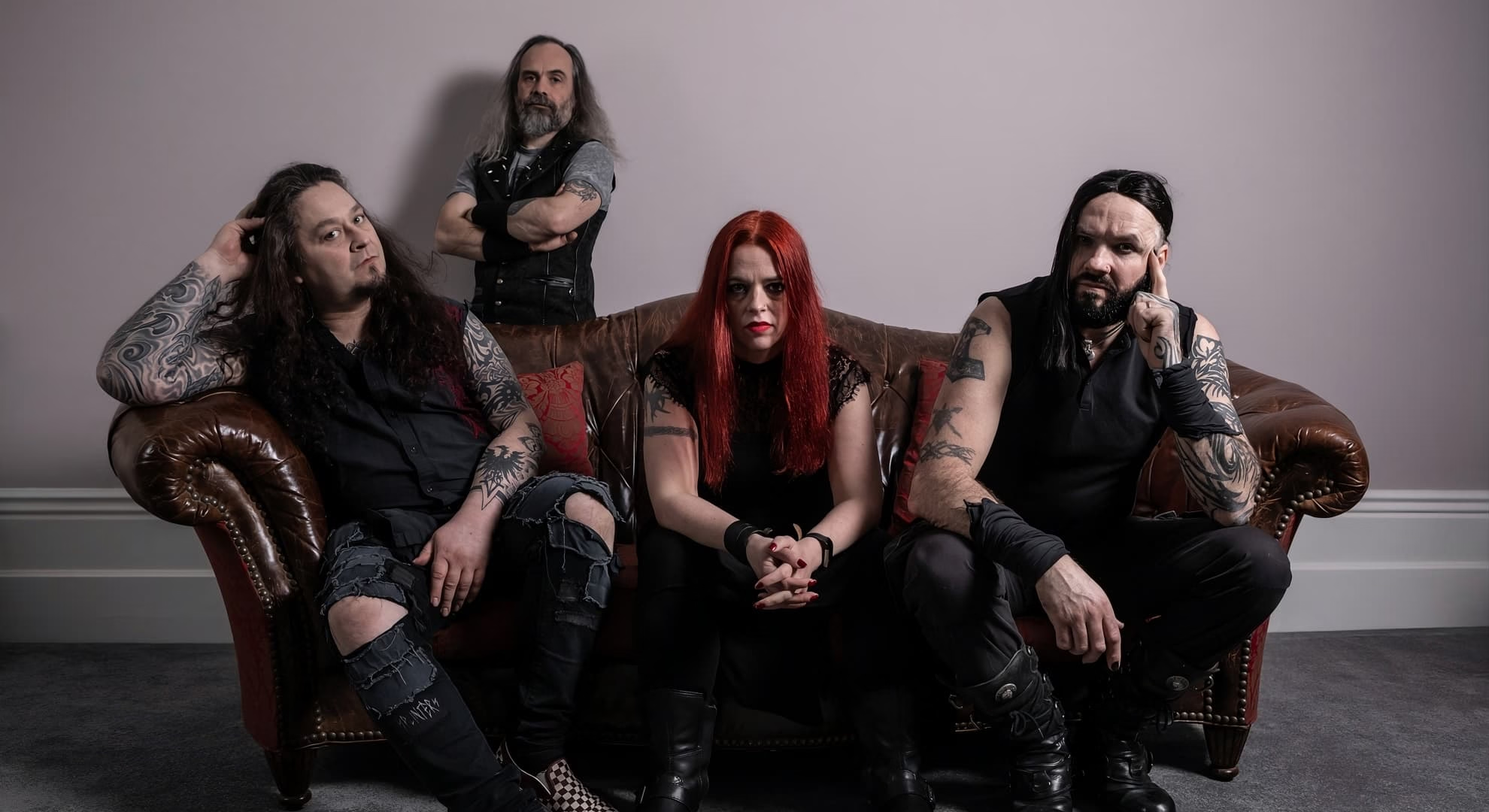


The town of Halifax sits in the upper Calder Valley of West Yorkshire, a landscape of post-industrial millstone grit and moorland that has produced, with consistent stubbornness, some of the darkest music the British Isles have offered since the late eighties. It is not a coincidence that the same topographic severity which informed the early records of My Dying Bride — formed seven miles north in Bradford — runs through the music of Godthrymm, a band whose founding members carry that lineage not merely as influence but as biography.
On May 29th, 2026, Godthrymm released ‘Projections’ via Profound Lore Records, completing the “Visions Trilogy” that began with ‘Reflections’ in 2020 and deepened with ‘Distortions’ in 2023. The trilogy’s formal ambition—a three-volume examination of grief, memory, and interior collapse—is uncommon in any subgenre of extreme metal.1
The Peaceville Thread
The Peaceville Three — My Dying Bride, Paradise Lost, and Anathema — emerged between 1988 and 1990 from the north of England, with Paradise Lost and My Dying Bride rooted in Yorkshire and Anathema formed in Liverpool, and collectively defined gothic doom as a subgenre. Their records on Peaceville Records through the early nineties mapped a specific emotional territory: slow tempos carrying weight rather than aggression, melancholic melody in the service of something closer to mourning than theatrics.
Hamish Glencross is not a student of that tradition. He is a participant in it. His tenure as guitarist for My Dying Bride spanned some of the band’s most formally restless years, from 1999 to 2014, and included work on records that pushed gothic doom toward progressive and orchestral registers. Shaun Taylor-Steels, the band’s drummer, holds comparable pedigree: credited across My Dying Bride and Anathema, the Peaceville tradition runs directly through his hands.2
Godthrymm was formed in 2017. The founding of the band was itself an argument: that the tradition deserved not revival but continuation, carried forward by those who built it.
What the Trilogy Built
‘Reflections’ (2020) introduced the “Visions Trilogy” as a document of inward collapse. ‘Distortions’ (2023) refined the formal premise, earning the band sustained attention as a serious creative force rather than an act of fond remembrance. Each record has functioned as a structured restatement of the same emotional territory: not the same argument made twice, but the same problem returned to with different evidence.
‘Projections’ arrives as the explicit conclusion of that structure. Its six tracks — running to nearly 49 minutes — include ‘Trenches Deep,’ featuring guest vocalists Adie Bailey and Jay Walsh; ‘Endure My Skin,’ featuring Aaron Stainthorpe of My Dying Bride; and the advance singles ‘Truth in My Own’ and ‘Jewels.’
Two Singles, Two Registers
‘Truth in My Own,’ released March 30th, 2026, as the album’s lead single with a video directed by Ash Pears, establishes the record’s aggressive pole. Glencross described it as “the most fist clenching and head banging song on the album,” positioning the track as a direct confrontation rather than the melancholic drift the subgenre more often favors. The track holds Catherine Glencross’s keyboards alongside the guitars without subordinating either, a balance that points toward the expanded lineup’s contribution to the record’s internal range.
‘Jewels,’ released May 18th, 2026, with a video shot and edited by Glencross himself — with Catherine Glencross at the center of the frame — occupies the opposite register. Glencross noted that the track “finds us in a more somber and reflective vibe” and described it as a demonstration of “how we have pushed the dynamics of our sonic palette.” Together the two singles delineate a record whose argument requires both poles to hold.
The Expanded Lineup
Catherine Glencross’s formal addition as keyboardist and co-vocalist represents the most consequential structural change since the band’s formation. The keyboard in the British doom tradition has served two distinct functions: as harmonic coloring in the Paradise Lost manner, and as a vehicle for melodic lead work in the tradition of later Anathema. Catherine Glencross’s presence in ‘Jewels’ positions her contributions closer to the latter.
Bob Crolla on bass and Kris McLaughlin on rhythm, lead, and acoustic guitars complete a five-piece configuration that allows for textural layers the trio format of prior years could not sustain. The recording distributed the work across multiple studios — drums tracked at The Nave Studios by Andy Hawkins, vocals and guitars at Got Rhythm? Studio under Glencross, bass at Sasquatch Studio by Crolla — with Hawkins handling the final mix and Mark Midgley mastering at Northern Mastering Co.3
Stainthorpe and the Bloodline Argument
The guest appearance of Aaron Stainthorpe on ‘Endure My Skin’ carries an argument that cannot be accidental. Stainthorpe has fronted My Dying Bride since the band’s inception in 1990, and his voice is one of the most specifically weighted in the subgenre’s recorded history — a baritone whose phrasing carries the Yorkshire doom tradition as lived practice, not acquired style.
His presence on ‘Projections’ places that tradition inside the record not as citation but as participation. Glencross and Taylor-Steels carrying their My Dying Bride years into the band’s formal identity already makes the lineage argument structural; Stainthorpe’s contribution makes it explicit.
Where the Record Arrives
‘Projections’ is the most texturally layered record in the “Visions Trilogy.” The addition of Catherine Glencross as keyboardist and co-vocalist opens harmonic space the earlier records did not occupy, and the five-piece configuration allows for dynamic shifts — from the concentrated aggression of ‘Truth in My Own’ to the measured gravity of ‘Jewels’ — that a leaner lineup could not sustain.
Grief, which has always been the primary material of this tradition, is rendered here across a wider register than before: not only as weight but as texture, contour, and, in ‘Hope Is Eternal,’ as something approaching stillness.
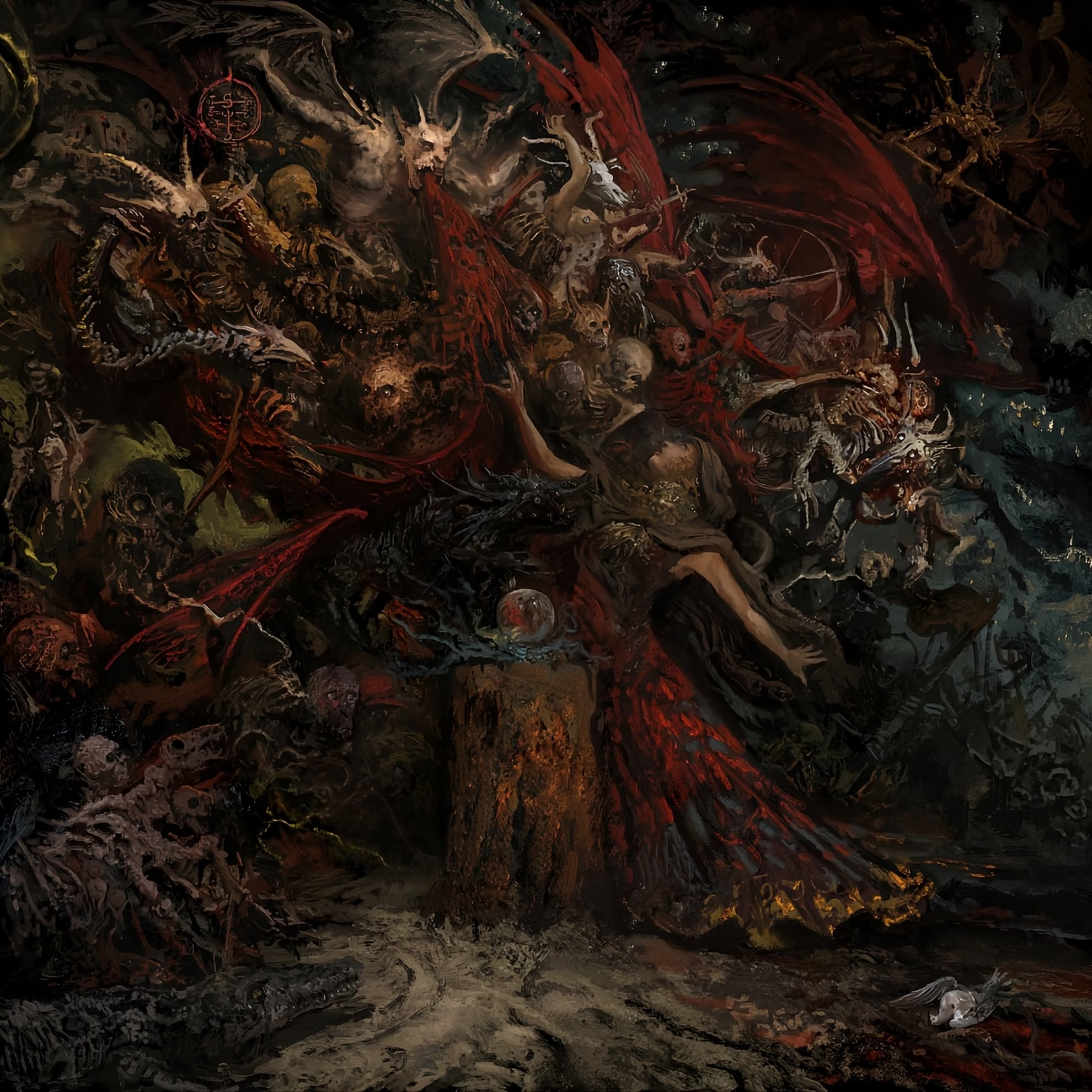
Profound Lore Records — founded in 2004 by Chris Bruni in Ontario and built into one of the extreme metal underground’s most trusted imprints through releases by Agalloch, Pallbearer, Bell Witch, and YOB — positions ‘Projections’ within a catalog defined by aesthetic integrity over commercial calculation.
Bruni has cited Peaceville Records as one of the formative influences on the label’s identity, which gives Godthrymm’s signing a particular coherence: the band that carries the Peaceville tradition forward landing on the label that was shaped, in part, by the same tradition’s example.
What Closes and What Continues
Glencross has been deliberate about the trilogy’s conclusion without treating it as a terminal point. “Even though we have said that this is the concluding part of a trilogy, we are far from done,” he noted. “Our love for this music is immense, and there is still much yet to be explored as we navigate through life.”
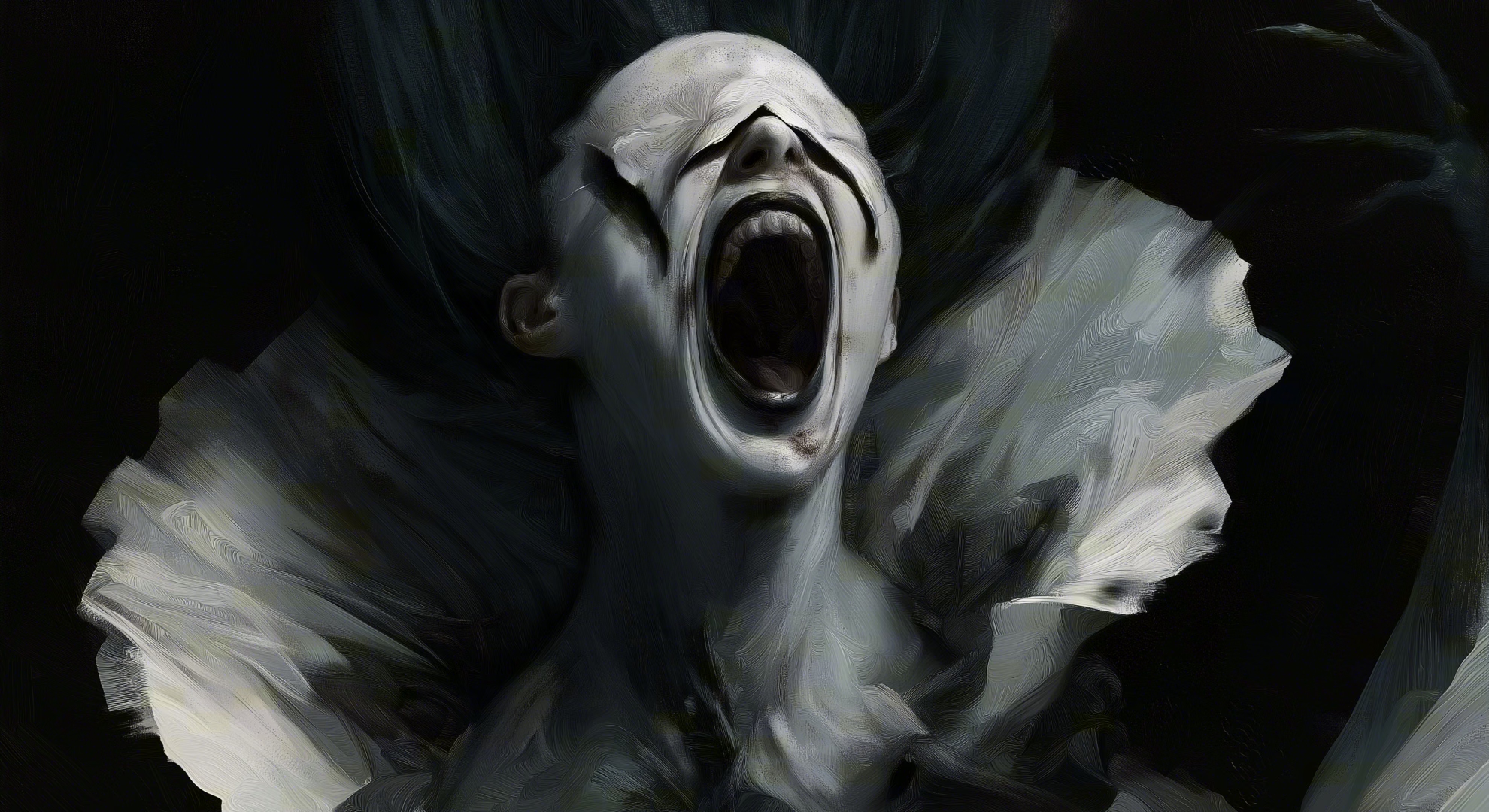
Mitchell Nolte’s cover artwork extends the visual grammar established across the three records. ‘Projections’ is available through Bandcamp and on CD, LP, and digital formats via Profound Lore Records.
The “Visions Trilogy” is now complete. What that means for Godthrymm’s next formal statement remains open, but the record itself lands as a documented conclusion rather than a provisional one: three albums across six years, each making the same fundamental argument with increasing specificity, from a band that formed out of a tradition it had already helped build.
For those who have followed the “Visions Trilogy” from ‘Reflections’ to ‘Projections’: how does the formal act of closing a three-part structure change your relationship to the individual records, and what does the trilogy’s completion mean for a tradition that has always treated grief as something that cannot be resolved, only inhabited?
References
- Simon Reynolds, ‘Rip It Up and Start Again: Postpunk 1978–1984’ (London: Faber and Faber, 2005), 10–16. ↩︎
- Robert Walser, ‘Running with the Devil: Power, Gender, and Madness in Heavy Metal Music’ (Hanover: Wesleyan University Press, 1993), 41–48. ↩︎
- Paul Hegarty, ‘Noise/Music: A History’ (New York: Continuum, 2007), 88–94. ↩︎

Leave a Reply