

In 1988, the philosopher Timothy Morton had not yet coined the term “hyperobject” — that would come two decades later — but the concept was already latent in the speculative physics of the era: the idea that certain entities are so massively distributed across time and space that they defeat every human attempt to comprehend them in full.
Morton’s later formulation was rooted in ecological theory, but its logic migrates into extreme music with a strange naturalness. There is a strand of black metal that has always operated on that same premise: that the universe is not human property, that consciousness is an interruption rather than a destination, and that the appropriate response to this recognition is not despair in the sentimental register but something closer to ritual acknowledgment.
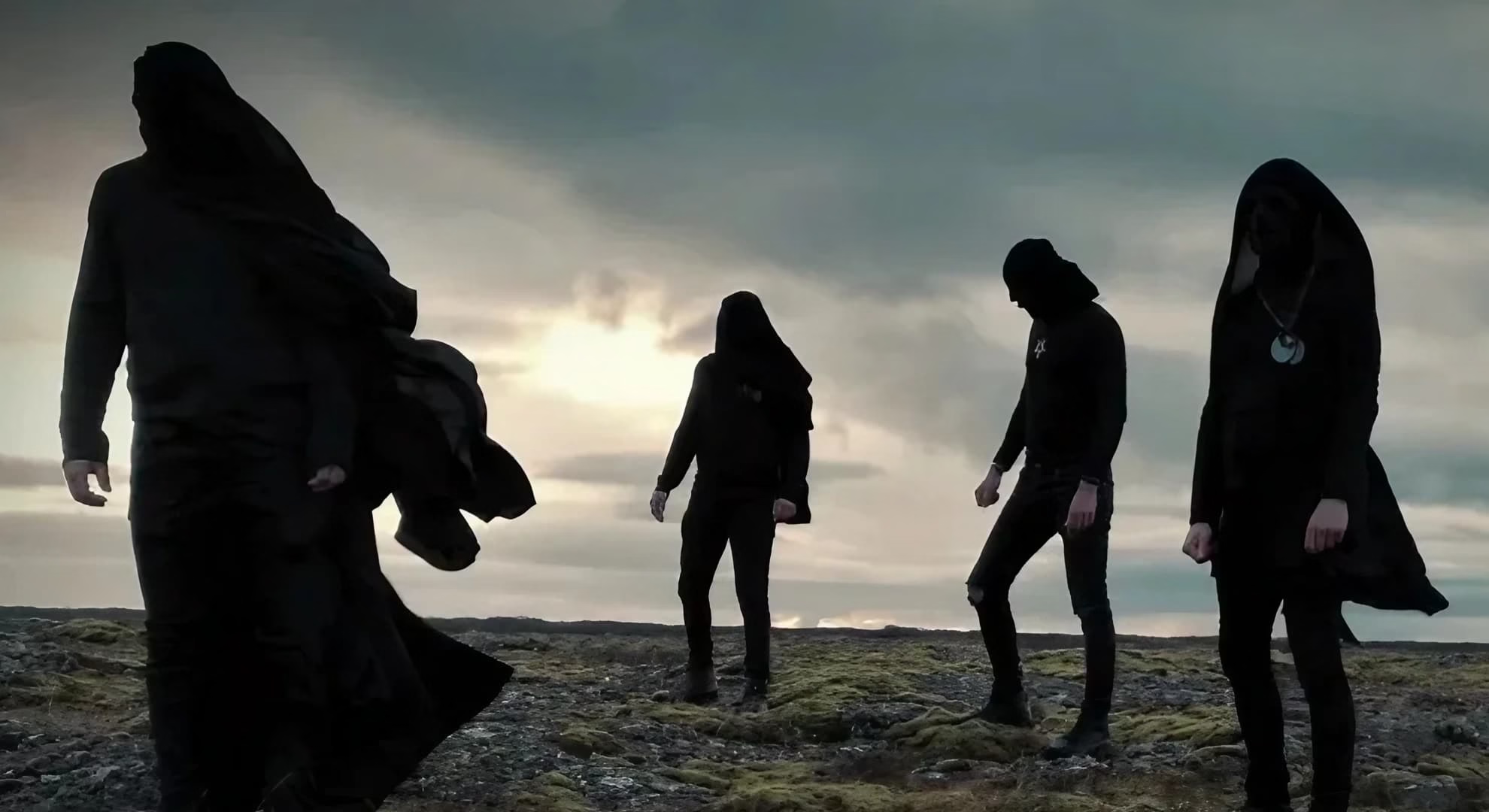
From Karviná, an industrial city in the Moravian-Silesian region of the Czech Republic — a place defined by coal extraction, post-communist economic rupture, and a distinctly un-pastoral relationship to the natural world — Inferno have spent thirty years building one of the most philosophically demanding bodies of work in Central European extreme metal. Their ninth full-length, ‘The Anthropic Sophisms (On the Heights of Despair),’ arrives July 17th, 2026, on Debemur Morti Productions, and it does not arrive quietly.
Thirty Years in the Karviná Dark
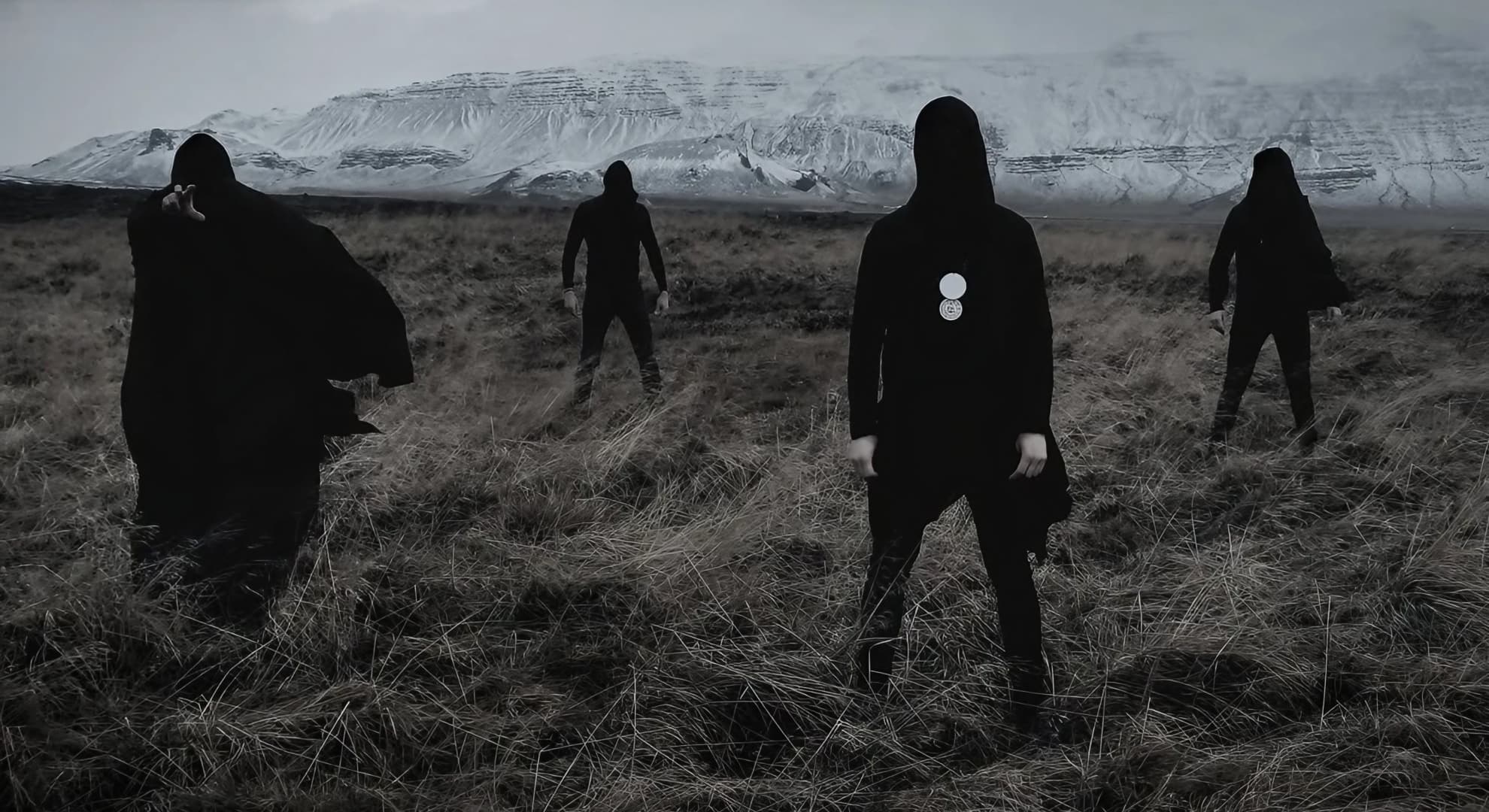
Inferno came into existence in 1995, at a moment when the Czech underground was absorbing the first cassette transmissions of the Norwegian second wave while simultaneously navigating the disorienting freedoms of the post-Velvet Revolution decade.
The Czechoslovakia that had maintained a functioning underground cassette network — circulating banned recordings through samizdat channels repurposed from political literature distribution — had dissolved into two republics four years prior. The networks that had transmitted forbidden culture became, almost without interruption, the channels through which extreme music moved.
Inferno’s earliest demo offerings, ‘Peklo Na Zemi’ (1996) and ‘Temá Poselství Dávných Předkuř’ (1997), arrived into an underground that was not merely receptive but structurally prepared to receive and distribute exactly that kind of severe, uncommercial music.1
The band’s early catalog — ‘Duch slovanské síly’ (2001), ‘V návratu pohanství…’ (2003), ‘Nikdy nepokřtěni’ (2006), and ‘Uctívání temné zuřivosti’ (2008) — operated within the tradition of Slavic pagan black metal: defiant, raw, rooted in an anti-Christian mythology drawn from the same pre-Christian substrate that Norwegian and Polish extremists were mining in their own registers. The pivot arrived with ‘Black Devotion’ (2009), which the band has described as a regenerative rupture. That album did not abandon aggression; it redirected it inward.
The subsequent transformation was deliberate and unfolding: ‘Omniabsence Filled by His Greatness,’ recorded at Necromorbus Studio in 2013, pushed the compositional framework toward something more structurally complex and tonally dissonant. ‘Gnosis Kardias (Of Transcension and Involution)’ (2017), released on World Terror Committee, arrived fully formed as a psychedelic black metal document, dense with occultist philosophy and modal harmonic drift.
‘Paradeigma (Phosphenes of Aphotic Eternity)’ (2021), on Debemur Morti, recorded at KSV Studios in Prague and mixed and mastered by Iceland’s Stephen Lockhart at Studio Emissary, refined all of this into a record described by the band as engaged with cosmology, depth psychology, and the horror of uncontrolled consciousness. The distance from ‘Peklo Na Zemi’ to ‘Paradeigma’ is not linear progression. It is transformation.
Against the Human Center
The title ‘The Anthropic Sophisms’ declares its philosophical position before a note sounds. A sophism is a plausible but ultimately false argument — reasoning that holds together on the surface but collapses under examination. The anthropic principle, in cosmology, holds that the universe’s physical laws appear calibrated for the existence of conscious observers precisely because conscious observers are the ones doing the observing.
It is a statement about the limits of inference, but it has been frequently misread as evidence of human cosmic privilege. Inferno take this misreading as their subject and dismantle it systematically.
The band’s own statement on the record’s conceptual premise is a model of philosophical precision: “The human being is neither measure nor destination here, only a witness. An infinitesimal point within a field of forces that surpass it. The senses fail, reason loses its footing, and yet something is happening. Something unnameable, existing beyond language and beyond control. This is not music that tells a story or offers consolation in a refrain. It is a movement unfolding regardless of expectation.”
The subtitle borrowed from the Romanian philosopher Emil Cioran’s 1934 debut — ‘On the Heights of Despair’ — is not merely decorative. Cioran’s argument in that text was that suffering has no redemptive trajectory, that consciousness is a disease rather than a gift, and that the authentic response to existence is not resolution but unflinching confrontation.2 Inferno take that position as their ground and push further from it.
The Single and Its Argument
‘Circulus Vitiosus Deus (The Infinity Ravages All),’ released May 1st, 2026, as the album’s sole advance single — the band announced it as the first and only single for this record — runs 7:28 and represents the album’s shortest track; the remaining three compositions extend between nine and nearly fourteen minutes.
The video, directed by Fabio Rincones (known for work with Venezuelan avant-metal project Selbst), is surrealist in the clinical sense: objects rendered in contexts that drain them of their expected function, images that refuse to resolve into narrative. The track itself works through booming, motorik-inflected percussion driving beneath dense atmospheric interference: guitar lines that do not resolve into riffs so much as generate interference patterns, electronics that creep rather than punctuate, and vocals that arrive as texture rather than declaration.
The title’s circular logic is architectural in the older sense of that word — it names a formal property of the music itself. ‘Circulus vitiosus’ is the vicious circle: a self-referential chain of reasoning in which conclusions support premises that generate the same conclusions without external anchor. Applied to a piece of music, the phrase describes a temporal experience of accumulation that never arrives at destination, that simply intensifies and repeats.
The track as publicly available demonstrates this logic at the level of composition. The band’s statement accompanying the single extends the premise: “Every deed turns to dust, washed away by the waves of oblivion, and yet he walks forth, renouncing, silent and blind. Such a grotesque spectacle, which, however, lacks witnesses and script. It lays bare the fateful truth: Man is a mere footnote in the work of spontaneous creation without end.”
De Gieter, Plotkin, and the Belgian-American Chain
The choice to mix ‘The Anthropic Sophisms’ with Tim De Gieter at Much Luv Studio in Lembeke, Belgium, is a precise alignment with a specific register of extreme music production. De Gieter, who functions simultaneously as a founding member and bassist of Amenra — the Belgian post-metal institution whose Mass series constructed one of the most emotionally severe bodies of work in contemporary heavy music — operates Much Luv from a rural facility designed to hold both the analog weight of vintage mixing hardware and the spatial control of modern conversion.
His prior mixing credits, which include Treha Sektori’s ‘Rejet’ (2021) and the Amenra catalog, document a consistent aesthetic approach: sound that achieves density without sacrificing definition, where the elements within a recording remain individually legible even at maximum pressure.3
Mastering responsibilities fell to James Plotkin, the American guitarist, composer, and engineer whose career spans from the grindcore trio O.L.D. in the late 1980s through the drone-doom collective Khanate (co-founded in 2000 with vocalist Alan Dubin and guitarist Stephen O’Malley of Sunn O)))), and now encompasses a mastering practice running to thousands of credits across drone, noise, dark ambient, and extreme metal.
Plotkin has described his approach to mastering “difficult” recordings as a practice rooted in the same anti-conventional instinct that governed his compositional work: finding the correct relationship between elements without imposing normative expectations about what those elements should do. The combination of De Gieter’s analog-inflected density and Plotkin’s disciplined spatial mastering represents a coherent production philosophy for a record that specifically refuses the consolations of conventional structure.
Four Tracks, No Resolution
The full tracklist — ‘Fission of the Soul,’ ‘Dekranos Katexochen (Mých smrtoí je bezpočet, mých nemocí mnoho),’ ‘With Raving Mouths They Utter Things Mirthless, Unadorned and Unperfumed,’ and ‘Circulus Vitiosus Deus (The Infinity Ravages All)’ — carries a deliberate formal argument in its arrangement.
The album opens on fission: the splitting of a fundamental particle. It closes on the vicious circle, the infinite regress. Between those poles, a track whose title borrows its Greek prefix from the word for madness and a track whose title is a direct quotation about utterance stripped of ornament.
Taken as a sequence, the record moves from foundational rupture through psychological dissolution to verbal annihilation and finally to the irreducible loop. There is no restoration in this structure. Resolution is not offered because resolution is precisely what the album identifies as the sophism.
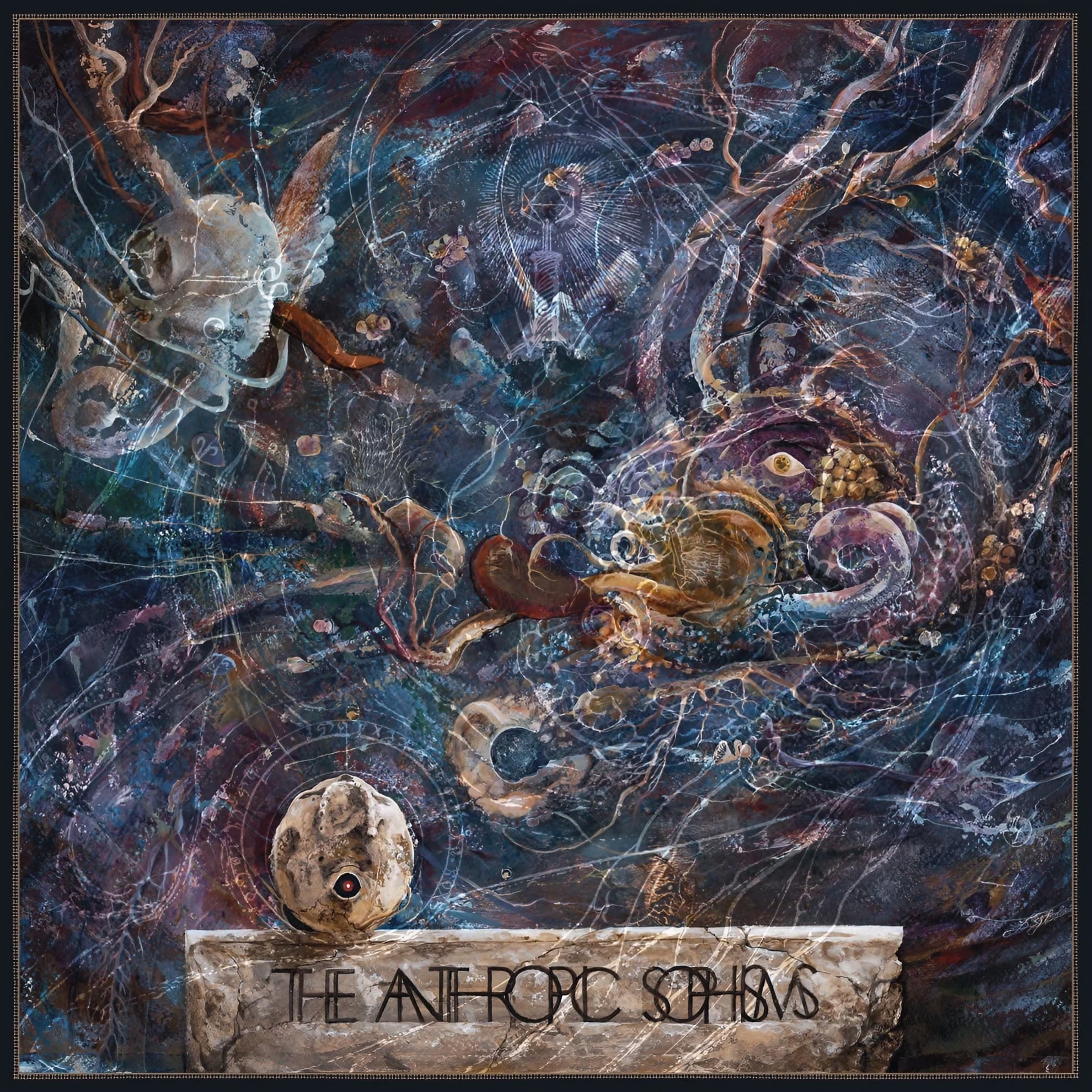
Cover paintings were produced by Dávid Glomba, a Slovak artist known for his work on records by Ascension, Cult of Fire, and Malokarpatan — projects with which Inferno share a Central European underground proximity if not a stylistic continuity. The layout was designed by Heresie Studio.
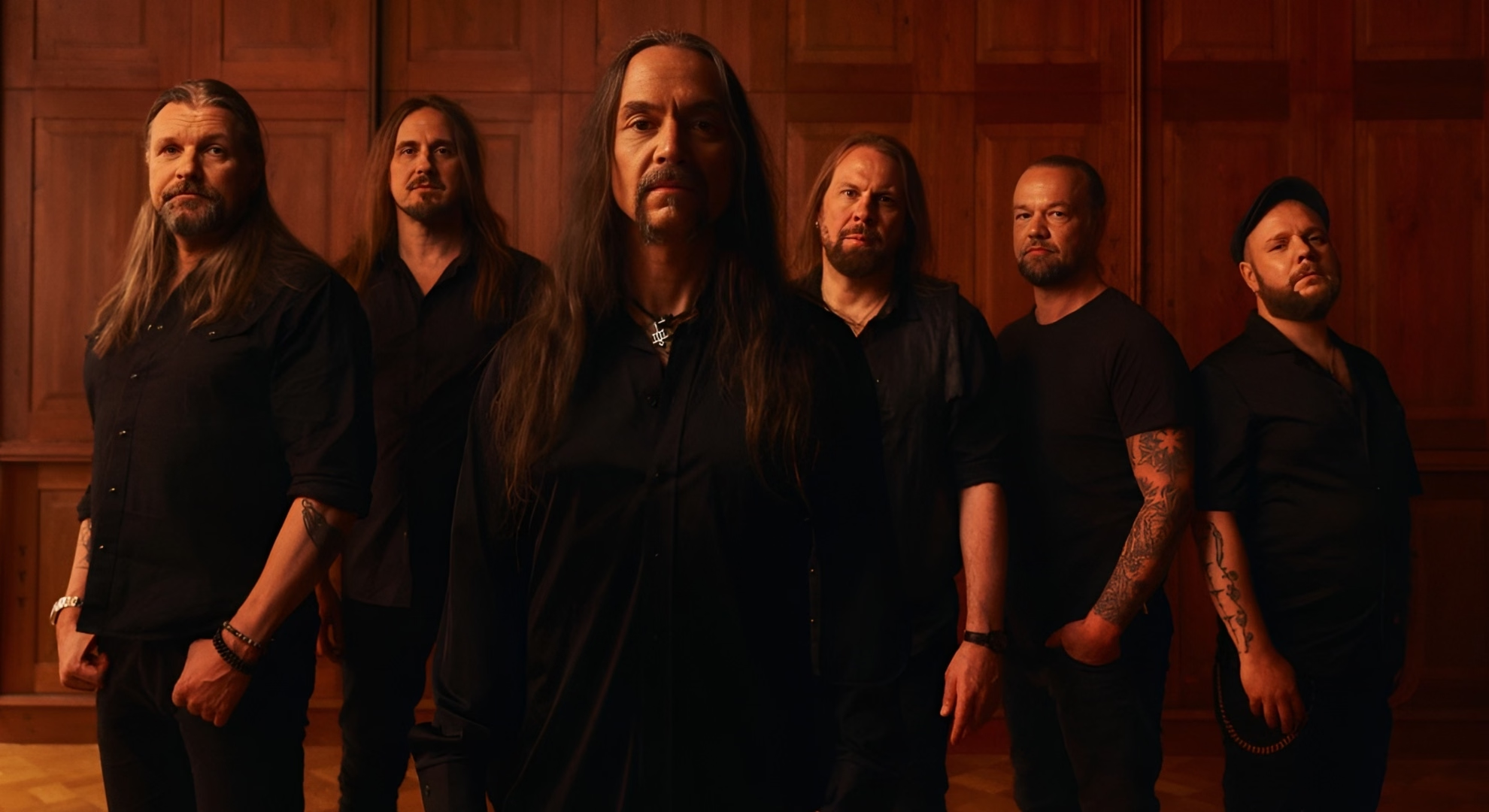
All music and lyrics were composed collectively by Ska-Gul, Sheafraidh, Morion, Adramelech, Matron Thorn, and Spicí hrdlo Antikrista — the six members who constitute Inferno’s current formation. Matron Thorn, who also contributed to the visual work for ‘Paradeigma,’ bridges the band’s sonic and visual output in a way that positions the artwork not as illustration but as parallel argument.
Debemur Morti and the Label’s Logic
Debemur Morti Productions, the French independent label, has spent two decades constructing a catalog that operates on a single consistent principle: the work does not concede to the listener. Its roster — Deathspell Omega, Abigor, Blut Aus Nord, Batushka, and now the full arc of Inferno’s recent work — represents an audience that brings prior commitment to every encounter, listeners who have already decided that difficulty is not a barrier but a precondition.4
The label’s exclusive DMP vinyl edition of ‘The Anthropic Sophisms,’ pressed on smoky purple heavy vinyl with black, red, and blue swirls and limited to 150 copies, accompanied by a twelve-page booklet, A2 poster, and download card, is a physical object calibrated for exactly that audience: not a souvenir but a document, acquired with intention.
The record is available on CD in a six-panel digipack with a twelve-page booklet and poster, on standard gatefold vinyl pressed on deep blue marble effect vinyl, and digitally through Bandcamp. Pre-orders open across Debemur Morti’s European, United States, and Bandcamp shops. The distribution logic is not designed to reach passive listeners. It is designed to be found by the ones already searching.
What the Underground Receives
For the international extreme music underground — which encounters a record like this through the deliberate circuits of label Bandcamp pages, underground distribution networks, and festival word-of-mouth rather than through algorithmic placement — ‘The Anthropic Sophisms’ arrives with a specific charge.
The philosophical framework Inferno deploy is not regional. Anti-anthropocentrism has no national address; the argument that human consciousness is a marginal phenomenon rather than the universe’s intended outcome is equally legible in Seoul, Buenos Aires, or Bratislava.
What the Czech context supplies is not a translation requirement but a specific material history: the experience of a society that maintained cultural practice under conditions of prohibition, that built underground networks precisely because mainstream channels were controlled, and that produced extreme music from a position of genuine social marginality rather than subcultural posturing.
That history does not reduce the music to its context, but it calibrates the seriousness with which Inferno approach the premise. A band from Karviná — a city whose economic identity was built on coal and whose post-industrial transformation has been among the most difficult in the Czech Republic — making music that treats human consciousness as an insignificant interruption in a universe that neither requires nor notices it, is not performing nihilism.
It is reporting from a specific position within material reality. The listener who finds this record at the far end of a Debemur Morti Bandcamp search arrives with the patience the music demands, and that patience is the precondition for what the four tracks actually offer: not catharsis, not consolation, but the experience of moving through a field of forces that exceeds the human.
The Witness and the Void
Thirty years after their formation in Karviná, Inferno release a ninth full-length that does not conclude their argument so much as restate it at greater depth. ‘The Anthropic Sophisms (On the Heights of Despair)’ is a record structured as a philosophical demonstration: four tracks that perform, in sound, the position the title names.
The human being is a witness here, not a destination — and the music offers the witness nothing to hold onto except the experience of witnessing itself. On July 17th, 2026, through Debemur Morti Productions, the record arrives for the audience that has already decided to find it. What that audience receives will not be music in the consolatory sense. It will be a movement unfolding regardless of expectation, exactly as announced.
Has Inferno’s persistent philosophical radicalism enhanced your connection to their evolving discography, or does the sheer density of their conceptual evolution—moving from Slavic pagan roots to the dissonant cosmology of ‘Paradeigma’ and ‘The Anthropic Sophisms’—act as a barrier for those who have not followed every phase of their thirty-year journey?
References
- Alexei Yurchak, ‘Everything Was Forever, Until It Was No More: The Last Soviet Generation’ (Princeton: Princeton University Press, 2005), 104–109. On the samizdat networks of the late Soviet and Eastern Bloc period and their structural role in cultural transmission under censorship. ↩︎
- Emil Cioran, ‘On the Heights of Despair,’ trans. Ilinca Zarifopol-Johnston (Chicago: University of Chicago Press, 1992), 3–11. On the philosophical premises of Cioran’s anti-redemptive nihilism and its rejection of consolatory frameworks. ↩︎
- Timothy Morton, ‘Hyperobjects: Philosophy and Ecology after the End of the World’ (Minneapolis: University of Minnesota Press, 2013), 1–19. On the category of the hyperobject as a philosophical tool for engaging with phenomena that exceed human cognitive and perceptual access. ↩︎
- Andy Bennett and Ian Rogers, eds., ‘Popular Music Scenes and Cultural Memory’ (Basingstoke: Palgrave Macmillan, 2016), 88–93. On the institutional logics of independent extreme music labels and the communities of listening they sustain. ↩︎

Leave a Reply