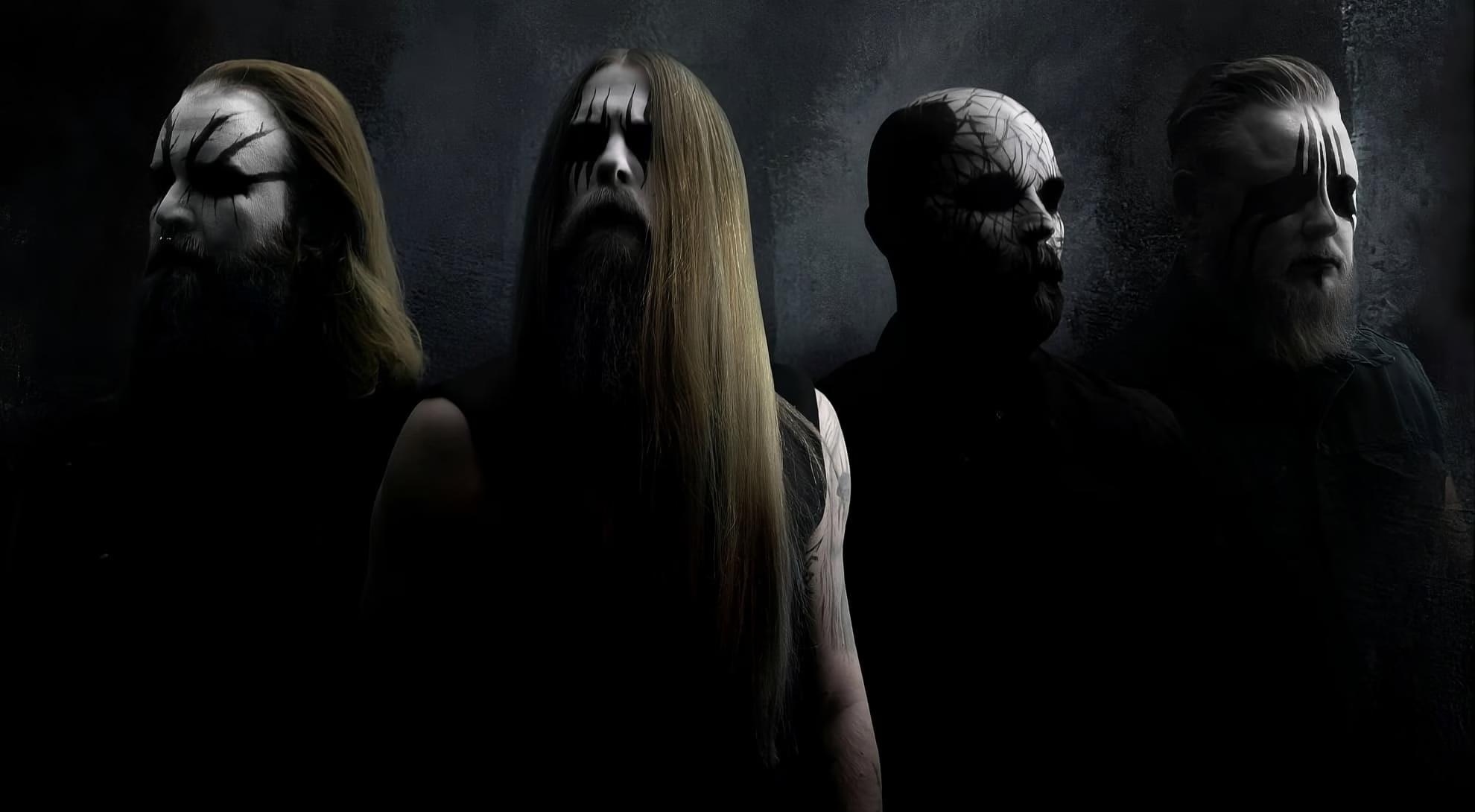


In the summer of 1993, two men recorded an album in a makeshift studio in Oslo with equipment so rudimentary that the limitations of the hardware became the aesthetic itself. What Darkthrone produced at Necrohell Studios — tracking directly to eight-track, deliberately rejecting the production standards that had governed metal since the mid-eighties — was not a failure of resources. It was a manifesto.
Thomas Eriksen was in Halden, a border town in Østfold, when he absorbed that tradition. He was twelve years away from forming Mork, and further still from the debut album he would press in a run of 100 copies and never expect anyone outside his immediate circle to hear.
The project that emerged — built on solo recordings that refuse atmospherics, post-black metal drift, and any formal accommodation with contemporary taste — has since become one of the clearest Norwegian arguments for the continued validity of the second wave’s first premises.
A Hundred Copies and a Career
Mork began as a side project in Halden in 2004, and operated for nearly a decade without a label, a distributor, or any expectation of audience. A demo, ‘Rota Til Ondskap,’ was compiled from recordings made between 2005 and 2007 and released in a self-pressed edition of 100 copies. When the debut album ‘Isebakke’ arrived in 2013 — triggered, by Eriksen’s own account, by a visit to Darkthrone’s old rehearsal space that summer — it was produced in the same format: a hundred copies, pressed for the sake of completion.
That origin story is not incidental context. It maps the trajectory of everything that followed. Eriksen signed to Peaceville Records for ‘Eremittens Dal’ in 2017, a record that brought in guests from 1349 and Dimmu Borgir and introduced Mork to an international audience that recognized the idiom immediately. ‘Katedralen’ (2021), ‘Dypet’ (2023), and ‘Syv’ (2024) consolidated that position: three albums in four years from a project that treats pace as its own form of severity.1
‘Syv’ marked a shift in geographic reach, generating tours across the Far East and Australia and drawing Mork into a global circuit that the second wave’s founding generation had never navigated. What ‘Monolitt,’ scheduled for June 19th, 2026, on Peaceville Records, represents is the continuation of that reach without any corresponding concession to the audiences it has found.
What the Title ‘Monolitt’ Announces
Eriksen described the album’s central image with a precision that leaves no room for metaphorical softening. “A stark monument to the unrelenting brutality of reality,” he noted. “The monolith looms above us, immovable, indifferent, eternal. Its crushing presence bears down on the spirit, suffocating hope and testing the limits of endurance. It is an experience carved in stone, unyielding.”
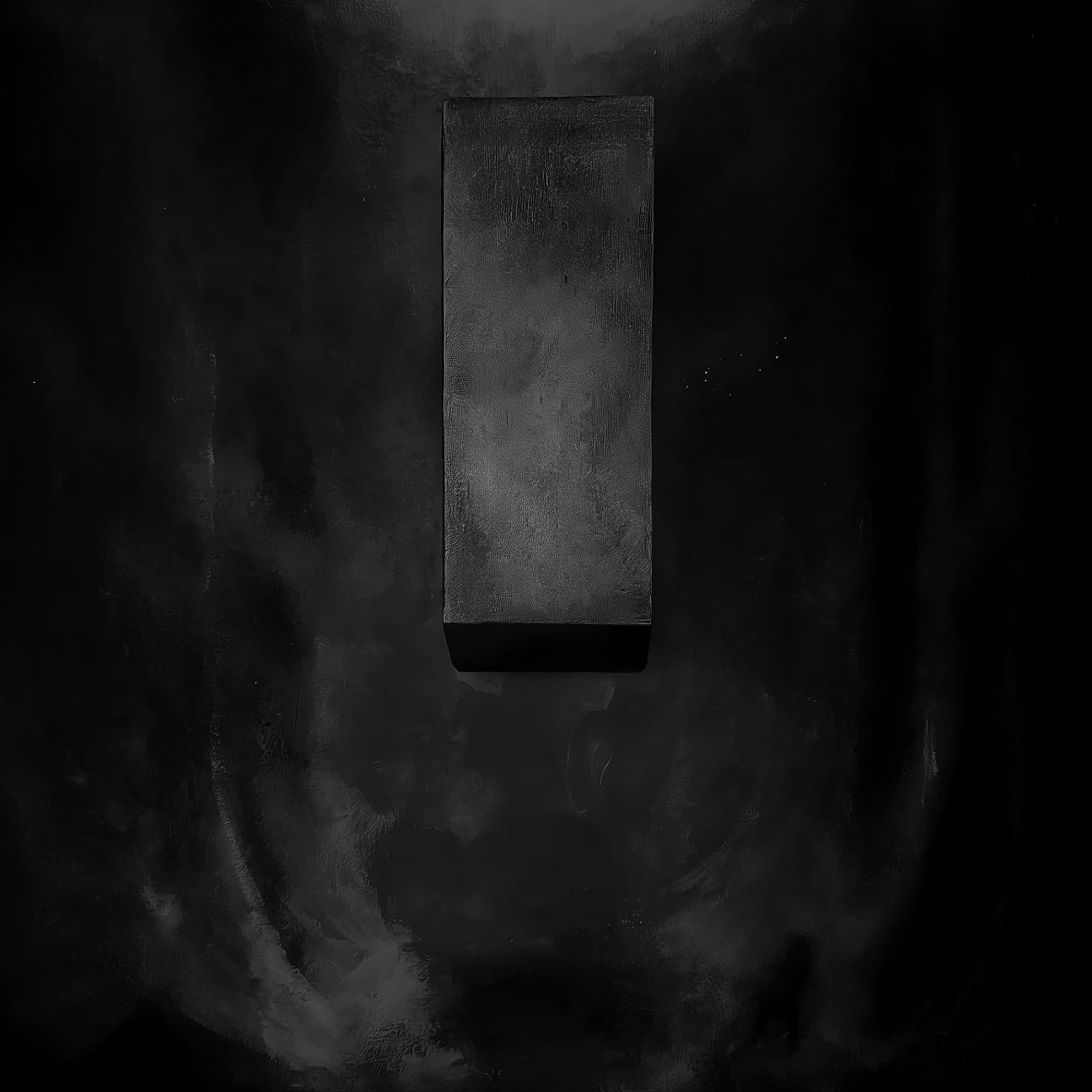
The monolith, in this framing, is not a symbol of transcendence. It is the opposite: an image of indifference so absolute that it collapses the distance between oppression and nature. The choice to build an entire nine-track record around that image — rather than the folkloric wandering and cathedral metaphysics of prior albums — signals a narrowing of focus that the two confirmed advance singles make audible.
Two Singles, Two Registers
‘Ødelagt,’ released April 2nd, 2026, as the first advance single, operates at the slower end of Mork’s established range. The track moves through extended riff cycles that resist rhythmic urgency, building weight through repetition rather than acceleration. The thematic content — defeat, self-destruction, disillusionment — finds its formal expression in the track’s refusal to resolve: the riff does not climax, it accumulates.
‘Torden,’ released May 15th, 2026, as the second advance single, occupies a different register entirely. Where ‘Ødelagt’ descends inward, ‘Torden’ moves outward in velocity and atmosphere. Eriksen described it as capturing the moment a storm strikes — “when the elements have had enough and it is time to wash everything away in anger.” The track runs under four minutes, the shortest confirmed on the album, and functions within the broader tracklist as a moment of kinetic release within a largely suffocating sequence.
Together, the two singles position ‘Monolitt’ across the same dual register that has characterized Mork’s most disciplined work: weight against velocity, collapse against storm.
Toproom and the Norwegian Chain
The decision to mix ‘Monolitt’ at Toproom Studio in Lunner with Børge Finstad is an alignment that carries more than technical meaning. Finstad’s credit roster — which runs from Arcturus’ ‘La Masquerade Infernale’ (1997) and Ulver’s ‘Themes from William Blake’s The Marriage of Heaven and Hell’ (1998) through Mayhem’s ‘Grand Declaration of War’ (2000) and Borknagar’s ‘Empiricism’ (2001) — traces the exact period in which the Norwegian extreme metal tradition moved from raw austerity toward its most ambitious formal experiments without abandoning its founding severity.2
Mastering responsibilities were split between Jack Control at Enormous Door — whose work with Darkthrone across multiple albums has made him the functional custodian of that project’s sonic document — and Maor Appelbaum at Appelbaum Mastering. The presence of both engineers in a single album’s production chain signals a deliberate choice to hold two frequencies simultaneously: the raw compression of the underground and the wider spatial range of international release.
Nine Tracks, No Concession
The nine tracks of ‘Monolitt’ — confirmed on the Peaceville Bandcamp page with full runtimes — run from the 5:57 opening ‘Under Vekten Av Verden’ to the 5:50 closing ‘Utryddelse.’ Between those poles, the record moves through the spectral wandering of ‘Skrømt,’ the extended atmospheric drift of ‘Inn i en annen sfære’ (6:34, the album’s longest track), and the compressed force of ‘Martyr’ and ‘Jutul.’ Peaceville’s own description of the record names themes of collapse, transformation, isolation, and destruction, where nature rages and giants awaken.3
The thematic territory is consistent with prior Mork releases in its preoccupation with Norwegian landscape and mythology, but the framing around the monolith suggests a more static form of menace: not the wandering darkness of ‘Katedralen’ or the cathedral’s implied ritual space, but an object that simply stands, immovable, against every effort to move past it. Drummer Asgeir Mickelson, whose credits include Borknagar and ICS Vortex, contributes the album’s rhythmic skeleton. Øyvind Kaslegard, also of Svart Lotus, provides additional vocals.
What Arrives at the Other End
Peaceville Records occupies a particular position in the history of extreme metal distribution. Founded in Dewsbury, England in 1987, the label built its catalog through the doom and gothic metal of Paradise Lost, My Dying Bride, and Anathema before its roster expanded to encompass Darkthrone, Katatonia, and Opeth.
The infrastructure it provides is not the integrated multinational machinery of a Nuclear Blast or a Century Media. It is the infrastructure of dedicated attention to audiences that neither require nor expect mainstream access.
The dark Norwegian introspection that runs through Mork’s work — the landscapes of Halden’s border territory, the mythological weight of a tradition rooted in Darkthrone’s early rehearsal rooms and Burzum’s cassette distribution — does not translate intact into that reception. What translates is the formal argument: that music built around resistance, austerity, and the refusal of comfort carries its own kind of necessity across radically different social contexts. The monolith that Eriksen invokes is not a Norwegian one. It is wherever the listener places it.
‘Monolitt’ is available for pre-order via Peaceville Records on gatefold vinyl in two pressings — pearl arctic and classic black — and on jewel case CD with an eight-page printed booklet. Cover artwork was created by Norwegian artist Kjell Åge Melland.
The Object in the Ground
Twenty-two years after Eriksen first recorded in Halden with no audience in mind, Mork arrives at its eighth album on the same formal premises that governed the first: a solo vision, a refusal of concession, and a sound calibrated to severity rather than reach. ‘Monolitt’ does not adjust its register for the global audience ‘Syv’ found. It offers that audience the same object it has always made: immovable, indifferent, carved in stone.
Whether ‘Monolitt’ constitutes the sharpest formal expression of that vision — or whether the dual registers of ‘Ødelagt’ and ‘Torden’ hold together across nine tracks in the way the advance singles suggest they might — June 19th will answer. What the record’s announced structure already argues is that the question itself is precisely the one Eriksen has been asking, in Halden, since 2004.
For those who have followed Mork through the Peaceville catalog: does the shift in thematic framing from the wandering and ritual geography of ‘Katedralen’ toward the static, indifferent weight of the monolith change how you hear what Eriksen has been building across these eight albums — or does the formal discipline remain constant regardless of the image he places at its center?
References
- Michael Moynihan and Didrik Søderlind, ‘Lords of Chaos: The Bloody Rise of the Satanic Metal Underground’ (Los Angeles: Feral House, 1998), 79–95. On the formation of the Norwegian black metal underground, its distribution networks, and the self-pressing tradition. ↩︎
- Paul Hegarty, ‘Noise/Music: A History’ (New York: Continuum, 2007), 122–128. On the production aesthetic of the Norwegian second wave and its deliberate opposition to mainstream metal sonics. ↩︎
- Arjun Appadurai, ‘Modernity at Large: Cultural Dimensions of Globalization’ (Minneapolis: University of Minnesota Press, 1996), 48–52. On the circulation of cultural objects across asymmetrical global markets and the transformations of meaning that transit produces. ↩︎

Leave a Reply