

Above the Arctic Circle, the sun sets in late November and does not climb back over the horizon for weeks. Norwegians call this stretch the mørketid, the dark time, and it is less a metaphor than a fact of latitude — a season in which day narrows to a few hours of blue dusk and then disappears.
The people who lived through that darkness, long before any of it was set to music, read it as a thinning of the world. The cold carried a weight that felt older than weather, and the long night seemed to bring the dead a little closer to the living.
It is the word a band present at the very beginning of Norwegian black metal has chosen to name its second album, due on July 3rd, 2026, through Peaceville Records. The choice reaches back nearly four decades, to a recording almost no one has heard.
The Demo and the Dead
In 1989, two friends in Norway committed a clutch of songs to tape under the title ‘Slow Death.’ The sound was raw to the edge of hostility, and it circulated among only a handful of listeners.
What lends that cassette its later gravity is the company it kept. Øystein Aarseth, the Mayhem guitarist who worked as Euronymous, produced it; Per Yngve Ohlin, the Swedish singer known as Dead, drew its cover; and a young drummer called Hellhammer sat in for the sessions.
Those three names would become inseparable from the most chronicled and most violent chapter in Norwegian music. Two of the men in that room did not live out the decade.
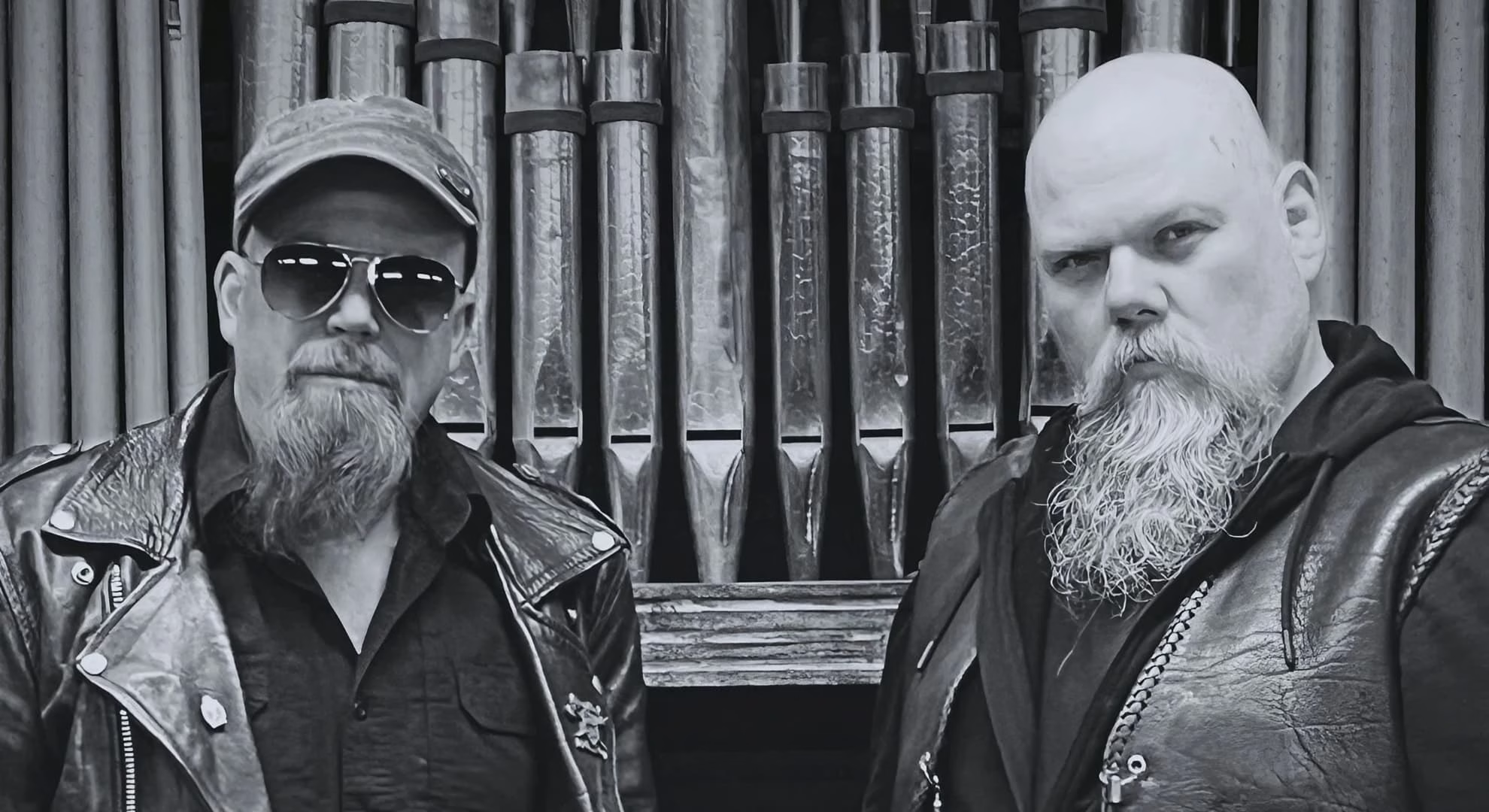
The band was Mortem, started in 1989 by vocalist Marius Vold and keyboardist Steinar Sverd Johnsen. It belonged to the first tremors of a movement that would soon define itself against the rest of European metal through a deliberate cult of cold, of nation, and of northern ground — terms its own historians now handle with caution, wary of how easily national feeling hardened into something uglier.1
Vold and Johnsen would shape that movement less through Mortem than through what came after. Johnsen poured his keyboard writing into Arcturus; Vold lent his voice to the earliest version of Thorns. Mortem itself was laid down like a body and left in the ground.
The Corpse Brought Back
For three decades, Mortem amounted to that demo and a rumor of one. Then, in 2019, Johnsen and Vold opened the grave.
Johnsen described the reunion without ceremony — a long-held wish to make something faster and colder than Arcturus had become, and a plain instinct, as he put it, to “drag Mortem out of the ground.”
The result, ‘Ravnsvart,’ appeared on September 27th, 2019, through Peaceville Records: eight tracks that kept the brutality of the first incarnation while folding in the harmonic keyboard writing Johnsen had spent years refining elsewhere.
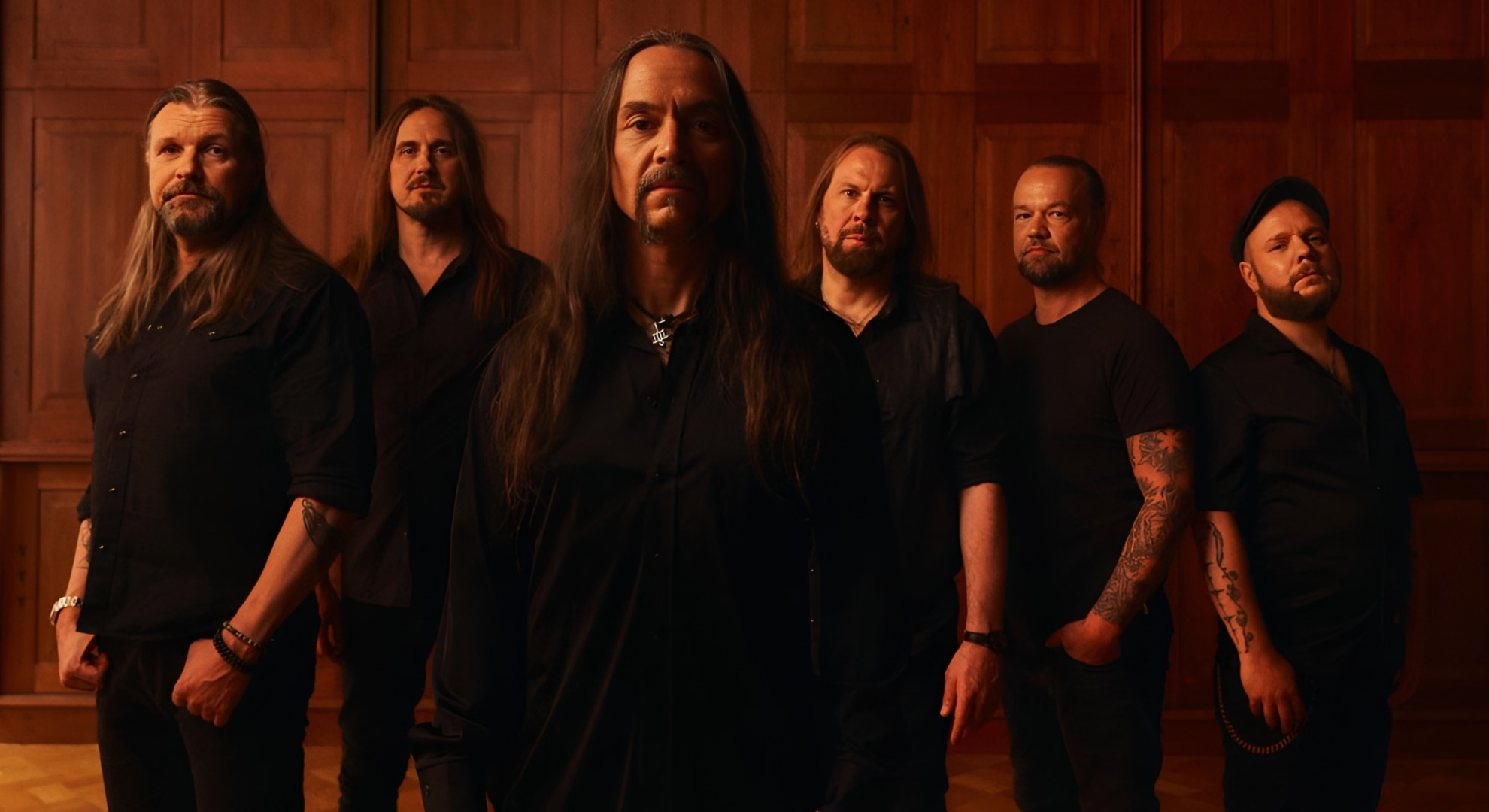
The reformed lineup drew together an unlikely concentration of the scene’s working players. Hellhammer returned on drums, Tor R. Stavenes of 1349 took the bass, and the band that had once preceded Arcturus now pulled its members back through Arcturus, Mayhem, Thorns, and 1349.
‘Mørketid’ is the album that follows, and it is only the second full-length in a career stretching back to 1989. That arithmetic makes the record less a continuation than a second pulse from a body that has spent most of its existence underground.
The Circle Back to Arcturus
‘Mørketid’ was recorded at Toproom Studio in Lunner, the long-running room owned and operated by Børge Finstad, with Kevin Kleiven sharing the engineering.
Finstad has manned the console for Norwegian extreme metal since the nineties, and one thread of his work matters here above the others. He engineered Arcturus across the years when that band turned Johnsen’s keyboard writing into something orchestral and strange.
To bring Mortem into the same room is to close a circle that opened the day Johnsen first traded his guitar for a synthesizer. The cold, harmonic clarity Finstad helped Arcturus find is the very quality Mortem now borrows back for blunter ends.
Kleiven’s presence beside him points toward a record made for definition rather than murk. That is a production stance at odds with the deliberately degraded sound the genre prized in 1989, and a measure of how far the idiom has carried from its first cassettes.
The Spirit in the Passage
The first sound the public has from ‘Mørketid’ is ‘Skyggeånd,’ a single issued in June 2026 with a lyric video by Matthew Vickerstaff.
Its title renders roughly as shadow spirit, and the song’s source is neither cosmology nor anti-clerical anger but a private fear. Vold has explained that the words came from a nightmare vivid enough to linger long after waking, a dream in which he had to save his son from a presence that “stood and swayed waiting in a basement passage.”
That image — a threshold, a half-light, a figure neither fully present nor gone — sets the song in the oldest country of the dark. The anthropologist Victor Turner named such in-between conditions liminal: moments and places where ordinary structure dissolves and a person hangs suspended between one state and the next.2
A basement passage at the edge of sleep is precisely that kind of threshold, and the single positions the record toward an interior register rather than the grand blasphemies of early black metal.
In sound, ‘Skyggeånd’ moves between the brooding, mid-paced weight the band has always favored and sudden runs of velocity — a contrast Mortem has carried since the demo. On the evidence of a single track, whether the full album sustains that balance remains a question for July.
The Permeable Dark
The album’s title hands that interior dread a geography. The mørketid is the polar night, the weeks-long withdrawal of the sun across Norway’s far north, and it carries a folklore far older than any guitar.
In the pre-Christian thought of the North, the year’s descent into darkness was bound up with the movement of the dead. The scholar Hilda Roderick Ellis, in her study of how Old Norse literature imagined the dead, traced a land of the dead reached by travel — a journey north and downward, into cold and shadow.3
The mørketid, in that older reckoning, was the season when the distance between the living world and that cold country grew shortest. Darkness was not simply the absence of light but the nearness of something.
Mortem’s choice of the word as a title binds the record to that inheritance without preaching it. The dread is carried in the structure rather than announced — the same economy that once named a demo ‘Slow Death.’
The Shape of the Second Dark
‘Mørketid’ runs to eight tracks. Among them sit the title piece, the single ‘Skyggeånd,’ the flatly anti-clerical ‘Den Sanne Gud,’ and ‘Mørkets Ormebol,’ alongside the English-titled ‘The Mighty Odious’ and ‘Aftermath.’
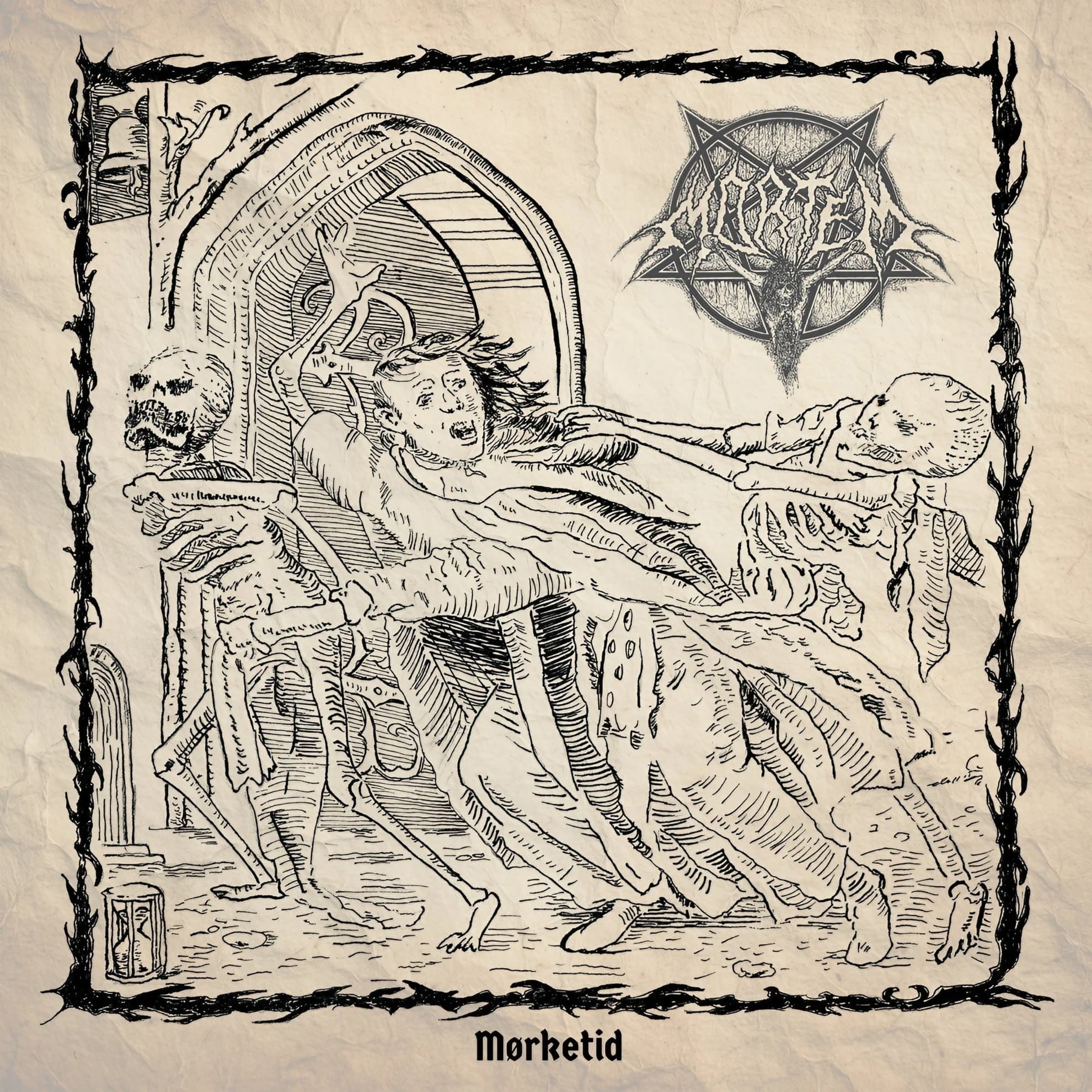
That bilingual split is itself telling. Norwegian titles sit beside English ones, mirroring the band’s double life between a national underground and an audience that reads it from the outside.
Where the debut took the cruelty of nature as its theme, the new titles lean toward the spectral and the damned — a shadow spirit, a serpent’s nest of darkness, blood-soaked ground. The preoccupation has narrowed from the cosmic toward the haunted.
Peaceville issues the album on oxblood red vinyl, on classic black vinyl, on a compact disc with a 12-page booklet, and in digital form, with pre-orders open through the label and through Bandcamp.
The physical formats are not incidental to how this music survives. For a band whose founding artifact was a near-private cassette, the record as a held object — colored vinyl, a printed booklet — is still the medium through which the cult keeps itself alive.
A Cult That Travels
That cult is no longer Norwegian in any strict sense. The early Norwegian black metal underground, once a few dozen people trading tapes, became across three decades a shared inheritance for listeners on every continent.
The sociologist Motti Regev has described how the vocabularies of pop and rock turned into a common tongue across borders — a cosmopolitanism in which local idioms are absorbed and remade far from where they began.4
Black metal is among the most extreme instances of that drift. A genre that defined itself through a particular cold, a particular nation, and a particular darkness now reaches people who have never seen a polar night, and for whom the mørketid is an idea rather than a season they endure.
What survives the passage is not the lived experience but the form: the conviction that darkness can be turned into music without irony and without apology. For an underground scattered far from the Arctic, Mortem’s return offers something close to a primary source — a band present at the genesis, still working in the original key.
Older Than the Scene It Began
‘Mørketid’ arrives as an odd sort of document: a second album from one of the oldest bands in its field, by a group that has barely recorded.
Its weight comes not from a volume of work but from position. Mortem stood at the start, in a room with the people who would become the scene’s founding myth, and then stepped aside while others carried the genre into a worldwide language.
To return now, on the far side of all that history, with a record named for the season when the dead draw closest, is to argue that the first impulse never needed the scale the genre later found. The dark was always the point.
Whether the album makes good on that argument across its full length will be settled on July 3rd. What is already plain is that the band can say what no later arrival can — that it was there when the long night first found its sound.
For listeners who came to Norwegian black metal long after its first decade, through reissues and through the bands that outlived Mortem’s silence, does word from one of the genre’s earliest voices alter what the music means — or has the form itself grown past any single point of origin?
References
- Imke von Helden, ‘Norwegian Native Art: Cultural Identity in Norwegian Metal Music’ (Zürich: Lit Verlag, 2017), 47–52. ↩︎
- Victor Turner, ‘The Ritual Process: Structure and Anti-Structure’ (Chicago: Aldine Publishing, 1969), 94–97. ↩︎
- Hilda Roderick Ellis, ‘The Road to Hel: A Study of the Conception of the Dead in Old Norse Literature’ (Cambridge: Cambridge University Press, 1943), 83–87. ↩︎
- Motti Regev, ‘Pop-Rock Music: Aesthetic Cosmopolitanism in Late Modernity’ (Cambridge: Polity Press, 2013), 18–22. ↩︎

Leave a Reply