

Bogotá teaches its extreme music bands to be self-sufficient before it teaches them anything else. The city’s metal history is a record of rooms borrowed rather than owned — university auditoriums, cramped bars in Chapinero and Teusaquillo, warehouses on the industrial edge — and of short-run records passed hand to hand across a capital whose cultural infrastructure has never distributed itself evenly.
That inheritance is older than most listeners assume. Colombian extreme metal was not an import received passively. Medellín’s Parabellum, active between 1983 and 1988, issued the two-track EP ‘Sacrilegio’ in 1987 in a pressing of 500 copies, and Norwegian musicians of the following decade credited that band and its compatriots Reencarnación as formative influences.
Heavy metal’s subculture was still settling the boundaries of its own extremity,1 and Colombian musicians were already working outside them.
The national frame around them was never neutral. Colombia spent the twentieth century deciding which regional sounds would stand for the country, and the coastal repertoire that won left the Andean capital’s harder music outside the official account of what Colombian music is.2 Extreme metal in Bogotá grew inside that exclusion, and grew the habits that come with it.
Ritual as Counterargument
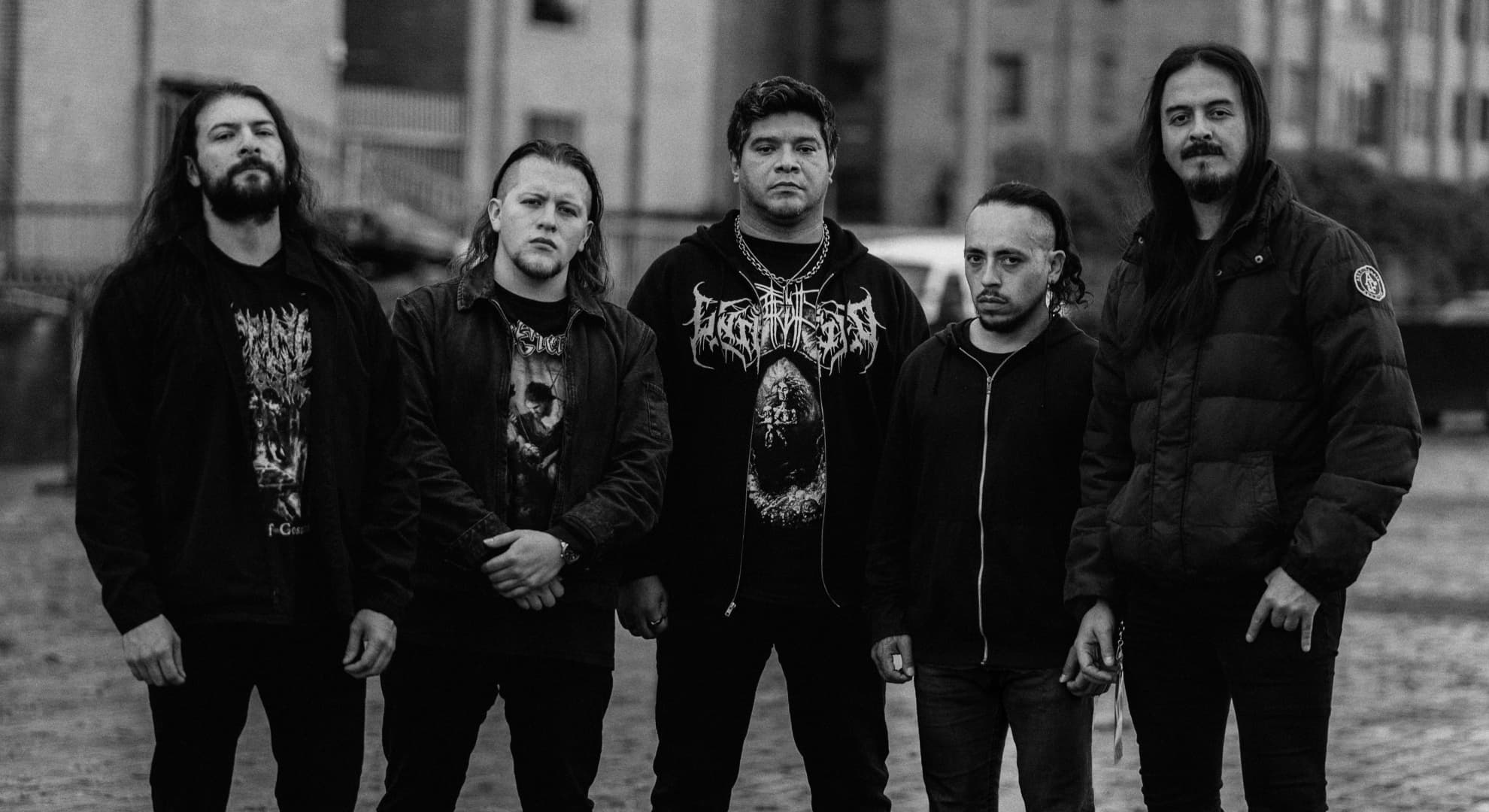
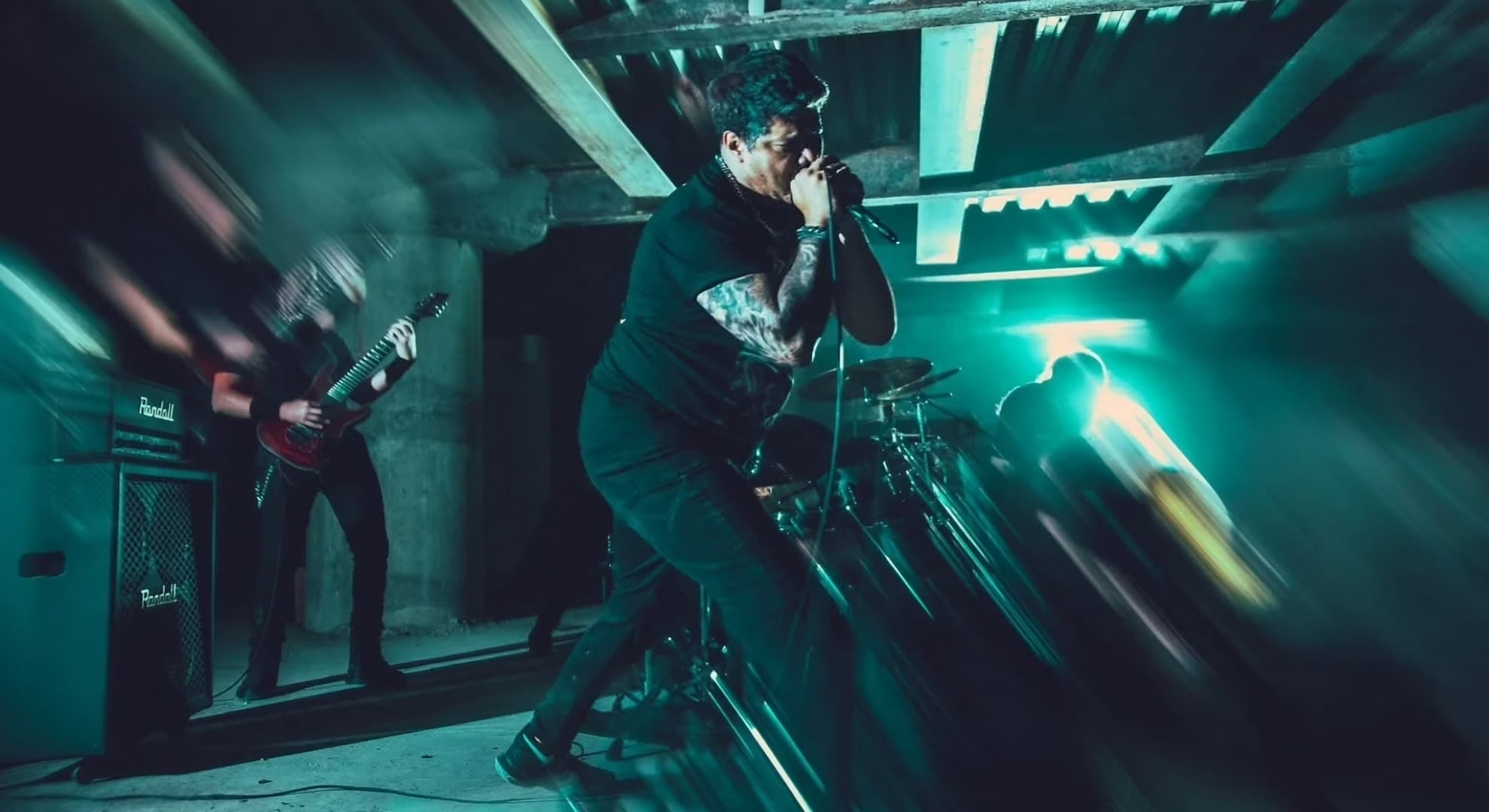
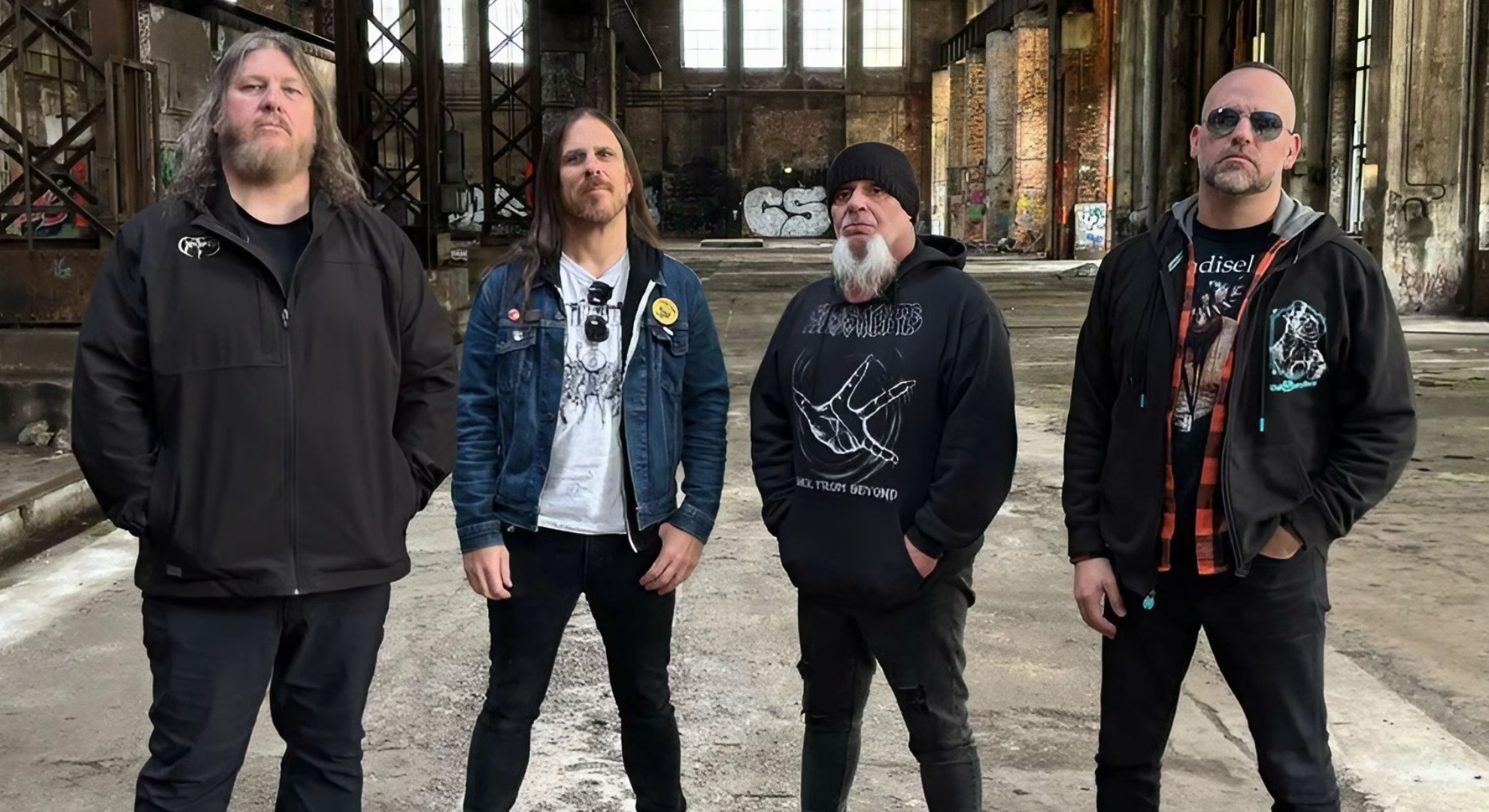
Unified formed in Bogotá in 2024 around the brothers Daniel and Camilo Duarte, on bass and guitar, and they describe ‘Arcane of Uncertainty’ as a song about personal transformation under conditions of uncertainty, drawing on imagery of ritual, ancestral knowledge, and spiritual symbolism to stage an awakening of consciousness and a refusal of fear. Their own account of the song frames that refusal as an act of resistance rather than of escape.
That sets the band at an angle to the brutal death metal tradition it inherits, which has favored bodily horror over interiority.
Ancestral knowledge is not a neutral phrase in this country. Colombian institutions of the nineteenth century built part of their authority by deciding which voices counted as knowledge and which as noise, placing Indigenous and Afro-Colombian ways of knowing beyond that line.3 A Bogotá band reaching for ancestral imagery is reaching across that line, and the reach is legible whether or not the band frames it in those terms.
The band’s account of their subject matter runs wider than one song: the human condition, internal conflict, and social dynamics, pushed toward the self-destruction of the individual and the decay of what surrounds them. Mediocrity, on that reading, names the settled, unexamined life the record sets itself against.
A Signal Routed North
The record was assembled across three sites and two continents. Diego Rodríguez recorded the drums at Red Spot Studio, guitars and bass were tracked at the Duarte brothers’ home studio, and Sebastián Piedrahita, credited to Mythic Records in Norway, co-produced with the brothers and handled the mix and master.
That is the Colombian independent condition stated plainly. A band with no major-label pipeline does not book one studio for six weeks; it spreads the work across the rooms it controls, treats a home studio as infrastructure rather than compromise, and sends the files abroad for a finish it cannot obtain locally. What once required access now requires a connection — a gain in reach, a loss of the expertise a scene builds at home.
Distribution runs through Pathologically Explicit Recordings, the Spanish label founded in 2006 that has specialized in brutal death metal for two decades and issued Wormed’s ‘Quasineutrality’ in 2010. A Colombian debut joining that catalogue enters a network Bogotá bands have had to build one contact at a time.
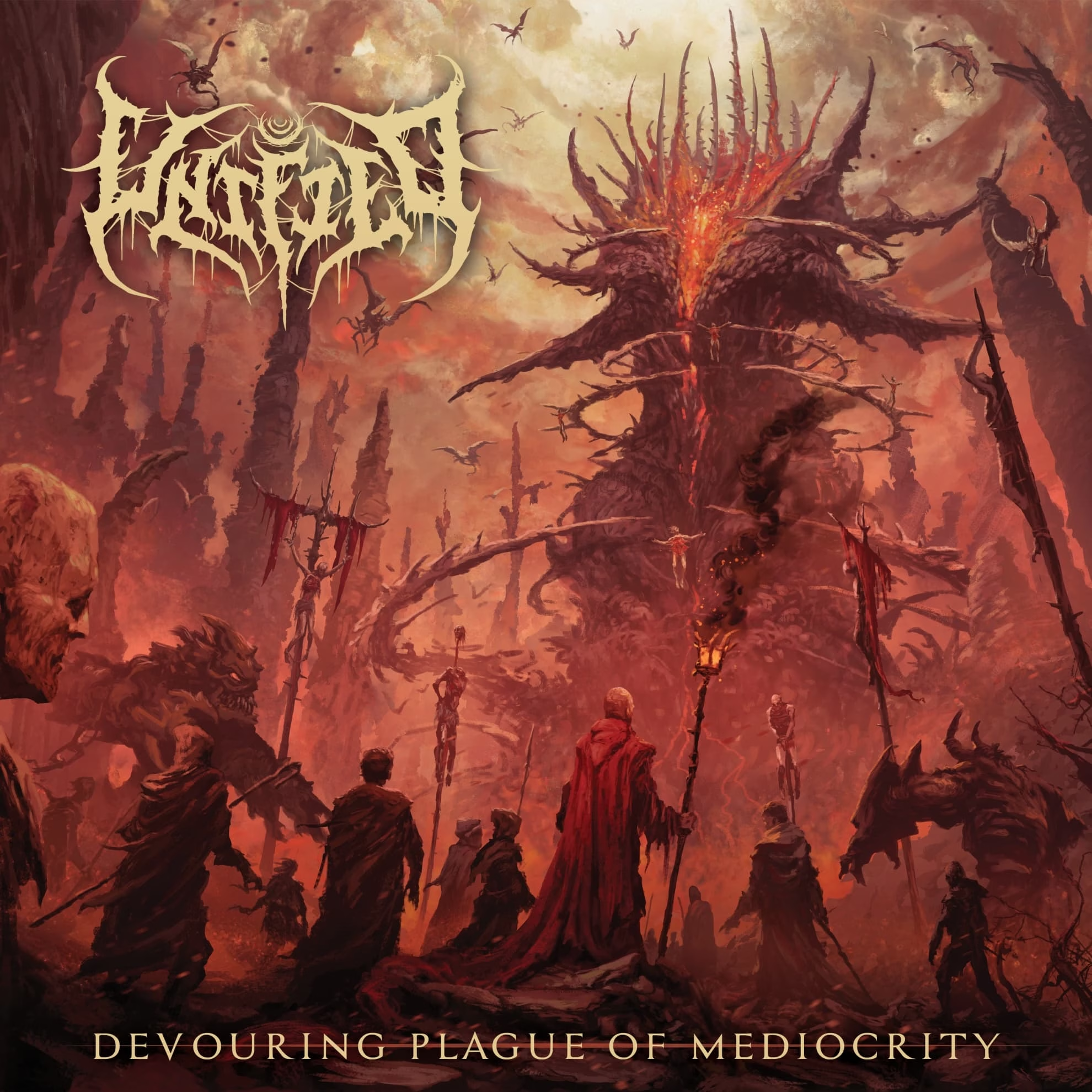
The cover painting states the case at apocalyptic scale. A horned colossus rises from a burning ridge, fire venting from its crown, while hooded figures cross an ochre plain hung with crucified bodies on standards, a celebrant in deep red leading them. Nothing is being resisted. The crowd walks willingly into the fire, which illustrates complacency far more sharply than a monster attacking would.
Holding brutal density and technical display together is a compositional problem before it is a stylistic one, and Bogotá’s precedent — Suppuration from 1997, Carnivore Diprosopus from 2002 — runs deeper on the first count than the second. Pereira’s Internal Suffering carried the register abroad on ‘Awakening of the Rebel’ in 2006.
The Gate and the Silence
Two structural conditions shape how a Bogotá band formed in 2024 becomes visible. The first is Rock al Parque, held in the city since 1995, among the largest free open-air festivals in Latin America and the most consequential gate to national visibility.
Unified have not passed through it. They debuted at Inga Fest on October 25th, 2025, played below the American bands Origin and Unmerciful in Bogotá on July 31st, 2026, and Insanity Assault on August 16th, 2026 — a live record booked from inside the scene rather than granted from above.
The second condition is the scarcity of specialist criticism. Death metal has long occupied an awkward position in music writing, where the qualities its audiences value most — extremity, opacity, technical difficulty — are the qualities general criticism is least equipped to describe.4 In Colombia that difficulty compounds a simple shortage of professional outlets.
The consequence is that a record with a full production chain, an international label, and a two-year live history reaches publication with its cover artist uncredited. The archive of the Colombian underground is written late, by whoever happens to be paying attention, or not at all.
A Plague Named Complacency
A debut album is the least protected thing a band ever makes. ‘Devouring Plague of Mediocrity’ is set for early September of 2026, the exact date still to be announced through the band’s own channels, and its two advance tracks span the group’s whole public life — ‘Predatory Pyramid’ in July of 2025, ‘Arcane of Uncertainty’ in July of 2026. It is less an opening statement than the close of an argument begun when musicians drawn from four older bands agreed to start a fifth.
‘Devouring Plague of Mediocrity’ will be measured, in time, against that choice rather than against its volume. The title is a wager: that complacency is worth naming as the enemy, and that a band two years old in Bogotá has standing to name it.
Which of the two traditions Unified are joining — the compression of brutal death metal or the dexterity of the technical strain — do you hope wins the argument on this record, and what would it say about where the Bogotá underground is heading if it does?
References
- Deena Weinstein, ‘Heavy Metal: The Music and Its Culture,’ rev. ed. (Cambridge, MA: Da Capo Press, 2000), 6–10. ↩︎
- Peter Wade, ‘Music, Race, and Nation: Música Tropical in Colombia’ (Chicago: University of Chicago Press, 2000), 1–12. ↩︎
- Ana María Ochoa Gautier, ‘Aurality: Listening and Knowledge in Nineteenth-Century Colombia’ (Durham: Duke University Press, 2014), 1–7. ↩︎
- Michelle Phillipov, ‘Death Metal and Music Criticism: Analysis at the Limits’ (Lanham: Lexington Books, 2012), 15–19. ↩︎


Leave a Reply