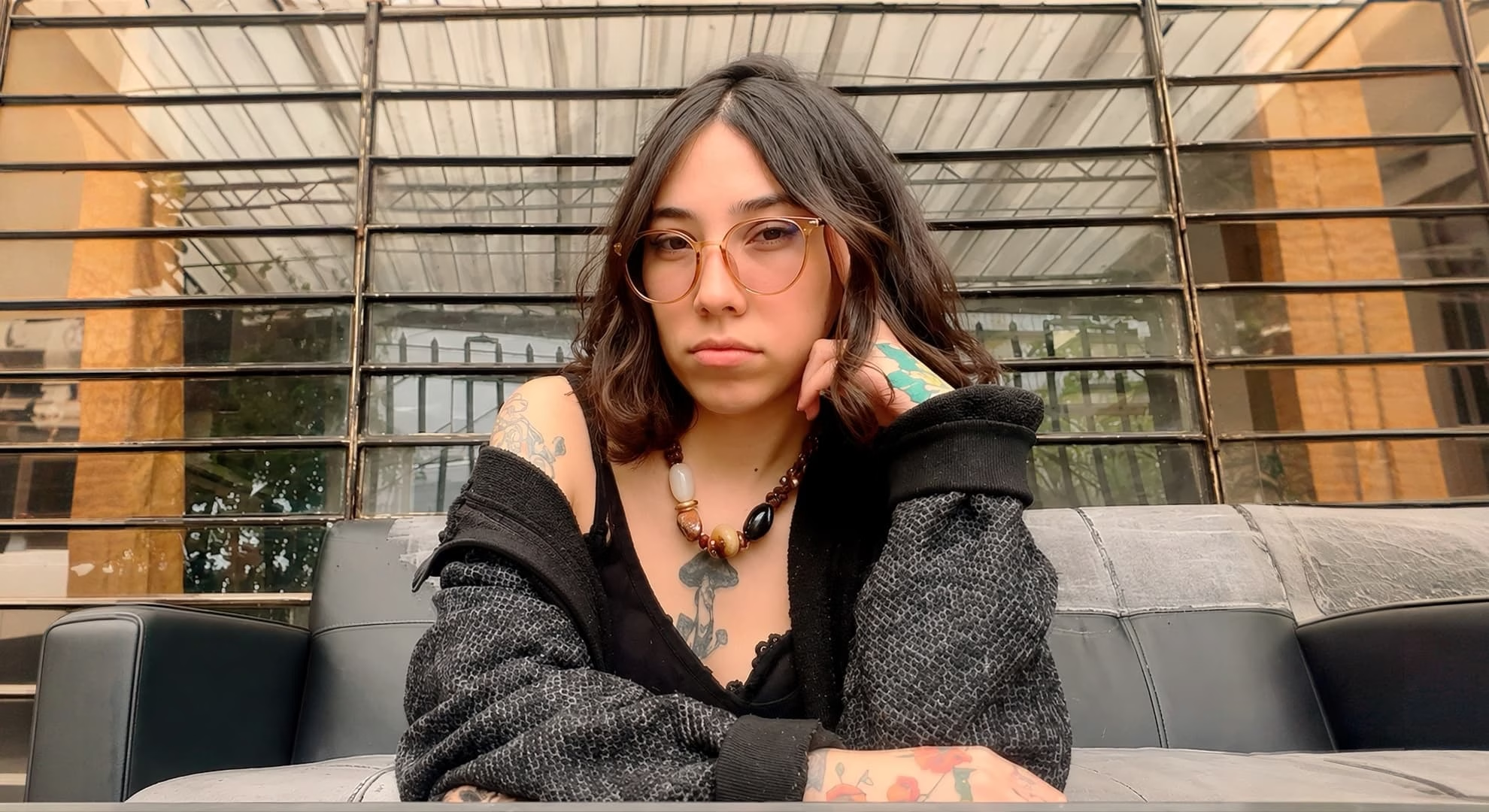


A Colombian illustrator who spent three years building an independent following around dark, fantastical artwork has folded that project into her first authored book. Presented at the Feria Internacional del Libro de Bogotá, held from April 21st through May 4th of 2026, and signed there for readers who sought her out, ‘Retratos de Niños Asesinos’ collects seven illustrated stories under a single organizing idea: children who are only slightly complex, slightly unpleasant, and slightly wicked — not yet monsters, but heading there.
A Debut in Miniature
Since 2023, Amarilla — a pen name standing in for her legal identity — has developed an independent artistic project built around illustration and dark, fantastical narrative, publishing standalone artwork and short pieces before assembling any of it into a bound book.
‘Retratos de Niños Asesinos’ marks the point where that practice becomes a first authored volume. The anthology is available as a standard paperback edition, with all seven stories and their accompanying illustrations credited to Amarilla alone. The book carries no imprint. It is self-published, sold through Amazon and, across Latin America, through independent Mercado Libre listings that place it outside institutional distribution entirely.

Because this is Amarilla’s first appearance in this publication’s coverage, and no earlier work of hers has previously been reviewed here, the scale of her existing practice matters more than it would for an established author. Her work before this book took the shape of an ongoing illustration project rather than a conventional route into publishing — a first book built on an audience assembled story by story, outside any editor’s acquisition process or agent’s submission list.
Portraits as Taxonomy
The description Amarilla gives the anthology avoids the vocabulary of true crime. Its cast, in her own framing, is only slightly complex, slightly unpleasant, and — like all children — slightly wicked, positioning the book closer to the moral fable than to the shelf of Spanish-language media that already claims nearly the same blunt phrase for factual reporting.
A 2018 Mexican film released internationally as ‘Murderous Children’ and an ongoing Discovery en Español true-crime series both use variations of the title ‘Niños Asesinos’ to document real juvenile killers, case by case, in a register built on procedure rather than portraiture.
Amarilla’s anthology borrows that same blunt phrasing and redirects it toward invented children whose wickedness is domestic rather than criminal: a girl unsettled by a little sister who multiplies into a horde outside her window, a boy who commands ranks of toads as though reviewing troops, a child whose murderous ambition is measured, in the book’s own back-cover copy, against the size of her breakfast cereal.
The device of using childhood as a vehicle for cruelty and death, without addressing children as an audience, has a specific Spanish-language precedent. Ana María Matute’s ‘Los niños tontos,’ published in Madrid in 1956, gathered 21 stories built around child protagonists explicitly excluded from both the adult world and the world of other children — through deformity, illness, or class — using that exclusion to stage death and cruelty in a register closer to allegory than to children’s fiction.
Amarilla’s anthology inverts Matute’s angle of exclusion: her children are not marginalized by circumstance but are themselves the source of the threat. Both books share the same operating principle nonetheless, using the child as a figure whose innocence the reader presumes and the text revokes.
Line Work and Dread
The anthology’s illustrations, all by Amarilla, work in two distinct registers that track its shift in tone from story to story. Chapter openings for pieces like ‘La hermanita de Sussie’ use spare, sepia-toned line drawings — two small figures, plain and almost storybook in economy — that undersell what the prose that follows actually does.
Other stories open instead on full-page, fully painted illustrations in warm, saturated color. ‘La niña de las ojeras doradas’ begins on a close, asymmetrical portrait of a golden-haired girl with heavy circles beneath both eyes, her face doubled and split by pale scar-like lines, with flame-wreathed hares floating above her.
‘Maky su ejército de sapos’ opens on a small boy in a cape leading ranks of identical toads as though reviewing troops. The contrast between the two registers — plain line art against grotesque, painterly close-up — performs the same function as the text’s own qualifier of slightness: it withholds the anthology’s full visual register until a given story has already committed to its child.
A Title’s Double Edge
‘Retratos’ borrows the vocabulary of portraiture, a genre built to dignify and individualize its subject, and applies it to children the anthology declines to dignify. The choice sharpens once set against the true-crime titling this anthology already echoes: the 2018 film and the ongoing docuseries built around the phrase “niños asesinos” both use documentary procedure to describe real killers, while “retratos” insists on the intimacy of a sitting.
Amarilla’s title sits between those two vocabularies — the individualizing intimacy of portraiture and the forensic bluntness of a true-crime shelf — and the tension between them describes most of what the book is doing: children rendered with a portrait’s patience, named in language borrowed from a courtroom docket.
Monstrous Children Before Her
Colombian folklore’s best-documented dark figures are predators of children rather than children themselves. La Tunda, a shape-shifting spirit from the Afro-Colombian communities of the Pacific coast, is said to lure children from home by disguising herself as someone they trust, holding them in the jungle until they are found disoriented or lost.
She belongs to a family of Colombian folkloric monsters — La Patasola, Madremonte, El Mohán — built around endangering the young rather than embodying danger within them.
Amarilla’s anthology works in the opposite direction: it takes the vulnerable position Colombian folklore reserves for the child and relocates the threat inside that same figure. The book makes no explicit claim to any of these legends, and the move is not drawn from a single named source, but it sits in productive tension with the tradition: where La Tunda’s warning tells a child to fear what waits in the trees, ‘Retratos de Niños Asesinos’ asks the reader to consider what a child might already be.
A Category of Her Own
Self-published dark fiction rarely receives sustained critical attention before it accumulates the sales record or festival credentials that make institutional coverage feel obligatory. Amarilla’s anthology reaches readers without an imprint, without a distributor beyond Amazon and Mercado Libre, and without any prior critical record — conditions under which most illustrated dark fiction goes unremarked regardless of what it is doing on the page.
What ‘Retratos de Niños Asesinos’ does is specific: it takes an independent illustration practice, built story by story outside any publishing structure, and converts it into a bound anthology that treats the ordinary menace of a child as material serious enough for portraiture.
Whether the project extends past this first volume remains to be seen. What it has already established is a working method — plain line art holding back what follows, painted color released only once a story has committed to its threat — precise enough to survive without any institutional support behind it.
Among the anthology’s seven children, which portrait does the most to earn the book’s insistence that wickedness begins, in even the most ordinary child, only slightly?

Leave a Reply