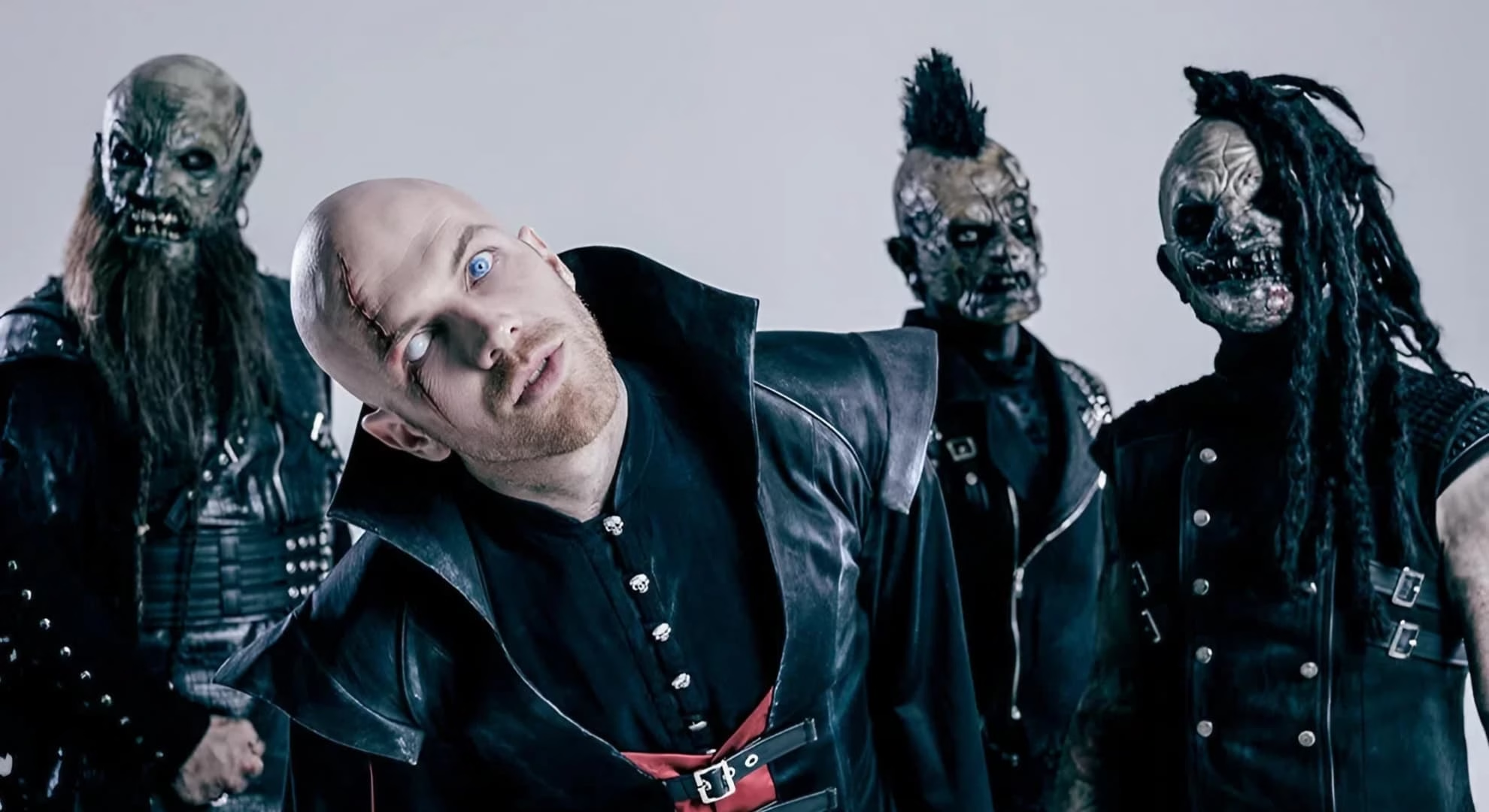


On the opening night of April 13th, 1897, a converted chapel in the Pigalle district of Paris drew its first paying crowd into a room built for fewer than three hundred bodies. The plays staged there traded in throats cut on contact, faces dissolved in acid, and the slow theater of madness. Le Théâtre du Grand-Guignol ran on a simple wager: that an audience would pay to be horrified, provided the horror arrived with enough craft to feel earned. The faintings were counted as reviews.
More than a century later, a German band in zombie prosthetics has staked a career on the same wager, and on July 3rd, 2026, it tests that wager at full length again.
A Band Born in a Mask
Dominum took shape in Nuremberg in 2022, assembled by the songwriter and producer Felix Heldt out of the remains of his previous group, Hyrax. Heldt vanished into a character he calls Dr. Dead, a mad scientist commanding a horde of the reanimated.
The conceit could have been a novelty act. Heldt has said as much about the early days, recalling that on the first record the band did not yet know what a zombie band even was, or how broad such a thing could be.
What kept the project from collapsing into costume was the songwriting underneath it. Heldt had already worked as a writer and producer for Feuerschwanz and Visions of Atlantis, and he brought a craftsman’s ear to the masks.
The debut, ‘Hey Living People,’ arrived on December 29th, 2023, and entered the upper reaches of the German album chart on first appearance. Its successor, ‘The Dead Don’t Die,’ followed on December 27th, 2024, and pushed into the Top 10.
Two albums in two years is an unusual pace for a band still defining itself, and the speed mattered. It compressed the distance between the joke and the thing the joke became.
The lineage Dominum claims is not the funereal slowness of doom or the misanthropy of black metal. It is the bright, fortified bombast of German gothic power metal, the tradition of Powerwolf and the marching choruses that fill European festival fields each summer. Heavy metal has always carried a streak of the carnival within it, a performed excess that turns dread into communal spectacle, and Dominum work that seam directly.1
The Carnival Arrives
‘Night Is Calling’ opens, by design, with its first advance single. ‘The Circus Is in Town,’ released at the end of March 2026, doubles as the album’s overture and its thesis.
The track moves on the machinery of arena power metal: a galloping pulse, a chorus pitched for thousands of voices, and a production gleam that never lets the theatricality tip into murk. It announces a procession rather than a single song.
Heldt framed the single in the language of a threat dressed as an invitation, describing a band coming city by city and an audience already implicated whether it consents or not. The carnival, in his telling, is not a place one visits. It is a thing that arrives.
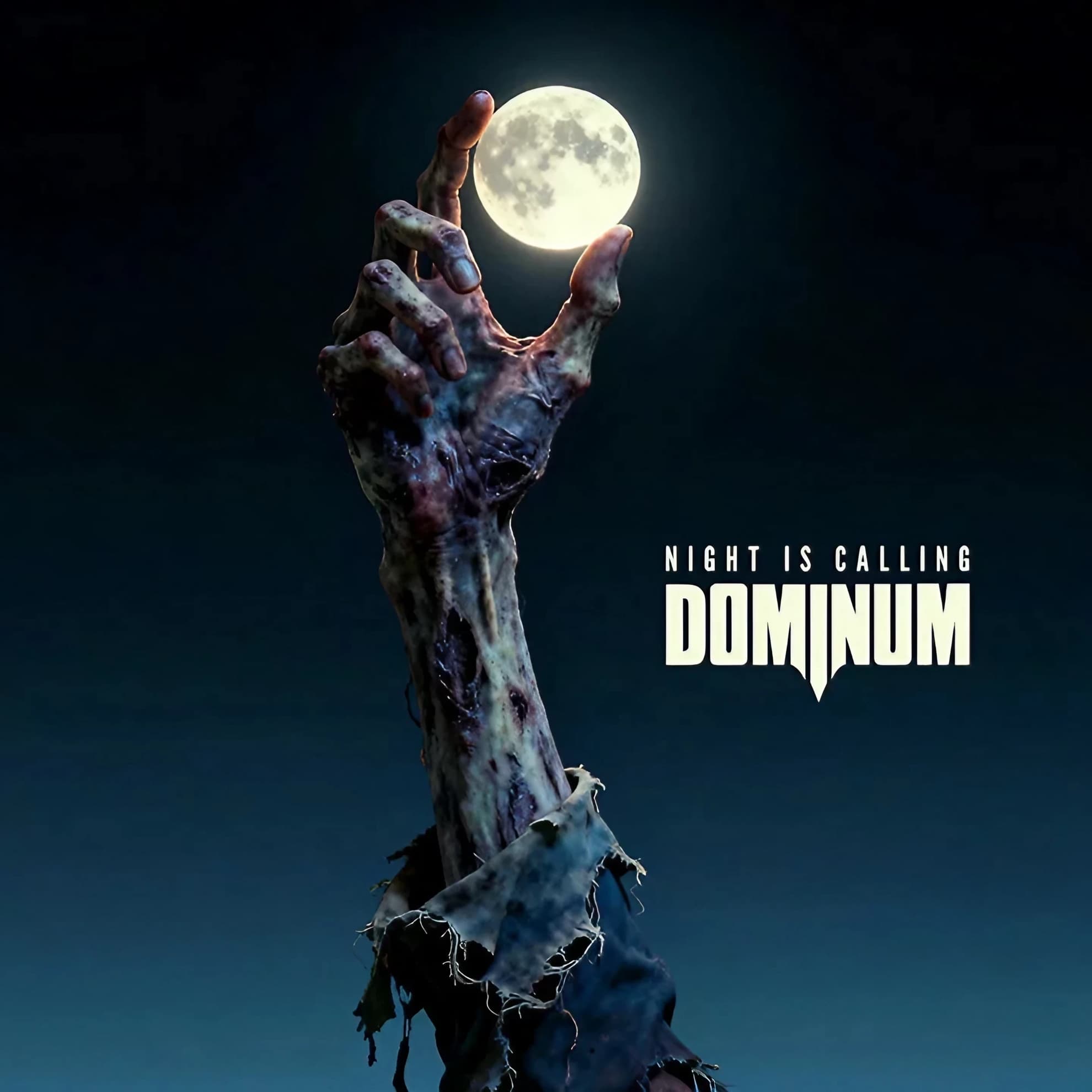
That framing places Dominum squarely inside an old European inheritance. The procession of the dead through the living town runs from the medieval danse macabre through the naturalistic shocks of the Grand-Guignol stage.2
The second advance single, ‘Doctor Doctor,’ followed in early May 2026 with a video the band described as the bittersweet story of a sickening love. Its hooks are broader and its tempo more immediate than the opener’s.
Heard together, the two released tracks position the record toward a sharper, heavier register than its predecessor without abandoning the sing-along instinct that carried the band into the charts. They suggest expansion rather than reinvention.
What neither single resolves is how the full sequence will balance its two appetites, the appetite for spectacle and the appetite for the song. That balance is the unheard album’s central question.
Precision Behind the Glass
In keeping with the band’s established workflow, Heldt oversaw the production of ‘Night Is Calling,’ maintaining his role as the architect of every Dominum release. For the critical final stages, the project returned to Ribe, Denmark, where engineer Jacob Hansen handled mixing and mastering at Hansen Studios.
Hansen’s involvement serves as a definitive statement on the album’s sonic intent. Having spent twenty years defining the melodic-metal aesthetic for prominent acts such as Arch Enemy, and Epica, he is renowned for achieving a high-fidelity clarity that remains intact even within the most dense arrangements.
This technical definition is vital for Dominum’s survival. Their brand of theatrical metal—characterized by layered guitars, choirs, and synthetic orchestration—risks becoming a wall of noise without a specialist capable of maintaining the legibility of every individual track.
Because Hansen was responsible for the mix on the previous two albums, this collaboration ensures a deliberate sonic lineage. The technical skill that provided ‘The Dead Don’t Die’ with its sleek power is put to use here to elevate a more aggressive record, ensuring that even as the weight increases, the melodic hooks remain front and center.
For an act whose core appeal relies on the audience perceiving every syllable of their gothic performance, employing an engineer with Hansen’s pedigree is what prevents their macabre cabaret from descending into mere static.
Heldt produced ‘Night Is Calling’ himself, as he has produced every Dominum record. The mix and master went, again, to the Danish engineer Jacob Hansen, working from Hansen Studios in Ribe.
Hansen’s name functions as a structural argument about the kind of record this is meant to be. Across two decades he has shaped the modern melodic-metal standard for Amaranthe, Epica, Arch Enemy, and Evergrey, a sound prized for clarity that survives even at maximum density.3
That clarity is the precondition for what Dominum attempt. A theatrical metal built on choirs, programmed orchestration, and layered guitars collapses into noise without an engineer who can hold each element legible against the others.
Hansen mixed both prior Dominum albums, so the continuity is not incidental. The same hands that gave ‘The Dead Don’t Die’ its polished bombast return for a third pass.
Guests and the Horror Canon
The title track carries a guest turn from Battle Beast, the Finnish band whose powerhouse vocal delivery sits comfortably inside Dominum’s widescreen ambitions. The pairing reads as a deliberate signal of the company Dominum now keep on the European festival circuit.
The confirmed sequence threads the band’s zombie mythology through the wider horror canon. Track titles invoke Nosferatu, Jack the Ripper, and the children of the night, drawing the album into more than a century of inherited macabre imagery.
Among the covers sits a metal reading of Michael Jackson’s ‘Thriller,’ the most theatrically literal choice a zombie band could make, given that song’s own video set the modern template for the dancing dead.
The gesture is characteristic. Dominum’s previous album closed with a symphonic-metal cover of a Scorpions anthem, a homage Heldt timed to the song’s fortieth anniversary. The covers are not filler but acts of placement, fixing the band within a lineage it wants named.4
Vampire, ripper, reanimated corpse: the figures Dominum gather are the durable furniture of European fright, the same stock the Grand-Guignol once dressed in stage blood. The band’s contribution is to set them marching to a chorus.
The Spectacle Beyond Germany
Dominum’s rise has been, so far, a largely European story, built on festival stages and tours alongside Bruce Dickinson, Avantasia, and Battle Beast. ‘Night Is Calling’ is the record that tests whether the spectacle travels.
Theatrical metal occupies a particular position in the global underground. Its visual extravagance and its reliance on instantly graspable hooks make it more legible across language barriers than the genres that demand close reading of lyric or atmosphere.
For listeners far from the German festival circuit, the appeal of a zombie cabaret is not regional. The danse macabre is a near-universal inheritance, and a band that performs death as communal celebration speaks to that inheritance directly rather than through local idiom.
There is also the matter of access. Much of the international audience for a record like this meets it through whatever channel a given market makes affordable, and the band’s availability across pre-order formats and the open marketplace of Bandcamp matters to how widely the spectacle can actually reach.
That gap between a release’s European launch and its global arrival is where a band either crosses over or remains a regional curiosity. ‘Night Is Calling’ is structured, in formats and guests alike, like a record built to cross.
The Dead Keep Marching
Three albums in, the joke has outlasted the question of whether it was ever only a joke. Dominum have done what the most durable theatrical acts in metal have always done, which is to make the costume a vehicle for the craft rather than a substitute for it.
‘Night Is Calling’ arrives on July 3rd, 2026, through Napalm Records as the band’s clearest bid yet for a stage larger than the one that formed it.
For those who have watched theatrical metal carry costume and spectacle into serious craft, where does a zombie cabaret built on power-metal choruses sit against the darker traditions of the European macabre, and what would it take for a spectacle this rooted in one festival circuit to mean something to an audience that has never stood in those fields?
References
- Deena Weinstein, ‘Heavy Metal: The Music and Its Culture’ (Boston: Da Capo Press, 2000), 27–33. ↩︎
- Mikhail Bakhtin, ‘Rabelais and His World,’ trans. Hélène Iswolsky (Bloomington: Indiana University Press, 1984), 197–204. ↩︎
- Albin Zak, ‘The Poetics of Rock: Cutting Tracks, Making Records’ (Berkeley: University of California Press, 2001), 163–169. ↩︎
- David J. Skal, ‘The Monster Show: A Cultural History of Horror’ (New York: Faber and Faber, 2001), 41–47. ↩︎
Leave a Reply