


The vampire has always been a creature of appetite, and for two centuries that hunger has stood in for whatever a given age most feared losing. Blood, virtue, empire, health, the sovereignty of one’s own body — the predator takes the shape of the era’s dread. The newest figure in that long descent arrives on July 7th, 2026, and its dread is unglamorous and immediate.
‘Brokeula,’ the new novel from Michael J. Seidlinger, publishes in paperback from CLASH Books, the independent press that has issued his last two works of horror.
At 120 pages, it is a lean, satirical entry in a body of work that has spent more than a decade locating terror in the ordinary machinery of contemporary life.
A Vampire Down to His Last Coin
James Sugre has lived for centuries, and he has never been this poor. The publisher’s synopsis places him at the bottom of a long losing streak: investments wrecked by fraud, a chronic habit of arriving late to each new crypto-fad, and a coffin he rarely leaves because he cannot afford to be seen.
As the video game industry climbs to record heights, Sugre stakes a last hope on a studio of his own. Then he meets a game developer named Lauren, a self-professed devotee of vampire lore, whose arrival promises that his fortunes might turn.
A body called the Vampire Nation moves to make a product of vampirism itself, folding the condition into the logic of a multi-level marketing scheme. What Sugre learns, in the publisher’s phrasing, is that “a dollar is worth more than a drop of blood.”
The premise is a joke with a long tradition behind it, and the joke has teeth.
The Predator as Debtor
The vampire entered English fiction as an aristocrat. John Polidori’s Lord Ruthven, in ‘The Vampyre’ of 1819, feeds on the social inferiors who surround him, a nobleman whose survival depends on those beneath him.
Bram Stoker’s Count, three-quarters of a century later, carried a different anxiety — foreign wealth and contagion arriving at the heart of the metropolitan center. The figure has proven unusually elastic, which is why Nina Auerbach could argue that every age embraces the vampire it needs.1
That elasticity has often bent toward money. Karl Marx reached for the same creature in 1867, describing capital as dead labor that lives by draining the living, a figure of speech, documented and much-quoted, that later critics turned back onto the fiction itself.
Franco Moretti read Stoker’s novel as a fable of accumulation, the Count a landlord of blood who hoards what he takes.2 Ken Gelder extended the pattern, treating the vampire as the tradition’s most durable emblem of consumption, the mouth that takes and never fills.3
‘Brokeula’ takes that inherited reading and turns it over. Sugre is not the predator who bleeds the world; he is the one being bled, an immortal ground down by the same machinery the vampire once personified, and the monster does not sit above the system. It has been swallowed by it, reduced to hustling for a foothold like everyone else.
Seidlinger’s Horror Practice
Seidlinger did not set out under a horror banner. He has said that it was Christoph Paul of CLASH Books who named the work for him, telling him plainly that he was a horror writer, and that he writes mainly psychological horror in novel-length forms.
The books bear that out. ‘Anybody Home?,’ published by CLASH Books in 2022, treats a home invasion as spectacle and implicates the reader in the watching, a fractured narration that keeps the audience complicit in what it consumes.
‘The Body Harvest,’ which CLASH Books released in 2024, pushed further into the body, a transgressive account of two people who chase illness the way others chase a high, pitched by its publisher as J.G. Ballard’s ‘Crash’ by way of Albert Camus’s ‘The Plague.’
His nonfiction runs alongside the horror and feeds it. He has written ‘Scream’ for Bloomsbury’s Object Lessons series and ‘Tekken 5’ for Boss Fight Books, and he covers games for Polygon, a documented fluency in the industry that ‘Brokeula’ places at the center of its plot.
The through line is method, not subject. Each book takes a genre frame — the invasion, the plague, now the vampire — and turns it onto a pressure the reader already recognizes: surveillance, sickness, and the daily arithmetic of getting by.
CLASH and the Transgressive Line
CLASH Books is not a horror specialist, and that matters to how ‘Brokeula’ reaches print. Founded in 2017 and based in Troy, in upstate New York, the press grew out of a media website into a publisher issuing around twenty titles a year across fiction, nonfiction, and poetry.
Its editors, Leza Cantoral and Christoph Paul, describe a mission to challenge genre expectations, and the list runs to literary and transgressive horror alongside work that refuses category. Distribution through Consortium places that catalog in bookstores well beyond the reach of many independent presses.
‘Brokeula’ is the third of Seidlinger’s horror titles to appear under the imprint, after ‘Anybody Home?’ and ‘The Body Harvest.’ That continuity sets the vampire novel within a settled author-publisher relationship rather than a one-off.
The independent horror press has a long record of giving transgressive work a home the larger houses avoid, and CLASH Books belongs to that documented tradition by temperament and method.
Satire in the Coffin
The catalog listing files ‘Brokeula’ under horror and satire together, and the pairing is the point. Seidlinger’s recent novels have worked in an airless register of dread; a comic vampire asks something different of the same method.
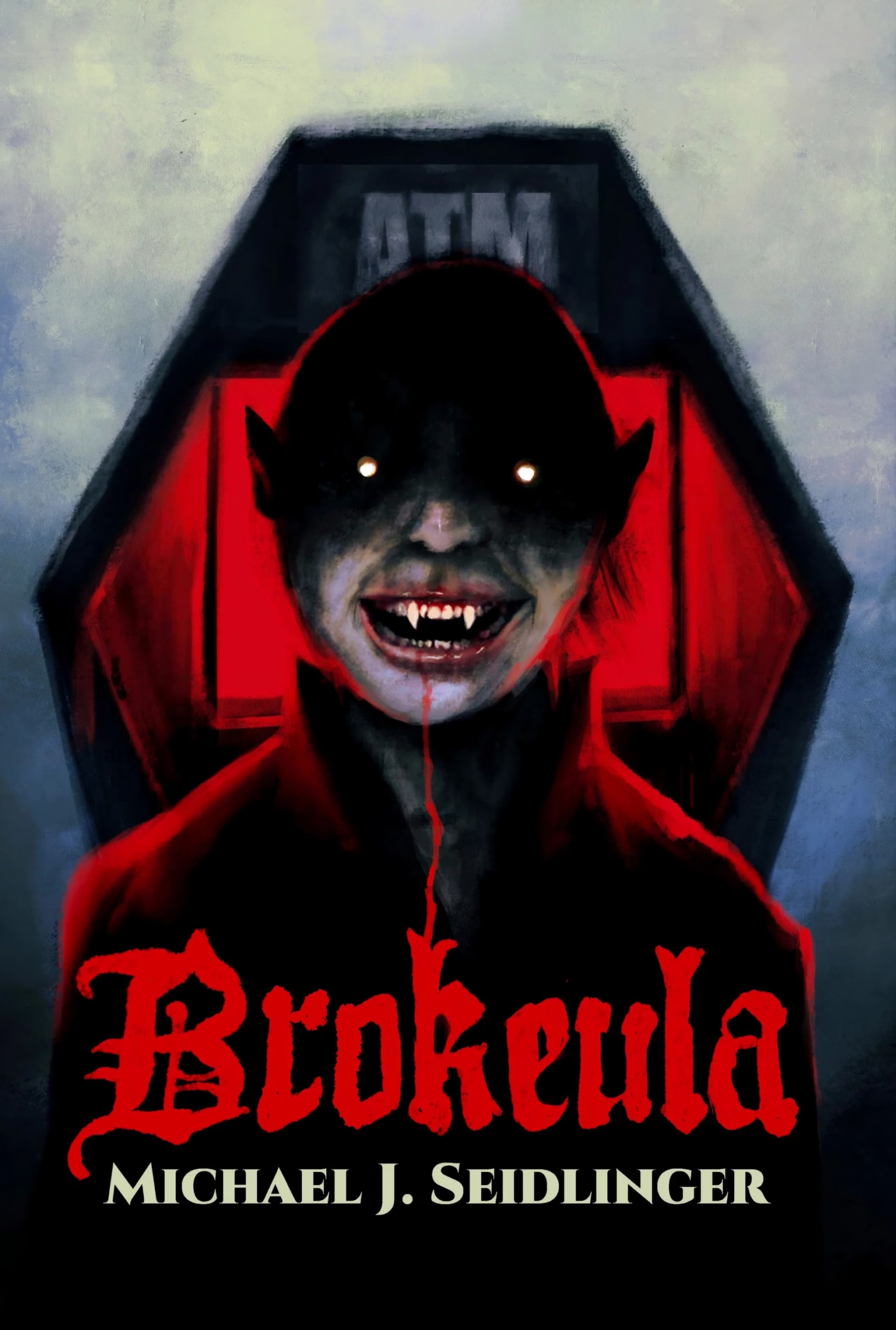
The premise sets a specific formal wager. Satire wants the reader laughing, while horror wants the reader uneasy, and a broke immortal chasing a marketing scheme has to hold both without letting either cancel the other.
Seidlinger’s earlier work suggests how that balance might be struck, a clipped, immediate narration that keeps the reader close to a character coming apart. Whether the comedy sharpens the dread or relieves it is the question the finished novel sets for its reader.
A Myth Stripped of Its Romance
For much of the past half-century the vampire has been a romantic figure. Anne Rice gave it interiority and grandeur, and the paranormal romance that followed made the immortal an object of desire rather than fear.
‘Brokeula’ withholds all of that. There is no castle and no seduction, only a coffin its occupant cannot afford to leave and a hustle he cannot afford to abandon.
The setting completes the inversion. Video-game studios, crypto losses, and a marketing pitch move the vampire out of the manor and into the present’s most ordinary forms of striving, without surrendering the folkloric core of blood, coffin, and un-death.
A Predator Without a Pedestal
The significance of ‘Brokeula’ is not that horror can be funny, which the tradition settled long ago, nor that a vampire can carry an argument, which it has done since Polidori. It is that Seidlinger takes the most over-romanticized monster in the canon and denies it dignity.
A creature that once stood for aristocratic power is put to work as a debtor and a salesman, and the horror lands precisely because the indignity is recognizable. The novel’s wager is that the scariest thing left to do with the undead is to make one of them broke.
Where would you place the broke, scheming vampire of ‘Brokeula’ against the romantic immortals that have shaped the tradition since Anne Rice — a correction to the myth, or a wholly different creature set loose in the same folklore?
References
- Nina Auerbach, ‘Our Vampires, Ourselves’ (Chicago: University of Chicago Press, 1995), 1–9. ↩︎
- Franco Moretti, ‘The Dialectic of Fear,’ in ‘Signs Taken for Wonders: Essays in the Sociology of Literary Forms’ (London: Verso, 1988), 83–108. ↩︎
- Ken Gelder, ‘Reading the Vampire’ (London: Routledge, 1994), 20–41. ↩︎

Leave a Reply