

There is a moment in the history of every long-running band when the title of a release becomes indistinguishable from biography. Hanoi Rocks — the Helsinki glam ensemble whose reckless theatrics in the early eighties drew a generation of Finnish teenagers into the orbit of Anglo-American rock — never had the luxury of survival long enough to name an EP after endurance.
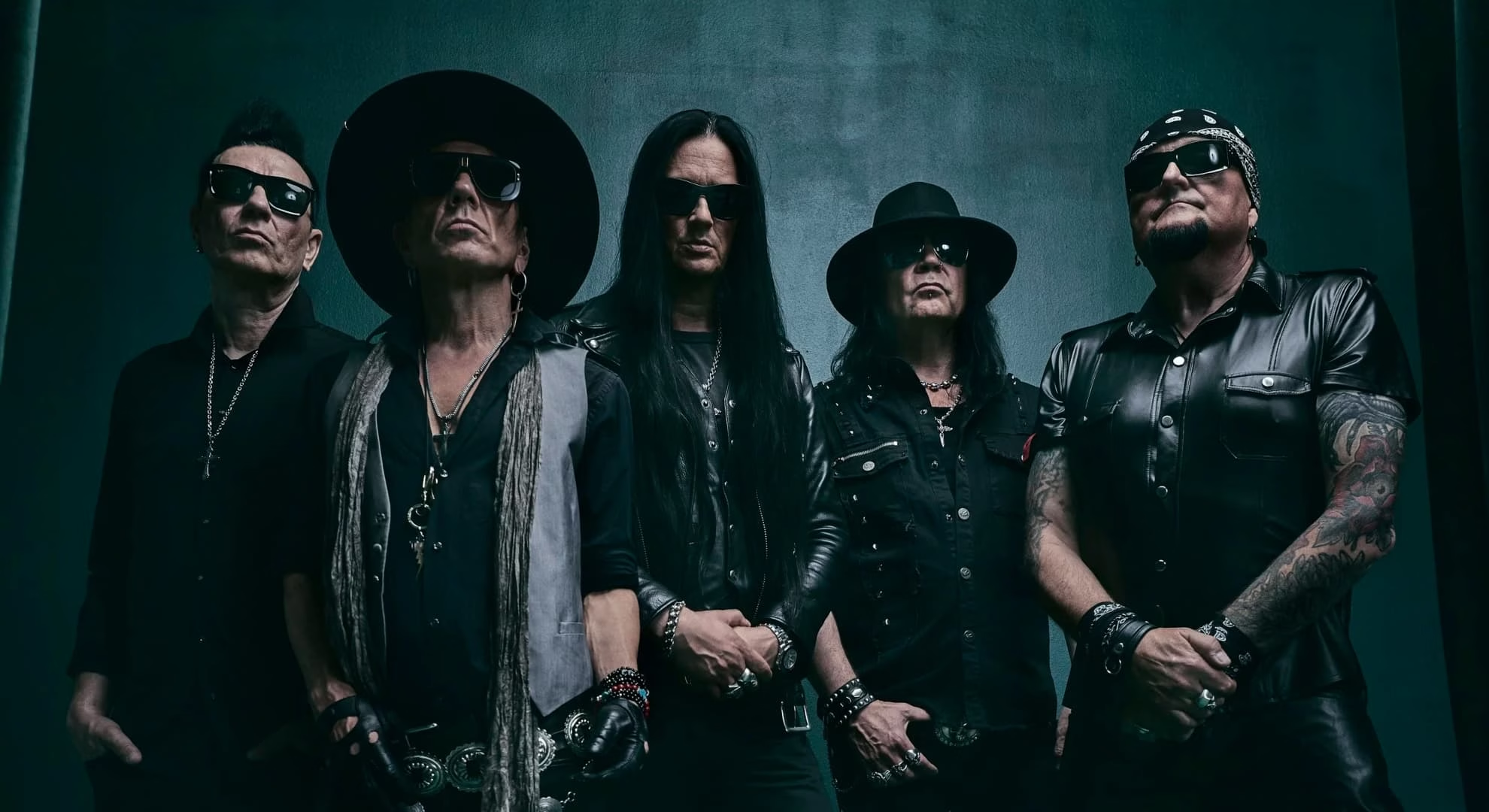
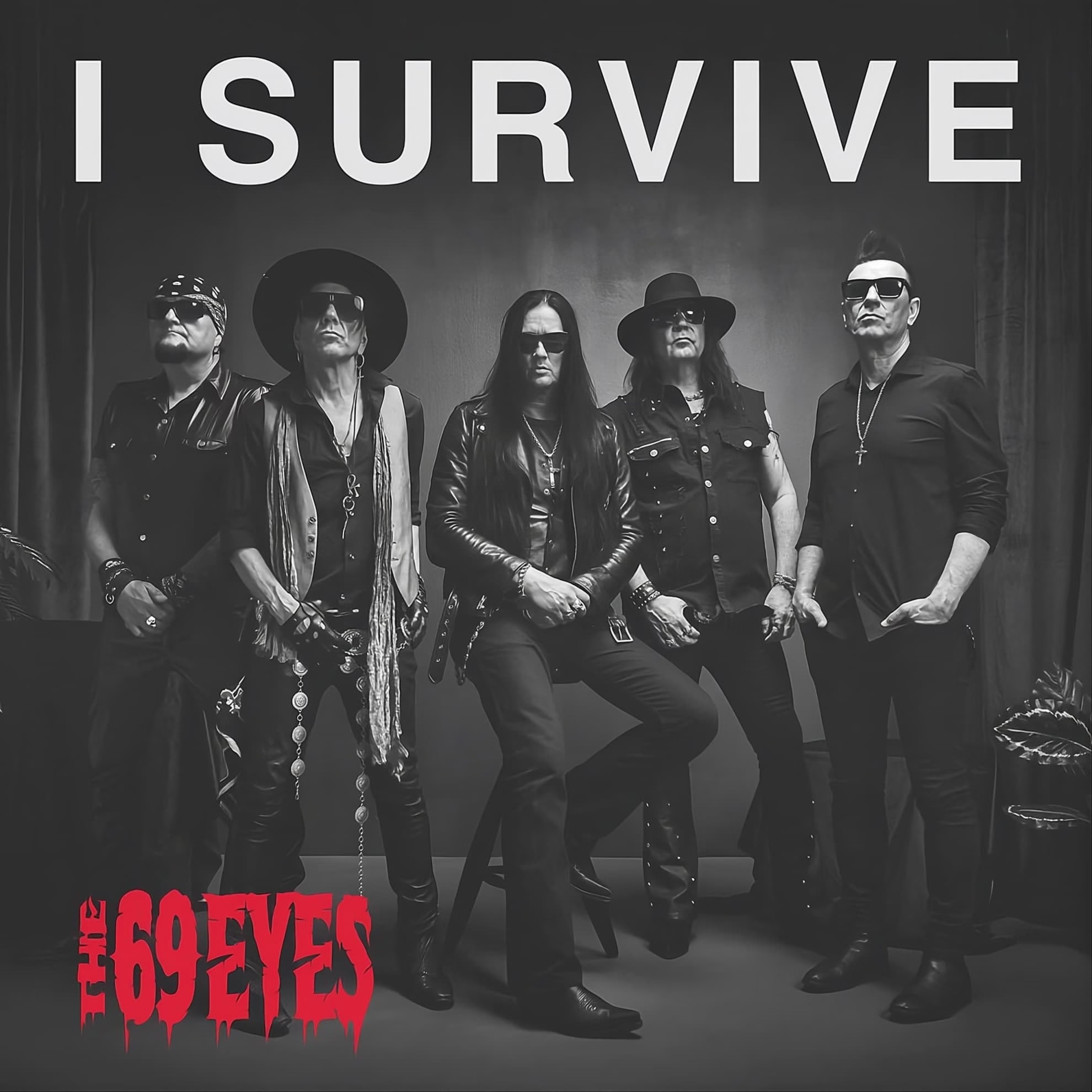
The 69 Eyes, formed in those same Helsinki bars in 1989 by a group of friends who would not change their lineup for thirty-five years, have arrived at exactly that moment. ‘I Survive,’ the four-track EP the band released on June 5th, 2026, via BLKIIBLK, the Frontiers Label Group imprint, is not a retrospective gesture.
It is something more considered: a document of sustained relevance assembled from collaborators whose own careers map the half-century arc from glam theatrics through gothic rock to the American hard rock underground — all of it filtered through a Finnish sensibility that has always absorbed those traditions without being absorbed by them.
A Pivot That Was Never a Revolution
The band’s trajectory from glam metal to gothic rock has been well documented in its own right, but the ‘I Survive’ EP represents a phase beyond that already-complete transformation.
Since the release of ‘Paris Kills’ in 2002 — the record that established the band’s international gothic rock profile — ‘Lost Boys,’ their definitive single, would follow on ‘Devils’ in 2004 — the five Helsinki musicians have operated as one of the genre’s most stable institutional presences.
Their thirteenth studio album, ‘Death of Darkness,’ which this publication covered upon its April 21st, 2023, release, demonstrated a band producing at their established level without audible anxiety about what comes next.1
What ‘I Survive’ announces is a different kind of momentum. The signing to BLKIIBLK, with Finnish distribution retained through Vallila Music House, places the band in a network whose recent rosters include acts oriented toward the intersection of hard rock, glam, and goth at which The 69 Eyes have long operated. The choice is a lateral expansion, not a repositioning — and the EP’s guest credits confirm exactly that logic.
Stevens at the Intersection
Steve Stevens, who co-wrote the EP’s title track with the band, carries a specific genealogical significance that extends well beyond his most recognizable credit.
Born in New York in 1959 and trained at the LaGuardia High School of Performing Arts, Stevens forged his public identity through his partnership with Billy Idol beginning in the early eighties — producing the guitar architecture on ‘Rebel Yell’ (1983) and ‘Whiplash Smile’ (1986) that fused post-punk aggression with a shredder’s technical precision, and winning a Grammy in 1987 for his performance on the ‘Top Gun Anthem.’2
What his presence on ‘I Survive’ introduces is not simply a celebrated name but a specific meeting of vocabularies. Stevens built his sound at the exact intersection where glam spectacle, new wave’s angular economy, and hard rock’s physicality converged — the same intersection from which The 69 Eyes drew their own influences three decades ago.
The fact that Stevens has more recently appeared alongside Ozzy Osbourne on Billy Morrison’s ‘The Morrison Project,’ mixed by Barry Pointer — the same engineer who handled ‘Cold Sweat’ and the rest of the ‘I Survive’ EP — suggests a shared production orbit that preceded this collaboration rather than one assembled for its occasion.
The Thin Lizzy Thread
‘Cold Sweat,’ the advance single released ahead of the EP and accompanied by a video filmed during the band’s January 2026 European tour with D-A-D on the Cowpunks & Glampires circuit, is a cover of the Thin Lizzy track originally released in 1983 — the year of Phil Lynott’s final studio recordings before his death three years later.
Produced by Erno Laitinen, who handled ‘Death of Darkness’ at Inkfish Studios in Helsinki, and mixed by Pointer at his Los Angeles facility, the track situates the EP within a hard rock genealogy distinct from the gothic tradition the band more typically invokes.
That distinction is intentional, not incidental. Jyrki 69 noted in press materials that a decade-old demo of the track had been surfaced by a friend, with Gabi Hakanen of Vallila Music House responding that it captured the band at their essential. What that observation identifies — and what the released version confirms — is that The 69 Eyes “goth’n’roll” synthesis was always capacious enough to hold Thin Lizzy’s twin-guitar melodicism alongside the darker atmospheric instincts the band developed after 1999.3
The video features a cameo by Fernando Ribeiro of Moonspell, the Portuguese gothic metal institution — a presence that threads together two of the oldest continuous gothically-inflected bands operating in Europe, one from Helsinki and one from Lisbon, both now entering their fourth decade.
Mundell and the Heavy Psychedelic Register
Ed Mundell’s contribution to ‘Devil’s Rose,’ the EP’s closing track, pulls from a different tradition entirely. As the lead guitarist of Monster Magnet from their formative period through the band’s most commercially successful phase, Mundell developed a style rooted in the American heavy psychedelic underground — a lineage that runs from Blue Cheer and MC5 through the stoner rock formations of the early nineties, a scene whose relationship to Gothic rock has been one of parallel rather than overlap.
His presence on the EP functions as evidence of reach rather than convergence: a guitarist whose associations lie in a different corner of the hard rock map, engaged here in a meeting of idioms that The 69 Eyes’ own long career has made plausible. A band that has spent thirty-five years absorbing influences without surrendering its own character is precisely the kind of band that such a collaboration neither overwhelms nor is overwhelmed by.
What Pointer Brings to the Console
Barry Pointer’s mixing credits situate ‘I Survive’ within a specific strand of Los Angeles hard rock production — one that encompasses Rob Zombie, John 5, and most recently the Ozzy Osbourne and Billy Morrison collaboration ‘Gods of Rock and Roll,’ on which Stevens himself appeared.
That body of work is defined by a clarity of attack within the low end and a guitar presence that does not sacrifice frequency range for power — a mix aesthetic suited to a band whose strength has always been the coherence of its guitar textures rather than sonic extremity.
Gothic Rock as Survival Mechanism
The four tracks of ‘I Survive’ do not argue for gothic rock’s continued relevance. They simply proceed as though relevance were never in question — which, for a band that has held the same lineup since 1992 without softening its commitments, is the only sustainable position.
The collaborators gathered here — Stevens from the glam-punk underground of eighties New York, Mundell from the heavy psychedelic circuit of New Jersey, Ribeiro from Lisbon’s gothic metal scene — each represent a different axis of influence that the band has always operated within without explicitly acknowledging.
‘I Survive’ brings together musicians from three distinct corners of the hard rock and gothic underground — does the gathering of those different lineages on a single four-track EP illuminate something about the breadth of The 69 Eyes’ own position in that tradition, or does it raise a question about where the band’s center of gravity now lies?
References
- Simon Reynolds, ‘Rip It Up and Start Again: Postpunk 1978–1984’ (New York: Penguin Books, 2005), 312–318. On the consolidation of post-punk and glam idioms in early-eighties Anglo-American rock and the conditions that produced the gothic rock synthesis. ↩︎
- Deena Weinstein, ‘Heavy Metal: The Music and Its Culture,’ revised ed. (New York: Da Capo Press, 2000), 99–105. On the virtuoso guitarist as co-author of commercial hard rock identity and the role of guitar vocabulary in establishing genre legibility. ↩︎
- Mark Prendergast, ‘The Ambient Century: From Mahler to Trance: The Evolution of Sound in the Electronic Age’ (New York: Bloomsbury Academic, 2000), 211–217. On the absorption of Anglo-American rock traditions into Northern European popular music cultures from the late seventies onward. ↩︎


Leave a Reply