


The history of heavy metal is, in its most essential distillation, a history of transgression. It is a genre that has spent five decades mapping the topography of the forbidden, from the tritone intervals that saw Black Sabbath accused of summoning the devil to the church burnings of the Scandinavian second wave that sought to enact a literal scorched-earth policy against Christendom. Yet, within this vast and often chaotic lineage of sonic rebellion, there exists a rarefied strata of artists who do not merely seek to shock, but to chronicle.
These are the historians of the abyss, the composers who recognize that true heaviness is found not just in the distortion of a guitar, but in the weight of the stories that define the human condition. It is in this high-altitude atmosphere, where the air is thin and the ambition is vertiginous, that the Italian trio Genus Ordinis Dei has chosen to build their fortress.
With the announcement of their latest opus, ‘The Land East Of Eden,’ which is scheduled for release on January 16, 2026 via Eclipse Records, this ensemble from Crema has declared their intention to elevate their craft from the realm of historical fiction into the terrifying clarity of foundational mythology.
If their previous work, the critically lauds ‘Glare of Deliverance,’ was a masterclass in narrative specificity—chronicling the persecution of a fictional inquisitor’s victim—then ‘The Land East Of Eden’ represents a shift toward the universal. The title alone, stripped from the fourth chapter of ‘Genesis,’ evokes the primal desolation of the first human exile. It is a phrase that carries the dust of the Levant and the silence of a God who has turned His back.
For a band that has spent over a decade refining a precise alchemy of symphonic grandeur and technical death metal precision, this subject matter offers the ultimate canvas: the story of Cain, the first murderer, and his banishment to the land of Nod.
Genus Ordinis Dei: The Italian Extremity
The roots of this release’s significance lie in its origins. Italy has always been a distinctive exception within the international metal scene—a country where the influence of operatic masters like Verdi and Puccini persists, subtly shaping the sound even in the rehearsal spaces of its most aggressive death metal acts.
While the Bay Area of San Francisco birthed the staccato violence of thrash and Gothenburg cultivated the melodic dual-guitar harmonies of Swedish death metal, Italy spent the late 1990s and early 2000s nurturing a scene defined by a unique tension between virtuosity and melodrama. It is a culture that inherently understands the power of the spectacle.
In the late 1990s, Rhapsody (later Rhapsody of Fire) introduced the world to “Hollywood Metal,” a style deeply indebted to high fantasy and film scores. They posited that a double-kick drum could serve the same propulsive function as a galloping horse in a cinematic epic. Later, acts like Lacuna Coil brought a gothic, accessible sheen to the Italian sound, proving that heavy music could possess a seductive, melancholy beauty.
However, the true spiritual predecessors of Genus Ordinis Dei are the titans of the technical and symphonic death metal scene: Fleshgod Apocalypse and Hour of Penance. These bands stripped away the fantasy whimsy of power metal and replaced it with a brutal, militaristic chassis, retaining the orchestral elements but deploying them to evoke apocalypse rather than adventure.
Genus Ordinis Dei emerged from this crucible in 2011, originally forming in the Lombardy region. Their name, Latin for “The Kind (or Gender) of the Order of God,” immediately signaled their fascination with religious hierarchy, ritual, and the archaic. Unlike their peers who often focused on sheer velocity—the arms race of beats per minute that defined much of the death metal underground in the 2000s—Genus Ordinis Dei gravitated toward the mid-tempo stomp of groove metal.
They recognized early on that heaviness is often a function of space, not just speed. Their sound is built on the interaction between the seven-string guitar and the symphonic arrangement, a dialogue where the cello and the palm-muted riff perform a synchronized dance of percussion.
The release of their debut, ‘The Middle,’ in 2015 was a raw declaration of intent, but it was 2017’s ‘Great Olden Dynasty’ that solidified their identity. Featuring Cristina Scabbia of Lacuna Coil on the track ‘Salem,’ the album proved that Genus Ordinis Dei could attract mainstream metal attention without sacrificing their abrasive edge.
Yet, even ‘Great Olden Dynasty’ feels like a prelude when viewed against the sprawling ambition of what followed. The band was not content to write isolated tracks; they wanted to write chapters. This desire culminated in 2020 with ‘Glare of Deliverance,’ a concept album that essentially functioned as a heavy metal opera, complete with a series of interconnected music videos that told a continuous story.
It is within this lineage that ‘The Land East Of Eden’ must be viewed. It is the logical progression of a band that has spent a decade learning how to weave the orchestra into the mosh pit. They are not merely adding strings to death metal; they are composing death metal that thinks like a symphony.
‘The Land East Of Eden’ Structure of Exile
‘The Land East Of Eden’ promises a significant sonic evolution, moving the band’s thematic focus from the confined setting of the Inquisition (the subject of their previous work) to the expansive, desolate wilderness of the biblical narrative. Early teasers and press materials point toward a more organic and stark production style compared to their previous output.
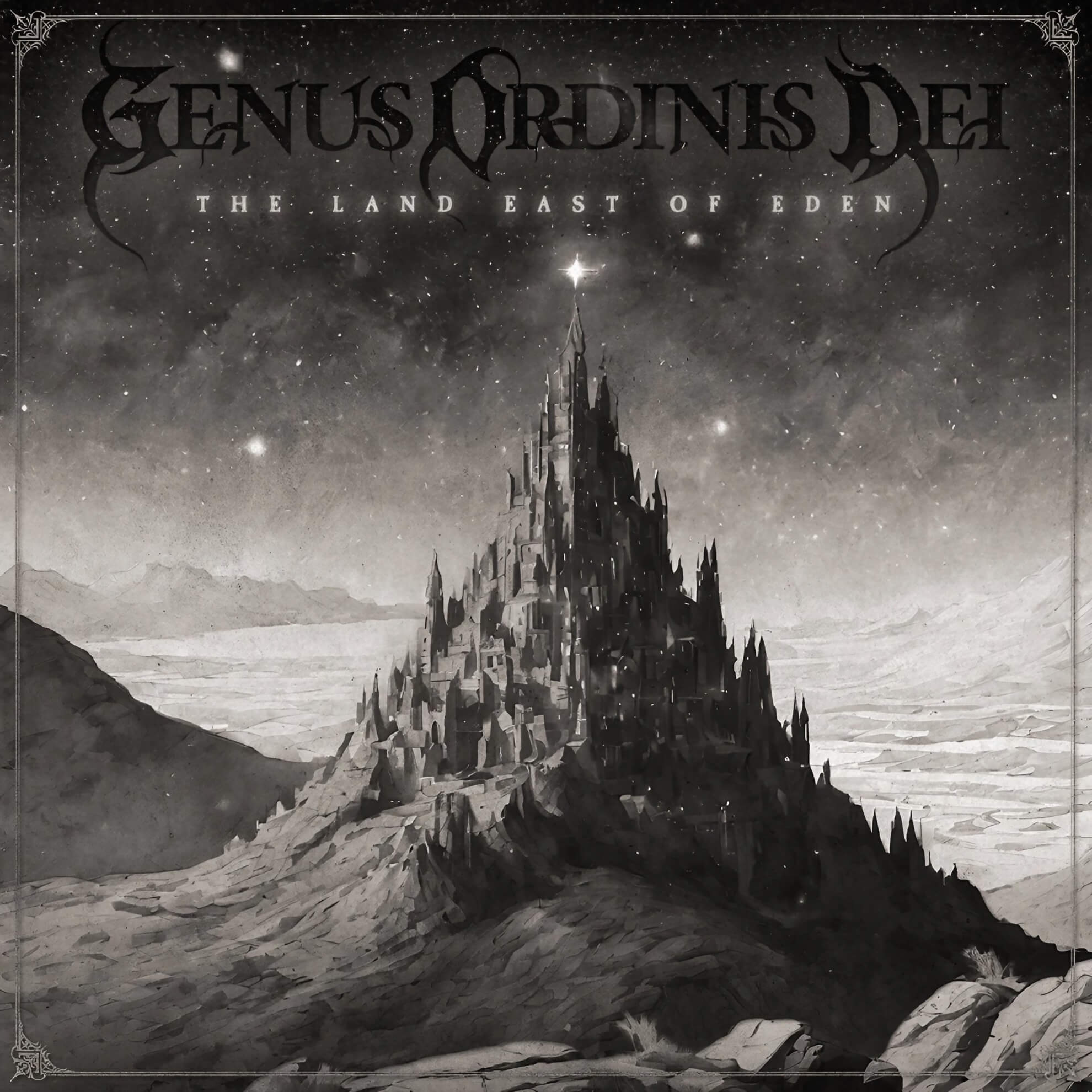
To engage with ‘The Land East Of Eden’ is to engage with one of the foundational texts of Western civilization. The story of Cain and Abel, found in ‘Genesis,’ is not merely a story of murder; it is the archetype of fratricide, jealousy, and divine caprice. The title refers specifically to the destination of Cain after his judgment: “And Cain went out from the presence of the Lord, and dwelt in the land of Nod, on the east of Eden.”
In Hebrew, “Nod” (נוֹד) stems from the root verb “to wander” (לנדוד). Thus, Cain is not exiled to a specific place, but to a state of wandering. He is sentenced to be a fugitive. This concept of “placelessness” is a potent theme for a metal album. Metal has always been the music of the outsider, the exile, the one who does not fit within the walls of the “garden” (society).
Genus Ordinis Dei approaches this material not as preachers, but as dramatists. They are interested in the human element of the myth. What does it feel like to be the first human to take a life? What is the psychological weight of the “Mark of Cain”—the divine protection that is also a curse, ensuring that no one can kill you, forcing you to live with your guilt?
The narrative arc of the album appears to follow the chronology of the fall, beginning with “The Offering,” where the rejection of Cain’s sacrifice sows the seeds of resentment. This tension escalates into “The Act,” depicting the first murder in the field, a moment of irreversible transgression. Following the violence comes “The Judgment,” a terrifying confrontation with the “Divine Voice” that seals his fate. Finally, the story concludes with “The Exile,” marking his departure into the land of Nod.
This structure allows the band to explore a wide range of emotional and sonic territories, from the jealousy and rage of the opening tracks to the crushing doom and isolation of the finale.
The Genesis of the “Embassy” Sound
Tommy Mastermind, the band’s guitarist and producer, is essential to the Genus Ordinis Dei sound. Mastermind, whose studio is jokingly called the “Embassy of the Groove,” has developed a sonic signature that is incredibly dry, punchy, and articulate. The producer’s influence is often as crucial as that of the songwriter, a role Mastermind fully embodies.
Where many symphonic bands drown the guitars in reverb to blend them with the orchestra, Mastermind tends to keep the rhythm guitars surgically precise, placed front and center in the mix.
On ‘The Land East Of Eden,’ this precision is expected to be juxtaposed against a more expansive, atmospheric backdrop. The theme of “Exile” suggests vastness—windswept plains, lonely wanderings. We can anticipate that the orchestral elements will move away from the baroque harpsichords and organs of ‘Glare of Deliverance’ toward more primitive, organic sounds: tribal percussion, woodwinds, and perhaps the use of the duduk or other Middle Eastern instrumentation to evoke the Levantine setting of the ‘Genesis’ narrative.
The Revealed Chronicles: Singles and Visuals
While the full album awaits release, the arrival of the lead singles offers a definitive glimpse into the creative direction of ‘The Land East Of Eden.’ We are no longer dealing with mere speculation; the band has planted their flag in the soil of Nod.
‘East of Eden’ (featuring Roy Khan)
Serving as the album’s thematic anchor, this track does more than merely feature Roy Khan (Conception, ex-Kamelot); it casts him as a sonic foil to the narrative’s brutality.
Amidst the chugging, down-tuned aggression of the rhythm section, Khan’s voice emerges not as a duet partner but as a distinct entity—ethereal, sorrowful, and commanding. The interplay creates a “sacred versus profane” dynamic, where Nick K’s guttural delivery embodies the earthy, violent reality of Cain, while Khan’s operatic range occupies the space of the Divine or the lost Paradise.
The production of ‘East of Eden’ emphasizes this separation, often stripping back the metallic chaos to let the symphonic elements and Khan’s lament breathe, before plunging back into the heaviness of the exile.
‘Awakening’
Functioning as a pivotal narrative beat—situated later in the album’s chronology—the ‘Awakening’ represents a moment of terrifying realization for the exiled protagonist. If ‘East of Eden’ chronicles the initial flight, ‘Awakening’ suggests the moment where the adrenaline fades and the eternal weight of the curse settles in.
Visually, the music videos accompanying these releases have set a high bar, continuing the band’s tradition of cinematic storytelling. Moving away from standard performance tropes, the visualizers function as short films, utilizing chiaroscuro lighting heavily influenced by Caravaggio.
The imagery likely depicts the protagonist grappling with his new reality, transforming the “Mark of Cain” from a theological concept into a visceral, physical burden.
The Mark of the Artist
Ultimately, ‘The Land East Of Eden’ transcends a mere set of tracks. It stands as a potent indication of the timeless resilience of myth and the limitless potential for heavy metal to evolve. Genus Ordinis Dei has forged this ancient narrative, subjecting it to the intensity of contemporary production and technical skill.
They have proven that one can be brutal without being mindless, and symphonic without being soft. They have walked into the desert of the creative process and returned with something that feels both ancient and urgently new. As the final notes of the album fade—leaving the listener in the sonic equivalent of the wilderness—one is left with the distinct impression that this band is no longer following in the footsteps of giants. They are leaving footprints of their own.
Before we journey into ‘The Land East Of Eden’—an aural depiction of the first exile—let us consider our relationship with heavy music. Specifically, how does incorporating foundational mythology into modern metal shift our understanding of these age-old narratives? Does the intense sonic experience offer a more visceral connection to the myth’s core reality than a conventional narrative ever could?
Leave a Reply