


The skies over West Yorkshire have always seemed to possess a unique gravity, a relentless slate-grey weight that presses down upon the Victorian architecture of Halifax. It is from this dour, rain-slicked landscape that Paradise Lost has broadcast its lamentations for nearly forty years, providing a soundtrack to the slow decay of the industrial age.
As historian Eric Hobsbawm noted regarding the psychological toll of the Industrial Revolution on the North, the landscape itself seems to enforce a “melancholy regularity” upon its inhabitants, a sentiment that permeates the region’s cultural output.1 Yet, the arrival of ‘Ascension’ on September 19, 2025, via Nuclear Blast Records, feels less like a routine addition to a storied discography and more like a necessary intervention in a culture increasingly obsessed with its own decline.
Emerging from a five-year silence—the profoundest gap in the band’s thirty-seven-year history—this sixteenth studio album is a monolith built from the debris of the post-pandemic world. It is a dense, sonic artifact that captures a band in the midst of a sophisticated alchemy: reconciling the raw, subterranean doom of their origins with the polished, gothic romanticism that transformed them into global icons.
As the final recording to feature drummer Guido Zima Montanarini, ‘Ascension’ stands as a pivotal document of transition, a record that repurposes the band’s signature melancholia to diagnose the spiritual maladies of the modern era. Here, the architects of the “Peaceville Three” sound do not merely revisit their past; they weaponize it to confront the fallacy of hope and the tyranny of grief in an uncertain future.
The Years of Dust and Silence
To understand ‘Ascension,’ one must first understand the vacuum from which it emerged. The band’s previous album, ‘Obsidian’ (2020), was a critical triumph, a record that effortlessly synthesized the disparate eras of their career into a cohesive whole. However, its release coincided with the onset of the global pandemic, a catastrophe that severed the vital connection between the band and their audience.
Tours were cancelled, momentum was stalled, and the members of Paradise Lost found themselves isolated in their respective homes, staring into an uncertain future.
Purging the Synthetic Ghost
During this enforced hiatus, the creative energies of the band’s core songwriting duo—guitarist Gregor Mackintosh and vocalist Nick Holmes—did not lie dormant. Instead, they diverted their focus to a side project, Host, releasing the album ‘IX’ in 2023. This project was a revisit to the electronic, synth-driven sounds that characterized Paradise Lost’s controversial late-90s era (specifically the 1999 album ‘Host’).
The existence of the Host project is crucial to understanding the sonic profile of ‘Ascension.’ By channeling their softer, more electronic impulses into a separate vessel, Mackintosh and Holmes effectively “purged” those elements from the Paradise Lost songwriting queue.
Resurrecting the Old Gods
Perhaps the most significant factor in shaping ‘Ascension’ was the band’s decision to re-record their 1993 masterpiece, ‘Icon,’ released as ‘Icon 30’ in 2023. This was not merely a commercial exercise to reclaim rights or celebrate an anniversary; it was a masterclass in rediscovery.
For Mackintosh, this archaeological dig into his own fretboard was a revelation. “It took me back to a style that I had not really thought about in a long time,” he admitted, reflecting on the tactile memory of his early work. “I did not realize how much my style had changed over the years.”
Revisiting ‘Icon’ meant reconnecting with a “meat and potatoes” approach to metal—stripping away the layers of modern production polish to find the raw power of the riff. It meant dusting off the old Marshall JCM800 amplifiers and remembering the tactile joy of simple, effective heavy metal composition.
This “back to basics” philosophy bled directly into the writing sessions for ‘Ascension.’ The new album is not a clone of ‘Icon,’ but it shares that record’s muscularity, its lack of pretension, and its reliance on the interplay between Mackintosh’s weeping lead lines and Aaron Aedy’s rhythmic chug.
Burning the Blueprints
The path to ‘Ascension’ was not linear. Mackintosh revealed that prior to the ‘Icon’ re-recording, he had written “about six or seven songs” for the new album, only to scrap the entire lot. Mackintosh’s assessment of his initial attempts was brutal and immediate. “It was the total wrong vibe for me,” he confessed, prioritizing artistic integrity over convenience. “I just scratched the whole lot because I did not like it.”
This willingness to destroy mediocre work is a hallmark of the “discerning critic” within the artist himself, a phenomenon sociologist Andy Bennett describes as essential for “aging” artists to maintain authenticity within subcultures that value consistency over novelty.2 It suggests that ‘Ascension’ is not just “the next batch of songs,” but a curated selection that survived a rigorous internal quality control process. The material that remains is purposeful, cohesive, and devoid of filler—a covenant to a band that refuses to coast on its legacy.
The Theology of Descent
The title ‘Ascension’ is a masterstroke of irony, a linguistic trap set for the unwary. In a genre often obsessed with occult power or satanic majesty, “Ascension” might suggest a rising up, a spiritual transcendence, or a apotheosis. However, in the lexicon of Nick Holmes, a lyricist known for his “curmudgeonly sage” persona and biting secular humanism, the term takes on a darker hue.
Holmes explains that the title refers to the human delusion of the “deathbed conversion”—the belief that one can “rise to the better place” regardless of the life they have lived, simply by believing in the right deity at the final moment.
He dismantles the concept with his trademark nihilistic wit: “In real life, people are often striving to get to a better place from birth… regardless of the fact that the only reward is death.” This cynical view aligns with Philippe Ariès’s analysis of the “tame death,” where modern society attempts to strip death of its finality through ritualized hope, a practice Holmes aggressively rejects.3
Thus, ‘Ascension’ is not about going up; it is about the futile desire to go up. It is a critique of the stories we tell ourselves to mask the terror of oblivion. It is an album about the “requirements that go with” the belief in heaven, and the crushing reality that, in Holmes’s view, “the only reward is death.” This thematic thread runs through the album like a vein of black ore—from the ‘Serpent on the Cross’ representing the corruption of faith, to the ‘Silence Like the Grave’ that awaits us all.
Gazing at the Court of Death
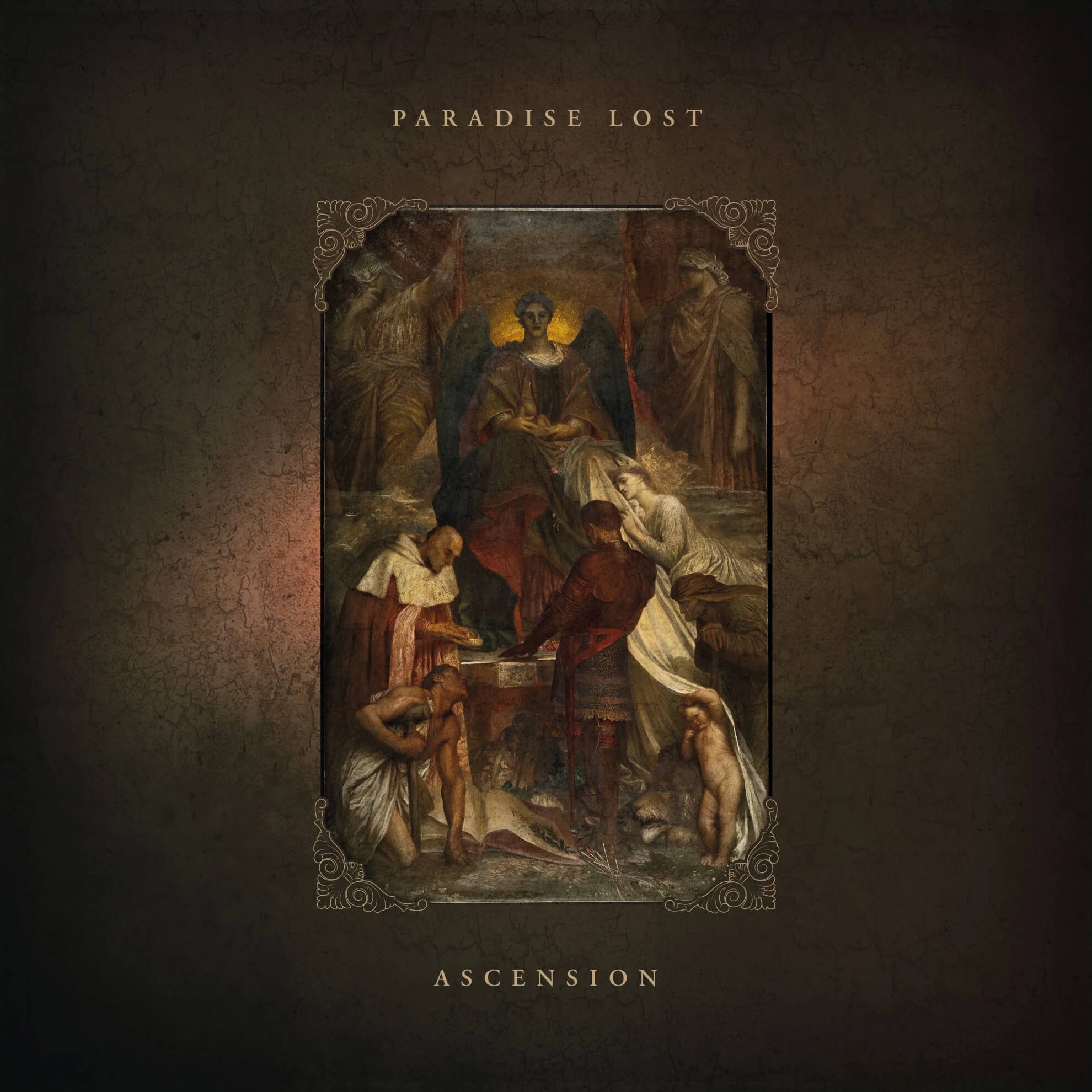
The visual identity of the album reinforces this theme of inevitable decline. The cover art is a reproduction of ‘The Court of Death’ (c. 1870-1902) by the Victorian symbolist painter George Frederic Watts.
The painting depicts a monumental, winged figure of Death, seated on a throne, cradling a swaddled infant. Flanking this central figure are personifications of Silence and Mystery. At the foot of the throne, representatives of human society—a warrior surrendering his sword, a duke laying down his coronet, a cripple dropping his crutch—bow in submission.
The choice of this artwork is significant for several reasons. First, it connects Paradise Lost to the “Grand Tradition” of classic metal albums that utilized high art (think of Morbid Angel using classical paintings or Celtic Frost’s use of Bosch). “We always loved when old thrash and death metal albums had grand master-type paintings,” Holmes notes, linking their aesthetic choices to the genre’s golden age.
Second, it situates the album within a specifically English tradition of melancholy. Watts was a Victorian, living in an era obsessed with mourning and the macabre, often referred to by art historians as the “Cult of Death.”4 His work is grand, allegorical, and deeply sombre—perfect adjectives for the music of Paradise Lost.
The image subverts the traditional religious iconography of ascension. Usually, figures in Renaissance art look up to God in the sky. Here, they look down or forward at Death. The “Ascension” is a lie; the reality is the Court of Death, where all status is stripped away and only the silence remains.
Forging the Black Planet Sound
The production of ‘Ascension’ is a character in itself. Helmed by Gregor Mackintosh at his own Black Planet Studios in East Yorkshire, with drums and vocals captured at NBS and Wasteland studios in Sweden, the album possesses a sonic signature that is distinct from its predecessors.
An Unfiltered Vision
Mackintosh’s role as producer has allowed for an unfiltered expression of the band’s vision. There is no external hand smoothing over the rough edges or pushing for radio-friendly structures. The result is a sound that critics have described as “crystalline” yet “harsh,” a production that “enhances the emotional gravity of each track rather than smothering it.”
This balance is difficult to achieve. Too clean, and the doom loses its menace; too raw, and the intricate melodies get lost in the mud. Mackintosh, drawing on decades of experience, has found the “sweet spot.” He makes use of modern technology—digital modeling, remote file sharing—but anchors it in vintage analog warmth.
The Analog Resurrection
As mentioned, the re-recording of ‘Icon’ led to the resurrection of the band’s original Marshall JCM800 amplifiers. These amps, legendary in the rock world for their mid-range “crunch,” provide the rhythmic backbone of ‘Ascension.’
Unlike the high-gain, saturated distortion of modern metal (which can often sound like “fizz”), the JCM800 sound is woody, organic, and articulate. When Aaron Aedy plays a chord, you can hear the individual notes ringing out within the distortion. This gives riffs like those on ‘Sirens’ or ‘Deceivers’ a classic heavy metal punch—a “thundering classic metal” sound that critics have compared to the ‘Black Album’-era Metallica or early Alice In Chains. It is a sound that occupies physical space, pushing air with a visceral authority.
The Final Percussive March
‘Ascension’ marks the final recorded performance of drummer Guido Zima Montanarini, who departed the band in May 2025. His performance here is described as “bombastic and precise,” driving the emotional pulse of the album.
While some critics have noted that the drums lack the specific “rhythmic brutality” of previous drummer Waltteri Väyrynen (who played on ‘Obsidian’), Montanarini’s playing is praised for its “heavy conviction” in the slower moments. He understands the space required for doom; he does not overplay.
On tracks like ‘Salvation,’ his drumming is funereal, a slow march to the gallows. On ‘Deceivers,’ he unleashes a “super charged” barrage that proves he can handle the faster tempos.
It is worth noting that for the upcoming tours and videos, the band has welcomed back Jeff Singer, a veteran of the ‘In Requiem’ era. This revolving door of drummers has become a running joke in the band (reminiscent of Spinal Tap), but it also ensures that the core duo of Mackintosh and Aedy remain the defining architects of the sound.
Into the Sonic Maëlstrom
‘Ascension’ is a journey of fifty-one minutes (in its standard guise) that traverses the spectrum of the band’s history. It is a curated collection of misery, structured to pull the listener deeper into the void.
‘Serpent on the Cross’ (6:12)
The album opens with a statement of intent. ‘Serpent on the Cross’ begins with ornate guitar lines weaving an elegant melody over waves of distortion, a classic Paradise Lost intro that immediately establishes the mood: majestic, sorrowful, and grand.
The song’s lyrics deliver a scathing indictment of religious deception. The powerful subversion of religious imagery is evident in the vision of the serpent—traditionally representing Satan, knowledge, or corruption—usurping the Christ figure on the cross. Holmes’s snarling vocalization emphasizes the fall, declaring that “The deluded righteous will fall / Before the serpent on the cross.”
The dynamic core of the track lies in its mid-song transition, which abandons a characteristic doom crawl for an aggressive, thundering classic metal gallop driven by double-bass drumming. This move, shifting from atmospheric melancholy to raw aggression, serves as a powerful reminder that Paradise Lost remains fundamentally a metal band and is a defining element of the album.
Nick Holmes’s performance is particularly striking, showcasing a revitalized vocal approach that spans raw growls and clear baritone, expertly capturing a mood of both despair and defiance.
‘Tyrants Serenade’ (4:20)
If the opener was the storm, ‘Tyrants Serenade’ is the grey aftermath. The tempo slows, the groove deepens, and the atmosphere becomes suffocating.
The “tyrant” of the title is a metaphor for grief itself. Holmes provides a chilling gloss on the lyrics, personifying grief as an active, malicious agent: “The God of Malevolence serves as an internal voice to dismantle those cherished memories and reintroduces the initial anguish of loss.” The song explores how the changing of seasons can trigger painful memories of the dead—a silent lament that turns memory against the mourner.
‘Ascension’ is a masterful piece of gothic metal, achieving musical perfection. The track is built on a foundation of a powerful chugging groove and a stunning melodic guitar line, drawing comparisons to the classic ‘Draconian Times’ era. The song achieves a unique blend of intimacy and the apocalyptic, lyrically expressing the isolation of grief with a bleak serenity. This emotional depth is further enhanced by vocalist Holmes’s matured clean vocals in the chorus, a texture evocatively described as “glistening wine.”
‘Salvation’ (7:07)
The centerpiece of the album, ‘Salvation’ is a sprawling epic that sees the band pushing their boundaries into progressive doom. At over seven minutes, it is the longest track, and it utilizes that space to build a towering edifice of sound.
The track is notable for the guest appearance of Alan Averill, vocalist of the Irish pagan metal band Primordial. Averill’s voice—a dramatic, soaring wail—provides a haunting counterpoint to Holmes’s grit. This collaboration introduces a “pagan metal” element to the band’s sound, a subtle shift that adds a new dimension of ancient, earthy dread.
“A wretched dog afraid seeks God’s Salvation”—this desperate lyrical plea captures the bargaining phase of grief, the moment an atheist might cry out in the dark. Paradoxically, Mackintosh incorporates a festive element into this funereal atmosphere, using sleigh bells in the rhythm section alongside a magical spidery melody.
Mackintosh notes the dark humor in this musical fusion: “It is a full-on Christmas song… but, you know, like an alternative, miserable Christmas.” This juxtaposition of the festive and the bleak is quintessentially Paradise Lost, illustrating their knack for finding the absurdities within profound darkness.
‘Silence Like The Grave’ (4:46)
Chosen as a lead single, ‘Silence Like The Grave’ is the album’s anthem. It is a track built for the stage, with a bombastic rhythm that critics have universally compared to the ‘Black Album’ era of Metallica.
The song addresses the “pointlessness of war” and the “horrors of disease,” themes that resonate strongly in the post-pandemic, conflict-ridden world of 2025. The chorus—”Preach to all like a prophet from long-dead tales”—is an earworm, catchy enough for radio but heavy enough for the pit.
This track wears the responsibility of a single well. It balances immediacy with depth, featuring a hook built from despair. When Holmes drops back into gutturals in the bridge, it feels like a claw from under the floorboards dragging the track down. It is the most accessible entry point to the album, a reminder of the band’s ability to write massive, stadium-sized rock songs without compromising their gothic identity.
‘Lay A Wreath Upon The World’ (4:51)
Here, the album takes a turn into the ethereal. ‘Lay A Wreath Upon The World’ opens with acoustic guitars and strings, a little calm amidst the storm.
The track features backing vocals from Heather Thompson (formerly of Tapping The Vein), whose sublime wailing adds a ghostly, feminine presence to the proceedings. The song explodes abruptly from its quiet intro into a crushing middle section, a dynamic shift that mimics the sudden onset of grief.
The lyrics are apocalyptic: “As Hell ascends to greet the Earth / Our descent will be the birth.” It is a song about the end of the Anthropocene, a funeral for the planet itself.
Critically, this track has been divisive. Some praise its particularly potent and beautiful exploration of surrender. Conversely, others label it the worst track on ‘Ascension,’ criticizing it as a lethargic ballad that takes far too long getting to the point. This polarization highlights the risk inherent in the band’s slower, more atmospheric numbers—they require patience, and for some, the payoff does not justify the wait.
‘Diluvium’ (5:47)
‘Diluvium’ (Latin for “Flood”) returns the listener to the doom. It begins with a slightly psychedelic doom flourish before settling into a vibrant gothic metal runner.
The track is defined by its guitar work. Mackintosh’s melodies writhe like snakes in a pit, creating a sense of unease and fluidity. The song builds slowly, dragging out the riffs and beats until a phenomenal ending where the electrifying melodic-earworms take over. Tragically, it deals with being overwhelmed—by emotion, by history, by the “flood” of time. It is a track that demands immersion; for those willing to drown in it, it is a highlight. For those seeking aggression, it can feel like “drift.”
‘Savage Days’ (3:54)
‘Savage Days’ is a nostalgic nod to the band’s mid-90s era, specifically the ‘One Second’ album. It features powerful ballad-like sections and swathes of distorted guitars, blending the electronic textures of their gothic rock phase with their current heaviness.
The “savage” of the title refers not to violence, but to the cruelty of time and memory. The vocal delivery here is cleaner, offering breathing space after the heaviness of the preceding tracks. It is a beige entry for some critics who prefer the heavier material, but for fans of the band’s more commercial gothic rock output, it is a welcome return to form.
‘Sirens’ (4:46)
‘Sirens’ is perhaps the most traditional heavy metal track on the album. It opens with guitar riffs that mimic the sound of air-raid sirens—a literal interpretation of the title that transitions into an old school barrage of chugging riffs.
The chorus has drawn comparisons to Tool, with its vocal effects and superb winding melody. The structure is tight, driving, and energetic. It serves as a wake-up call in the album’s second half, injecting a dose of adrenaline and “Metallica-ish” groove that gets heads banging.
‘Deceivers’ (3:37)
The shortest and fastest track, ‘Deceivers’ is a super charged burst of aggression. Driven by Jeff Singer’s (credited) thunderous drums, it packs a punch with every snare hit.
This track channels the spirit of “early Trouble-gone-gothic,” combining the speed of thrash with the gloom of doom. It is a superior variant of the band’s faster tracks like ‘Universal Dream,’ proving that even in their 50s, Paradise Lost can still play fast and hard when the mood strikes.
‘The Precipice’ (5:42)
The standard edition closes with ‘The Precipice,’ a cinematic finale that synthesizes all the album’s elements. It begins with ghostly voices and piano lines before descending into a volcanic flow of scorching riffs.
Nick Holmes gives one of his most visceral performances here, sounding like he is gargling razor blades. The contrast between the delicate piano intro and the brutal verses captures the album’s central tension: the fragility of life versus the crushing weight of reality. It brings the album to a dark, yet hopeful conclusion, leaving the listener standing on the edge, looking down into the void, but still standing.
The Bonus Tracks: ‘This Stark Town’ and ‘A Life Unknown’
For those with the limited edition (or streaming the deluxe version), the journey continues with two significant tracks. ‘This Stark Town’ features an Alice In Chains-like verse and a snarling vocal from Holmes that is borderline demonic. It explores the decay of urban landscapes, perhaps a nod to the band’s grim Northern roots in Halifax.
‘A Life Unknown’ closes the expanded experience with a glam stomp beat and wandering guitars reminiscent of Billy Duffy from The Cult. This post-punk influence has always been part of Paradise Lost’s bloodline, and here it rises to the surface, ending the album on a rhythmic, almost danceable note of defiance.
Voices From Beyond the Veil
‘Ascension’ is notable for its use of guest vocalists, a rarity in the Paradise Lost catalog. Alan Averill, the frontman of Ireland’s Primordial, brings a specific gravitas to ‘Salvation.’
Averill is a scholar of extreme metal history and a vocalist known for his emotive, storytelling style. His band mixes black metal with Irish folk and history, often dealing with tragedy and resistance. His presence on ‘Ascension’ acts as a bridge between the English gothic doom of Paradise Lost and the Celtic pagan metal tradition. It validates Paradise Lost’s “heavier” credentials while adding a theatrical flair that fits the album’s grand scope.
Heather Thompson, formerly of Tapping The Vein, has collaborated with the band before (notably on ‘In Requiem’), and her contribution to ‘Lay A Wreath Upon The World’ provides the necessary feminine counterpoint to Holmes’s masculine grit.
In the tradition of gothic metal (think Theatre of Tragedy or early Within Temptation), the “beauty and the beast” vocal interplay is a staple. However, here it is not used for romance, but for mourning. Thompson’s voice is not a seductress, but a banshee, wailing for the world.
This interplay of vocals reflects what Keith Kahn-Harris describes as the “transgressive capital” of extreme metal, where the subversion of beauty standards (the “beauty and the beast” trope) serves to articulate a specifically gendered form of melancholy.5
The Eternal Autumn
‘Ascension’ is a necessary counter-monument to the era of toxic positivity. While contemporary culture incessantly pushes for spiritual and social ascension, Paradise Lost deliberately grounds us in the unyielding reality of the North. The album is a powerful reminder that gravity—the fall, the weight of existence—is the only truly constant, unbreakable law.
By seamlessly blending the crushing weight of their doom roots with the elegant decay of their current gothic sound, they have done more than simply endure the five years of silence; they have transformed that silence into a compelling voice.
As the final chord of ‘The Precipice’ decays, we are left not with the false promise of a better world above, but with the stark, empowering realization that we can endure the one we are in. In the ruins of the industrial dream, amidst the “melancholy regularity” of their origins, Paradise Lost has built a cathedral not to God, but to the endurance of the human spirit in the face of the void.
- Hobsbawm, Eric. ‘Industry and Empire: The Birth of the Industrial Revolution.’ New York: The New Press, 1999. ↩︎
- Bennett, Andy. ‘Music, Style, and Aging: Growing Old Disgracefully?’ Philadelphia: Temple University Press, 2013. ↩︎
- Ariès, Philippe. ‘The Hour of Our Death.’ Translated by Helen Weaver. New York: Knopf, 1981. ↩︎
- Jalland, Pat. ‘Death in the Victorian Family.’ Oxford: Oxford University Press, 1996. ↩︎
- Kahn-Harris, Keith. ‘Extreme Metal: Music and Culture on the Edge.’ Oxford: Berg, 2007. ↩︎
Leave a Reply