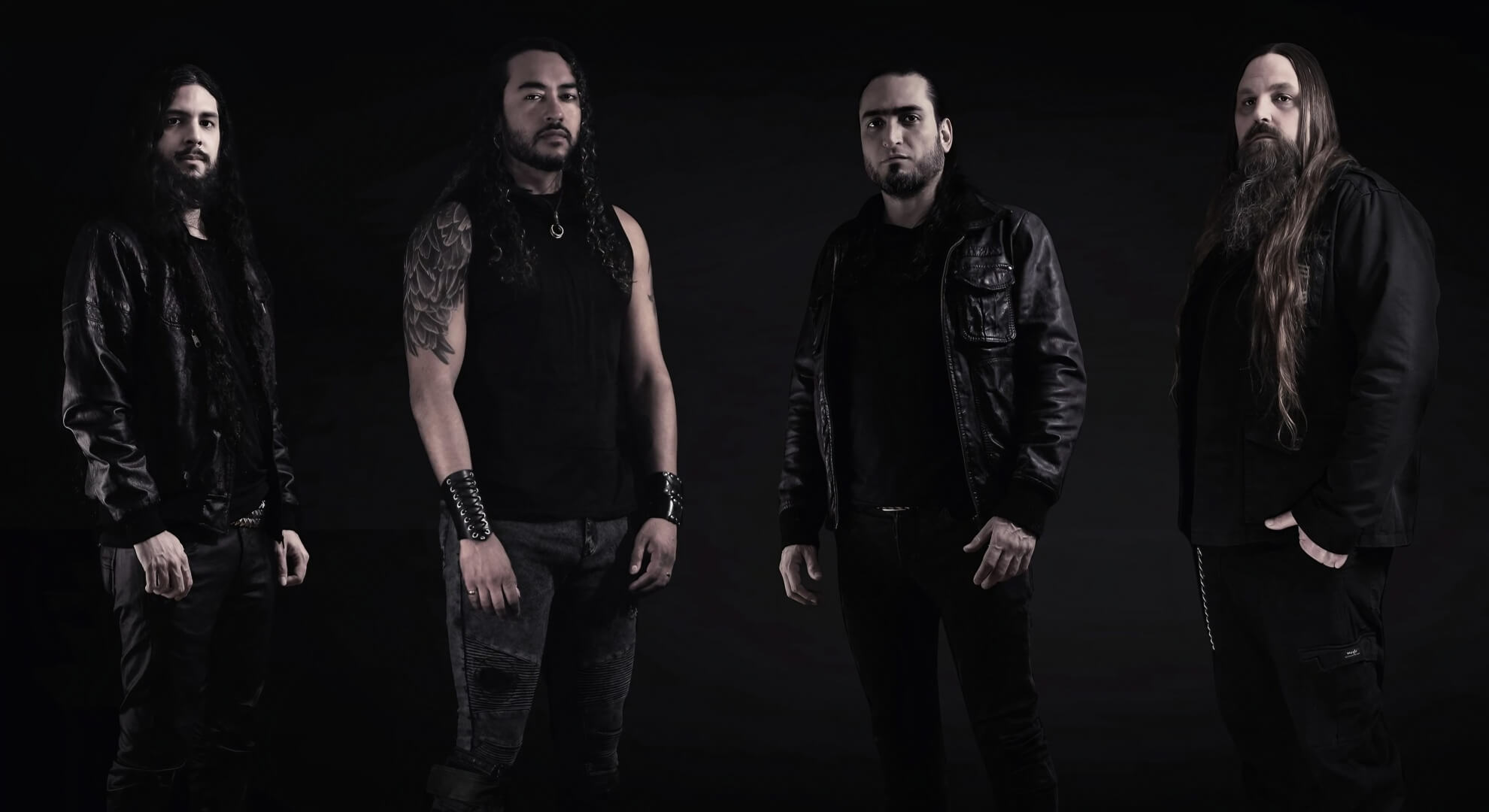


In the sprawling, sun-scorched northern reaches of the Aburrá Valley, where the industrial clamor of Bello meets the imposing silence of the Andean cordillera, the atmosphere is rarely one of stillness. It is a place where history is not read in books but felt in the pavement and the humidity. On January 24, 2026, this atmospheric density will find its release inside the concrete echo chamber of the Coliseo Manchester. Here, the Black Angel Fest XI will convene not simply as a musical showcase, but as a high-decibel liturgy for a community that has long used heavy metal as a shield against the chaos of the outside world.
Returning to this crucible is No Raza, the Bello-born death metal quartet that has spent recent years in the United States sharpening a sound that is now as technical as it is primal. They come bearing ‘Tyrona,’ an album that turns its back on modern nihilism to embrace the ancestral resistance of Colombia’s indigenous Sierra Nevada.
The event marks a significant homecoming: a collision of the band’s transnational evolution with the raw, uncompromising loyalty of the local “legión metalera.” In the heat of the night, amidst the mosh pits that European observers often describe with a mixture of awe and trepidation, No Raza will attempt to fuse the polished precision of their Florida era with the untamed spirit of their origins, transforming a municipal sports arena into a temple of distortion and memory.
Resistance in the Antioquian Valley
A Stubborn Independence
The Black Angel Fest has, over the course of a decade, cemented itself as a bastion of independent metal production in a region historically dominated by state-sponsored mega-festivals like Altavoz or Rock al Parque. Organized by José López Producciones, the festival’s survival into its eleventh edition is a demonstration of the sheer stubbornness—the “teimosia”—of the paisa metal ethos.
In Europe, a festival of this magnitude often relies on corporate sponsorship, municipal grants, or the sanitized machinery of the entertainment industry. In Bello, it relies on the blood pact between the promoter and the “legión metalera.”
The flyer for this year’s edition, a digital artifact circulating through the veins of social media and global metal forums, presents a hierarchy of violence that demands close visual examination. The billing is described as a “cartel de lujo” (luxury lineup), a phrase that in the Colombian context implies not opulence in the material sense, but a richness of aggression and historical weight.
Topping the bill alongside No Raza is Revenge, a speed metal institution in Colombia, whose presence signals a bridging of the old guard with the modern death metal technicality of No Raza.
The date—January 24, 2026—is significant. It places the festival at the very beginning of the cultural calendar, a time of renewal following the festive chaos of December. The venue, Coliseo Manchester, is contiguous to the Bello Metro station, a geographical detail that matters profoundly to the urban historian.
The Metro is the spine of Medellín, a symbol of civic pride and connectivity in a city once fractured by invisible borders of gang violence. That the metal hordes will descend via this artery into the heart of Bello speaks to the integration of this subculture into the very nervous system of the city.
Iconography of the Underground
The visual language of the event’s promotional material tells a story of grim determination. The “Black Angel” logo, winged and demonic, sits atop a list of names that read like a taxonomy of extreme emotions and dark histories. The typography is jagged, aggressive, rooted in the aesthetic traditions of 1980s thrash and 1990s death metal. It does not try to be modern or minimalist; it screams its allegiance to the “Old School.”
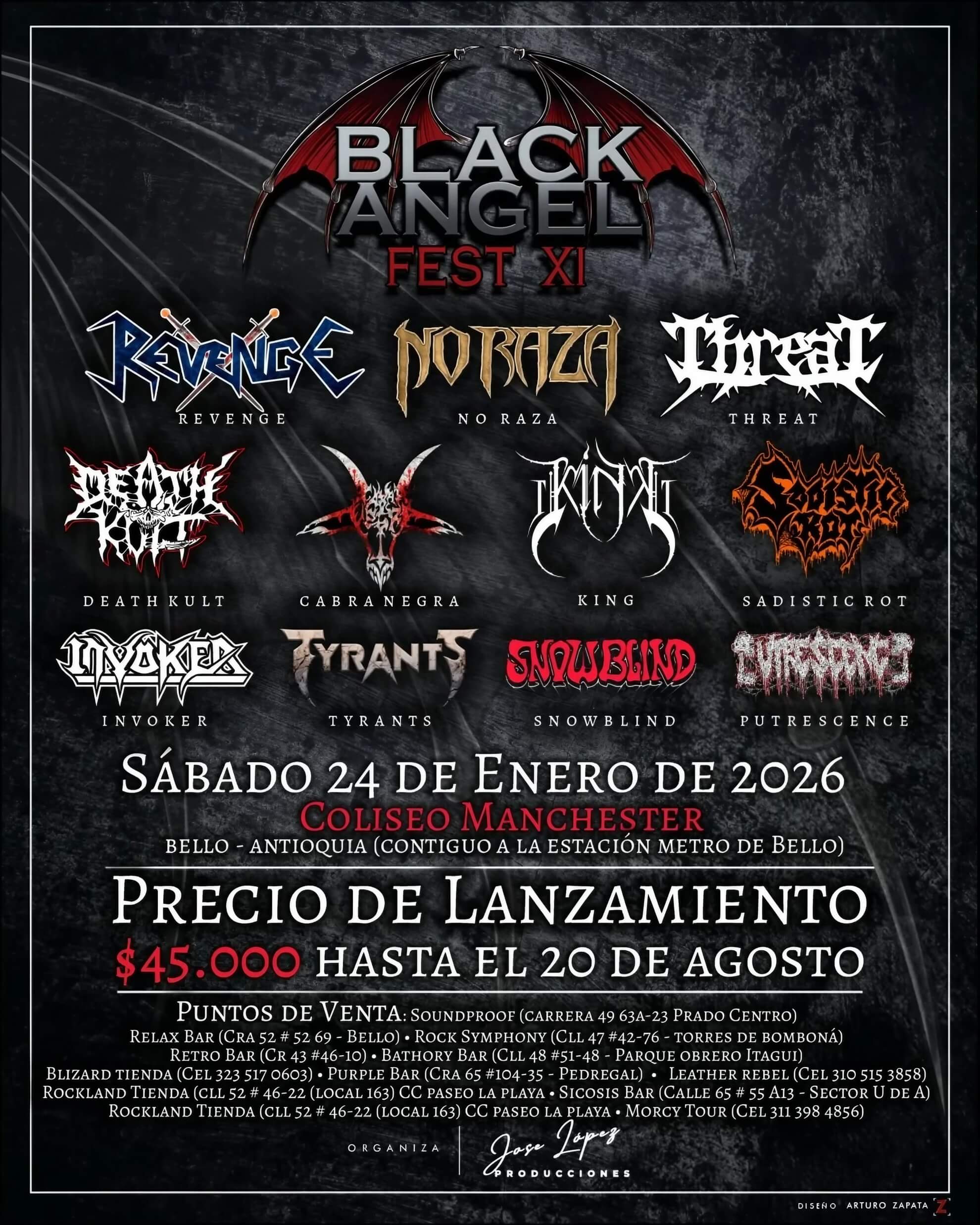
The pricing structure revealed in the flyer—45,000 COP (approximately $11 USD) for the launch price, rising to 75,000 COP (approximately $19 USD) on the day of the event—tells a socioeconomic story. In a European context, where festival tickets often exceed 100 or 200 Euros, these prices signal a commitment to accessibility for the working-class fan base that sustains the scene. It is a festival for the people, by the people, devoid of the exclusionary economics that plague the European circuit.
The list of ticket vendors further grounds the festival in the physical geography of the scene. Tickets are not just sold online; they are sold in bars and shops—Soundproof in Prado Centro, Relax Bar in Bello, Rock Symphony in Torres de Bomboná, Retro Bar, Bathory Bar in Itagüí.
These are the nodes of the network, the watering holes and gathering spaces where the culture lives and breathes between shows. Each location is a sanctuary, and the physical act of traveling to a bar to buy a paper ticket is a ritual of commitment that the digital age has largely erased in the Global North.
A Taxonomy of Extremity
To gauge the weight of No Raza’s headlining spot, one must scrutinize the phalanx of bands supporting them. This is not a random assortment of opening acts; it is a curated cross-section of the national sound, representing different generations and sub-genres of the Colombian extreme metal tradition.
The lineup features Revenge, a storied act in the Colombian scene representing the traditional, leather-clad speed metal that refuses to die. Their pairing with No Raza offers a dialectic between the “Old School” heavy metal worship and the modern, blackened death metal evolution. Joining them is Threat, a veteran act that represents the Bay Area influence processed through the aggressive filter of the Andes, likely bridging the gap between the speed of Revenge and the brutality of No Raza.
Further darkening the bill is King, hailing from the “deepest bowels of the Medellin barrios.” They represent the nihilistic, blasphemous edge of the scene, with a sound described as a “sonic barrage” featuring “supremely evil twists”—a direct descendant of the Ultra Metal movement. Cabra Negra brings a fusion of genres as an emerging force blending the raw energy of thrash with the atmospheric darkness of black metal, creating a sound that is both primitive and sophisticated.
The roster also includes Death Kult, purveyors of the classic, guttural sound that reinforces the festival’s death metal core; Sadistic Rot, whose name evokes the gore-grind aesthetic likely to appeal to the most visceral element of the crowd; and Invoker, a band blending the rhythmic attack of thrash with the heaviness of death metal.
Rounding out the extensive bill are Tyrants, providing another nod to the speed metal heritage; Snowblind, offering a melodic counterpoint drawn from the Sabbathian tradition; and Putrescence, focused on the grotesque and morbid elements of death metal imaginary.
The presence of bands like King and Revenge creates a historical continuum. King, formed in 2005, and Revenge, active for decades, represent the soil from which No Raza grew. No Raza, having left and returned, now stands as the international ambassador of this lineage.
The flyer, listing eleven bands including Tyrants, Snowblind, Invoker, and Putrescence, promises a marathon of endurance. In Europe, we might call this a “day festival” and expect gourmet food trucks and chill-out zones. In Bello, it is a “jornada cargada de distorsión”—a day loaded with distortion, a test of physical and auditory stamina where the only respite is the camaraderie of the pit.
The Crucible of Coliseo Manchester
Architecture of Heat
The choice of the Coliseo Manchester is not merely logistical; it is atmospheric and symbolic. Located in Bello, a municipality with a fierce working-class identity and a history of social struggle, the Coliseo is a covered sports arena.
In the context of a metal festival in Latin America, such venues take on a specific, almost mythical character. Unlike the open-air fields of Wacken Open Air or the acoustically treated, climate-controlled clubs of London or Berlin, the Latin American “Coliseo” is an echo chamber of immense proportions. The concrete surfaces reflect the blast beats and guttural screams, creating a chaotic, enveloping sonic barrage that is not just heard but physically felt in the chest cavity.
But the most critical element, the one that defines the experience for any European observer, is the heat. January in Antioquia is dry and warm, a stark contrast to the European winter. Pack thousands of bodies into a covered concrete box, add the kinetic energy of a mosh pit that rivals any in the world, and the Coliseo Manchester becomes a crucible.
The sweat condenses on the ceiling; the air becomes heavy with the scent of adrenaline, cheap beer, and leather. For the Portuguese observer, accustomed to the breezy Atlantic evenings of Vagos Metal Fest, the Coliseo Manchester represents a descent into a troglodytic, womb-like intensity where the boundaries between individual bodies dissolve into a single, heaving mass.
A Temple of Noise
The Coliseo has a history of hosting heavy music, serving as a key node in the decentralized network of venues that sustain the paisa scene. It is a space where the “hermandad” (brotherhood) of the scene is tempered and tested. As noted in local reports, the festival is organized to highlight the “vitality of the scene in Antioquia.” The venue itself, humble in its architectural origins as a sports facility, is transfigured by the event into a temporary temple of noise.
The proximity to the Metro station transforms the surrounding area into a pilgrimage site in the hours leading up to the show. One can visualize the “metaleros” clad in black, disembarking from the trains, gathering in the surrounding tiendas and parks, claiming the public space in a city that, decades ago, was too dangerous to traverse at night. This reclamation of public space through music is a crucial function of the metal scene in Medellín. It turns the “No Future” of the 80s into a “Present Presence.”
The specific atmosphere of the Coliseo Manchester is also defined by its acoustics—or lack thereof. It is a raw space. The sound bounces, clashes, and reverberates. This favors bands that play with sheer volume and aggression, like King or No Raza. It is not a place for subtle audiophile appreciation; it is a place for sonic warfare. The audience does not attend to critique the mix; they attend to be crushed by it. This aligns perfectly with No Raza’s description of their sound as a “crushing assault.”
The Alchemy of Exile and Return
The trajectory of No Raza is not a simple line from point A to point B; it is a complex geometry of departure and return. To see them at Coliseo Manchester is to witness the closing of a loop that began in the chaotic, punk-infused “Ultra Metal” scenes of the late 90s—a sound born of necessity in a city under siege.
Early records like ‘Del Poder A La Muerte’ (2004) were raw screams from the void, sonic artifacts of a society eating itself alive. But the band’s migration to Florida marked a pivotal shift in their sonic architecture. It was a self-imposed exile that traded the grit of Bello for the high-fidelity precision of the American death metal machine.
This period of “sharpening the blade” culminated in ‘Transcending Material Sins’ (2020), a record that proved they could stand toe-to-toe with the genre’s northern giants in terms of production and technicality. Yet, the true significance of the January 2026 performance lies in the application of this newfound weaponry.
With ‘Tyrona,’ No Raza has not just returned to Colombia physically; they have returned philosophically. They are no longer just emulating the technical death metal of Morbid Angel or Cannibal Corpse; they are weaponizing that foreign precision to narrate a strictly local, indigenous history. The “native sons” return not as prodigals seeking forgiveness, but as masters bringing fire—a synthesis of the global and the hyper-local that transforms the mosh pit into a space of profound cultural reclamation.
Retrieving the Tairona Spirit
Echoes of the Sierra
If No Raza’s earlier work was a reaction to modern social collapse, their latest album, ‘Tyrona’ (released May 16, 2025), is a seeking of ancient wisdom. The title itself is a direct reference to the Tairona (or Tayrona) civilization, a complex pre-Columbian chiefdom that inhabited the Sierra Nevada de Santa Marta in northern Colombia.
From a cultural historian’s perspective, this conceptual shift is fascinating. The Tairona were renowned for their resistance, retreating into the high mountains to wage a century-long war against the Spanish, eventually evolving into the modern Kogi, Wiwa, and Arhuaco peoples.
As documented by anthropologist Gerardo Reichel-Dolmatoff, this retreat was not merely physical but cosmological, allowing the descendants to preserve a “Law of the Mother” that stood in stark opposition to European modes of extraction and conquest.1
In conceptualizing this record, No Raza eschews the typical death metal fixation on abstract horror. Instead, they position the album as a “sonic tribute to the sacred legacy of the indigenous chiefdoms.” This framing is critical; it recontextualizes the genre’s inherent aggression not as a celebration of violence, but as a “war cry from the past”—a sonic channeling of the resistance that predates the Colombian nation-state.
Invoking these “brave ancestral guardians,” the band links the anti-establishment ethos of death metal with the anti-colonial struggle of the indigenous peoples, effectively positioning the electric guitar not as a foreign invader, but as a tool for unearthing buried local histories.
A Sonic Architecture
The album acts as a historical resurrection, with specific tracks functioning as chapters in a larger narrative of resistance. In articulating the violence of the conquest, the band turns to the track ‘Imperial Holocaust,’ which they describe as a reflection on the “cowardly minds… raining destruction” that characterized the colonial encounter. This narrative focus shifts the listener’s gaze from the fantasy tropes often found in the genre to the concrete, historical trauma of the region.
Similarly, the track ‘Savage Strength’ is not an exercise in aimless brutality but is constructed as an “anthem that pays homage to the true guardians… the animal world.” Here, the “savage” is reclaimed from colonial slurs and elevated to a position of reverence, referencing the shamanic transformation practices of the Tairona caciques who donned jaguar and bat masks to channel power.
The album’s narrative arc moves through various facets of this historical trauma and resilience. ‘Looters,’ released with a companion video, addresses the theft of heritage, explicitly cursing the guaqueros (grave robbers) and museums that hold sacred artifacts, framing looting as a spiritual violation rather than mere property theft.
‘Overflowed,’ the first single, sets an apocalyptic tone that speaks to the Kogi concept of “The Little Brother” (Western man) destroying the world’s balance—a warning from the Sierra. In a masterstroke of cultural translation, the band covers ‘Ring of Gold’ by the Swedish band Bathory, recontextualizing the original Viking imagery to refer to the Tairona’s stolen gold, thereby linking Nordic paganism with Andean-Caribbean paganism.
Tracks like ‘Estable Corrupción’ return to their socio-political roots, contrasting the “noble” indigenous past with the “corrupt” colonial present, while ‘Chiefdom’ celebrates indigenous hierarchy and leadership as a counterpoint to modern failed democracies.
Cultural Cannibalism and the Modernist Lineage
To categorize No Raza merely as a “folk metal” act would be a historiographical error. Their approach to ‘Tyrona’ aligns them less with the flute-laden melodies of European folk metal and more with the “Manifesto Antropófago” (Cannibal Manifesto) proposed by Brazilian modernist Oswald de Andrade in 1928. Andrade argued that Latin American culture should not imitate the colonizer, but “devour” European forms, digesting them to produce something aggressively new.2
No Raza enacts this ritual precisely: they consume the technical death metal frameworks of Florida (the “colonial” standard of Morbid Angel or Death) and fill that hollow vessel with the blood memory of the Tairona.
In this sense, ‘Tyrona’ operates in the same cultural lineage as Sepultura’s watershed 1996 album, ‘Roots.’ Just as the Cavalera brothers turned their gaze from the global north to the Xavante tribes of the Amazon, No Raza reorients the Colombian metal narrative toward the Sierra Nevada. However, where Sepultura embraced groove and nu-metal bounce, No Raza retains a surgical hostility closer to contemporary French masters Gojira.
They bridge the gap between the raw, existential scream of Medellín’s “Ultra Metal” progenitors—a sound immortalized in the gritty, cinema-verité realism of Víctor Gaviria’s film ‘Rodrigo D: No Futuro’—and the high-concept environmentalism of the modern avant-garde. They are the synthesis of the comuna’s despair and the museum’s memory, proving that the most authentic preservation of history often comes not from academia, but from the amplifier.
City Under Siege
To measure the intensity of the audience that will fill the Coliseo Manchester, one must explore the history of the “Ultra Metal” scene in Medellín. In the 1980s, while the Bay Area had Thrash and Norway was fermenting Black Metal, Medellín had “Ultra Metal.” Bands like Parabellum and Reencarnación created a sound so raw and chaotic that it reportedly influenced Mayhem’s Øystein Aarseth.
This music was born in a city under siege by narco-terrorism. The “No Future” punk ethos was not a fashion statement; it was a demographic reality for young men in the comunas. As historian Mary Roldán notes in her analysis of regional violence, Antioquia has historically been characterized by a distinct pattern of social exclusion and rebellion, where violence often became the primary language of political and social negotiation.3
The violence was not an abstract concept; it was the atmosphere they breathed. This history is encoded in the bloodline of the crowd. The audience at Black Angel Fest is not there to “spectate.” They are there to participate in a catharsis. They are the children and grandchildren of the generation that used metal as a shield against the madness of the drug wars.
The Homecoming
The timing of this concert is impeccable. No Raza is riding the crest of the ‘Tyrona’ wave. The album, released in May 2025, has had eight months to permeate the consciousness of the fans. The singles ‘Looters’ and ‘Imperial Holocaust’ are no longer new novelties but established anthems. The lyrics have been memorized; the breaks in the riffs have been internalized.
The band’s recent activity—the December 2025 shows in Bogotá and Ibagué—suggests they are in peak touring form. They have shaken off the studio rust and re-acclimatized to the altitude and the chaotic energy of Colombian production. They arrive in Bello not as a studio project, but as a well-oiled machine of destruction.
It is worth noting the band’s last major cultural milestone in Colombia prior to the ‘Tyrona’ cycle: the performance at Altavoz Fest 2020. There, they performed ‘Lloverá Sangre En El Barro’ with the Orquesta Filarmónica de Medellín. That performance was a declaration of legitimacy. It elevated Death Metal to the level of high art, merging the guttural with the symphonic.
The return to the Coliseo Manchester is a different beast. It is not the polished, state-subsidized stage of Altavoz. It is the raw, sweaty underground. It is a return to the roots. If Altavoz was the “gala,” Black Angel Fest is the “brawl.” Both are necessary facets of the band’s identity.
As we anticipate this convergence of technical precision and ancestral fury, we invite you to reflect on the role of the audience in this equation: does understanding the deep, indigenous resistance embedded in No Raza’s new material transform the physical experience of the mosh pit for you, elevating it from a mere release of aggression into a participatory act of historical memory?
References:
- Reichel-Dolmatoff, Gerardo. ‘The Loom of Life: A Kogi Principle of Integration.’ Journal of Latin American Lore 4, no. 1 (1978): 5-27. ↩︎
- Andrade, Oswald de. ‘Manifesto Antropófago. In Vanguardia Latinoamericana: Historia, Crítica y Documentos,’ edited by Gilberto Mendonça Teles, 114-121. Frankfurt: Vervuert, 2002. ↩︎
- Roldán, Mary. ‘Blood and Fire: La Violencia in Antioquia, Colombia’ 1946-1953. Durham: Duke University Press, 2002. ↩︎


Leave a Reply