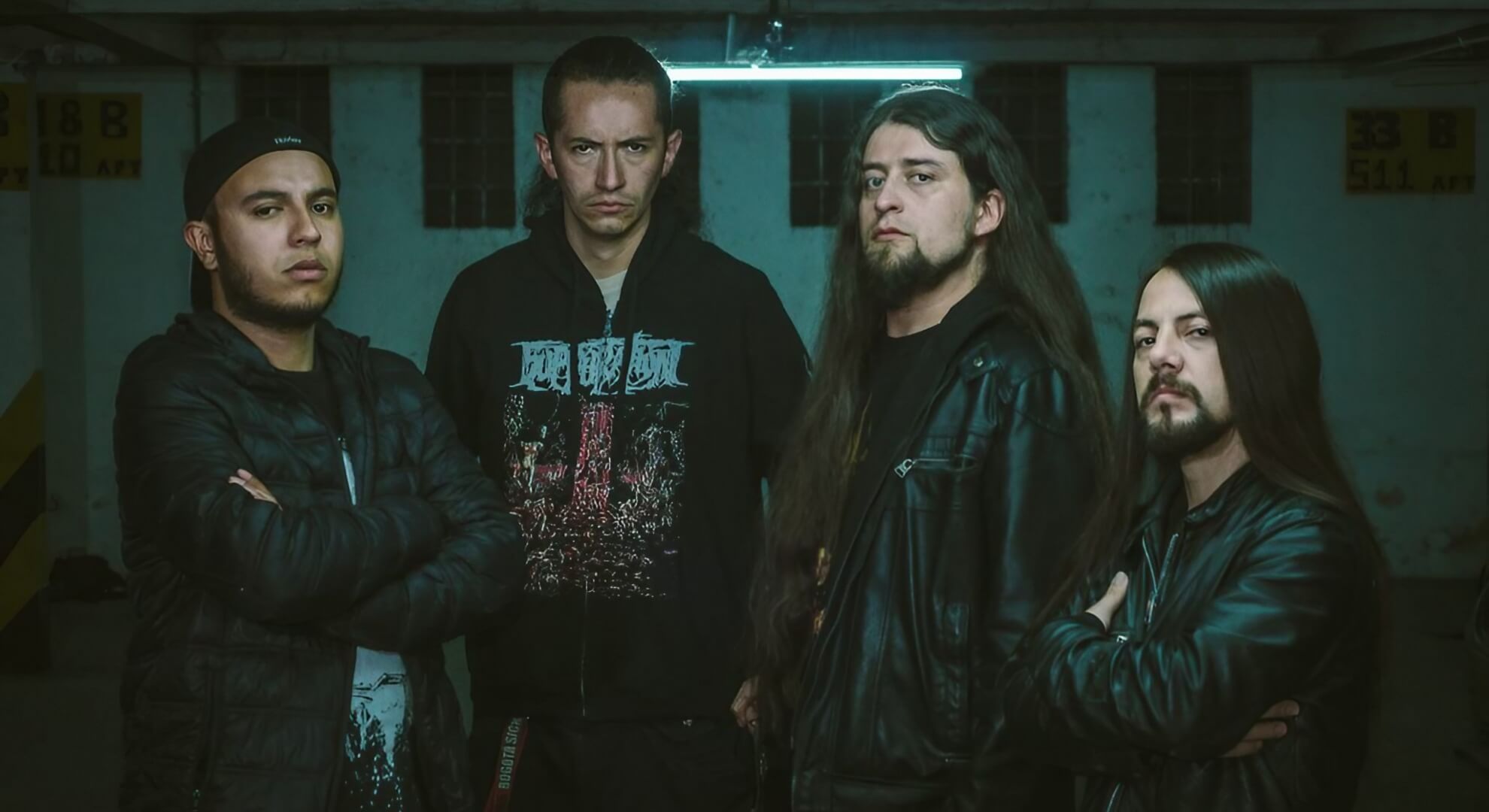


There is a particular kind of authority that accumulates not through conquest but through persistence — through showing up, year after year, in the same underground spaces, on the same festival stages, before the same community that has watched a band develop from promising act to essential one.
The Bogodeath Metal Fest, presented by Viuda Negra Music at the Relevent Music Hall on May 9, 2026, is not a celebration of anything imported. It is a declaration by Bogotá’s extreme metal underground about what it has built for itself across a quarter-century of sustained, independent commitment to the genre.
Among the eight Colombian bands sharing the evening with Brazilian brutal death metal visitors Escafism, no act carries the accumulated weight of that declaration more fully than Tears of Misery.
The Weight That Precedes the Night
Tears of Misery did not arrive at death metal fully formed. The project took its first steps in Bogotá in the year 2000 under the name Lágrimas de Miseria, navigating the heavy and thrash metal terrain that characterised the capital’s underground during those years. The renaming, which came in 2003, was not cosmetic — it accompanied a decisive stylistic shift toward death metal and, more significantly, a clarification of the thematic territory the band has occupied ever since.1
Where other Colombian extreme metal acts of that era treated violence as an inherited genre convention, something borrowed from North American or European templates, Tears of Misery turned it into direct material. Their lyrics address the reality of the Colombian armed conflict not as metaphor or aesthetic posture but as subject matter that the music has an obligation to articulate.
That decision situates the band within the most substantive current of Colombian extreme metal — the tradition that produced, across the eighties and nineties, a generation of musicians who understood that the genre’s formal vocabulary of brutality was not imported shock theatre but a genuine instrument for processing conditions that offered no clean resolution.
The 2006 demo ‘State of Catharsis’ captured both halves of this impulse: melodic death metal with shades of doom, built over words that refused to aestheticise the decade that preceded them. In a scene where demonstration of technical ambition frequently substituted for thematic depth, Tears of Misery chose a harder discipline.
Twenty-Three Years of Precision
By the time this publication documented their appearance in the Rock al Parque opening circuit — a performance in which the band’s improvement from their 2015 festival showing was evident to anyone who had followed their development — Tears of Misery had accumulated the stage command that only comes from treating every appearance as consequential rather than promotional.
‘Inconformity Manifesto,’ the title track of their 2014 full-length, produced the kind of mosh pit that has a specific logic to it: not the random collision of bodies that a loud sound produces, but the coordinated kinetic response of an audience that knows the material well enough to anticipate its internal momentum.2
The album itself, their second full-length, contains the clearest statement of the band’s compositional philosophy. Recorded in Bogotá between 2012 and 2013, it sits at the intersection of North American brutal death metal and European melodic death metal without fully submitting to either tradition — a positioning that the band has consistently described as Latin American death metal, a designation that carries real meaning rather than serving as mere geographic branding. The tracks address what the conflict produced in those who lived inside it: ‘Godless Nation’ does not describe violence from outside; it speaks from within the conditions that violence created.
Their output across 23 years — four recordings, compilation appearances on the Extreme Magazine series and the Patria Extrema anthology, and a live practice that has taken them through multiple Rock al Parque cycles — represents a body of work built without label support or international distribution infrastructure.
Master Machine Music, the independent Bogotá label that handled ‘Inconformity Manifesto,’ is the closest the band has come to institutional backing, and even that arrangement was domestic and self-determined. This is a project that has survived on the strength of its own musical conviction and the loyalty of a community that recognised something genuine from the beginning.
A Record Being Made in the Dark
The announcement accompanying Tears of Misery’s Bogodeath appearance is that ‘Inner Satan,’ their forthcoming album, is currently in production, with rhythm guitar tracking now completed. The band noted that they expect to return to the stage soon to present the new material — a statement that gives the May 9 performance a specific charge.
This is not a tour supporting a finished record. It is a live appearance by a band that is actively in the process of becoming something new, performing accumulated material while the studio work documents where they are heading.
The title ‘Inner Satan’ signals a possible shift in the band’s thematic register. Where earlier releases directed their critique toward the external mechanics of the conflict — the institutional structures, the armed actors, the conditions they imposed on civil society — the suggestion of an internal adversary points toward the psychological residue that violence leaves in those who survive it.
The work of articulating the conflict has always been the work of those inside it; ‘Inner Satan’ seems to turn that inward gaze into the album’s explicit subject. No release date had been confirmed at the time of publication, and full album details were unavailable.
The Chapinero Room Where It Happens
The Relevent Music Hall, at Carrera 9A No. 68-27 in the Chapinero district, is a venue whose industrial configuration matches the conditions that Bogotá’s death metal community has consistently demanded from the spaces it occupies.
Chapinero has functioned for decades as the geographical centre of gravity for extreme music in the capital — the neighbourhood where the underground bars and clandestine rehearsal spaces of the nineties gradually gave way to venues capable of hosting events at greater scale without sacrificing the proximity that defines the experience.
The Relevent is one of those venues: sound conditions oriented toward the fidelity that extreme metal requires, a room whose intimacy ensures that the physical barrier between the performers and the audience is functionally irrelevant.
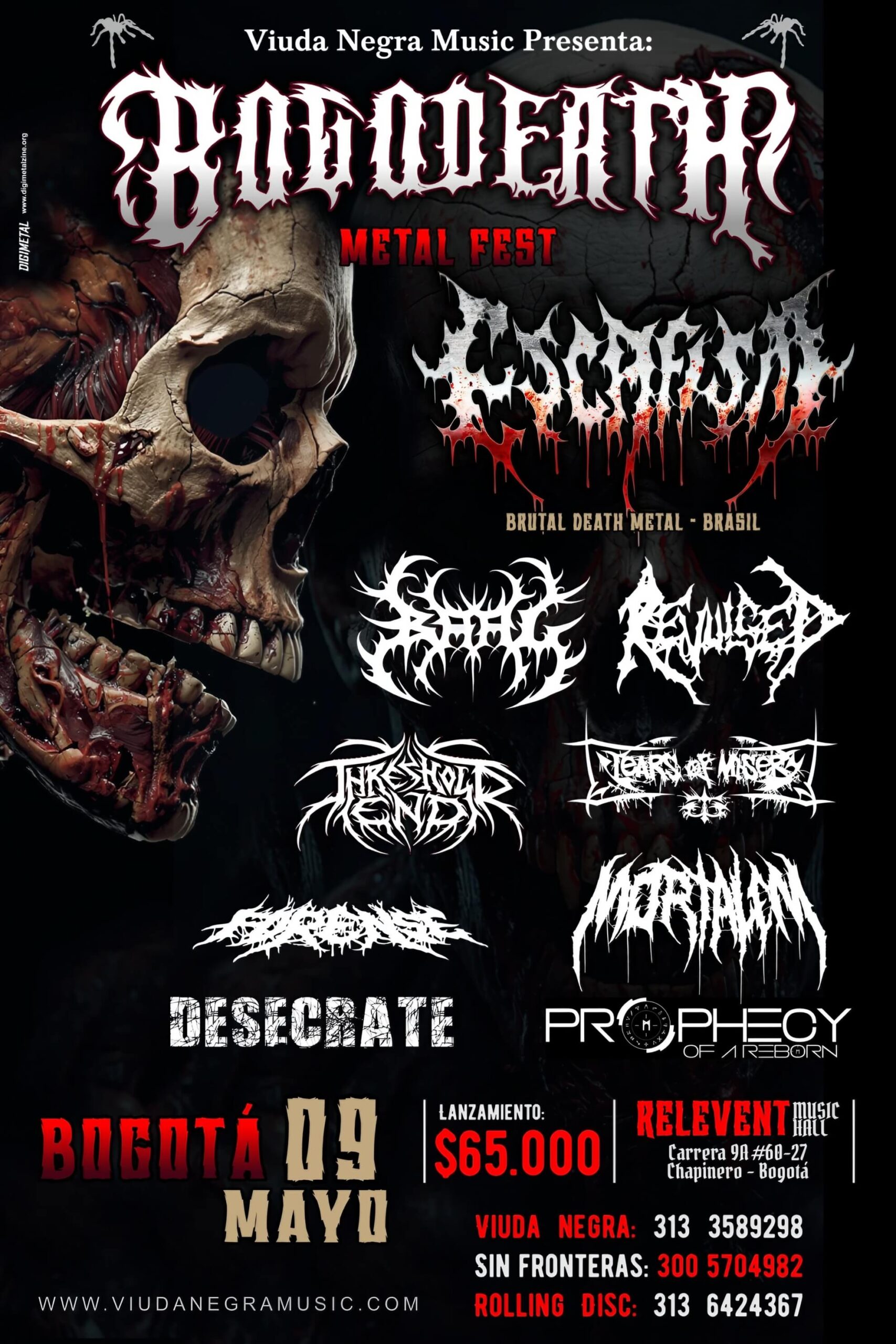
Doors open at 5:00 PM on May 9. Tickets for the Bogodeath Metal Fest are available at a launch price of 65,000 COP (approximately $18 USD). An optional bundle including a physical CD is available for an additional 25,000 COP (approximately $7 USD). Tickets are available through Viuda Negra Music, Sin Fronteras Discos, and Rolling Disc. Further pricing tiers had not been announced at the time of publication.
The Community That Fills the Night
The full Bogodeath Metal Fest bill is itself an argument about the current state of the Bogotá death metal scene. Alongside Tears of Misery, the capital’s contingent includes Revulsed, Forense, Threshold End, Mortalum, Prophecy of a Reborn, and Desecrate — a range of projects that together represent the scene’s stylistic diversity at this moment, from technical and brutal approaches to more groove-oriented variants of the genre.
Baal, arriving from Medellín, bring the Antioqueño strand of Colombian death metal into the conversation, carrying with them the inheritance of a city that developed its own distinct relationship to extremity during the conflict decades — a scene whose influence on the global black and death metal underground has been documented but rarely adequately credited.
Escafism, the Brazilian brutal death metal act joining the bill from outside the country, provide the evening’s one international reference point. Their presence is a reminder that the Colombian underground has always existed in active dialogue with the broader South American extreme metal circuit, a dialogue conducted across borders that have constrained other kinds of movement far more effectively than they have constrained music.
For an audience that has lived inside this scene across its full modern history — the Rock al Parque cycles, the underground club nights in the Chapinero and La Candelaria districts, the decades of rehearsal and release that preceded any institutional acknowledgement — the Bogodeath Metal Fest is not a departure from that tradition. It is an expression of it, organised from within the community rather than presented to it.
When Tears of Misery take the Relevent Music Hall stage on May 9, they do so as the most historically grounded Colombian act on this particular bill, with a forthcoming record still being assembled in the studio and a live catalogue that the Bogotá underground has been hearing develop for more than two decades. The distance between ‘Lágrimas de Miseria’ in 2000 and the rhythm guitar tracks of ‘Inner Satan’ in 2026 is not a trajectory of ascent toward some external standard of recognition — it is the record of a band that chose, at each juncture, to remain inside the community that formed it and to make the music that community needed it to make.
Which track in the Tears of Misery catalogue has stayed with you longest, and what does it tell you about what you are hoping to hear from ‘Inner Satan’ when it finally arrives?
References
- Stephen Zepke and Nicolás Alvarado Castillo, eds., ‘Violence and Resistance, Art and Politics in Colombia’ (Cham: Palgrave Macmillan, 2023), 1–15. ↩︎
- Robert Walser, ‘Running with the Devil: Power, Gender, and Madness in Heavy Metal Music’ (Hanover: Wesleyan University Press, 1993), 41–47. ↩︎

Leave a Reply