
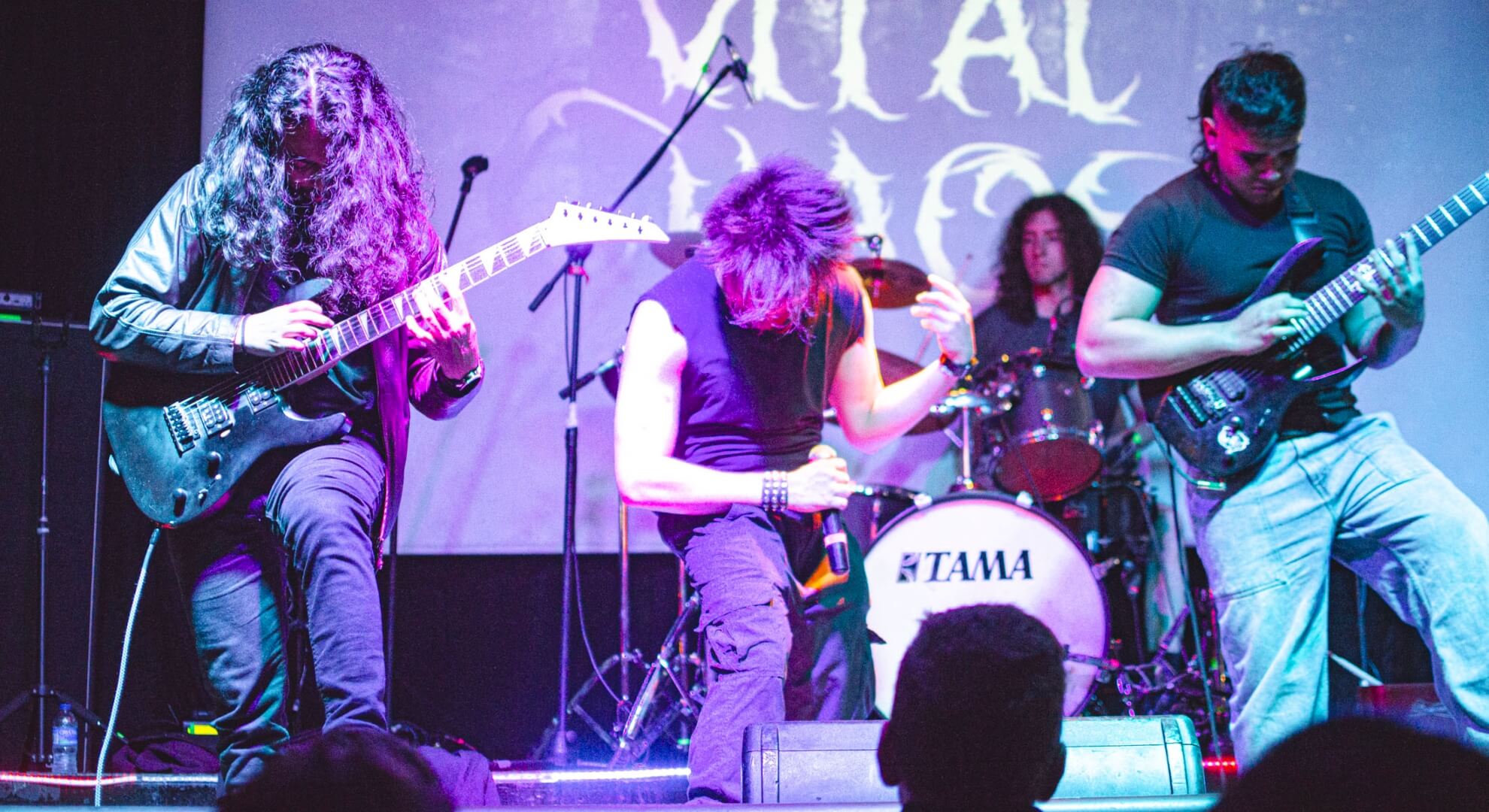


Ten kilometers north of Bogotá’s Chapinero, past the boundary where the capital’s brick and density gradually yield to the wider skies of the Sabana, lies a city whose name the Muisca gave to the moon. Chía, the city of the moon, named for the lunar goddess at the center of a pre-Columbian ceremonial world, now holds more than 160,000 residents and a progressive death metal band that has spent years carving its own claim on that particular darkness.
On April 25, 2026, Vital Chaos headlines the Syam Fest at the Auditorio Zea Mays in Chía, performing free of charge at 5:00 PM before an audience drawn from the same Sabana communities that produced them. For the band, this is not a debut in their hometown. It is a return.
What the Sabana Carries
The received history of Colombian extreme metal has most often been told from two places. Bogotá supplied the institutional framework: Rock al Parque, established in 1995, gave the capital’s rock and metal communities a government-sanctioned platform that gathered tens of thousands annually and forced the broader civic mainstream to acknowledge the roqueros as a legitimate constituency.
Medellín supplied the rawer and more internationally resonant chapter — the Ultra Metal movement of the cartel decades, when young musicians reached for the most extreme available language because the conditions they inhabited demanded nothing less.1
But the Sabana de Bogotá, the high plateau that surrounds the capital and holds its satellite municipios in the same cold highland light, has produced its own tradition of underground musical practice. Chía, at the northern edge of Bogotá’s metropolitan zone, did not develop extreme music in isolation from the capital — proximity made that impossible — but it developed it in its own register, shaped by the particular character of a municipio rather than a barrio, a community more internally coherent and with a different relationship to the city’s cultural gravity.2
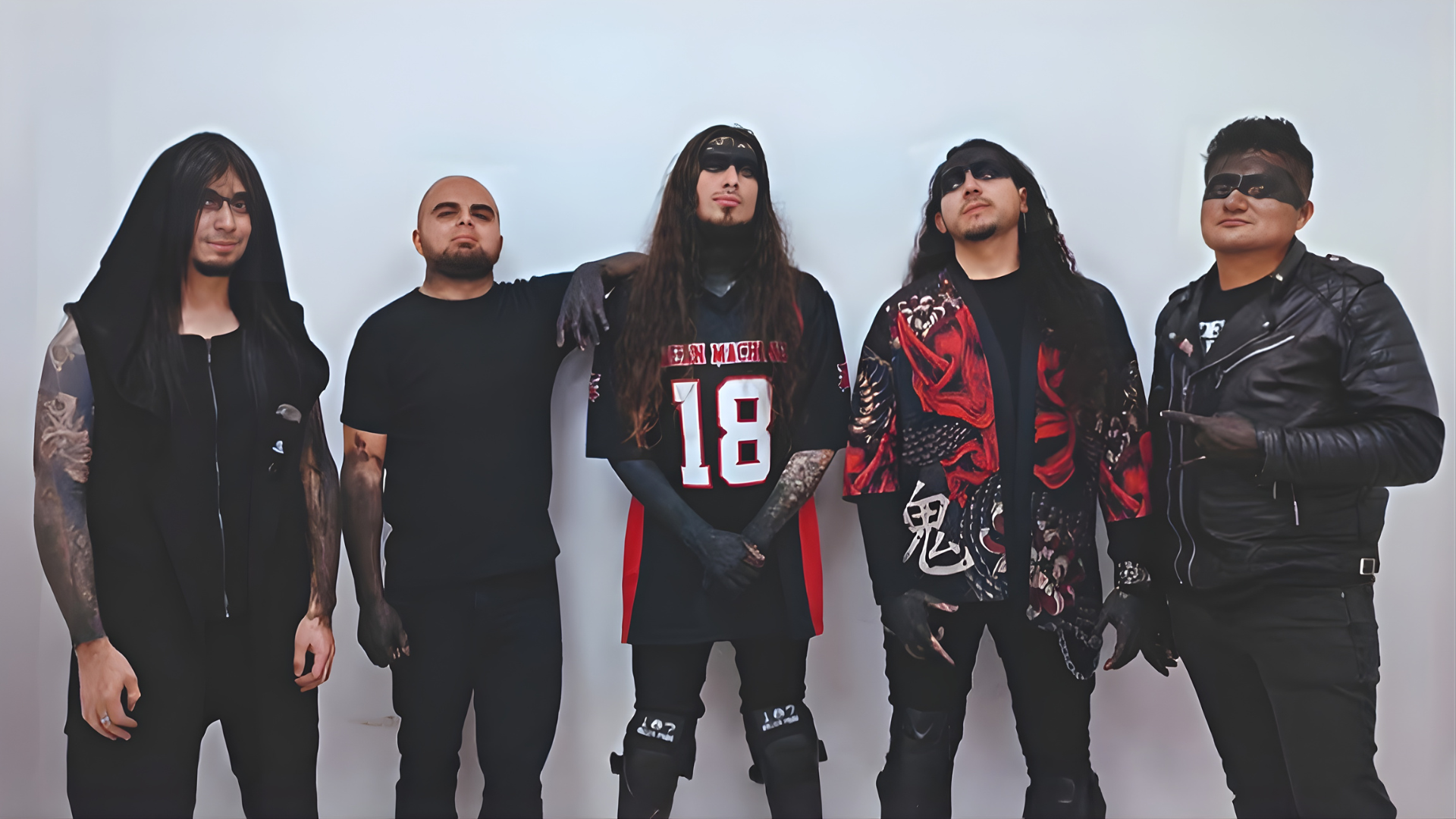
Vital Chaos emerged from this geography. The five-member group — comprising Juan Sebastián Vargas Franco on lead vocals, Juan Alejandro Bautista Vargas on seven-string lead guitar and backing vocals, Juan Felipe Rodríguez Pulido on rhythm guitar, Davis Santiago Uribe Muñoz on bass, and Andrés Felipe González Rodríguez on drums and backing vocals — chose progressive death metal not as a genre imported wholesale from European templates but as a form they would inhabit on specifically local terms.
A Sound Carved in Moonlight
The ‘Crown of Blood’ single, released in 2020, established the formal argument that Vital Chaos makes within progressive death metal: the fusion of old-school death metal aggression with melodic, atmospheric, and symphonic density, producing a compositional weight that exceeds the genre’s traditional blunt-force register. The two guitars — a seven-string on lead and a six-string on rhythm — provide the foundational structural tension, while programmed sequences supply the atmospheric and symphonic textures that give the compositions their spatial depth.
The live recording ‘Crown of Blood & Genesis,’ captured at FM Records in February 2024, placed those compositions in front of an audience, which is the only condition under which a song’s internal coherence is genuinely tested. The session was itself a prize: Rock ‘N La Luna 2023, Chía’s own annual music festival, awarded Vital Chaos the title of best band in the competition, and the recording and production of a live session at FM Records came as part of that recognition. The arrangement held. The recording documented a band that had developed its material thoroughly enough that the transition into live delivery did not cost the music its discipline.
The full discography, compact but deliberate, documents a band expanding its thematic vocabulary with steady precision. The ‘Genesis’ single of 2021 — accompanied by an official lyric video — engaged the cosmological scale that has since become the band’s signature register: the creation of the universe as both scientific event and lyrical territory, traversed through chaos, medicine, and science.
That civic positioning has been accompanied by a media reach that mirrors the band’s trajectory. Luna Estéreo, Chía’s own FM station, interviewed Vital Chaos in the context of Rock ‘N La Luna 2023, airing ‘Crown of Blood’ and ‘Genesis’ to an audience that shares the band’s postal code. The Uruguayan radio programme Efecto Radioactivo broadcast the band’s music and conversation to a South American audience well beyond the Sabana. Rock and metal media from Venezuela have registered their output. For a group still assembling its debut LP at RedSpot Studio, this is the kind of reach that establishes context before the full-length arrives.
What the catalogue articulates, even in its current brevity, is a concern with the weight of survival and the persistence of light under conditions that make light feel unlikely. This is not a thematic position unique to Vital Chaos, but it sits with particular gravity in a genre made, in Colombia, by musicians for whom that tension has not always been metaphorical.3
The Return
The announcement of the April 25 date carried three words that require no translation anywhere in the Colombian underground: “Volvimos.” (We are back). The affirmation of return implies a period of absence, and the specific act of returning to your hometown first — before any other stage, in any other city — is a choice that carries its own argument.
Admission to the Syam Fest is free of charge. The absence of a ticket price is itself a declaration: it frames the event as a civic act rather than a commercial one, a claim of presence within the community rather than extraction from it. The Plataforma de Juventudes Chía, the municipal government’s youth cultural initiative, is among the organizing bodies, which situates this metal event within the formal structures of local governance rather than in opposition to them.
The festival is explicitly a youth rock and metal gathering, organized from inside the scene it serves. The choice of the Auditorio Zea Mays — Chía’s own civic auditorium — over any commercial venue amplifies that orientation. The music does not arrive here from outside. It originates from within.
An Assembly From the Plateau
The confirmed bill for the Syam Fest reads as a working portrait of the Sabana’s current rock and metal practice. Alongside Vital Chaos, the evening presents Satélite, Titanio, Shatter, Avenida Principal, Zarck, Tachykardia, and The Stubborn Obes — seven acts whose collective presence constitutes a cross-section of the regional scene at this moment rather than an imported bill assembled for external credibility.
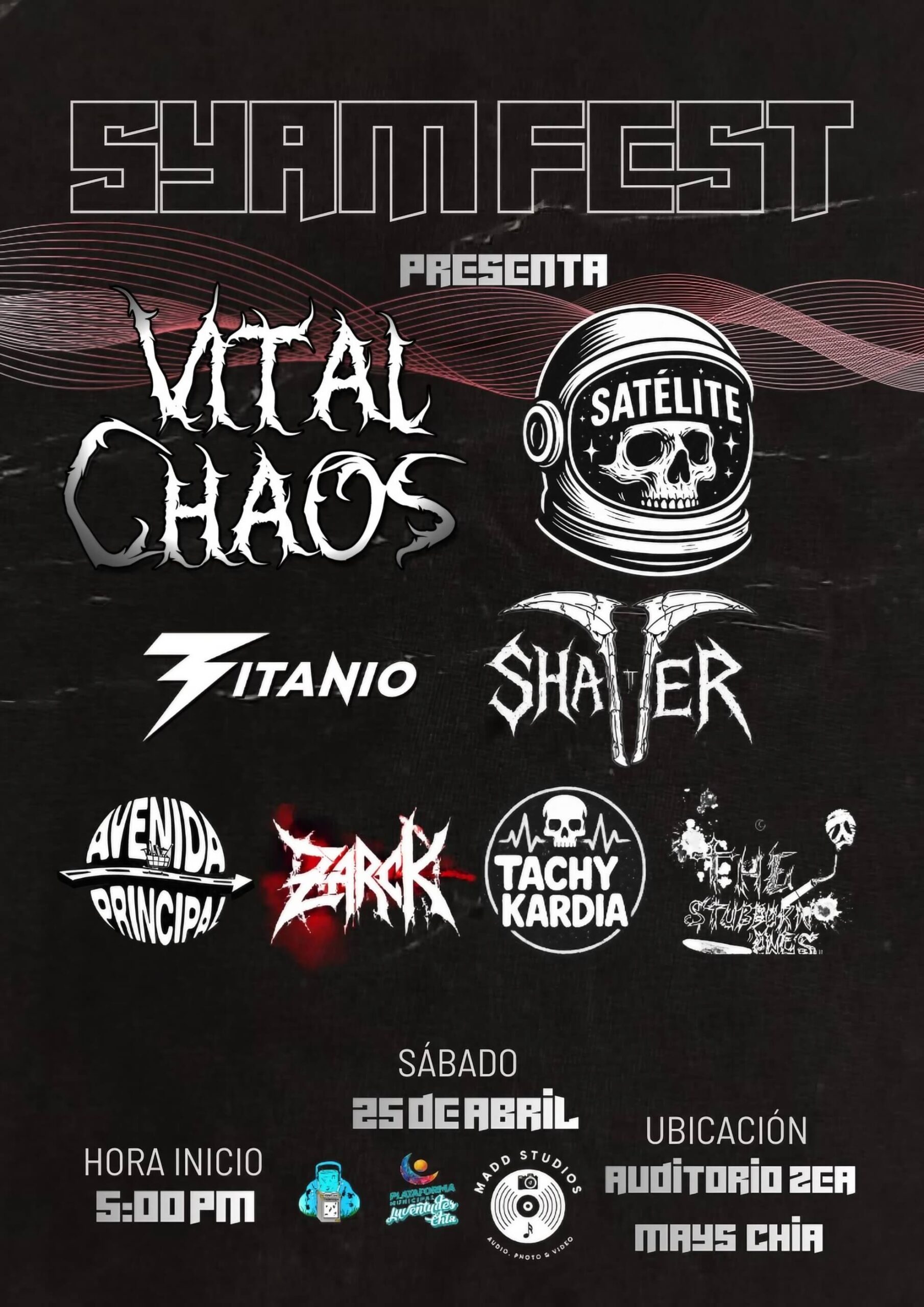
Shatter appears on the program both as a performer and as one of the event’s organizing entities, a dual role that reflects the practical structure of underground culture in smaller municipios: the distance between performer and organizer is nominal. This is what a genuine scene looks like from within — not a market with separate producers and consumers, but a community in which participants occupy both roles simultaneously.
Every act on the program emerges from the same regional context. The decision to keep the bill entirely local reflects both the festival’s youth development mandate and something more fundamental: the Sabana has its own bands, its own audiences, and its own reasons to gather.
The Auditorium at Carrera 7
The Auditorio Zea Mays, at Carrera 7 No. 15-51 in the center of Chía, is a 700-seat civic space inaugurated in October 2017 after more than a decade of interrupted construction across successive municipal administrations. Its name is the scientific designation for maize — the crop at the center of Muisca agricultural civilization across the Sabana — which places the venue within the long continuum of Chía’s pre-Columbian heritage even as its design is fully contemporary.
The auditorium’s acoustic infrastructure and lighting systems were built to the technical specifications of symphonic and theatrical performance. Those same specifications serve the demands of progressive death metal precisely. For a band whose compositions depend on the clear articulation of both dense, distorted guitar passages and delicate synthesizer lines, a room with that kind of acoustic fidelity is not incidental — it is the condition under which the music can be delivered as composed.
The venue has hosted rock acts of national standing in its short programming history. On April 25, it receives a local band returning home. There is no cultural distance to cross, no civic legitimacy to negotiate: Vital Chaos and the Auditorio Zea Mays share the same municipio, the same Sabana air, and the same moment.
On the Cerro de la Valvanera
The western hill above Chía — the Cerro de la Valvanera — is accessible by walking trail or road from the town centre, rising above the grid of streets to the point where the municipality’s two valleys diverge toward Tenjo on one side and Zipaquirá on the other. A chapel was founded there in 1937, its first stone blessed on the feast of the Epiphany by the parish priest who had organised its construction almost entirely through communal labour, with materials carried up the slope by hand. The site had been indigenous territory before that dedication — a hill on the western cordillera of a town whose Muisca name, Chía, designated the moon as both deity and celestial body.
The chapel is visible from any point in the municipio, including from street level near the Auditorio Zea Mays. What connects it to the evening of April 25 is not pilgrimage but the particular geometry of meaning that Vital Chaos inhabits: the band writes about the creation and death of the universe, about cosmic forces that operate at scales the human body cannot contain.
They perform in a venue named for maize — a sacred Muisca crop — in a city that named itself for the moon. The hill to the west holds, in its layered stone and mortar, both the pre-Columbian ceremonial geography that the Muisca organised their world around and the colonial religious structure that was subsequently built upon it.
These two inheritances — the lunar sacred and the imposed devotional — sit in the same soil, on the same slope, in direct sightline of the same concert hall. For music that insists on asking what the cosmos is made of and what survives the end of things, that proximity is not incidental.
The Moon Receives Its Own
When the house lights lower at the Auditorio Zea Mays at 5:00 PM on April 25, the music that follows will not be arriving from outside. It will be the sound of Chía speaking to itself — through distorted guitars and synthesized melodic passages, through the specific grammar that five musicians from this municipio have spent years developing in its rehearsal spaces. The Colombian underground does not require a Bogotá address to be legitimate.
The Syam Fest is free, local, and organized by the people who will perform in it and attend it. That alignment — between the musicians and the audience, between the event and the place — is not a logistical coincidence. It is what a community looks like when it decides to take its own culture seriously enough to present it without intermediary, without entrance fee, on its own stage, in the city that gave it its name.
In a scene where extreme metal’s most-documented chapters have been written from within Bogotá and Medellín, what does it mean for you that a band from a municipio like Chía is producing progressive death metal with this degree of seriousness — and what does this gathering suggest about where the Colombian underground will go next?
References
- Wade, Peter. Music, ‘Race and Nation: Música Tropical in Colombia.’ Chicago: University of Chicago Press, 2000, pp. 1–6. ↩︎
- Connell, John, and Chris Gibson. ‘Sound Tracks: Popular Music, Identity and Place.’ London: Routledge, 2003, pp. 92–97. ↩︎
- Ochoa Gautier, Ana María. ‘Músicas locales en tiempos de globalización.’ Bogotá: Norma, 2003, pp. 47–51. ↩︎
Leave a Reply