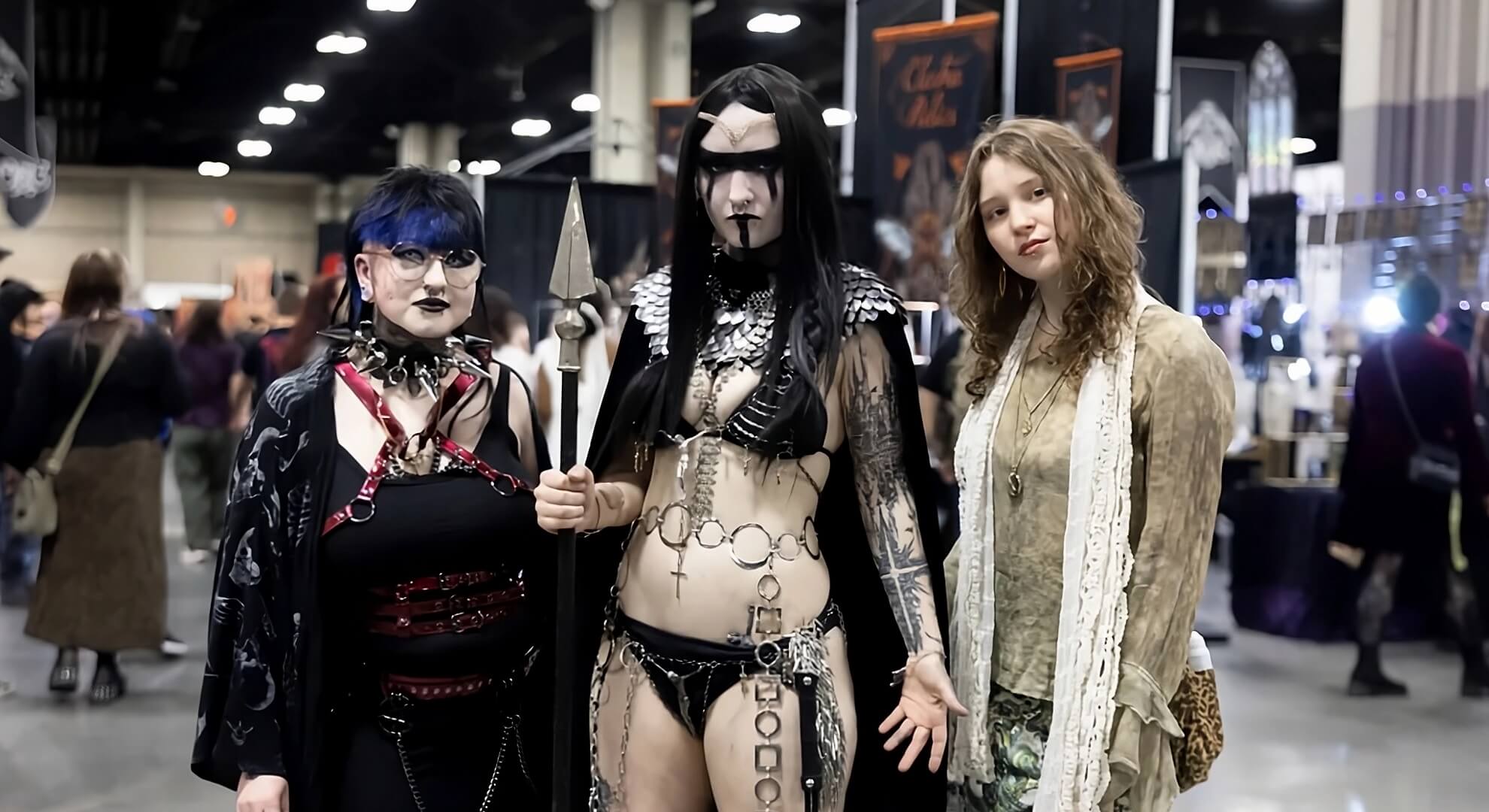


Milwaukee approaches the peculiar with the confidence of a city accustomed to making things that last. Its breweries, labor unions, and public institutions were built from the same temperament—a conviction that craft and community deserve to be taken seriously, even when, especially when, the subject is unconventional.
It is into this context that the Oddities & Curiosities Expo arrives at the Baird Center on April 4 and 5, 2026. Over two days, several hundred hand-selected vendors will occupy the convention space at 405 W. Kilbourn Avenue with taxidermied specimens, osteological material, horror-inflected original art, antique medical devices, and handcrafted objects that answer to the same question at different registers: what does a culture choose to preserve, and why?
That question has been the expo’s implicit subject since Michelle and Tony Cozzaglio launched it in Tulsa, Oklahoma, in 2017. Their circuit has expanded from two events a year to 40 cities across North America in 2026.
The curiosity market belongs to a documented American lineage. The dime museum of the nineteenth century—codified by operators including P.T. Barnum and subsequently carried into working-class neighborhoods across industrial cities—built its appeal on precisely this combination: preserved specimens, ethnographic objects, sideshow performance, and a floor plan that refused to separate the scientific from the popular in its accounting of what counted as worth examining.
The Oddities & Curiosities Expo inherits that form not as nostalgia but as a live continuation, updated for an era in which the death-positive movement has supplied institutional vocabulary for what dime museum visitors grasped without one.
Nine Years on the Road
Michelle Cozzaglio described the expo’s founding motivation in terms that have not softened: as collectors of strange objects themselves, she and Tony wanted to give unusual businesses and artists a dedicated commercial and communal space. That directness defines the institutional character of everything the expo has become.
It operates entirely without corporate sponsorship under what Cozzaglio calls a “do-it-yourself” model—organizers, vendors, and attendees composing a circuit that has never required an institutional imprimatur to confirm its legitimacy.
The Cozzaglios also run Boulevard Trash, a Tulsa-based concern, and have organized punk festivals across the country since 2013. The logistical infrastructure of a traveling music circuit and the curatorial instincts of a festival promoter—who must attract the committed while keeping the door open to the curious—translate directly into how the expo is structured. Vendor fees are kept low; the show is explicitly inclusive; the expectation is community rather than spectacle.
Preserved by The Sleeping Sirens
The Milwaukee edition’s most specifically documented programming comes from The Sleeping Sirens, the Florida-based practice of Heather Clark, whose taxidermy and natural history preservation workshops travel with the expo to select cities across the 2026 circuit.
Clark describes herself as a former army medic turned emergency room nurse whose commitment to the preservation of organic material was, in her words, “my curious love for preserving nature.” The clinic-to-studio trajectory is not incidental: both practices organize themselves around the same act—holding matter at the threshold of dissolution and refusing to let it pass without record.
At Milwaukee, The Sleeping Sirens offer five classes across the two-day run. Saturday opens with an opossum taxidermy class from 10:00 AM to 4:00 PM, priced at 1,190,000 COP ($325), with morning and afternoon sessions in Sunset Moth entomology pinning and scorpion habitat construction available at 549,000 COP ($150) per session.
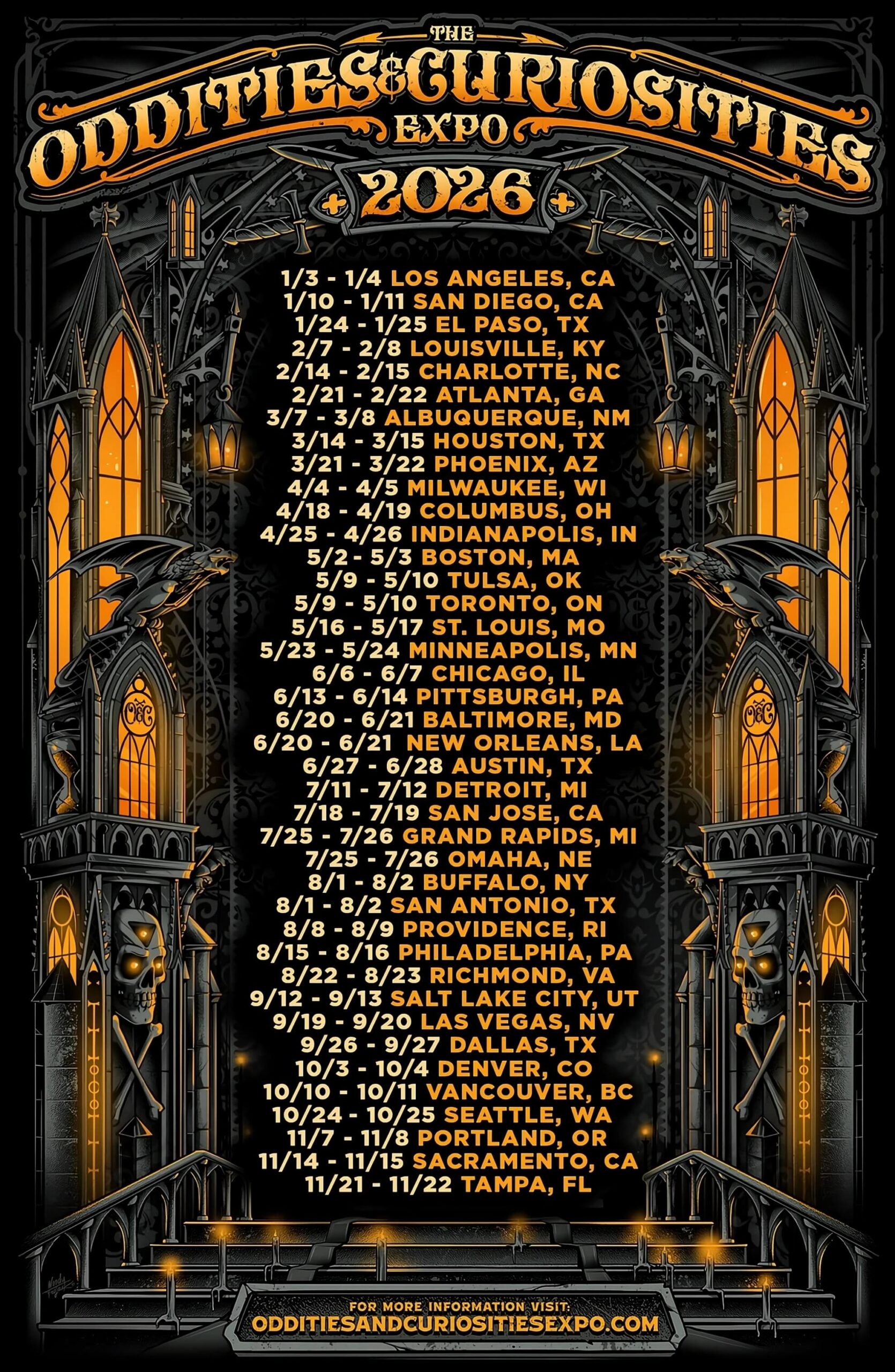
Sunday shifts toward wet specimen work—an octopus and tentacle globe preservation class in the morning and a ratalope mounted in a coffin-style case in the afternoon, each priced at 641,000 COP ($175). All five classes are designed for total beginners; all materials are provided; admission to the expo floor is included in every class ticket.
Clark’s sourcing protocols are documented with the same rigor one would apply to any natural history collecting practice: taxidermy hides from feeder animals, invasive species, and population-control programs; octopus specimens from food-industry suppliers; entomological material collected across years to avoid overreliance on any single source.
That sourcing argument is not merely ethical disclosure. It is the intellectual spine of the class itself: the student works with matter destined to disappear and participates, however briefly, in the logic of the natural historian who refuses to let it.1
The Floor in Broad Strokes
The specific Milwaukee vendor roster was not confirmed at the time of publication—the expo does not release city-by-city vendor lists in advance.
The category documentation is consistent across editions, however, and the floor’s range is reliably composed of: taxidermied specimens and osteological material anchoring the natural history section; horror- and Halloween-inflected original art, preserved botanical and apothecary goods, metaphysical material, handcrafted jewelry and wearable work, antique quack medical devices, funeral collectibles, and vintage ephemera.
Sideshow performers are confirmed for both days, operating on a stage within the exhibition floor throughout the event.
Concessions are typically available on site; specific food vendors for the Milwaukee edition were not confirmed at time of publication. The expo is family-appropriate at the organizers’ discretion; parents are encouraged to review the vendor categories in advance.
What that range produces, in practice, is a floor that declines a single register. The natural history collector who arrives for a pinned lepidopteran may find a hand-sculpted ceramic mounted beside it; the horror art collector comes for the prints and leaves with a bottled specimen. The movement between categories is not incidental—it is the argument the floor makes about where the genuine curiosities of a culture originate: at the crossing of disciplines, not safely inside any one of them.
The Colombian Register
A Colombian visitor to the Baird Center floor will move through it in a register already formed by material culture closer to home. The ex-voto tradition—in which a physical object is offered at a devotional site as evidence of miraculous intervention—trains its practitioners to treat objects as active agents between the living and the dead rather than passive relics.
Healer markets from Bogotá to Ipiales operate on a related logic: botanical specimens, resins, and carved figures that are not decorative but operative, each carrying a weight of intention and accumulated history.2
That formation does not require translation to navigate a floor organized around the same fundamental question of what an object carries when it crosses the boundary between the natural and the human, the living and the preserved. The materials differ. The underlying grammar does not.
The death-positive movement, which has shaped the expo’s institutional identity since the Cozzaglios launched it, carries particular weight in a country where Catholic theology of intercession has never been merely doctrinal but materially enacted—in candles at roadside shrines, photographs kept on household altars, and the annual cleaning of grave markers that makes cemetery visits a form of ongoing relationship rather than a ritual of finality.
The Colombian collector who travels to Milwaukee for this event arrives with a practice of object-relationship that the expo’s floor is, structurally, designed to address.
What the Price Gap Names
General admission tickets for the Milwaukee edition are available in advance for approximately 55,000 COP ($15) per person, with day-of pricing rising to approximately 73,200 COP ($20). Children 12 and under enter without charge. No VIP early-access tier is offered at this stop. Both admission levels open at 10:00 AM on each day; the event runs through 5:00 PM.
On a floor where a specific taxidermied specimen or limited-run hand-printed work will not reappear after it sells, the hour of arrival carries genuine stakes. The expo names this directly and without ceremony: doors open at 10:00 AM, and the floor belongs to whoever reaches it first.
Forest Home’s Hundred Thousand
Forest Home Cemetery stands at 2405 West Forest Home Avenue, roughly 3.5 miles southwest of the Baird Center and reachable via Milwaukee County Transit System routes in under 30 minutes. Established in 1850 by a committee of Episcopalians as a non-denominational public cemetery, it is listed on the National Register of Historic Places and holds more than 118,000 burials across grounds designed by Increase A. Lapham, Wisconsin’s first naturalist.
Its Victorian funerary monument collection is among the most extensive in the Upper Midwest. The 1892 Landmark Chapel, designed by the firm of Ferry & Clas, anchors grounds that once included artificial ponds, ornate fountains, 17 miles of carriage paths, and a resident flock of peacocks. Among its features is the Newhall House Monument—a mass grave for 64 victims of the 1883 hotel fire that remains one of Milwaukee’s most documented nineteenth-century disasters.
The cemetery operates public tours, including a Victorian Funerary Traditions program titled ‘The Good Death.’ That title, borrowed from the language of the contemporary death-positive movement, names a practice that Forest Home has conducted, without the label, for more than 170 years: treating the objects and spaces of mortality as worthy of sustained care and attention.
The Oddities & Curiosities Expo does not argue that death is interesting. It argues that what people have always made in response to it—the specimens preserved, the crafts practiced at the edge of dissolution, the communities that form around those practices—deserves to be held to the same standard as any other form of material culture. At Baird Center on April 4 and 5, that argument occupies convention space rather than gallery walls, and admission costs less than a meal.
What is the oldest object in your possession that was made or kept as an act of preservation—and what does the fact of its survival tell you about the tradition of care it belongs to?
References
- Andrea Stulman Dennett, ‘Weird and Wonderful: The Dime Museum in America’ (New York: New York University Press, 1997), 14–18. ↩︎
- Rachel Poliquin, ‘The Breathless Zoo: Taxidermy and the Cultures of Longing’ (University Park: Penn State University Press, 2012), 3–9. ↩︎

Leave a Reply