
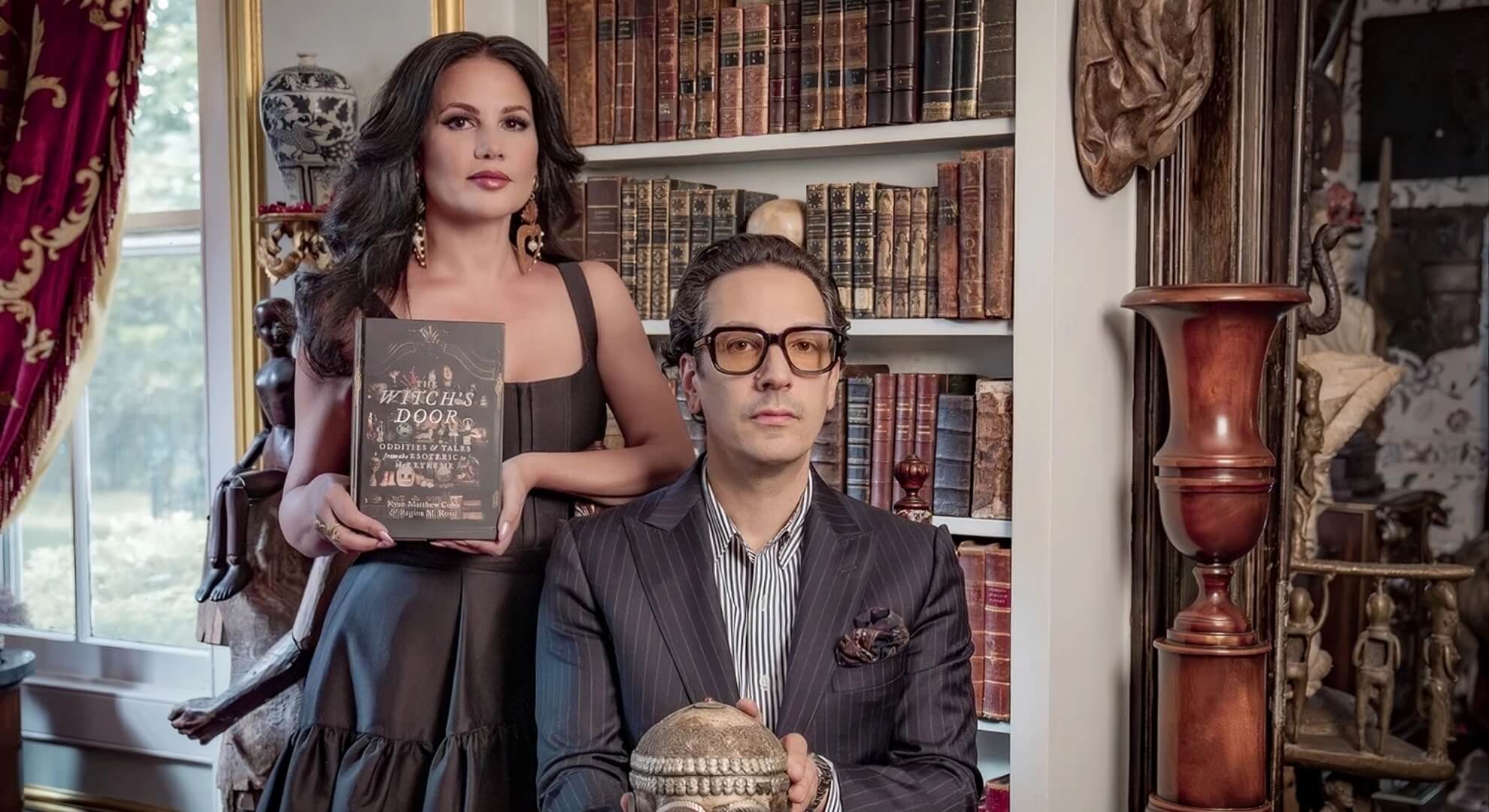


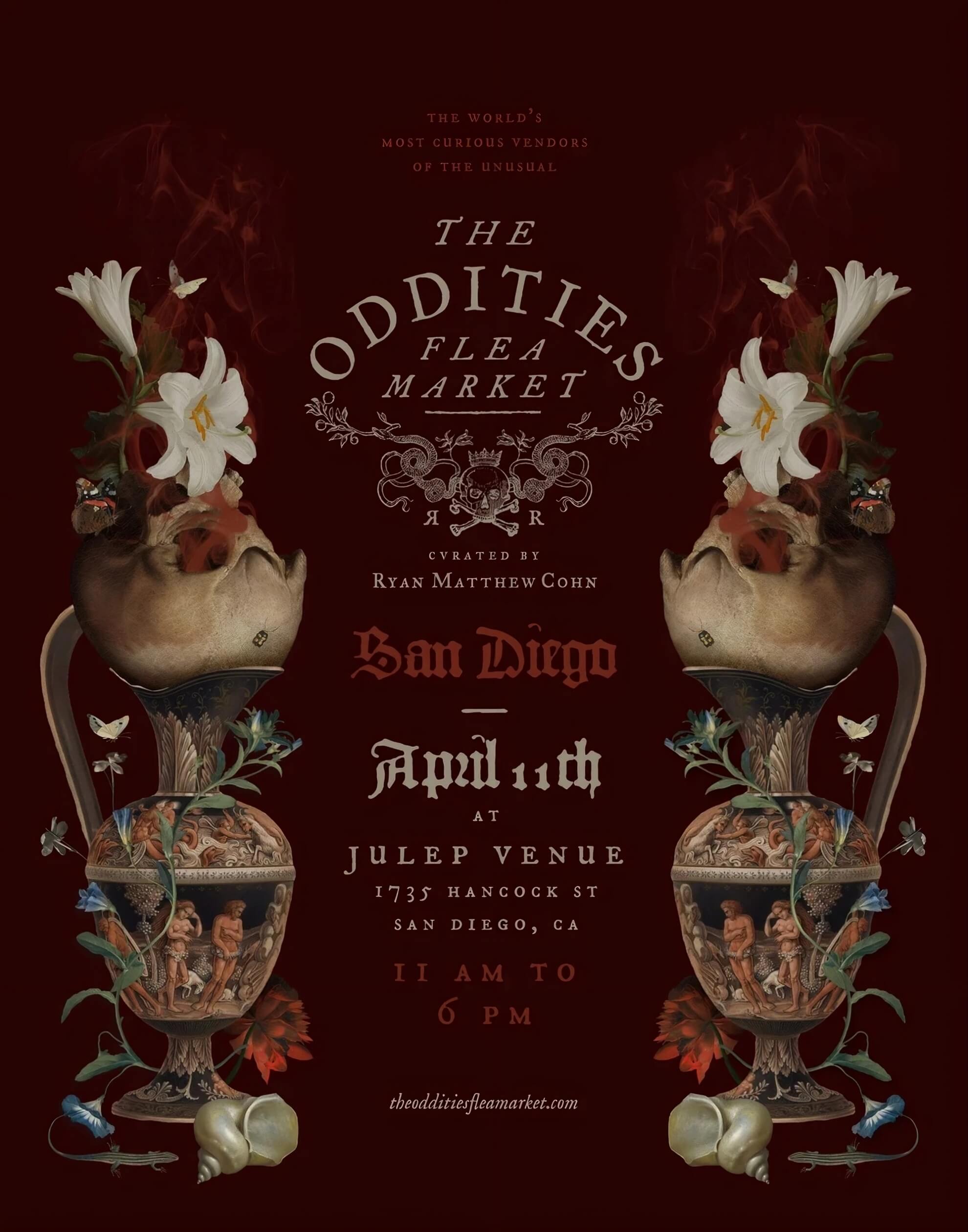
Every object that travels through a curiosity market carries two histories: the one embedded in its making, and the one accumulated through every hand that has held it since. The Oddities Flea Market, returning to JULEP Venue in San Diego’s Middletown district on April 11, 2026, is organized precisely around that understanding — that death-adjacent objects are not end points but carriers of narrative, demanding the kind of attention that most commercial spaces refuse to grant them.
The curiosity market is a specific and documented form. Its institutional ancestor is the “Wunderkammer” — the cabinet of wonders maintained by European scholars and princes from the sixteenth century onward, in which natural specimens, scientific instruments, and works of art occupied the same shelves, united not by academic taxonomy but by the wonder they produced in the viewer.1 The Oddities Flea Market inherits that lineage directly, if informally.
Its floor is not organized by discipline. A vendor of osteological specimens stands beside a silversmith whose work draws from pagan Wales; a photographer of sacred death practices sets up beside a bookseller. The arrangement is not coincidental — it is the argument.
Ryan Matthew Cohn and the Shape of the Market
The event is curated by Ryan Matthew Cohn, whose background as an artist, collector, and scholar of the unusual informs every vendor selection. Co-founded with Regina M. Rossi, The Oddities Flea Market began as a New York institution before expanding to cities including Los Angeles, Chicago, and Seattle.
Its San Diego debut in March 2025 established the JULEP Venue’s Hancock Street space as a natural home for this particular confluence of natural history and contemporary craft.
As this publication noted in its coverage of that inaugural edition — a two-day event organized around an exclusive meet-and-greet with composer Danny Elfman, documented under the title Oddities & Overtures: A Special Event with Danny Elfman — what distinguished the market from the outset was not its inventory but its insistence on treating each vendor as a practitioner of a specific historical tradition rather than a retailer of novelty goods.
The April 2026 edition builds directly on that first impression, arriving with more than 50 confirmed vendors and a curatorial sensibility already familiar to the city’s collector and artist communities.
Paul Koudounaris and the Argument of the Dead
Among the most intellectually rigorous presences on this year’s floor is Paul Koudounaris, whose booth, Memento Mori LA, extends a scholarly career that has taken him to more than 250 sites across 30 countries in search of cultures that refuse to separate the living from the dead.
Koudounaris holds a doctorate in art history from the University of California and has authored three volumes with documented critical reception: ‘The Empire of Death,’ a cultural history of ossuaries and charnel houses; ‘Heavenly Bodies,’ which examines the jewel-encrusted catacomb saints prepared for European Catholic veneration in the early modern period; and ‘Memento Mori,’ a cross-cultural photographic survey of death practices across more than 30 countries.2 His 2024 book ‘Faithful Unto Death’ extends this body of work into the history of animal burial and memorial.
Koudounaris is also a member of The Order of the Good Death, the death-positive organization whose work since the early twenty-first century has pressed mainstream Western culture to engage more honestly with mortality.3 His booth translates that institutional commitment into material form: the objects he brings to market are not merely available for purchase, but arguments, in physical form, about the place of death in daily life.
Alex Streeter’s Silver, Since 1971
A different and equally sustained argument about objects runs through the work of Alex Streeter, who has been casting silver in New York City since the early nineteen-seventies. Streeter began his practice in pre-commercial SoHo, learning partly from a French goldsmith neighbor and partly through decades of refinement among the craftspeople of Manhattan’s Diamond District.
Each piece begins as a wax carving — a process that links his work to metalsmithing traditions reaching back several millennia — before being cast locally in sterling silver and finished by hand.
His international reputation rests largely on the Angel Heart Ring, a silver pentagram encased in amber and held aloft by two rams, created for Alan Parker’s 1987 film ‘Angel Heart’ and worn on screen by Robert De Niro. Its subsequent life as a collector’s object is a precise case study in how a crafted piece accumulates meaning beyond the maker’s original intention. More than 1,000 unique carvings now constitute Streeter’s complete catalog.
The Floor in Full
The remaining confirmed vendors at the April 2026 edition represent the market’s characteristic range: natural history and osteological specimens from Deadskull Curio and Natures Oddities; dark art and illustration from Mortus Viventi, Rock N Horror, and Faustian Society; botanical and apothecary goods from Scent of Death Apothecary and Botanica Glow; jewelry and wearable work from Swoonful, Jennafer Grace, and La Dama Luna; vintage and archival material from Piece of Nostalgia, Slaughter Nostalgia, and Out of the Inkwell Books; and sculpture and mixed-media objects from Emorbid, Steven Russell Black, and Asylum Zone.
Old Rose Tattoo, operating in its standard market format, offers exclusive flash designs for attendees 18 and older. La Pinsa Mia, returning from the 2025 debut, provides Roman-style personal pizzas as the market’s sole food vendor. Prior independent exhibition histories for several vendors on this year’s roster — including Scent of Death Apothecary and Faustian Society as independent practices — could not be confirmed at the time of publication.
A Regional Calendar Taking Shape
San Diego’s appetite for this category of gathering is no longer dependent on a single annual event. The Oddities & Curiosities Expo, a traveling showcase founded in Oklahoma by Michelle and Tony Cozzaglio, returned to Del Mar Fairgrounds at 2260 Jimmy Durante Boulevard in January 2026 — the venue’s second consecutive hosting of the expo — running across two days with general admission priced at $55,500 COP ($15 USD) in advance or $74,000 COP ($20 USD) at the door. Children 12 and under entered without charge.
The expo’s format differs meaningfully from the Oddities Flea Market’s. Where the latter selects vendors through a curatorial process designed to ensure historical and craft specificity, the Cozzaglio expo operates as a broader traveling showcase, visiting 40 cities across North America in 2026 and positioning itself explicitly as a commercial platform for alternative small businesses.
Its workshop programming — taxidermy, wet specimen preservation, entomology pinning — tilts toward practical instruction rather than scholarly engagement. Both models serve the same underlying community, but they argue differently about what a curiosity market is for.
The presence of two distinct formats in the same metropolitan market, within months of each other, is worth noting. It suggests that the collector and death-positive community in the San Diego region has reached a scale where a single annual event no longer exhausts the demand — and that the city is becoming a consistent stop on a national circuit that this publication will continue to follow.
Admission follows the market’s established two-tier model. VIP ticket holders gain access from 11:00 AM and are granted re-entry privileges through the close of the event at 6:00 PM; this tier is priced at approximately 204,000 COP ($55 USD) per person. General admission, available through Eventbrite at approximately 106,000 COP ($29 USD), opens at 1:00 PM with no re-entry.
Children 10 and under enter without charge when accompanied by a ticketed adult. JULEP Venue operates a full-service bar; identification is required for all alcohol purchases.
The economic differential between admission tiers is not incidental to what the market offers. In a space where scarcity is material rather than theatrical — where a specific osteological specimen or a particular work on paper will not reappear after it has been sold — the two-hour window separating VIP entry from the general door represents a genuine first-selection advantage. The market names this distinction directly and without apology.
The Colombian Eye on San Diego
For collectors and cultural practitioners who encounter this type of gathering through the particular lens of Colombian material culture, the objects on the Oddities Flea Market floor arrive with an already-inhabited meaning. The Catholic tradition of the ex-voto — the votive object left at a devotional site as evidence of miraculous intercession — generates an entire practice of treating objects as mediators between the living and the dead.
The “velorio,” the extended funerary vigil that in many Colombian communities keeps the body of the deceased present among family and neighbors for days at a time, encodes a refusal of the strict boundary between life and death that characterizes much of Northern European modernity.
The Colombian collector who has handled the devotional goods at a regional pilgrimage site, or browsed the inventory of a Bogotá healer’s market, already moves through the Oddities Flea Market floor in a familiar register. The materials differ; the underlying practice of assigning weight to objects that touch mortality does not.
The Gallows Ground, One Mile Away
For those who arrive in San Diego with more than one afternoon to give to its death-adjacent history, the Whaley House stands roughly 1.5 miles from JULEP Venue, at 2476 San Diego Avenue in Old Town. Built in 1857 by businessman Thomas Whaley on the site of the city’s original public gallows, it is the oldest surviving brick structure in Southern California and holds dual designation as both a California Historical Landmark and a National Historic Landmark.
It is also the only property in the United States to have been officially designated as haunted by the U.S. Department of Commerce — a classification that, whatever its paranormal implications, reflects the building’s genuine historical weight. Before the Whaley family moved in, the property was the execution ground for at least one documented public hanging: that of James Robinson, convicted in 1852 of stealing a boat from San Diego Harbor. Thomas Whaley had personally witnessed the execution years before choosing to build on the same plot.
El Campo Santo Cemetery, a surviving fragment of the city’s original Catholic burial ground dating from 1849, sits adjacent to the house on San Diego Avenue. Several of its grave markers now lie beneath the street and sidewalk, absorbed by road construction in the late nineteenth century — a material record of how San Diego managed, or failed to manage, the conflict between urban expansion and the geography of the dead. Both sites are open to the public and are accessible from JULEP Venue by trolley from Washington Street Station, directly across Hancock Street from the market floor.
One Afternoon in the Tradition
The Oddities Flea Market does not ask its attendees to find death amusing. It asks them to take objects seriously — to recognize that what a culture chooses to preserve, display, and exchange around the fact of mortality reveals something that no other class of goods can. At JULEP Venue on April 11, 2026, that question is put again, by more than 50 vendors whose practices range from academic natural history to half-century-old silversmithing, across a floor shaped by two decades of curatorial discipline.
What is the oldest object in your possession that came to you through a tradition of remembering the dead — and what does the fact that you kept it tell you about your own relationship to the mortality it was made to address?
References
- Horst Bredekamp, ‘The Lure of Antiquity and the Cult of the Machine: The Kunstkammer and the Evolution of Nature, Art and Technology,’ trans. Allison Brown (Princeton: Markus Wiener Publishers, 1995), 34–37. ↩︎
- Paul Koudounaris, ‘The Empire of Death: A Cultural History of Ossuaries and Charnel Houses’ (London: Thames & Hudson, 2011), 7–14. ↩︎
- Caitlin Doughty, ‘Smoke Gets in Your Eyes: And Other Lessons from the Crematory’ (New York: W.W. Norton, 2014), 218–222. ↩︎
Leave a Reply