


In the rolling green countryside of Eastern Bohemia, where the Elbe and Mettau rivers converge, the Josefov Fortress slumbers. Built between 1780 and 1787 by order of the Habsburg Emperor Joseph II, its star-shaped bastions, deep moats, and formidable brick ramparts are monuments to a forgotten geopolitical anxiety: a bulwark against Prussian expansion that, in the end, never saw a major battle. For most of the year, its labyrinthine corridors and sprawling grounds are quiet, steeped in the silence of their own history—a repository of imperial ambition and military engineering.
But every August, the fortress awakens to a different kind of siege. A global tribe, up to 20,000 strong and clad predominantly in black, descends upon the small Czech town of Jaroměř. They come not with cannons and muskets, but with camping gear and an unwavering devotion to some of the most intense and sonically demanding music on earth. This is the Brutal Assault Festival, an open-air extreme metal gathering that has, against all odds, made this relic of eighteenth-century warfare its home.
The event presents a study in contrasts, a central paradox that defines its unique character. The very name suggests aggression, yet attendees and organizers describe an atmosphere that is overwhelmingly friendly and communal. The music is a maelstrom of guttural vocals, hyper-speed drumming, and distorted guitars, yet it unfolds within a space of profound historical resonance, its acoustics praised by musicians and fans alike. Here, the sound of a blast beat echoes off the same stone walls designed to repel artillery fire.
Fans explore subterranean catacombs between sets, seeking out a horror movie screening or an experimental art installation. This is not just a music festival but a fully immersive cultural event, shaped by a deep sense of place. The story of how a centuries-old fortress became the unlikely host of a modern metal pilgrimage is one of adaptation, curation, and vision.
The Unlikely History of Brutal Assault Festival
The global pilgrimage that Brutal Assault has become bears little resemblance to its humble origins. The festival began in 1996, a small, almost provincial affair focused on the niche subgenre of grindcore. In its infancy, it was an itinerant event, moving between various locations and featuring lineups composed primarily of Czech and Slovak bands, a reflection of a burgeoning local scene finding its voice in the post-Soviet era. For many years, it remained a modest gathering, a footnote in the burgeoning European festival circuit.
The first significant shift occurred in the mid-2000s. By 2006, the festival, then held in Svojšice, had swelled to an attendance of over 7,000 people, signaling a crucial transition from a local curiosity to a major national event. This growth presented a challenge: the festival had outgrown its nomadic phase and required a permanent, large-scale venue that could accommodate its expanding ambition and audience.
The solution, found in 2007, would prove to be the single most transformative moment in the festival’s history: the relocation to the Josefov Fortress. This was more than a logistical upgrade; it was the moment the Brutal Assault Festival discovered its identity. The fortress provided not just space, but character. Attendance numbers surged, reaching 15,000 by 2012 and eventually growing to 20,000 in subsequent years, solidifying the festival’s status as a premier international destination for metal fans. As organizer Tomáš Fiala later reflected, the search for a stable venue had been long and difficult, but in the nineteenth-century military complex, they had “finally found a place we can call home.”
This move was not merely a change of scenery; it was the catalyst that fundamentally shaped the festival’s modern identity. A typical music festival unfolds in an open field, a blank canvas upon which temporary stages and vendor tents are erected. The Josefov Fortress, however, is anything but a blank canvas. Its inherent structure—a pre-existing, atmospheric infrastructure that organizers describe as a “small town with stone pubs and bars, tiny squares and plenty of seating inside the walls”—provided a pre-existing, atmospheric infrastructure.
This architectural backdrop enabled the festival to grow beyond music, transforming it into a fully realized cultural experience. The fortress itself became an active participant—its moody corridors and hidden spaces providing the ideal stage for galleries, cinemas, and intimate bars. This interplay between environment and event forged the festival’s singular identity: a setting so integral to the experience that it is often described as Brutal Assault’s true headliner.
The Genius Loci: Where the Venue Is the Headliner
Attending Brutal Assault is an act of exploration. The fortress becomes a living map of sound and spectacle—a maze of stages and installations woven through historic battlements. The two main stages are ingeniously built against the massive outer walls, creating a stunning visual backdrop and a natural, acoustically powerful amphitheater. But the true magic lies in exploring the fortress’s nooks and crannies. Beyond the main stages, three other venues, including the experimental KAL club with its absinthe bar, offer more specialized programming.
The festival’s non-musical attractions are woven into the very fabric of the fortress. In one moment, an attendee might be watching a headlining act, and in the next, they could be descending into the historic catacombs to watch an avant-garde horror film, browsing an exhibition of “dark, marginal art,” or finding refuge from the summer sun in one of the many stone pubs and grassy chill-out areas hidden within the fortifications.
A “natural stand” on a grassy embankment opposite the main stages offers a unique, panoramic vantage point for taking in the spectacle. This is not a passive venue; it is an interactive playground that encourages exploration and discovery.
This unique atmosphere is enhanced by a remarkably positive relationship with the local community. Whereas many towns might resent the annual influx of thousands of metal fans, the residents of Jaroměř are described as exemplary in their welcome, doing their utmost to ensure visitors have the best possible experience. This sense of being welcomed, rather than merely tolerated, contributes to the festival’s reputation as a “heavy metal island in Central Europe” and a true pilgrimage for its devotees.
This welcoming environment highlights a fascinating paradox at the heart of the festival. The name “Brutal Assault” and the extreme nature of the music project an image of aggression and hostility. Yet, the overwhelming consensus from attendees is of an event that is “big, it is brutal and it is friendly.” Reviews consistently praise the “powerful sense of community” and the safe, respectful atmosphere among a diverse international crowd. This is not an accident; it is a core part of the festival’s identity, explicitly stated in its motto: “Against violence and intolerance.”
The “brutality” is purely aesthetic, confined to the artistic expression on stage. The social reality on the ground is its opposite. This phenomenon speaks to a broader truth within the extreme metal subculture: a shared passion for a niche and intense art form often forges a powerful in-group bond, where mutual respect and collective well-being are held paramount. The festival, therefore, serves as a piece of living cultural anthropology, demonstrating how a community that appears alien or aggressive from the outside can operate with a strong, positive, and inclusive social code.
Brutal Assault Festival: The 2025 Lineup
The soul of Brutal Assault Festival may reside in its fortress home, but its lifeblood is the music. The festival’s curatorial vision is as unique as its setting. The organizers have stated that the unifying principle is not a narrow genre definition but a “hard core and dark aura” that connects all performers. This philosophy results in a breathtakingly diverse lineup that consistently balances metal’s biggest names with underground heroes and experimental provocateurs.
The festival prides itself on freshness, with up to 40% of the 125-plus acts making their Brutal Assault debut each year, ensuring a dynamic experience even for veteran attendees. The 2025 edition is a masterclass in this vision, led by a triumvirate of headliners who represent distinct pillars of modern heavy music.
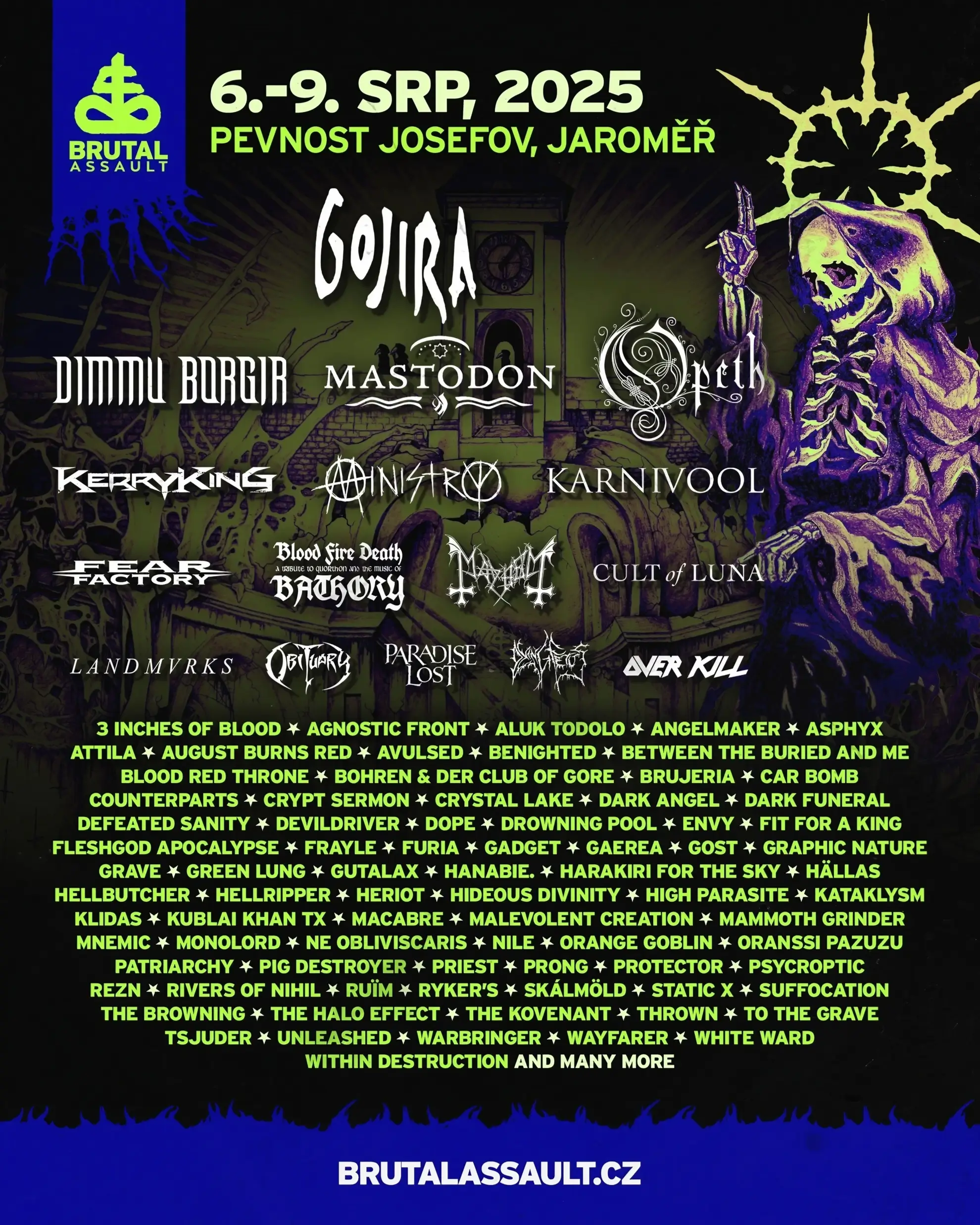
The Vanguard: A Headlining Triumvirate
Gojira: The Conscientious Colossus
Topping the bill are French titans Gojira, a band whose ascent from the underground of Bayonne to the global stage mirrors the festival’s own trajectory. For over two decades, brothers Joe and Mario Duplantier have steered their band to the pinnacle of the metal world with a sound that is both punishingly heavy and intellectually profound.
Their music, a potent fusion of technical death metal, progressive ambition, and irresistible groove, is inextricably linked to their lyrical focus on environmentalism, spirituality, and the human condition. Their 2021 album, ‘Fortitude,’ continued this tradition, blending raw aggression with melodic and tribal elements to critical acclaim.
In 2024, they achieved a new level of cultural penetration, becoming the first metal band to perform at an Olympics opening ceremony—a moment that brought their unique brand of thoughtful intensity to a worldwide audience and later earned them a Grammy Award for Best Metal Performance in early 2025. Their headlining performance at Brutal Assault Festival, part of a major 2025 European tour, feels like a triumphant victory lap for a band that has become the Grammy-winning standard-bearer for modern, forward-thinking metal.
Dimmu Borgir: The Orchestral Grandeur
From Norway come Dimmu Borgir, the undisputed pioneers of symphonic black metal. Since their formation in 1993, the band has been instrumental in taking the raw, primal energy of the early Norwegian scene and infusing it with opulent, cinematic orchestration. Albums like 1997’s ‘Enthrone Darkness Triumphant’ were watershed moments, breaking the genre out of the underground and onto international charts, proving that black metal could be both malevolent and majestic.
Their sound is a grandiose tapestry of raven-black riffing, blast-beat drumming, and sweeping orchestral and choral arrangements. After a period of relative quiet, the band has re-emerged, with their performance at Brutal Assault being a key date on their The Chosen Legacy Tour 2025, a celebration of their 30-year career that has influenced countless acts across the metal spectrum. Their presence promises a spectacle of gothic drama and sonic bombast perfectly suited to the fortress’s imposing atmosphere.
Ministry: The Industrial Anarchist
The third headliner is an American legend, the industrial machine known as Ministry. For over four decades, mastermind Al Jourgensen has been a relentless agent of sonic and political provocation. After beginning as a synth-pop outfit in the early 1980s, Jourgensen steered the band into harsher territory, becoming a primary architect of the industrial metal genre with seminal, platinum-selling albums like ‘The Land of Rape and Honey’ (1988) and ‘Psalm 69: The Way to Succeed and the Way to Suck Eggs’ (1992). Ministry’s music is a caustic blend of metallic riffs, punishing machine rhythms, and politically charged samples, a soundtrack for societal decay.
Their most recent album, 2024’s ‘Hopiumforthemasses,’ continued Jourgensen’s tradition of scathing social commentary, taking aim at political hypocrisy and cultural rot. As part of a 2025 European tour, Ministry’s set will bring a dose of abrasive, anarchic energy, a testament to the enduring power of one of rock’s most iconoclastic figures.
The Phalanx: A Spectrum of Darkness
Beyond the headliners, the true strength of Brutal Assault lies in the staggering depth and diversity of its undercard, a veritable encyclopedia of heavy and experimental music. The lineup is a roll call of foundational artists.
Death metal is represented by its most revered architects, including Florida’s Obituary and New York’s Suffocation, whose technical brutality remains a benchmark for the genre. Thrash metal’s old guard is present in the form of New Jersey’s Overkill and California’s Dark Angel. And the melancholic, gothic-tinged sound of doom metal will be delivered by British pioneers Paradise Lost.
The festival is also a haven for bands that push the technical and compositional boundaries of metal. Swedish masters Opeth and Atlanta’s Mastodon will bring their highly celebrated brands of progressive metal to the fortress. True to its “dark aura” ethos, the festival is peppered with acts that defy easy categorization. Germany’s Bohren & Der Club of Gore will offer their self-described “heroin jazz”—a dark, ambient, doom-laden take on noir soundscapes.
These are the bookings that give Brutal Assault Festival its reputation for adventurous and challenging curation. The festival has never forgotten its roots in raw, aggressive music.
The Bulletin
Subscribe
Subscribe today and connect with a growing community of 613,229 readers. Stay informed with timely news, insightful updates, upcoming events, special invitations, exclusive offers, and contest announcements from our independent, reader-focused publication.
The Brutal Ethos: A Festival with a Conscience
For an event centered on a genre often stereotyped as nihilistic or destructive, Brutal Assault Festival operates with a remarkably progressive and conscious ethos. This philosophy manifests in its pioneering environmental policies, its modern operational logistics, and its unwavering commitment to fostering a safe and inclusive community.
The festival’s dedication to sustainability is not a recent trend-hopping addition; it is a core value that has been in place for over a decade. The festival has long been an ecological pioneer in the region. As early as 2011, it implemented a system of reusable cups to reduce plastic waste, and in 2012, it began serving food on biodegradable palm-leaf plates.
A year later, it was the first to serve food on biodegradable plates made from palm leaves. These initiatives are part of a comprehensive environmental program that includes extensive waste sorting, the use of locally sourced food, support for fair trade products, and a carbon-offsetting project called the “Brutal Forest,” where the organization plants trees to mitigate the event’s ecological footprint.
Operationally, the festival is thoroughly modern. It runs on a completely cashless system, with all transactions handled via an RFID chip embedded in each attendee’s wristband. This system enhances security by reducing theft and streamlines the experience for festival-goers, minimizing queues for food, drinks, and merchandise.
These practical commitments are underpinned by a clear social contract. The festival’s motto, “Against violence and intolerance,” is more than a slogan; it is the guiding principle for the community that gathers within the fortress walls each year. The result is a global village, with fans traveling from as far away as Venezuela, united by their love for the music in an environment that prioritizes mutual respect.
This combination of progressive social values, modern operational efficiency, and a deep-seated environmental consciousness presents a compelling model for a twentieth-first-century cultural event. It powerfully subverts mainstream stereotypes, demonstrating that the most forward-thinking ideas can emerge from the most unexpected of places—even from the heart of the extreme metal underground.
Conclusion
For four days each August, the Josefov Fortress is transformed. It becomes more than a historical landmark; it is a living, breathing city of sound, a global nexus for a tribe united by a passion for music that exists on the fringes. Attending the Brutal Assault Festival is a pilgrimage for those who seek not just a concert, but a total immersion in an experience where history, community, and a powerful, dark aesthetic converge. It is a powerful expression of the idea that beauty can be found in brutality, and that a fortress built for war can become a sanctuary for art.
For those considering the journey, the 2025 edition of Brutal Assault Festival will take place from Wednesday, August 6, to Saturday, August 9, with a warm-up party scheduled for Tuesday, August 5. The festival is held within the historic eighteenth-century Josefov Fortress in Jaroměř, Czech Republic, a unique venue that hosts up to 20,000 attendees from around the globe. The event is open to all ages.
Prospective attendees should be aware that full festival passes, originally priced at €219, and most single-day passes (€102) are officially sold out. Limited day passes for Wednesday and Friday are still available, while passes for Thursday and Saturday are sold out.
Organizers strongly advise against purchasing tickets from unauthorized resellers and direct interested parties to the official BA Ticket Exchange on the official Brutal Assault Festival website, which is the only recommended platform for secure resale tickets.
A variety of accommodation options are available, though many are in high demand. On-site camping and spaces for RVs or campers are provided, but many of these spots have already been sold out. The festival also partners with local hotels and organizes bus services from nearby cities such as Hradec Králové to facilitate travel and lodging for attendees.
The on-site experience is designed for modern convenience and immersion. The entire festival operates on a cashless system, with all purchases made using a chip embedded in the attendee’s wristband. Beyond the five stages of music, the fortress grounds feature art galleries, a horror cinema, and a wide array of food stalls offering international and vegan cuisine, alongside numerous bars. In line with its community focus, the festival operates under the motto “Against violence and intolerance.”
Further enriching the experience, the festival offers special programs such as meet & greets with artists and paid clinics or lectures with musicians like Gene Hoglan, John Gallagher of Dying Fetus, and George Kollias of Nile.
Support
Independent
Journalism
Fund the voices Behind Every Story
Every article we publish is the product of careful research, critical reflection, and stringent fact-checking. As disabled individuals, we navigate this work with unwavering dedication, poring over historical records, verifying sources, and honing language to meet the highest editorial standards. This commitment continues daily, ensuring a consistent stream of content that informs with clarity and integrity.
We invite you to support this endeavor. Your contribution sustains the work of writers who examine their subjects with depth and precision, shaping narratives that question assumptions and shed light on the overlooked dimensions of culture and history.
Donations are processed through an in-kind sponsorship model powered by Paymattic—a secure, reliable donations plugin that enables direct support for our ongoing editorial work.
Leave a Reply