


Each December, as winter settles over North Brabant, thousands of black-clad metal enthusiasts make their way to Eindhoven for a gathering unlike any other. Drawn not by museums or tourist landmarks, they arrive for the Eindhoven Metal Meeting Festival, a two-day indoor festival devoted to the raw, often abrasive sounds of extreme metal.
Eindhoven, more commonly known as the “Silicon Valley of the Netherlands” for its high-tech industries, becomes a temporary haven for a global subculture. Within the walls of the Effenaar music venue, blast beats and guttural vocals replace the usual rhythms of urban life, creating an atmosphere that sharply contrasts with the city’s modern corporate landscape.
Unlike sprawling summer festivals, Eindhoven Metal Meeting offers a more intimate setting. The Effenaar features a large hall with a capacity of 1,300 and a smaller one for 400, fostering close interaction between performers and audience. Regulars often refer to the event as the “Christmas party of the Benelux metal family,” a seasonal tradition that blends community spirit with a celebration of musical extremity.
Eindhoven Metal Meeting: Venue and Festival History
The Eindhoven Metal Meeting has occurred annually since 2009. The event originated as the Arnhem Metal Meeting in 2004 before moving to Eindhoven five years later. It features bands from extreme subgenres like death, black, thrash, and doom metal. The lineup includes both long-established and newer acts, all performing at the Effenaar venue.
The history of the Effenaar venue provides context for the festival. In 1971, a group of young people squatted in an unused nineteenth-century linen factory on Dommelstraat. They named it “Open Jongerencentrum Para+,” and it became a gathering place for people who were dissatisfied with the societal norms of the time.
The venue’s origins in the counter-culture of the early 1970s preceded its association with punk and extreme metal. It became a stop on the European tour circuit for many alternative music artists, including the Sex Pistols, Joy Division, The Ramones, Bauhaus, and the Red Hot Chili Peppers. The venue hosted confrontational art and music before it began to feature extreme metal bands.
The venue was renovated between 2002 and 2005. The project, managed by the Dutch architecture firm MVRDV, converted the old factory into a 4,550-square-meter facility with two concert halls—one with a capacity of 1,300 and a smaller one for 400—at a cost of over 14 million euros. The building is now considered a technologically “smart” venue.
The transformation of the Effenaar from a squatted linen factory into a technologically advanced concert venue mirrors the broader evolution of extreme metal itself. Born from defiance, the venue’s counter-culture roots align with the genre’s rebellious origins, while its professionalization reflects how bands such as Batushka now navigate record contracts, global tours, and industry disputes—all without abandoning metal’s original spirit of resistance.
Two Pillars of Extreme Metal
The headliners for the 2025 festival, Hypocrisy and Triptykon, represent two distinct and significant trajectories within extreme metal. Each band is anchored by a central figure whose work has had a broad impact on the genre. Hypocrisy, from Sweden, is a long-running melodic death metal band guided by Peter Tägtgren, who is also a notable producer for many other groups.
The two headliners are not just genre contemporaries—they are collaborators. Peter Tägtgren produced Celtic Frost’s 2006 album ‘Monotheist,’ the very recording whose creative rupture led Fischer to form Triptykon. That shared legacy now culminates in both artists headlining the same stage, symbolizing how personal and artistic histories remain tightly woven in extreme metal.
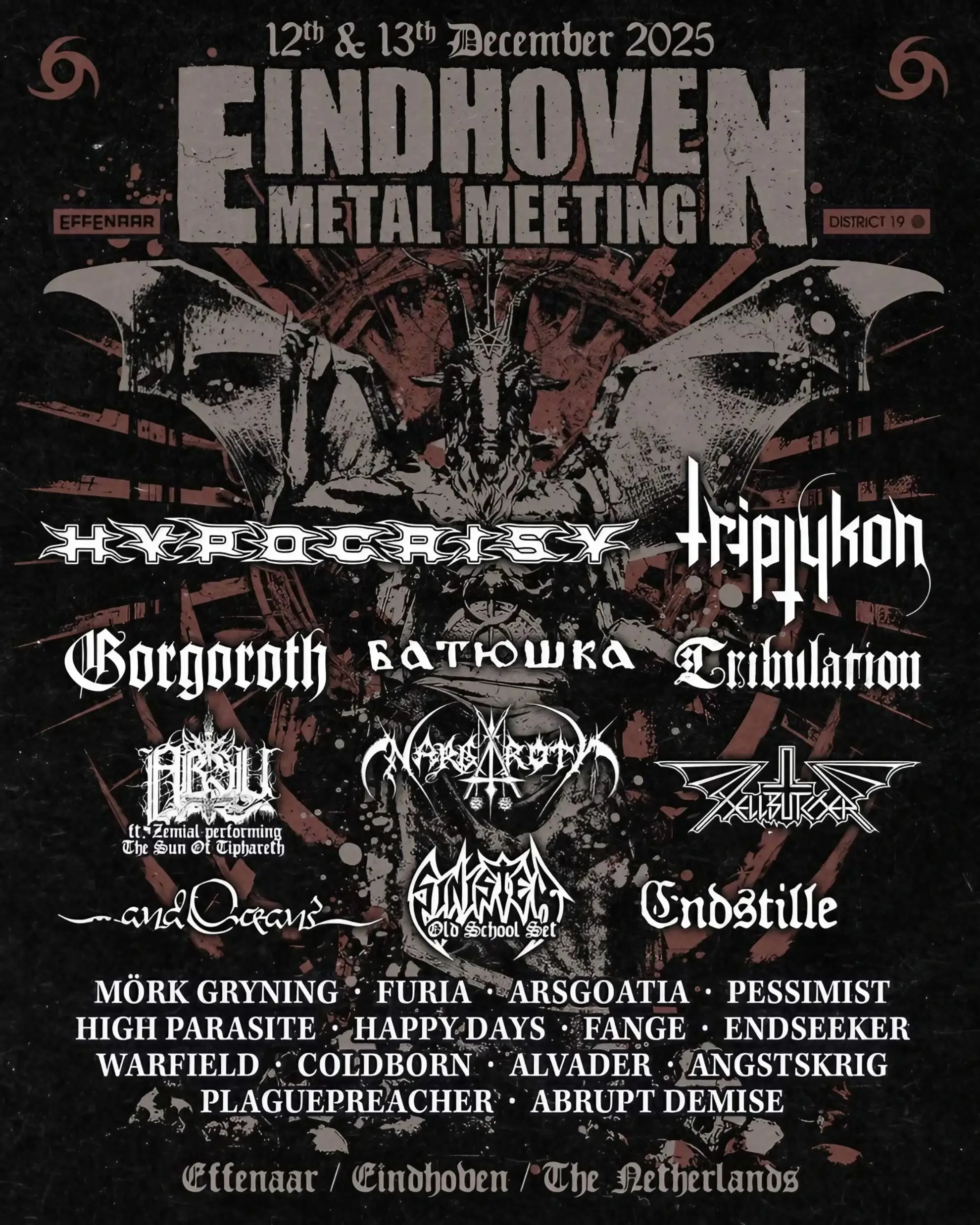
Hypocrisy and the Influence of Peter Tägtgren
The Swedish band Hypocrisy was formed in 1991 by its only constant member, Peter Tägtgren. In the early 1990s, he spent time in Fort Lauderdale, Florida, where a death metal scene included bands like Morbid Angel and Deicide. After he went back to Sweden, he formed Hypocrisy, which started as a solo project and became a full band.
The band’s early material was traditional death metal, with lyrics about anti-Christian topics that were common in the scene. The band’s style later became more melodic and atmospheric, and the lyrical subjects changed. Tägtgren began to write about the paranormal, alien encounters, and abduction experiences. The song ‘Roswell 47’ is an example of this, and the band became known for its science-fiction-related content.
Beyond fronting Hypocrisy, Tägtgren is widely regarded as one of the most influential producers in Scandinavian extreme metal. Through his Abyss Studio, he helped define the genre’s sonic architecture, shaping the dense atmospheres and razor-sharp clarity that characterize much of its modern sound.
His production credits include seminal recordings by Dimmu Borgir, Immortal, Dark Funeral, and even Celtic Frost’s ‘Monotheist,’ tying his work directly to the legacy of fellow headliner Tom G. Warrior. Tägtgren’s dual legacy—as both performer and producer—makes his presence at Eindhoven Metal Meeting not merely appropriate but emblematic of the scene’s interconnected evolution.
Triptykon and the Work of Tom G. Warrior
Triptykon was formed in May 2008 by Tom Gabriel Fischer, known in the music world as Tom G. Warrior, as a direct consequence of the final dissolution of his previous band, the highly influential Celtic Frost. Mounting internal tensions had made it impossible for Fischer to convene songwriting sessions for the intended follow-up to Celtic Frost’s acclaimed 2006 comeback album, ‘Monotheist.’
Triptykon was created specifically to further pursue the dark, heavy, and experimental musical path of that final Celtic Frost era. The connection is so direct that much of the material on Triptykon’s 2010 debut album, ‘Eparistera Daimones,’ consisted of songs Fischer had originally written for the next Celtic Frost record.
The band’s name is a deliberate and deeply personal choice. “Triptykon” is the Greek word for “triptych,” signifying that this is Fischer’s third and final major occult extreme metal project, completing a personal artistic triptych that began with Hellhammer and Celtic Frost. The name is also an homage to the dark, religiously themed triptych paintings of artists like Hieronymus Bosch, whose work had famously adorned the cover of Celtic Frost’s 1987 album ‘Into the Pandemonium.’
Triptykon’s musical lineage is rooted in the two projects that preceded it. The first, Hellhammer (1982-1984), was a primitive and raw band born from youthful frustration in rural Switzerland. It was a personal “sanctuary” for its members, who felt like outcasts, and was almost universally reviled by critics at the time. In its extremity and rejection of musical norms, however, Hellhammer accidentally laid a foundational blueprint for what would become black metal.
Recognizing Hellhammer’s limitations, Fischer and bassist Martin Eric Ain deliberately disbanded it and, overnight, designed a new band from scratch: Celtic Frost. From 1984, Celtic Frost shattered the conventions of 1980s metal, infusing it with avant-garde sensibilities, gothic atmospheres, and classical arrangements. They became pioneers of extreme and experimental metal, with a stated goal of being “anarchists” in a scene they felt was becoming too rigid and rule-bound. Their influence is cited by a vast number of bands across multiple subgenres.
Triptykon continues this legacy, with music and lyrics that explore themes of history, occultism, human disintegration, and nihilism. A performance by the band is therefore an encounter with this entire four-decade artistic journey, from the primal scream of Hellhammer to the genre-defying art of Celtic Frost, all culminating in the towering and pulverizing darkness of Fischer’s current work.
Other Scheduled Performers
While the headliners provide the festival’s anchor points, the true breadth of the Eindhoven Metal Meeting Festival is found in the diverse collection of bands supporting them. The lineup acts as a narrative map of extreme metal, featuring not only a spectrum of sonic styles from foundational acts to contemporary innovators, but also bands whose histories are fraught with the very drama that defines the scene’s passionate and often turbulent nature. Here, stories of internal schisms, public battles for a band’s identity, and uncompromising artistic visions are as much a part of the performance as the music itself.
The Schism of Batushka
The Polish band Batushka began in 2015 as an anonymous project, quickly gaining attention for its unique concept. The members performed in Orthodox Christian vestments and schemas, their identities concealed, while the music combined black metal with lyrics written exclusively in Old Church Slavonic and structured around the Eastern Orthodox liturgy. Their debut album, ‘Litourgiya,’ was released to widespread acclaim, becoming a commercial and critical success that led to high demand for live performances.
Following three years of growing acclaim, a public schism emerged in late 2018 between the band’s founder and composer, Krzysztof “Derph” Drabikowski, and vocalist Bartłomiej Krysiuk. In the aftermath, Krysiuk assumed control of the band’s established social media accounts and continued to tour and record under the Batushka name with a new lineup and a contract with a major record label.
In June 2024, a Polish court ruled in favor of Drabikowski as the rightful owner of the Batushka name and artistic legacy. As a result, Krysiuk’s version of the band was renamed Patriarkh, bringing a formal end to the dispute over the Batushka identity. The version of Batushka scheduled to perform at Eindhoven Metal Meeting Festival is the one led by its founder, Krzysztof Drabikowski, a detail of interest to the band’s followers and a direct link to the project’s origins.
Gorgoroth Forged in Controversy
Gorgoroth is a Norwegian black metal band formed in 1992 by guitarist Roger “Infernus” Tiegs. Tiegs has stated he started the band after making “a pact with the devil.” The band is associated with the extreme and confrontational aspects of the genre.
The band’s history includes controversy. Various members have had criminal convictions for violence and church arson. A 2004 concert in Krakow, Poland, included crucified models and sheep heads, which resulted in a police investigation for offending religious beliefs and the end of their contract with the label Nuclear Blast Records.
The conflict also became internal. In 2007, vocalist Gaahl and bassist King ov Hell attempted to remove founder Infernus from the band. They filed a trademark application for the Gorgoroth name and logo, and for a time two versions of the band existed. A Norwegian court ruled in 2009 that Infernus was the rightful owner of the name. Such disputes over artistic identity and control can arise in a genre where a creator’s individual vision is important.
The Bulletin
Subscribe
Subscribe today and connect with a growing community of 613,229 readers. Stay informed with timely news, insightful updates, upcoming events, special invitations, exclusive offers, and contest announcements from our independent, reader-focused publication.
Performances of Past and Present Material
The lineup for the Eindhoven Metal Meeting 2025 includes bands performing material from different points in their careers. The schedule includes performances of specific older albums as well as sets from bands whose sound has changed over time.
Performances of Older Material
Several performances are billed as focusing on older material. The North American band Absu will perform their 1995 album, ‘The Sun of Tiphareth,’ in its entirety. In the mid-1990s, Absu released an album that combined European-influenced black and thrash metal with lyrical subjects from Celtic and Sumerian mythology and occultism, which was not common for North American metal bands at the time.
The Finnish band …and Oceans will also perform an old school setlist. The band started in the 1990s playing symphonic black metal before changing their style to industrial and electronic music, at one point using the name Havoc Unit. They have recently begun playing music again in their earlier style.
The presence of Dutch death metal veterans Sinister, performing a special old-school death metal set, further adds to this theme of honoring the genre’s foundational texts. They are joined by Possessed—often cited as one of the originators of death metal—and I Am Morbid, led by former Morbid Angel frontman David Vincent, performing material from that band’s most influential era.
Bands with Changed Styles
In contrast to the historical sets, the lineup also features Tribulation, a band whose style has changed over time. The Swedish quartet began by playing death metal on their 2009 album, ‘The Horror.’ On later albums, such as ‘The Formulas of Death,’ ‘The Children of the Night,’ and ‘Down Below,’ their sound incorporated gothic and progressive rock elements. Their music now includes influences from post-punk, 1970s rock, and horror film scores.
The inclusion of bands like Tribulation alongside bands performing older material shows a range of styles within the genre. Attendees can hear music that is representative of the genre’s earlier sound, as well as music that has incorporated different influences over time.
Conclusion
The 2025 Eindhoven Metal Meeting Festival will be held on Friday, December 12, and Saturday, December 13, with a traditional warm-up evening on Thursday, December 11.
All events take place at the Effenaar, located at Dommelstraat 2, 5611 CK Eindhoven, in the city center and a short walk from the central train station. Regular two‑day combination tickets are available for €140.00, with the service fee already included. Tickets for the warm-up evening cost €29.00, though no breakdown of fees is published by the primary vendor. According to venue policy, concert access at Effenaar is restricted to attendees aged 16 or older—or individuals aged 12 and up only when accompanied by an adult.
Tickets can be purchased through the official vendor, Ticketmaster Netherlands. Prospective attendees should note that early bird tickets have sold out and there is no on-site camping available for this all-ages event.
Support
Independent
Journalism
Fund the voices Behind Every Story
Every article we publish is the product of careful research, critical reflection, and stringent fact-checking. As disabled individuals, we navigate this work with unwavering dedication, poring over historical records, verifying sources, and honing language to meet the highest editorial standards. This commitment continues daily, ensuring a consistent stream of content that informs with clarity and integrity.
We invite you to support this endeavor. Your contribution sustains the work of writers who examine their subjects with depth and precision, shaping narratives that question assumptions and shed light on the overlooked dimensions of culture and history.
Donations are processed through an in-kind sponsorship model powered by Paymattic—a secure, reliable donations plugin that enables direct support for our ongoing editorial work.

Leave a Reply