


The cultural distance between the melancholic, sea-battered cliffs of Portugal and the verdant, blood-soaked mountains of the Colombian Andes is, on the surface, vast. One is defined by “saudade”—a longing for what is lost—and the other by “desasosiego”—a restless anxiety for what might explode next. Yet, for someone who has spent over a decade navigating the chaotic urban sprawl of Bogotá, a profound resonance emerges between these two worlds.
Both nations carry the weight of empires and the scars of internal strife. However, while the Portuguese catharsis is often found in the weeping guitars of Fado, the Colombian exorcism is found in the guttural roar of Death Metal.
No entity embodies this Andean sonic purgation more completely than Masacre. They are not merely a musical group; they are a sociological institution, a surviving artifact of the late twentieth-century Colombian conflict that refuses to be relegated to a museum. The recent announcement of their Al Sur Del Infierno (To the South of Hell) tour, scheduled for June 2026, coupled with the monumental 2025 reissue of their seminal EP ‘Ola de Violencia,’ marks a pivotal moment in Latin American extreme music history.
Genesis of the “No Futuro” Generation
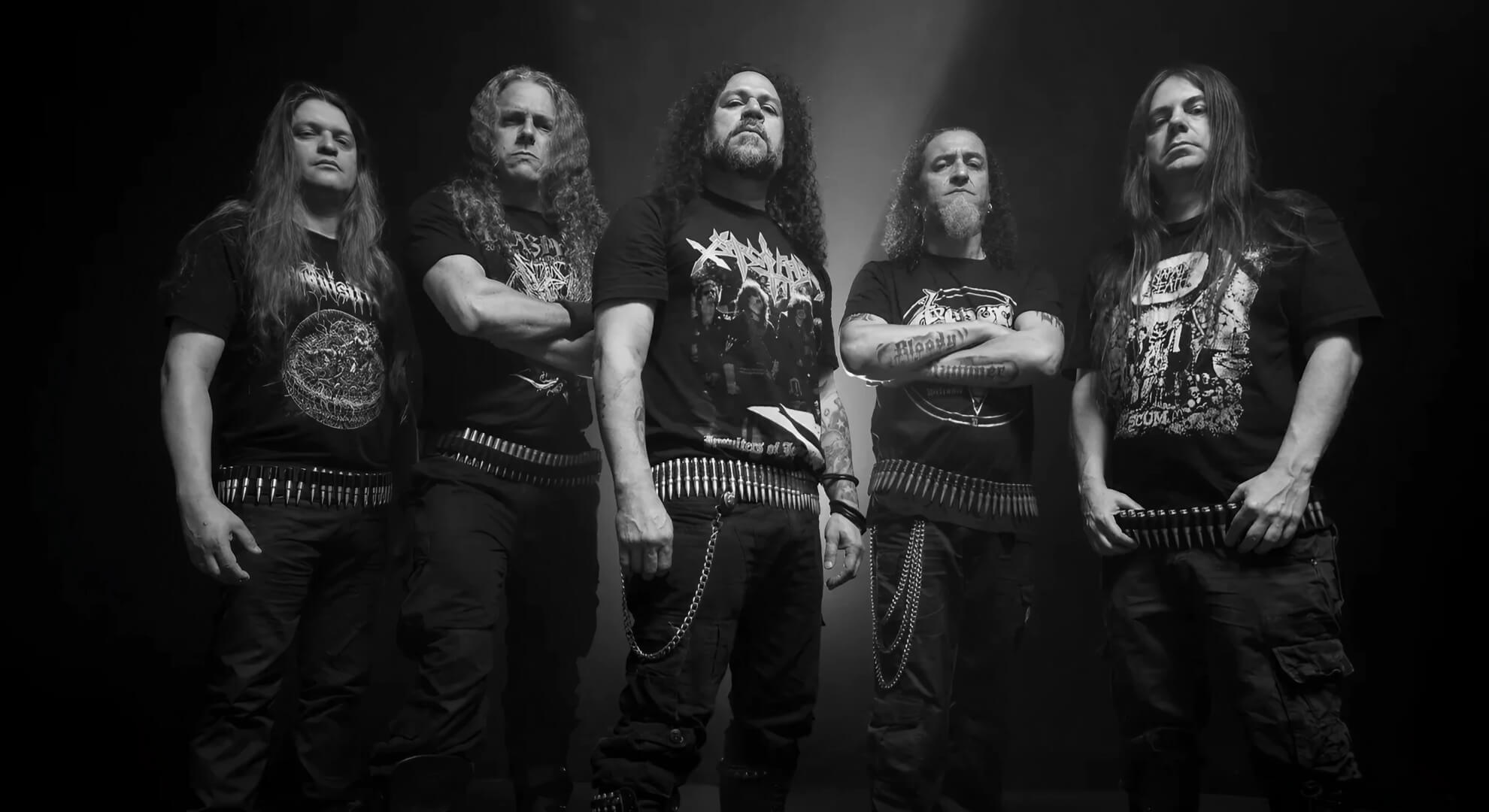
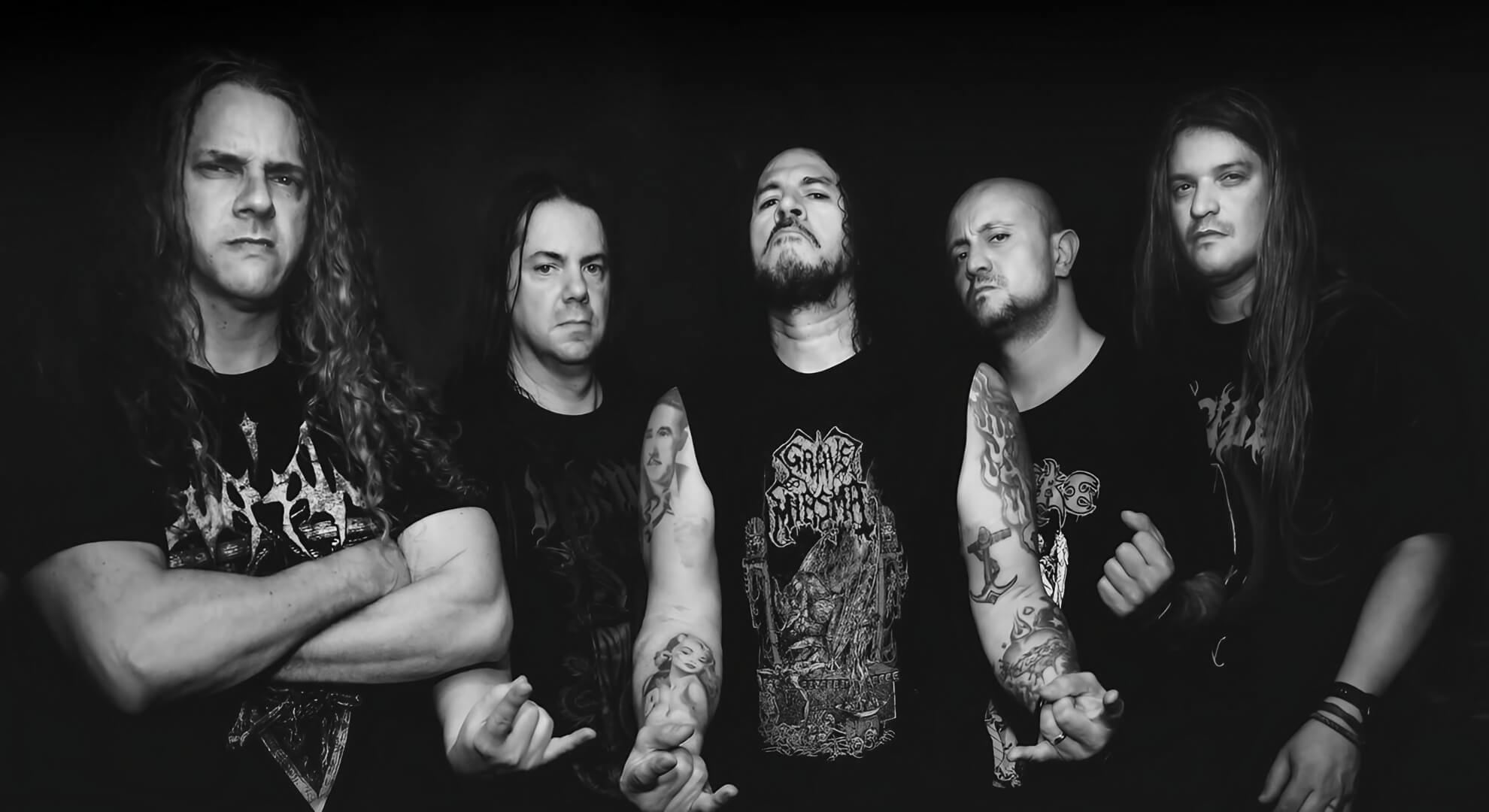
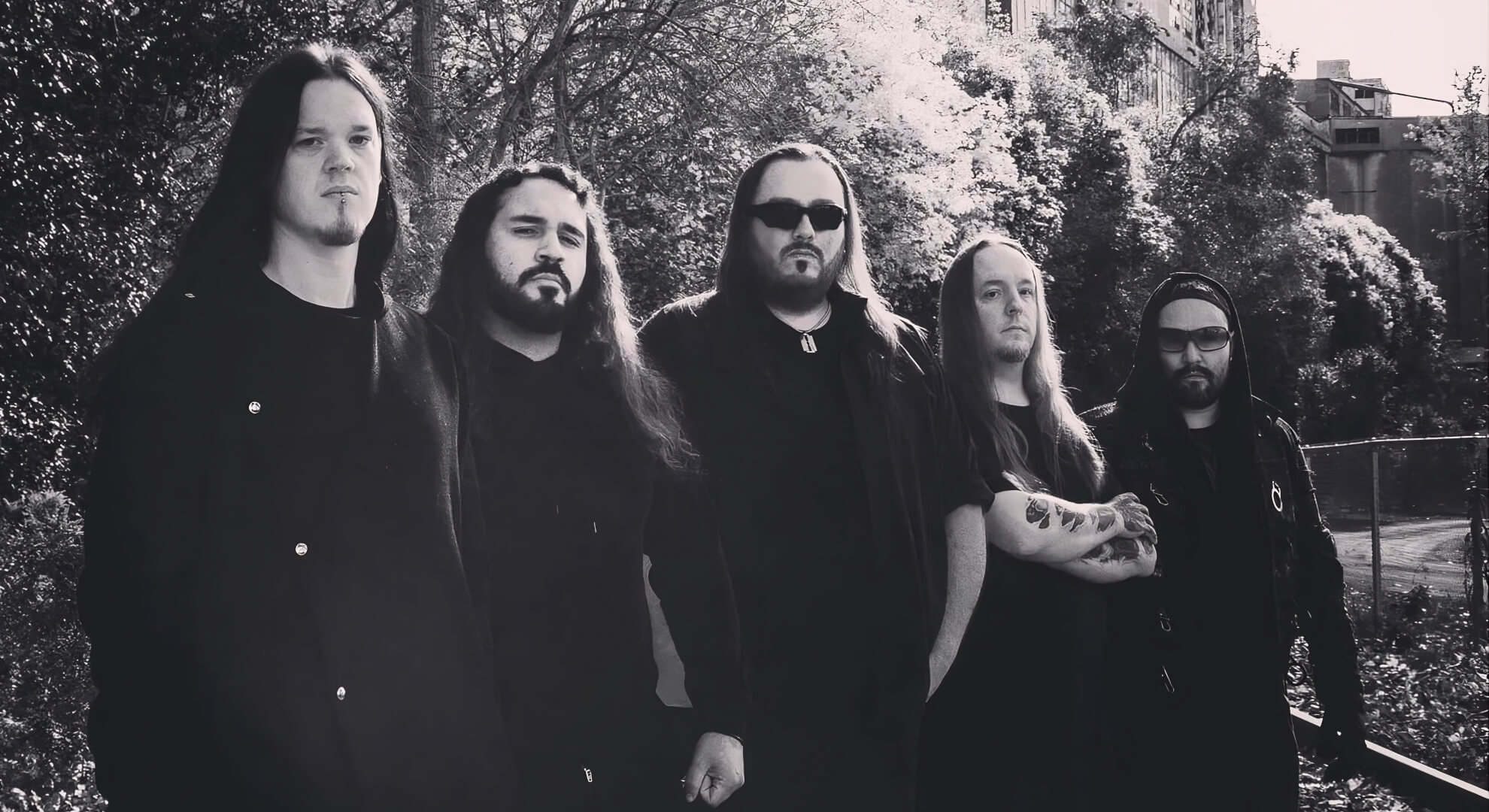
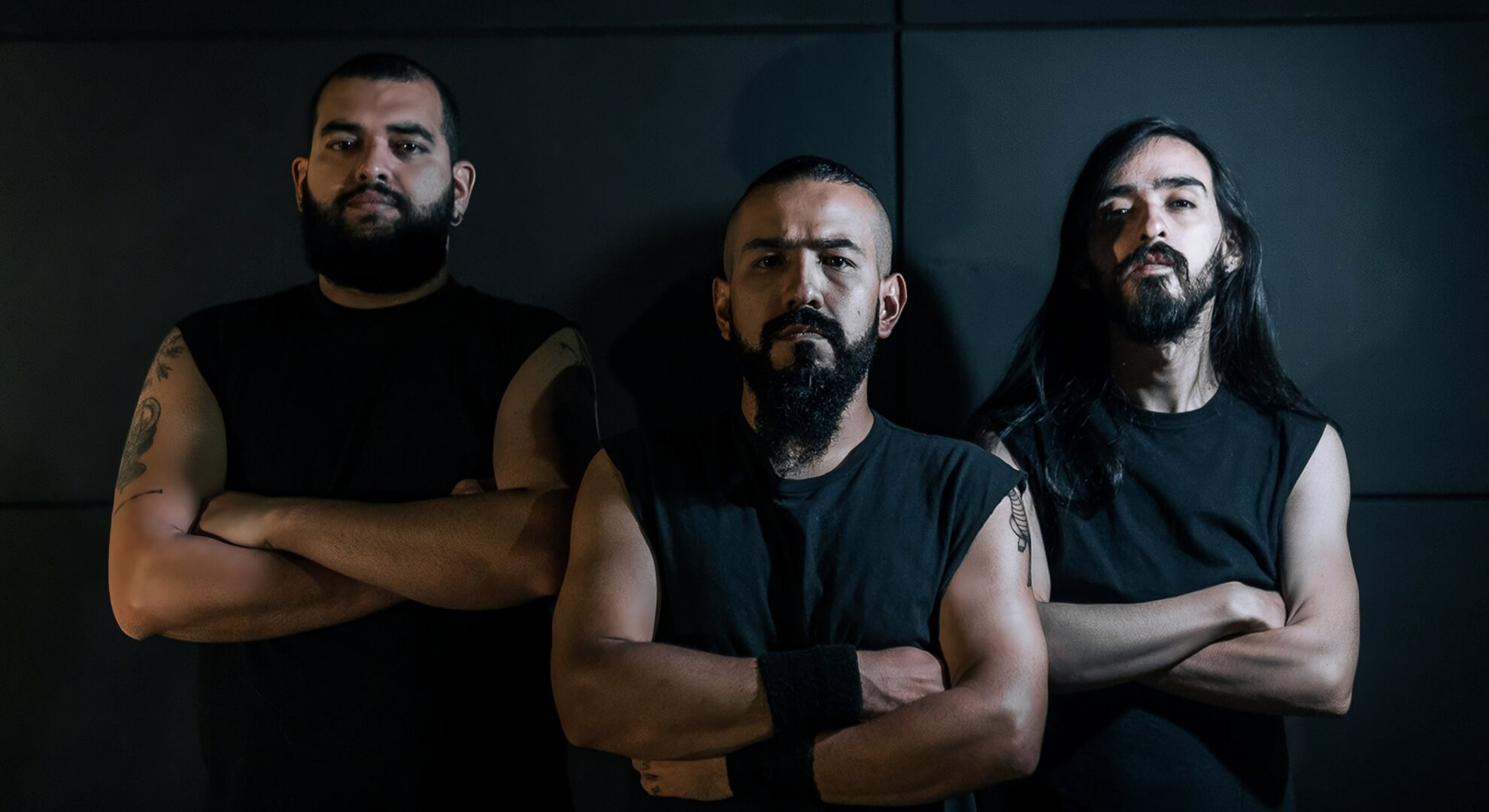
To interpret the poster announcing the 2026 tour—a graphic displaying the band members standing like sentinels of the underworld—one must first comprehend the city that shaped them. Medellín in the late 1980s was not the tourist-friendly “City of Eternal Spring” it is marketed as today. It was the epicenter of a global drug war, a city where the homicide rate spiraled into the thousands, and where car bombs (carros bomba) were as common as rainstorms.
In this vacuum of governance and surplus of violence, the youth of the working-class comunas rejected the tropical rhythms of salsa and vallenato, which seemed incongruous with the carnage on their streets.1 Instead, they looked to the north—to the punk of the United Kingdom and the thrash of the Bay Area—but found even those sounds insufficient to describe their reality.
What emerged was a uniquely Colombian sub-genre known as “Ultra Metal.” Bands like Parabellum and Reencarnación pioneered a sound that was primitive, chaotic, and structurally loose, prioritizing atmosphere over technicality. It was in this crucible that Masacre formed in 1988.
As noted in our recent feature on Thy Antichrist, who channeled this environment into a “Nietzschean existentialism” a decade later, Masacre’s reaction was far more visceral. Frontman Alex Oquendo has frequently distinguished their output from the fantasy-based gore of the American scene. While bands like Cannibal Corpse wrote scripts for horror movies that did not exist, Oquendo insists that Masacre’s lyrics were strictly “journalistic.”
For Oquendo, tracks like ‘Sangrienta Muerte’ (Bloody Death) were not attempts at shock value; they were, in his view, “documentary evidence” of daily life in Medellín. The violence in their music was not a creative choice, but a mirror held up to a city under the siege of the “Imperio del Terror.”
A Transatlantic Lifeline to France
A critical aspect of Masacre’s history, which connects directly to the 2025 cultural milieu, is their unlikely relationship with Europe. In the pre-internet era, the “tape trading” network was the only lifeline for South American bands. Masacre’s demos traveled across the Atlantic and landed in the hands of Hervé Herbaut of the French label Osmose Productions.
This connection was historic. In 1991, Osmose released Masacre’s debut album, ‘Reqviem,’ giving Colombian metal a legitimacy that few other scenes in the “Third World” possessed. This was not charity; it was a recognition that the “Ultra Metal” sound possessed a raw authenticity that the increasingly polished European scenes were losing. The fact that a French label would invest in a band from a pariah city in the Andes remains proof of the universal language of extreme art.
Situating Masacre in the Canon of Extremity
To gauge the magnitude of Masacre’s return to the south, one must situate them not merely as a band, but as a key vertex in the geometry of global extreme art. While the Florida scene pursued technical perfection and the Scandinavian circle courted atmospheric majesty, Medellín’s output was distinct. It was “Dirty Realism”—a term usually reserved for the literature of Charles Bukowski or the cinema of Victor Gaviria—transmuted into blast beats.
The South American Unholy Trinity
In the historiography of Latin American metal, Masacre forms the third point of an “Unholy Trinity” alongside Brazil’s Sepultura and Sarcófago. While Sepultura successfully integrated indigenous rhythms to achieve global commercial dominance, and Sarcófago leaned into a blasphemous, theatrical extremism that influenced black metal, Masacre followed a different trajectory. They became the sonic equivalent of a war correspondent. Their music did not seek to escape the favela or the comuna; it sought to mirror its horror.
Where their peers often adopted the aesthetics of fantasy or satanic ritual, Masacre’s aesthetic was grounding in the necropolitics of the Colombian state.2 They are less comparable to Cannibal Corpse and more akin to the painting “The Disasters of War” by Francisco Goya—if Goya had traded his brush for a downtuned guitar.
Audio-Visual Cinema of the Absurd
Culturally, Masacre’s work is inextricably linked to the “No Futuro” (No Future) philosophy that permeated the youth culture of late 80s Medellín. This was not merely a punk slogan borrowed from the Sex Pistols; it was a literal description of their mortality tables.
Just as the film ‘Rodrigo D: No Futuro’ employs local punk bands to score the nihilism of the city’s youth, Masacre’s discography serves as the unofficial score to the decades of conflict that followed. They represent a rejection of the “Magical Realism” that Gabriel García Márquez made famous.
In Masacre’s world, there are no butterflies or flying grandmothers; there is only the “Empire of Terror.” This commitment to a brutal, unvarnished reality gives their 2026 tour a weight that transcends entertainment—it is a traveling monument to a history that many wish to forget.
Reviving the ‘Ola de Violencia’ Artifact
Before the band heads south in 2026, the cultural terrain is being primed by a significant archival release. In February 2025, Osmose Productions unleashed a definitive reissue of the ‘Ola de Violencia’ EP. This release operates as more than a commercial product; it is a sonic anchor that forces a confrontation between the band’s primitive origins and their modern status as titans.
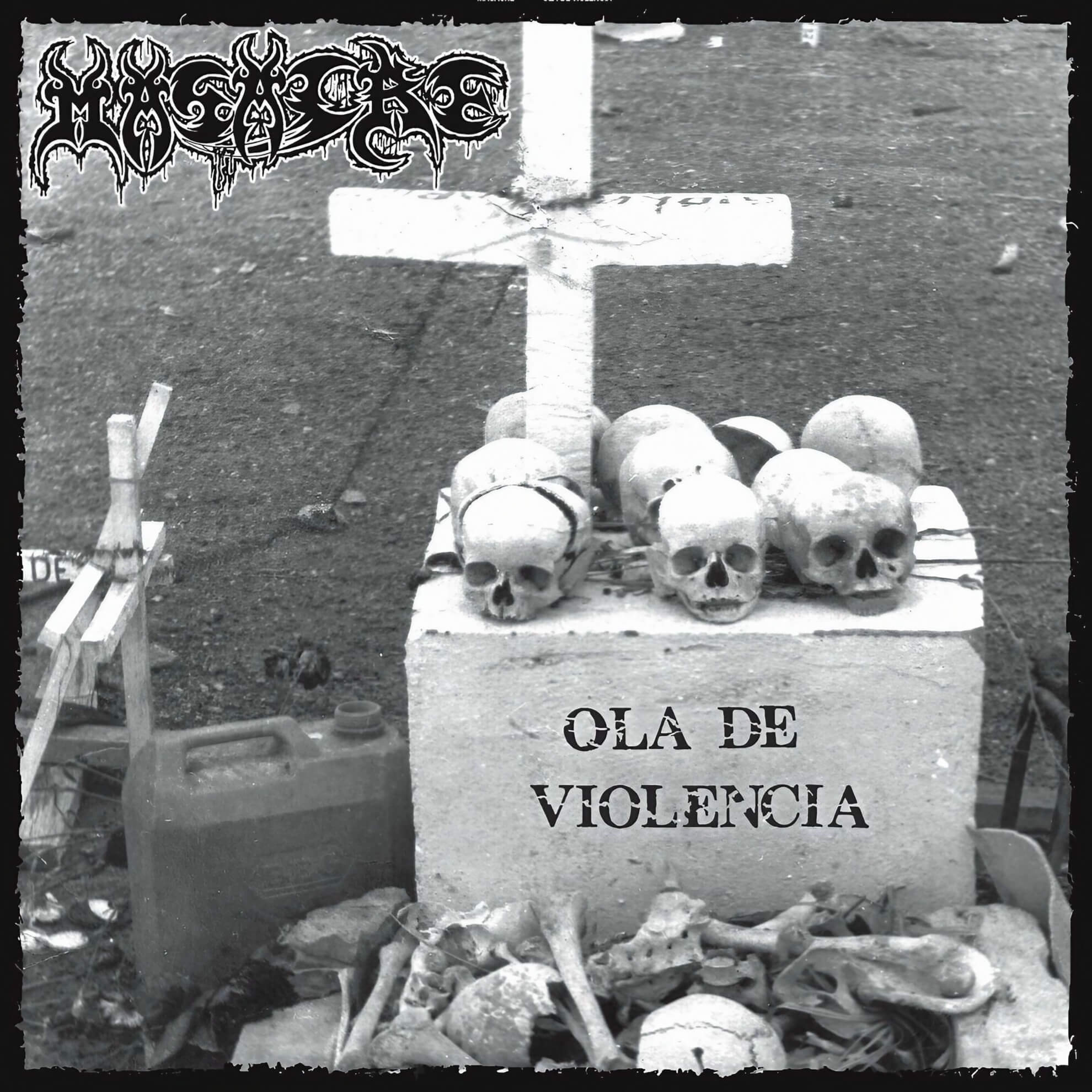
The 2025 reissue captures the band at a volatile transition point. It documents the moment when the raw, unpolished noise of the “Ultra Metal” demos began to calcify into the structured Death Metal that would define their 1991 debut, ‘Reqviem.’
Released on January 31, 2025, by Osmose Productions, this artifact reaffirms the 34-year alliance between Medellín and the European underground. It is available in physical formats that cater to the collector market, including a 12-inch LP in red and white vinyl as well as a compact disc, effectively fetishizing the “artifact” of analog violence.
Significantly, the release includes bonus tracks such as ‘Termonuclear’ and ‘Los Pecados del Dios,’ which restore lost tracks from the archives and expand the historical narrative. Furthermore, the inclusion of live material—specifically ‘Brutales Masacres’ and the title track ‘Ola de Violencia’—provides auditory proof of the band’s live intensity in the 1990s, offering a stark contrast to modern digital recordings.
An Auditory Experience of Terror
The remastered audio reveals the distinct Medellín sound: low-tuned guitars that sound less like musical instruments and more like machinery grinding to a halt, coupled with Oquendo’s dual-vocal attack. Influenced by Parabellum, Oquendo switches between a guttural growl and a high-pitched, hysterical shriek. This vocal schizophrenia perfectly mirrors the psychological state of a population living under the constant threat of “sicarios” (assassins)—a mix of deep dread and panic.
Charting the Al Sur Del Infierno Campaign
The tour announcement poster, titled Al Sur Del Infierno (South American Tour), outlines a focused, high-intensity campaign through the Southern Cone of South America. The imagery is stark: the band members, aged and hardened, stand against a backdrop of demonic iconography, signaling that they are not a nostalgia act but a contemporary force.
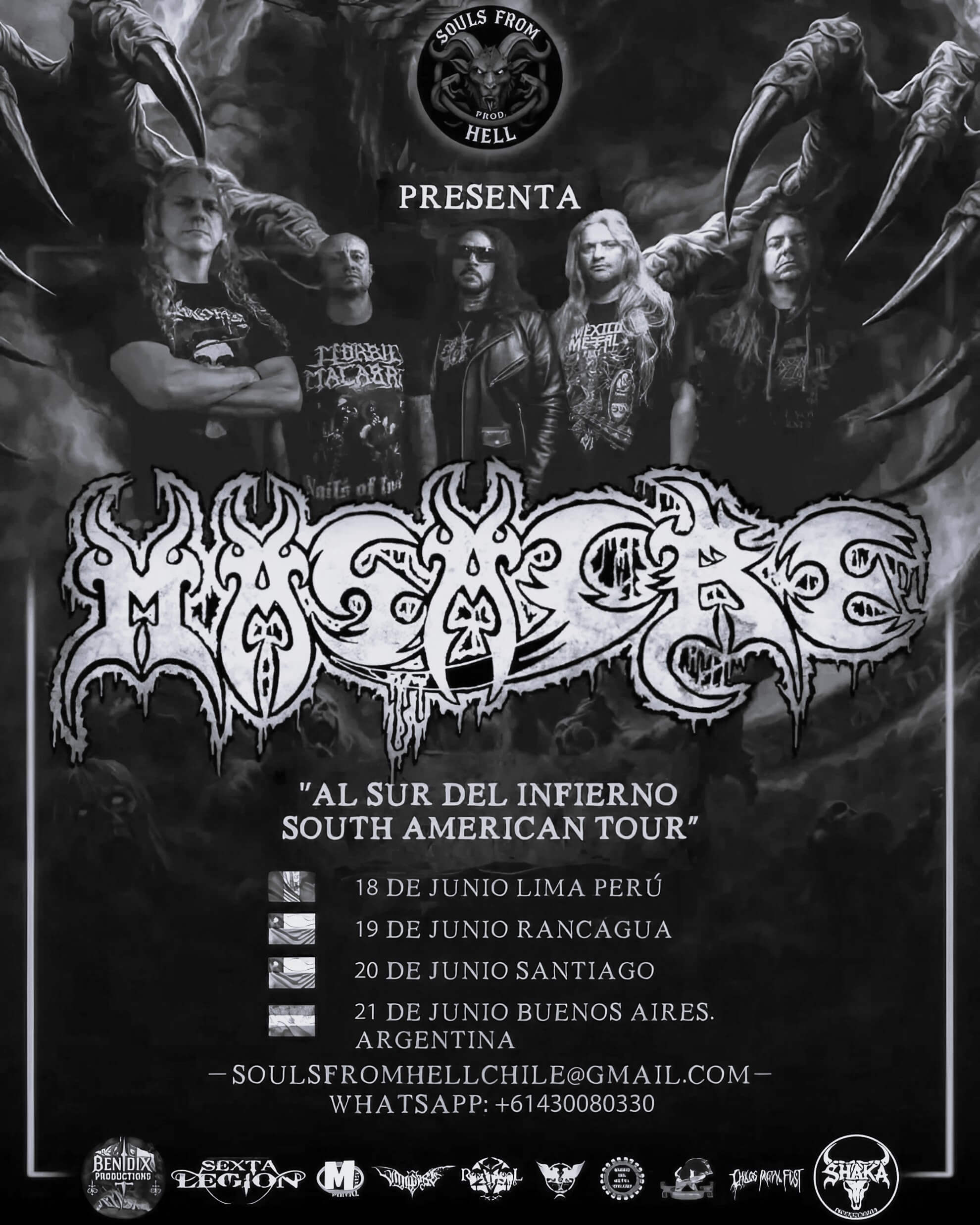
The choice of itinerary speaks to a deliberate geopolitical strategy, targeting capitals that have each weathered their own storms of dictatorship, economic collapse, and internal conflict.
The tour commences on June 18 in Lima, Peru, likely at a venue such as Bar Iwanna Rock or CC Lima. Here, Lima’s “Grey Sky” (Panza de Burro) atmosphere resonates with Masacre’s doom-laden tempos, while the nation’s shared history of terrorism in the 80s and 90s creates a profound bond with the Colombian narrative.
The following day, June 19, the band travels to Rancagua, Chile. As a mining and industrial hub south of Santiago, Rancagua represents the deep-rooted Chilean metal culture where decentralization is key to the scene’s survival.
On June 20, the pilgrimage reaches its symbolic peak in Santiago, Chile, at the Teatro Ex Mundo Mágico. Performing in the ruins of a defunct amusement park is a perfect metaphor for the collapse of innocence that Masacre’s music explores.
Finally, on June 21, the tour concludes in Buenos Aires, Argentina, likely at El Teatrito or Uniclub. The “Paris of South America” possesses a raucous, punk-inflicted metal scene known for chanting riffs like football anthems, ensuring a chaotic finale.3
Echoes in the Ruins of Mundo Mágico
The choice of Teatro Ex Mundo Mágico in Lo Prado, Santiago, for the June 20th show warrants specific attention. This venue sits within the grounds of a former theme park that opened in the 1980s and later fell into decay.
In recent years, it has been repurposed as a cultural space for underground events. For a historian, the semiotics are irresistible: Masacre, a band born from the social collapse of Colombia, performing in the skeletal remains of a failed capitalist fantasy in Chile. The acoustics of such a space—cavernous, concrete, and rough—will likely amplify the raw, muddy production that characterizes the band’s sound, creating an atmosphere closer to the illegal warehouse gigs of the 90s than a polished modern concert.
The Eternal Fire of “No Futuro”
Ultimately, the arrival of Masacre in the Southern Cone is not merely an export of Colombian culture, but a trans-continental communion of scars. When Alex Oquendo screams the lyrics of ‘Ola de Violencia’ in the repurposed ruins of Santiago’s Mundo Mágico, he is not performing a vintage hit; he is reopening a historical case file that never truly closed.
For the audiences in Lima, Rancagua, and Buenos Aires—cities that recognize the weight of silence and the noise of conflict—this tour is the ultimate validation of their own survival. In a modern society that often demands we forget the ugly truths of our past to embrace a sanitized future, Masacre remains the defiant memory of the “No Futuro” generation, proving that while empires of terror may fall, the art born of their fires burns eternal.
Considering this historical exorcism across the Southern Cone, how will physically inhabiting the tropel—alongside this living archive of conflict—transform your relationship with the “Empire of Terror,” moving it beyond mere musical appreciation into a personal act of remembrance?
Citations:
- Héctor Fernández L’Hoeste, ‘On How to Be Colombian,’ in ‘Rockin’ Las Américas: The Global Politics of Rock in Latin/o America,’ ed. Deborah Pacini Hernandez et al. (Pittsburgh: University of Pittsburgh Press, 2004), 132. ↩︎
- Achille Mbembe, ‘Necropolitics,’ Public Culture 15, no. 1 (2003): 27. ↩︎
- Idelber Avelar, ‘The Untimely Present: Postdictatorial Latin American Fiction and the Task of Mourning’ (Durham: Duke University Press, 1999), 56. ↩︎

Leave a Reply