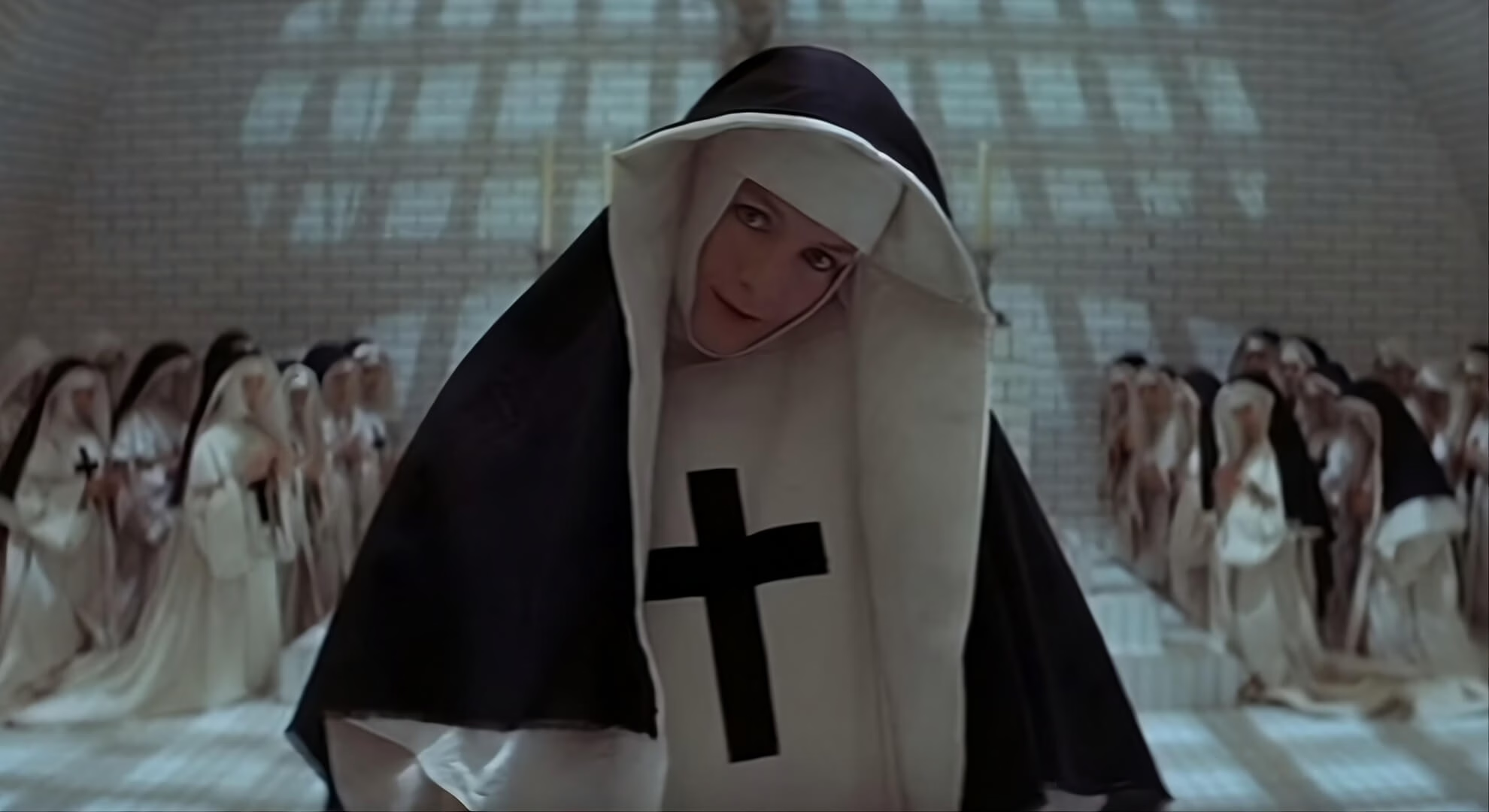


The films that institutional power most persistently suppresses are rarely the ones without something specific to say. When the British Board of Film Classification cut Ken Russell’s account of the Loudun witchcraft trial before its 1971 theatrical release, when Warner Bros. removed further material for the American market, when the studio declined for decades to authorize home video distribution in the United Kingdom — each act of excision argued, more eloquently than any review, that the film’s central claim remained too discomforting to present intact.
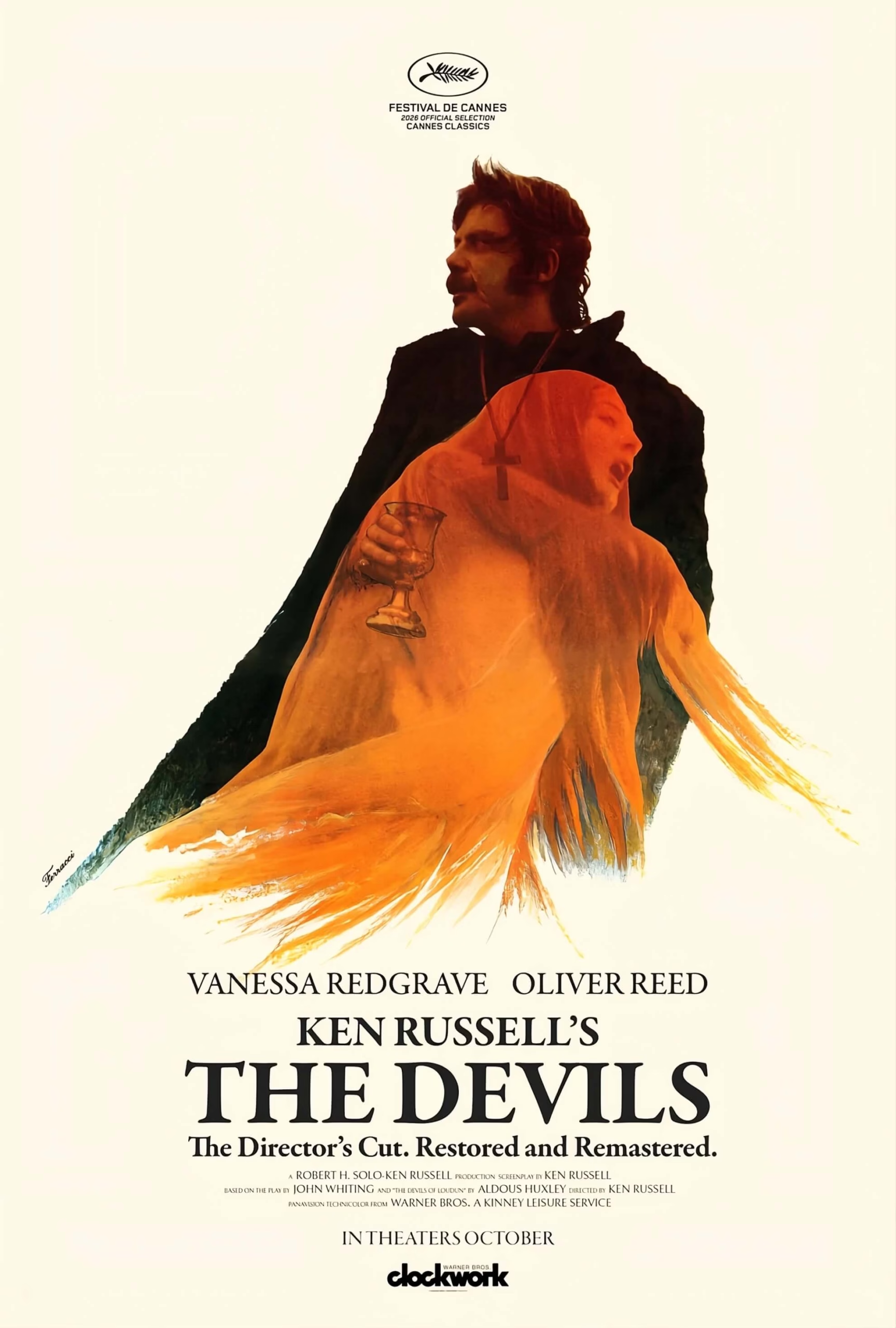
The Cannes Classics section of the 79th Cannes Film Festival presented the complete 114-minute director’s cut of Russell’s ‘The Devils’ on May 14th, 2026 — the first formal theatrical presentation of the film in its uncut form since the director completed it. Restored in 4K from the original camera negative by Warner Bros. Clockwork, the film arrived at Cannes fifty-five years after its original release and after decades of documented institutional resistance to the director’s cut receiving any authorized public presentation.
The Loudun Possessions
The historical events at the center of ‘The Devils’ are among the most thoroughly documented instances of politically weaponized witchcraft prosecution in the early modern period.
In 1634, Father Urbain Grandier, curé of the church of Saint-Pierre du Marché in Loudun, France, was tried for witchcraft, subjected to a judicial torture procedure in which wooden boards wedged between the legs were hammered to fracture the bones, and subsequently burned alive.
The accusations against Grandier emerged from a convent of Ursuline nuns whose prioress, Sister Jeanne of the Angels, claimed demonic possession; the political utility of those accusations to Cardinal Richelieu, who required Grandier’s removal as a local obstacle to his administrative consolidation of Loudun, is established in the proceedings’ documentary record — a record that Michel de Certeau, in his foundational study, characterized as an intersection of religious practice, political power, and early modern medical authority in which individual bodies became the terrain for institutional contests.1
Aldous Huxley’s 1952 work ‘The Devils of Loudun’ reconstructed the proceedings as judicial assassination conducted through the formal apparatus of witchcraft law.2 John Whiting subsequently adapted the material for the stage in 1961, and Russell’s screenplay draws from both sources, compressing and intensifying the theatrical and physical elements while retaining Huxley’s central political argument: Grandier was tried for inconvenience.
Russell’s Path to Loudun
Russell had established a specific directorial practice before ‘The Devils’ through his BBC films on composers — ‘Song of Summer’ (1968) on Frederick Delius, ‘Dance of the Seven Veils’ (1970) on Richard Strauss — in which biographical subjects were treated as occasions for expressionistic formal excess rather than conventional documentary reconstruction.3 The move to theatrical feature production at Warner Bros. extended that practice rather than containing it.
‘The Devils’ operates as a work of religious body horror: the film’s primary instrument of dread is the human body in states of institutional compulsion, forced compliance, and physical destruction. The convent sequences place mass hysteria in direct visual contrast with the stripped geometry of Derek Jarman’s production design — white-tiled institutional spaces that read simultaneously as medieval and modern, connecting ecclesiastical power to its later bureaucratic forms.
Jarman’s first significant film credit produced environments that refuse period-correct pictorialism: the surfaces are cleared of the historical texture that conventional costume drama uses to establish its distance from the present. The effect places Loudun’s seventeenth-century events in a space that declines comfortable historical remoteness — which is precisely the formal pressure that the film’s censors found most objectionable.
David Watkin’s Camera
David Watkin’s cinematography supports Russell’s formal argument through a treatment of light that prioritizes clinical exposure over warmth or pictorial softening. The convent interiors are flat and overlit; the torture sequences are staged with a procedural directness that refuses the mitigation that horror cinema frequently uses to make extreme violence manageable for its audience.
The result is a visual register in which the body’s degradation is presented as bureaucratic process — which is precisely what the historical record of the Loudun proceedings describes. The camera’s refusal to soften what it documents is where ‘The Devils’ earns its specific generic identity: this is body horror and institutional horror, organized before those categories had established names.
Reed and Redgrave
Oliver Reed’s performance as Grandier is among the most precisely calibrated of his career — a man of documented human failing, moral complexity, and genuine political courage, played without the exculpatory simplifications that conventional martyrdom narratives apply to their protagonists. Reed refuses heroic streamlining: Grandier is vain, transgressive by the standards of his clerical vows, and politically dangerous precisely because he antagonizes the institutional order while remaining integral to it.
Vanessa Redgrave’s Sister Jeanne of the Angels is the film’s most formally demanding performance. A woman whose religious vocation, institutional position, and repressed desire have been converted into a mechanism for judicial murder — Redgrave plays her without the moral clarity that would allow the viewer to categorize her as either villain or victim. The performance traces a character who is simultaneously perpetrator and casualty of the same system.
The Censorship Record
The cuts applied to ‘The Devils’ between Russell’s completed print and its 1971 theatrical release constitute one of the most extensively documented acts of studio censorship in postwar British cinema.4 The sequence most consistently discussed in this context — in which the convent’s nuns assault a Christ figure in a collective attack — was excised entirely from all distributed versions, along with material from the torture sequences and the execution.
The BBFC, Warner Bros., and American distributor interventions produced at least three distinct versions in circulation across the film’s subsequent history. The director’s cut now presented at Cannes represents the film as Russell completed it — which is also the film as Huxley’s and Whiting’s material most fully required.
The 4K Restoration
The 4K restoration was undertaken from materials held by Warner Bros., whose restoration infrastructure facilitated the digital preservation of the director’s cut. The full technical specifications — the source materials used, the encoding standards applied — had not been released in detail by the time of the Cannes program confirmation.
The May 14th screening was introduced by film critic and broadcaster Mark Kermode — who cited Russell’s own description of ‘The Devils’ as “my most — indeed my only — political film” — alongside Elisabeth Russell, the director’s widow. Cannes head Thierry Frémaux noted from the stage that the screening had drawn more requests from high-profile filmmakers for access than any other event at this year’s festival; Peter Jackson, in Cannes to receive an honorary Palme d’Or, was among those in attendance. The film received a standing ovation.
What the Festival Restores
Cannes has a documented relationship with works that other institutional structures have failed to present adequately — from its preservation programs for canonical world cinema through its periodic championing of films that domestic markets have misclassified or suppressed. The presence of ‘The Devils’ director’s cut in the 2026 program places it within that tradition.
Russell’s film has existed for fifty-five years in a state of deliberate institutional incompleteness. What Cannes 2026 offers is not the discovery of something previously unknown — the existence of the director’s cut and the specific content of the excised sequences have been documented by critics and archivists for decades — but the public restoration of material that was always known to exist and consistently denied formal presentation.
The Loudun proceedings of 1634 were themselves an exercise in the manipulation of evidence, the suppression of inconvenient testimony, and the formal erasure of political inconvenience. The film that documents those proceedings has spent half a century subject to procedures that rhyme with that history. The director’s cut at Cannes does not correct the historical record of the case — that work belongs to Huxley, de Certeau, and the scholars who have interrogated it for four centuries — but it restores the integrity of the work Russell made from that record.
The Cannes Classics premiere initiates a global theatrical run: Warner Bros. Clockwork opens the film in select North American theaters on October 16th, 2026, with the BFI co-releasing in the United Kingdom. The film that spent fifty-five years circulating in incomplete or suppressed form will reach its widest audience yet through the same studio infrastructure that once declined to release it intact.
Russell’s engagement with ‘The Devils of Loudun’ belongs to a broader practice of treating historical atrocity through the formal language of excess — a method that his censors consistently identified as dangerous and that his defenders have argued was the only appropriate formal register for the material; where do you position his approach relative to the contemporary question of what formal means are adequate to the representation of historical horror?
References
- Michel de Certeau, ‘The Possession at Loudun,’ trans. Michael B. Smith (Chicago: University of Chicago Press, 2000); first published as ‘La Possession de Loudun’ (Paris: Julliard, 1970). De Certeau’s analysis situates the Loudun proceedings within the intersection of early modern religious practice, political authority, and proto-medical discourse, establishing the case as a document of how institutional power operates through the formal mechanisms of possession proceedings. ↩︎
- Aldous Huxley, ‘The Devils of Loudun’ (London: Chatto & Windus, 1952). Huxley’s historical reconstruction characterizes the Grandier trial as judicial assassination conducted through witchcraft law, providing the primary source material that Russell adapted alongside John Whiting’s 1961 stage play. ↩︎
- Joseph A. Gomez, ‘Ken Russell: The Adaptor as Creator’ (London: Frederick Muller, 1976). Gomez’s study situates ‘The Devils’ within Russell’s consistent method of treating historical and biographical subjects as formal occasions for expressionistic excess, arguing that the method is inseparable from the content the films address. ↩︎
- Tom Dewe Mathews, ‘Censored: What They Didn’t Allow You to See, and Why: The Story of Film Censorship in Britain’ (London: Chatto & Windus, 1994). Dewe Mathews’s account of British film censorship covers the BBFC and distributor interventions applied to ‘The Devils’, including the removal of the “Rape of Christ” sequence and additional material from the torture and execution scenes. ↩︎
Leave a Reply