


Possession has always been the horror genre’s most theatrical crisis, the moment when the boundary between the human body and something else collapses in full view of witnesses. Cinema staged that collapse through sustained close observation, the medical-procedural pacing that made ‘The Exorcist’ inescapable in 1973. Games, by comparison, have mostly treated the possessed body as an obstacle to route around rather than a problem to negotiate with.
Most horror titles that reach for Catholic iconography deploy it as surface texture, crucifixes and holy water bottles scattered through level design without touching the actual mechanics of ritual. ‘Spiritus Sancti’ argues for a different approach, the debut wide release from the one-person Athens studio Divider Studios, which asks players to perform the ritual itself, speaking Latin invocations aloud into a microphone the game parses as spoken language rather than ambient noise.
A Solo Studio’s Second Game
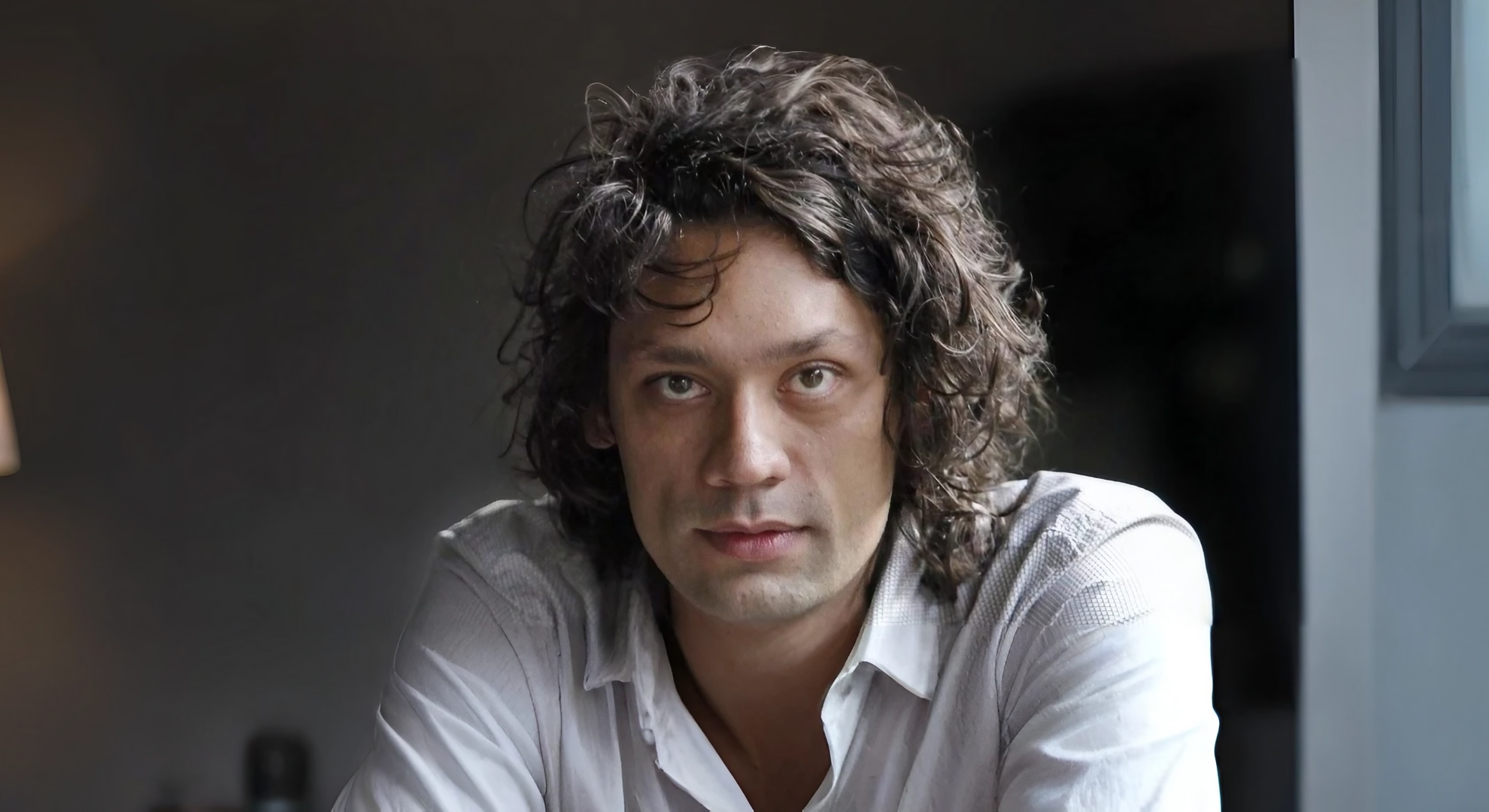
Divider Studios is the working name of Emmanouil, a 37-year-old developer based in Athens, Greece, who entered game development after years of treating Unreal Engine as a hobby rather than a profession. His first release, ‘Final Fall,’ was completed within an eight-month solo development window and shipped shortly before the birth of his daughter, an experience that convinced him to continue building games rather than return to his previous line of work.
The idea for a voice-driven horror mechanic predates ‘Spiritus Sancti’ itself. During the development of ‘Final Fall,’ Emmanouil wanted a hallucination sequence in which the player could vocally resist psychological influence, and settled for a quick-time event because the underlying voice technology was not yet workable. That unresolved idea became the starting premise for his second game once a functioning speech-recognition proof of concept was in hand.
Divider Studios both develops and publishes ‘Spiritus Sancti’ for PC through Steam, with a release date confirmed by the studio’s own store page for September 10th, 2026. Pricing has not been announced, and neither the Entertainment Software Rating Board nor the Pan European Game Information system had issued a formal rating at the time of this report; Steam’s mature content disclosure cites depictions of demonic transformation, violent struggle, and imagery tied to religious ritual.
Speech as the Central Mechanic
The game casts the player as Father Nathaniel, a newly ordained and inexperienced priest dispatched by his mentor to verify, not engage with, a suspected possession inside an apartment on Vayra Street. Nathaniel’s decision to intervene rather than simply confirm the case is the hinge the narrative turns on, and Divider Studios has framed the resulting story explicitly around the consequences of that overreach.
Combat and survival both run through the same channel: spoken Latin ritual phrases, drawn by the developer from documented exorcism accounts and selected specifically for brevity under pressure. The design intent is functional rather than decorative, since recalling and pronouncing a long liturgical phrase while an entity closes in produces a different kind of tension than a phrase built only to be read on a page.
Two further systems extend that same premise beyond the player’s own voice. A companion referred to as Cusco reacts to spoken commands and can be directed to locate objectives, while an optional feature sends real-time text messages to a player’s own phone at scripted points in the story, a use of an outside device the horror genre has rarely tied this directly to spoken interaction with its fiction.
An Apartment That Will Not Release
The game’s central location behaves less like a level than a trap: every attempted exit returns Father Nathaniel to the same apartment, and each return shifts the environment slightly further from its original, mundane state.

That structure of return without escape sits inside a specific design lineage in horror games, one most closely associated with Hideo Kojima’s 2014 ‘P.T.’ playable teaser, which established the looping corridor as a mechanism for accumulating dread rather than simply blocking progress. The Bloober Team and Frictional Games traditions of environmental dread work through slow revelation across new spaces; ‘Spiritus Sancti’ instead compresses that revelation into a single location that refuses to stay familiar.
Divider Studios describes a further environmental system, referred to internally as the Veil, that allows the player to strip color from the surroundings as the story advances, a visual technique layered onto the looping structure rather than replacing it. Whether the combination produces genuine escalation across a full campaign, rather than a single striking early impression, is a question the finished game rather than its marketing materials will need to answer.
Latin Ritual as Design Material
Divider Studios has named ‘The Exorcist’ as the project’s central influence, and has described building the game’s invocations from research into Catholic ritual practice and documented first-hand accounts rather than inventing liturgical-sounding dialogue from scratch.
That choice places ‘Spiritus Sancti’ closer to a tradition of possession horror that treats ritual language as a functioning system with rules, distinct from the more common tradition in which religious iconography operates as atmosphere without mechanical consequence.

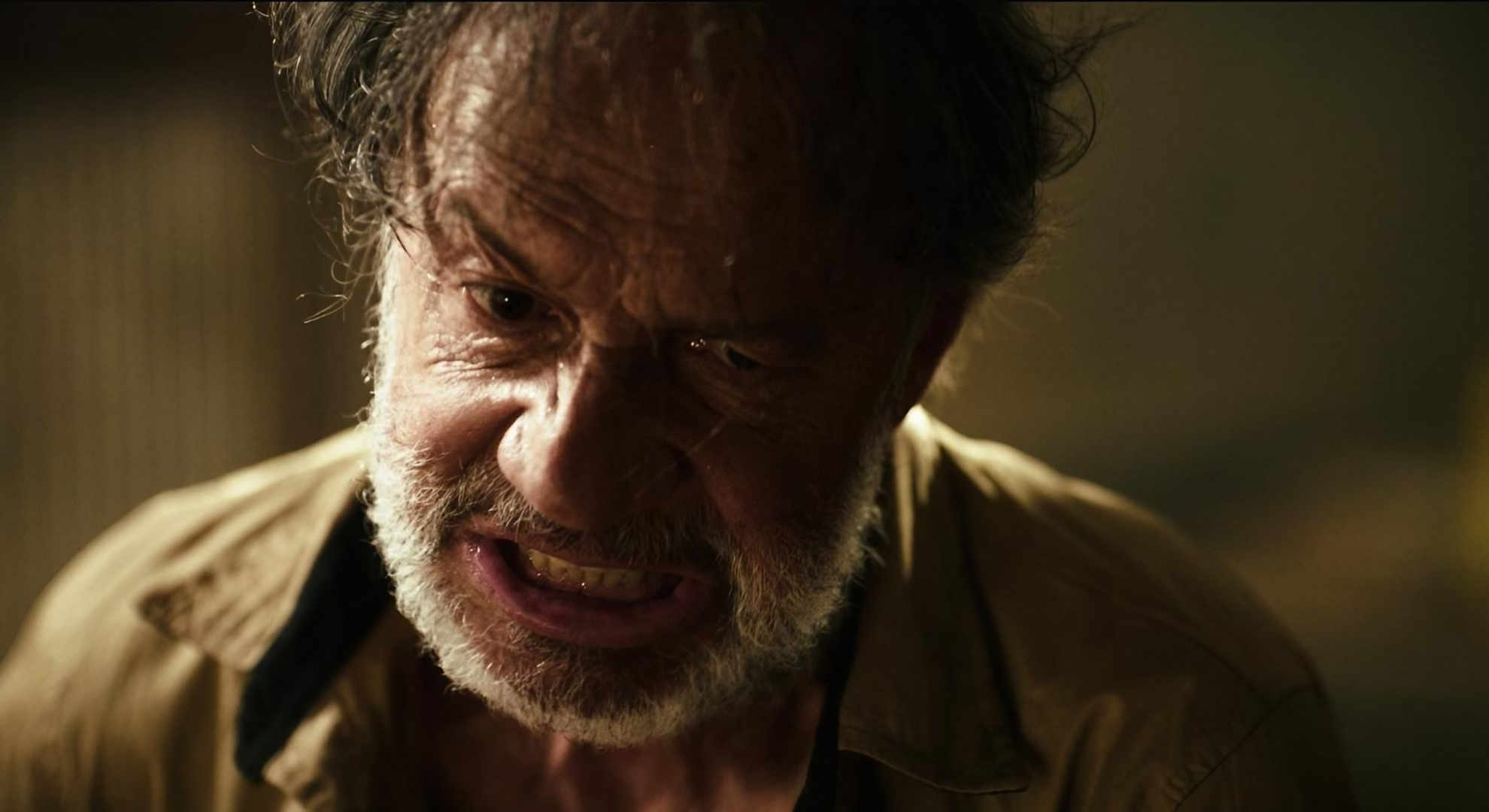
The demon at the center of the story is, according to the developer, a specific and documented entity drawn from established theological and folkloric record, though Divider Studios has declined to name it ahead of release, leaving the identification as a discovery reserved for players. That withholding is itself consistent with the game’s broader wager that specificity, rather than generalized dread, is what makes ritual horror function.
The apartment setting narrows the scope considerably. Divider Studios has confirmed no downloadable content, expansion, or sequel is currently planned, positioning ‘Spiritus Sancti’ as a self-contained account of a single case rather than the opening chapter of a larger mythology.
A Test Still Ahead of Release
‘Spiritus Sancti’ has not yet reached the point where its central wager can be judged. A voice recognition system built specifically to parse spoken ritual language is a genuinely uncommon technical commitment for a solo horror project, and its success or failure will depend on execution that a public demo alone cannot fully demonstrate.
What the project does confirm, ahead of a release now weeks away, is a willingness to treat Catholic possession horror as a system with functioning rules rather than a mood board, an approach with real precedent in the genre’s history but rare execution within it. Whether Divider Studios’ bespoke voice technology holds that promise across a complete story, rather than a demo’s opening sequences, is what September 10th, 2026 will settle.
Divider Studios has built ‘Spiritus Sancti’ around spoken Latin ritual rather than the horror genre’s more familiar vocabulary of inventory management or scripted combat encounters. Does grounding a possession narrative in a mechanic this specific make the horror more convincing than the genre’s common approach of religious iconography as backdrop, or does it introduce a technical dependency that risks undercutting the fiction it is meant to serve?

Leave a Reply