


Stonehenge keeps its silence regardless of who stands before it, but horror fiction has rarely been willing to leave that silence alone. Nineteen new stories from Titan Books test how much unrest a ruin can still produce, gathering some of contemporary horror’s most established and most recently arrived names around one shared premise: that the past, once disturbed, does not stay where it was left.
‘Unearthed,’ co-edited by Dan Coxon and Philip Fracassi, reaches American and British readers on September 15th, 2026, in a 416-page trade paperback from Titan Books, carrying ISBN 978-1-83541-309-8. The collection gathers nineteen original stories, none previously published, built around a single structural premise: horror that surfaces once a ruin, a tomb, or a buried site gives up what it was built to keep down.
Coxon has described the book’s animating idea in his own terms, calling it, in an interview given ahead of publication, a collection of what he and Fracassi refer to as “archaeological horror” — evil emerging from beneath ancient ruins.
That descriptor is the editors’ own coinage for this specific project rather than an established critical category with a documented scholarly history of its own, and the anthology’s actual subgenre debts run older and more specific: the excavation tale that runs from Théophile Gautier’s 1840 story ‘The Mummy’s Foot’ through Bram Stoker’s 1903 novel ‘The Jewel of Seven Stars’ and into the ruin-haunted cosmic dread of H.P. Lovecraft’s ‘At the Mountains of Madness.’ Coxon and Fracassi have updated that lineage with contemporary genre voices rather than invented a new one.
Digging Beneath the Ruins
Coxon has confirmed four of the anthology’s anchor sites in public remarks ahead of publication: Stonehenge, in Neolithic Britain; Machu Picchu, the fifteenth-century Inca citadel above Peru’s Sacred Valley; Pompeii, the Roman city sealed by Vesuvius in the year seventy-nine; and the Pine Barrens, the forested wilderness spanning much of southern New Jersey and carrying its own documented regional folklore, most associated with the Jersey Devil, since the eighteenth century.
The four sites span three continents and four distinct historical registers — Neolithic ritual, pre-Columbian Andean statecraft, Roman imperial catastrophe, and North American backwoods folk belief — a spread that argues for a genuinely global conception of the ruin rather than the genre’s more familiar default to Egypt and Western Europe.
Machu Picchu’s presence on that list places at least part of the collection inside a documented body of Andean archaeological narrative distinct from the European Gothic ruin. Peruvian folklore surrounding disturbed huacas, the sacred sites and burial grounds of pre-Columbian Andean religion, carries its own centuries-old record of consequence visited on those who loot or disturb them, a tradition documented in Andean ethnographic and folkloric scholarship independent of anything the horror genre imported from Egyptology.
Which contributor’s story engages that particular site, and how directly it draws on Andean rather than imported European ruin-horror convention, had not been confirmed at the time of publication.
The Mummy That Would Not Rest
The genre habit ‘Unearthed’ revives, the ruin that punishes its excavators, has one specific, well-documented point of origin in the modern press.
On November 26th, 1922, the British archaeologist Howard Carter, funded by George Herbert, the fifth Earl of Carnarvon, broke through into the antechamber of Tutankhamun’s tomb in Egypt’s Valley of the Kings, and by February 16th, 1923, Carter had opened the sealed burial chamber itself, revealing the pharaoh’s sarcophagus largely undisturbed since antiquity.
Carnarvon did not survive the year. He died on April 5th, 1923, of blood poisoning after nicking an infected mosquito bite while shaving, a mundane medical event that the British and American press converted within days into confirmation of an ancient curse.
Reporters denied access to the tomb after Carnarvon granted The Times of London an exclusive arrangement filled the resulting gap with speculation, including the popular novelist Marie Corelli’s published claim that disturbing a pharaoh’s tomb invited the most severe punishment. Of the twenty-six people present at the tomb’s official opening, only six had died within the following decade, and Carter himself lived a further seventeen years after the discovery.1
What survived the debunking was not the curse itself but the narrative shape it gave the genre: a documented disease death, refracted through tabloid competition, became the template that horror fiction has returned to for more than a century whenever it needs a reason for the past to answer back.
‘Unearthed’ inherits that template directly, even where its individual stories reach for folklore that predates Carter and Carnarvon by centuries.
An Editor Doubly Credentialed
Coxon is a London-based editor and writer whose anthology ‘This Dreaming Isle’ was shortlisted for both a Shirley Jackson Award and a British Fantasy Award, and whose debut collection ‘Only the Broken Remain’ was nominated for two further British Fantasy Awards, Best Collection and Best Newcomer.
His 2024 anthology ‘Heartwood: A Mythago Wood Anthology,’ a tribute volume built with the cooperation of Robert Holdstock’s estate and published by PS Publishing, won the World Fantasy Award. He has also won the Saboteur Award for ‘Being Dad’ and two further British Fantasy Awards, for ‘Writing the Uncanny’ and ‘Writing the Future,’ both co-edited with Richard V. Hirst.
He has been shortlisted for the British Fantasy Awards eight times in total and was a finalist for the Shirley Jackson Award beyond ‘This Dreaming Isle.’
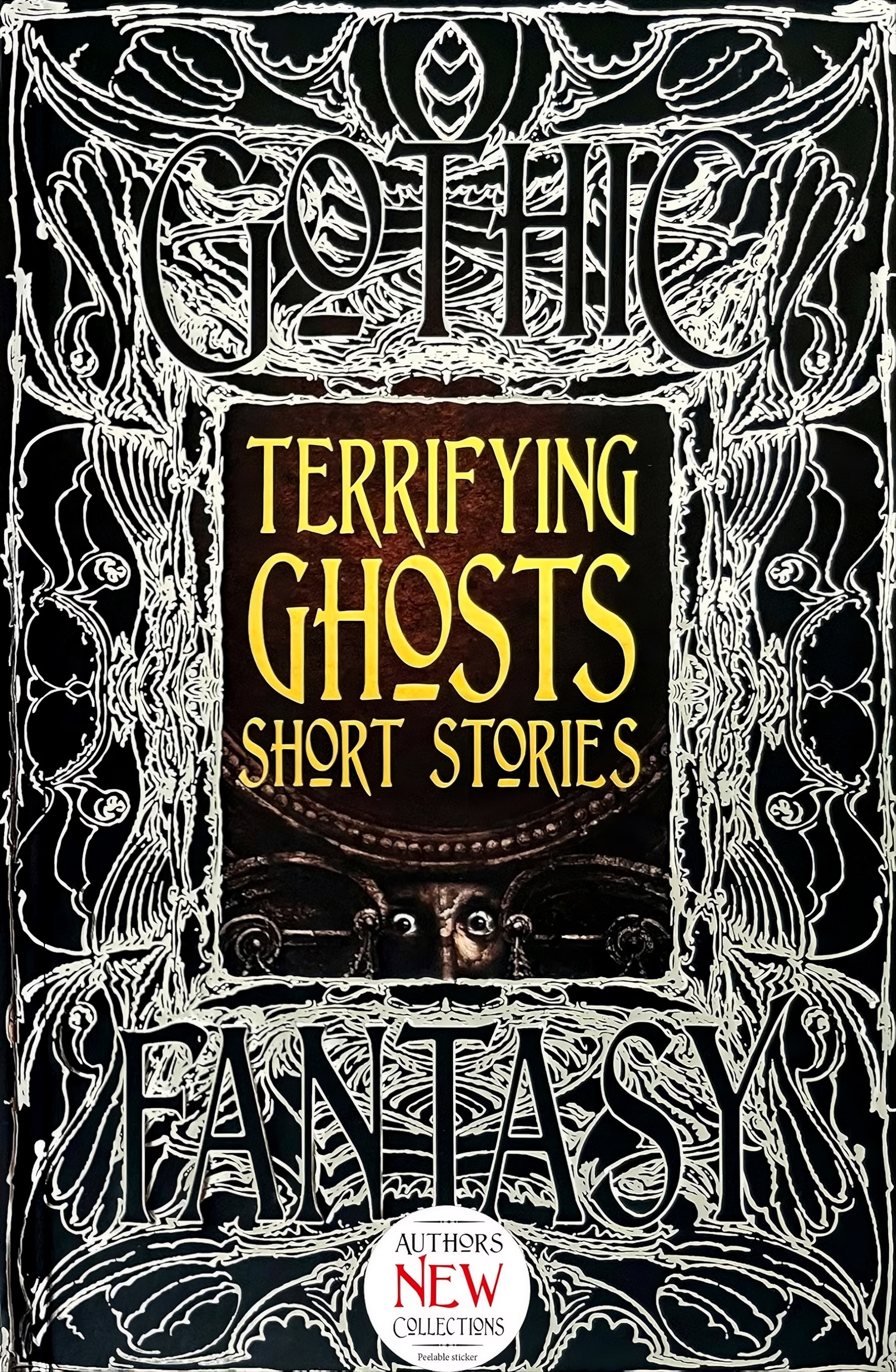
Coxon’s short fiction has appeared in Black Static, Nightscript, The Lonely Crowd, Unthology, Not One of Us, Nox Pareidolia, and Flame Tree’s ‘Terrifying Ghosts’ anthology, and his non-fiction has run in outlets including Salon and The Guardian. He is an editor at the independent press Unsung Stories, a role that places his own editorial practice within the same small-press ecosystem that many of ‘Unearthed’s contributors also publish through.
A Voice Already Distinct
Fracassi is the USA Today bestselling, Bram Stoker Award and British Fantasy Award-nominated author of the novels ‘A Child Alone with Strangers,’ ‘Gothic,’ ‘Boys in the Valley,’ ‘The Third Rule of Time Travel,’ ‘The Autumn Springs Retirement Home Massacre,’ and ‘Sarafina.’
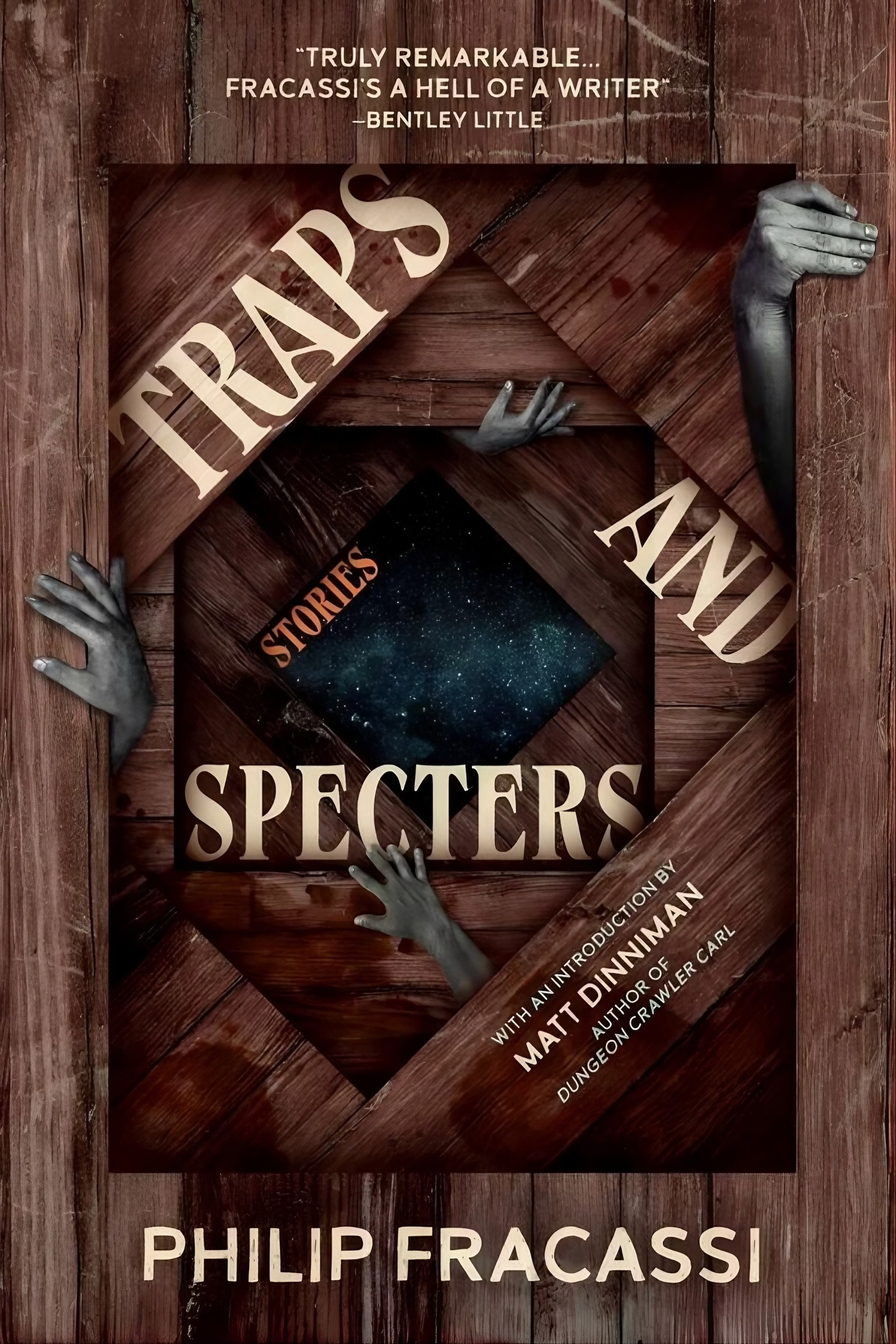
He has published four story collections, ‘Behold the Void,’ ‘Beneath a Pale Sky,’ a Bram Stoker Award finalist, ‘No One Is Safe!,’ and the forthcoming ‘Traps and Specters,’ arriving the same September as ‘Unearthed’ with an introduction by the bestselling author Matt Dinniman. His novellas include ‘Sacculina,’ ‘Shiloh,’ and ‘Commodore.’
Fracassi’s 2016 short story ‘Altar’ was adapted by the studio A24 into a feature film, a rare crossover for a writer whose reputation has otherwise been built almost entirely within short and long-form prose horror.
He lives in Los Angeles, and his fiction has been translated into multiple languages and published in Best Horror of the Year, Nightmare Magazine, Black Static, Southwest Review, and Interzone, among other magazines and anthologies.
A Chorus of Nineteen Voices
The nineteen writers gathered around Coxon and Fracassi’s premise span a deliberate range of career stages. Tananarive Due, Christopher Golden, Josh Malerman, Tim Lebbon, Jonathan Maberry, and Benjamin Percy each carry a documented record of major genre recognition; Golden alone has won the Bram Stoker Award for best novel, for ‘Ararat’ in 2017, been nominated ten times across eight categories, and shared a Shirley Jackson Award in 2020 with James A. Moore for ‘The Twisted Book of Shadows.’
Alongside that established cohort sit writers whose reputations have taken shape more recently, including Ai Jiang, Hache Pueyo, Steve Toase, and Hildur Knútsdóttir, a pairing that reads as a deliberate argument that the ruin-horror premise belongs to the genre’s newest voices as much as its most decorated ones.
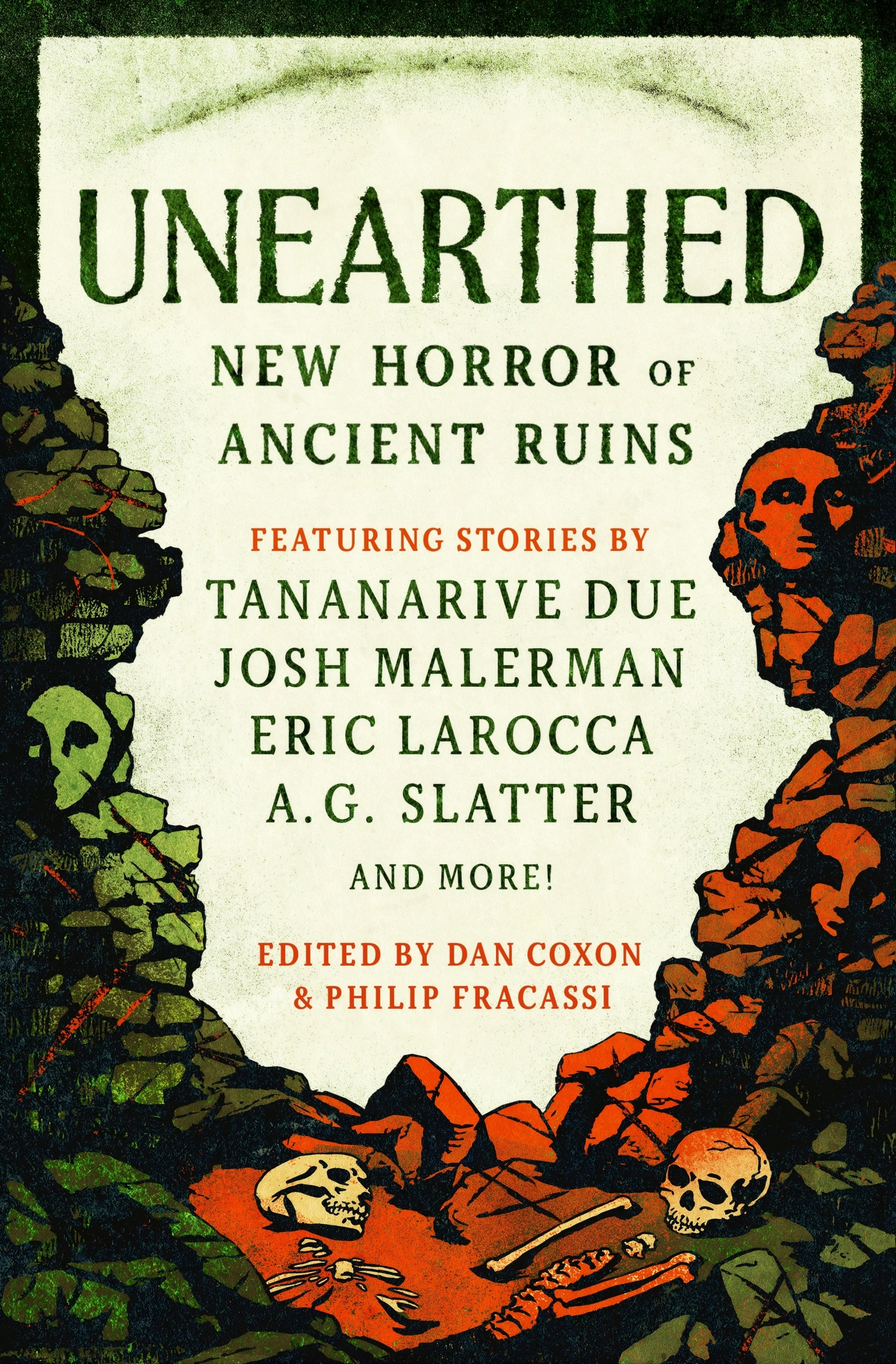
All nineteen stories are original to this volume, commissioned rather than reprinted, which distinguishes ‘Unearthed’ from a career-retrospective gathering and positions it, per the publisher’s own descriptive copy, alongside the model of curated all-original horror anthologies associated with editor Ellen Datlow.
Because the collection organizes itself by place rather than by a single monster, character type, or narrative device, each story’s craft rests on a specific formal demand not shared by every anthology: rendering one real, historically documented site convincingly enough, before that site’s disturbance can register as loss rather than simply as incident.
Individual story titles and their site assignments had not been made public at the time of writing, and any assessment of how particular contributors meet that demand must wait for the book itself.
Ground That Keeps Its Secrets
‘Unearthed’ arrives with an advantage not every themed anthology can claim: its nineteen contributors span enough career stages and enough geography that a single shared premise cannot flatten into one house style.
What the collection ultimately tests is not any individual site or any individual writer’s approach to dread, but whether a century-old journalistic habit, the disturbed grave recast as a moral lesson, still has something left to say about disturbed ground and the people who keep disturbing it, on a map considerably larger than the Valley of the Kings.
Beyond Stonehenge, Machu Picchu, Pompeii, and the Pine Barrens, which real excavated or historically disturbed site do you think horror fiction has left most unexamined, and what documented history at that site would give a story built around it genuine weight?
References
- Roger Luckhurst, ‘The Mummy’s Curse: The True History of a Dark Fantasy’ (Oxford: Oxford University Press, 2012). ↩︎

Leave a Reply