

In spring 2026, two European exhibitions place the history of the ‘Malleus Maleficarum’ — the fifteenth-century demonological manual that helped authorize the judicial killing of tens of thousands of women across early modern Europe — at the center of their arguments about witchcraft persecution.
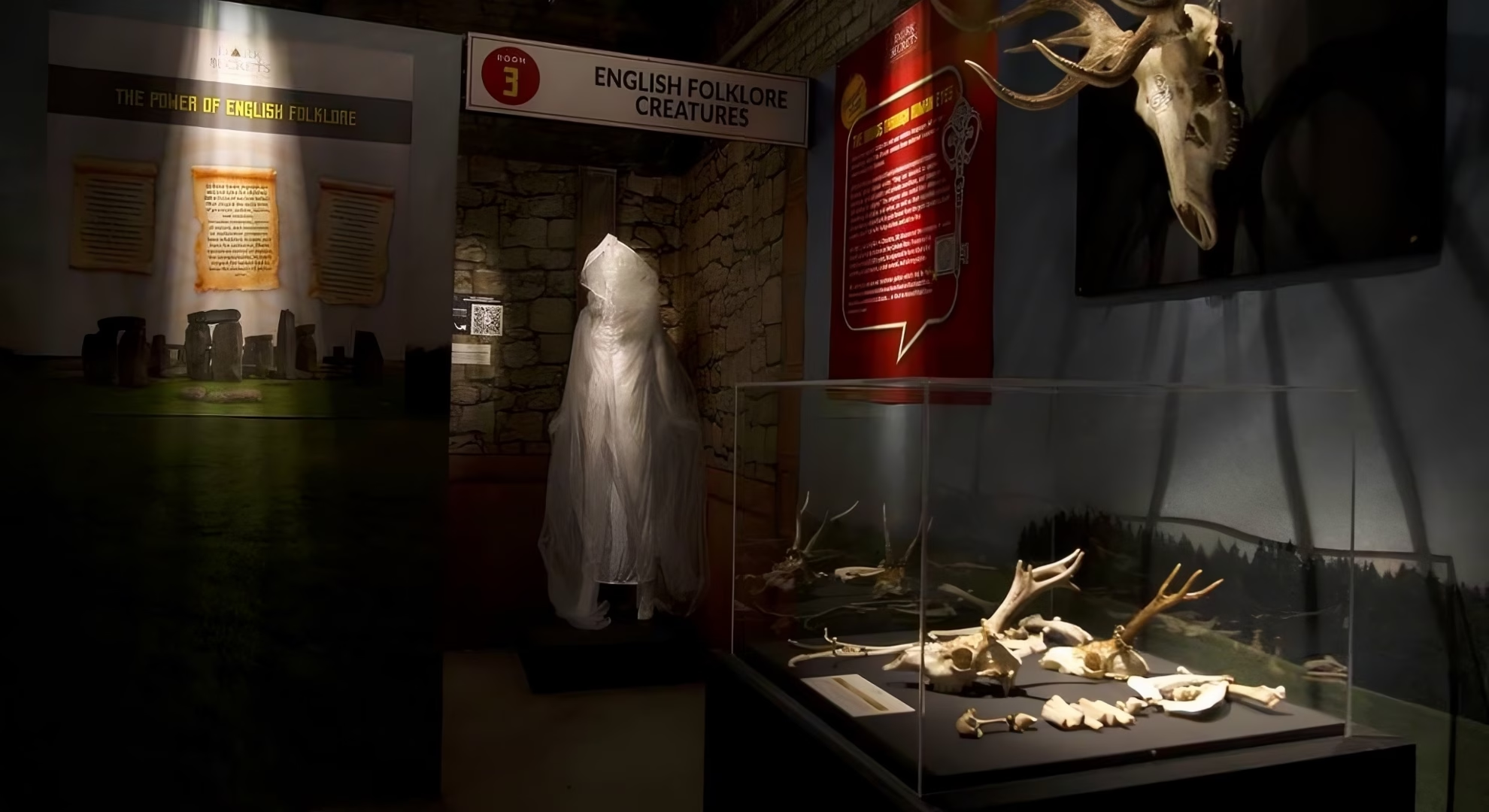
At The Vaults in London, ‘Dark Secrets: The Esoteric Exhibition’ displays a 1620 edition of the text as a featured object in a twenty-seven-room cabinet of esoteric curiosities, closing May 31st, 2026. At the Château des ducs de Bretagne in Nantes, ‘Witches’ builds its historical argument around the text’s specific role in generating the legal apparatus behind centuries of mass accusation, running through June 28th, 2026.
The Room Decides the Evidence
The ‘Malleus Maleficarum’ is not, in any traditional sense, a gothic object. Written by the Dominican inquisitor Heinrich Kramer and first published in 1487 in Speyer, it is a legal and theological procedural manual in three parts: the first arguing the theoretical reality of witchcraft, the second detailing the practices attributed to witches and methods for identifying them, the third providing a framework for prosecution.
Kramer received a papal bull, “Summis desiderantes affectibus,” from Pope Innocent VIII in 1484, which he prefaced to the work as evidence of official ecclesiastical sanction — though the Faculty of Theology at the University of Cologne quickly condemned the text as doctrinally unsound and legally unethical.
What gave the ‘Malleus Maleficarum’ its catastrophic reach was not the Church’s formal endorsement but the printing press: in the eight decades after its first appearance, the work went through at least twenty-six editions, carrying its logic of accusation from ecclesiastical courts into the secular magistracies of German-speaking territories, where it found the conditions — political fragmentation, religious conflict, generalized social anxiety — most favorable to mass prosecution.
Stuart Clark’s analysis of early modern demonology establishes that the ‘Malleus Maleficarum’ imposed a specific symbolic economy on the figure of the witch: defined primarily by her inversion of recognized social roles, the accused woman was most legibly the unmarried healer, the elderly widow, the woman with independent knowledge of the body and its remedies.1 That symbolic economy is what both exhibitions, running simultaneously in spring 2026, each inherit — and each contests in its own way.
What the Castle Preserves
‘Witches’ runs at the Château des ducs de Bretagne in Nantes through June 28th, 2026. Admission is €8 full price (approx. $34,900 COP) and €5 reduced (approx. $21,800 COP); free for visitors under 18. The Château is a fifteenth-century fortified castle that served as a ducal residence, a garrison, and a prison before becoming the Musée d’histoire de Nantes. The physical space carries its own historical argument.
The curators have assembled nearly 180 works and objects — engravings, paintings, ancient manuscripts, and ritual artifacts loaned from French and European institutions — with multimedia installations designed to situate the material within a continuous historical account of witchcraft persecution.
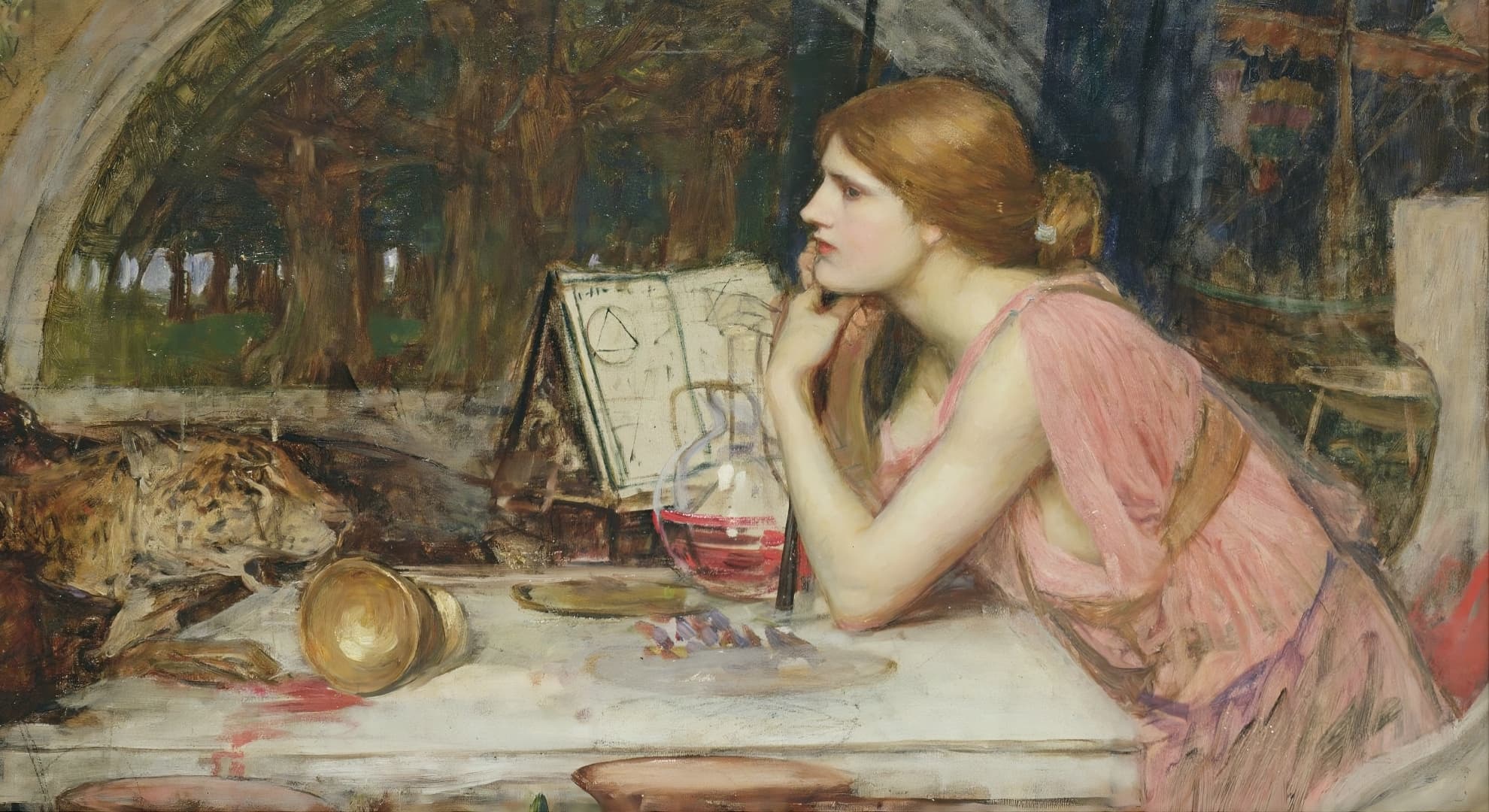
The exhibition’s structure is chronological and deliberate: it moves from the sorceresses of antiquity — Circe and Medea in their Greco-Roman ambivalence — through the medieval period’s gradual theological consolidation of the witch as heretical threat, arrives at the Renaissance as the moment when Humanist rationalism and mass judicial killing occupied the same decades, and concludes with the contemporary feminist reclamation of the figure.
The ‘Malleus Maleficarum’ appears in this sequence not as esoterica but as instrument: the text that turned the printing press, the very emblem of Renaissance intellectual progress, into an apparatus of accusation. The exhibition’s framing draws on the feminist historiographical argument, central to Silvia Federici’s Caliban and the Witch, that the persecution of so-called witches was inseparable from the suppression of female bodies and knowledge in the transition to a rationalized, institutionalized, male-controlled medical and economic order.2
Among the visual works in the exhibition are engravings and paintings in the tradition of early modern demonological iconography — the specific visual lineage of the Sabbath scene that Hans Baldung Grien developed in the early sixteenth century, depicting the witch’s gathering as a systematic inversion of Christian liturgical order.
That tradition is not gothic in the sense of Gothic Revival Romanticism; it belongs to an earlier and more literally violent history, in which the printed image functioned simultaneously as prosecutorial evidence and popular distribution mechanism. The Nantes exhibition preserves that distinction.
From Evidence to Atmosphere
‘Dark Secrets: The Esoteric Exhibition’ closes at The Vaults, Waterloo, London, on May 31st, 2026. Standard tickets are priced at £23 (approx. $116,000 COP). The production company, Italmostre, is an Italian commercial organization whose previous London show, ‘Serial Killer: The Exhibition,’ drew more than 120,000 visitors to the same underground venue in 2024.
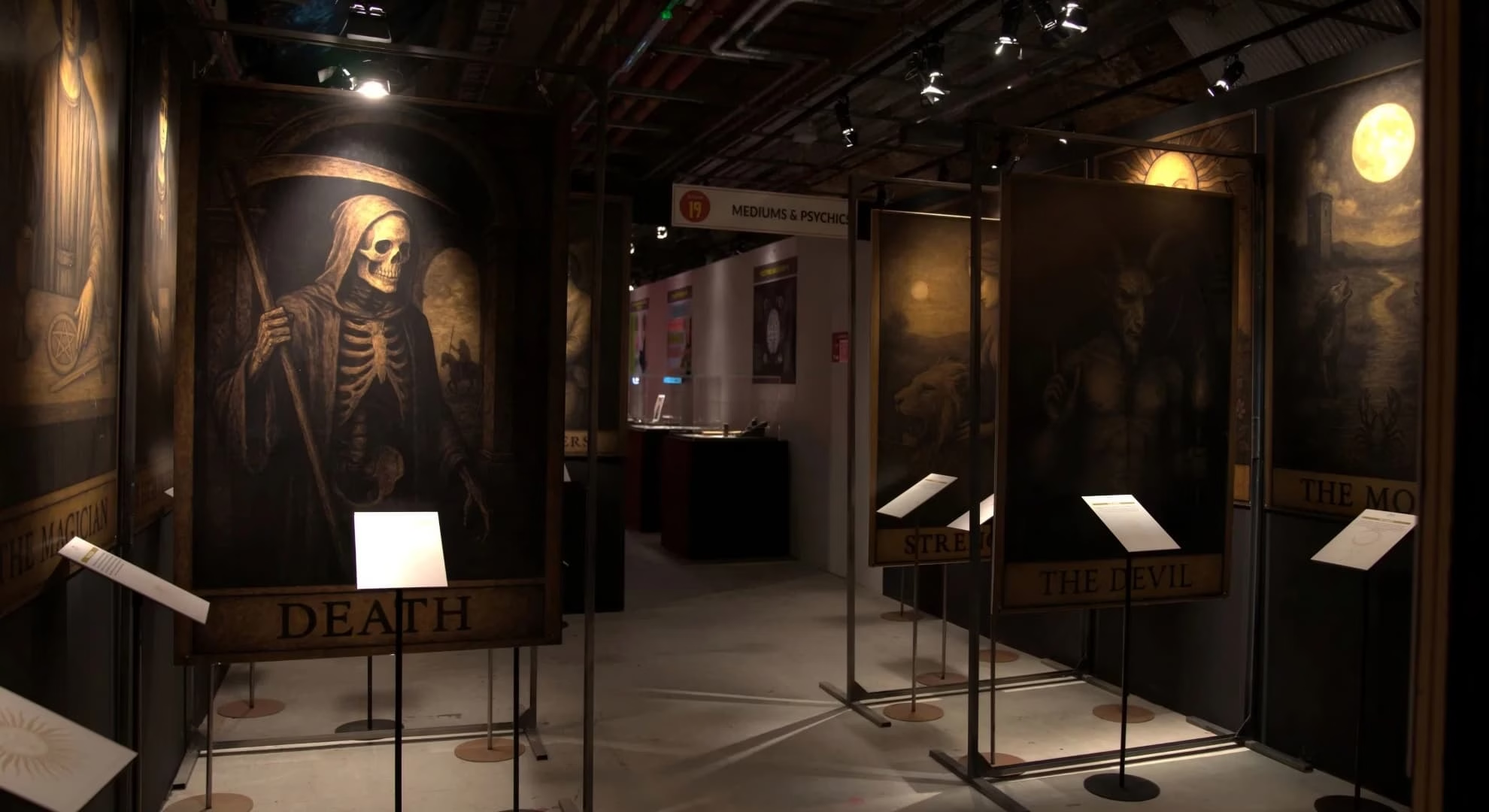
‘Dark Secrets: The Esoteric Exhibition’ occupies 1,200 square meters across twenty-seven themed rooms, presenting more than a thousand objects sourced from private collectors: Satanic ritual objects, Freemasonic regalia, cursed sports memorabilia, voodoo fetishes, Tibetan skull cups, Aleister Crowley’s ceremonial staff and Thoth Tarot, a Dybbuk box, and a full 1620 edition of the ‘Malleus Maleficarum.’
The production company frames the exhibition as anthropological. “Rationality remains the constant lens,” the venue’s official description states. Academic consultant Christian Alpini — a private collector of paranormal objects who has assembled more than three hundred of them — supplies the show’s claim to scholarly positioning.
In practice, however, the exhibition’s structure produces a specific kind of leveling: the ‘Malleus Maleficarum’ sits within the same conceptual register as Jimi Hendrix’s jacket, a Soviet two-headed dog chimera produced by a Cold War surgeon, and a Victorian vampire-hunting kit. These objects are not historically related. Their juxtaposition is the product of a mode of commercial curation with a recognized lineage — the Wunderkammer, the Victorian sideshow museum, the contemporary experiential entertainment industry — in which the single organizing rubric is strangeness rather than historical argument.
The Wunderkammer and its pleasures are real. But the Wunderkammer was never designed to process documents of organized killing. When the ‘Malleus Maleficarum’ is displayed as atmosphere — one object among a thousand in a sensory labyrinth designed for a ninety-minute experience — the specific legal procedures it codified, and the specific women executed under those procedures, recede into the general category of the eerie.
The academic framing and the entertainment format are pulling in opposite directions, and the entertainment format, at twenty-seven rooms and one thousand objects, wins.
The Names Not in the Tunnel
The difference between these two exhibitions is not about institutional prestige. It is about what each decides the ‘Malleus Maleficarum’ is. At the Château des ducs de Bretagne, it is a document with named victims — women whose trial records the exhibition brings forward, whose accusations are preserved in archives that still exist, whose executions can be dated and located. At The Vaults, it is a relic.
The distinction carries real weight: a relic asks nothing of its viewer except wonder or unease. A document asks its viewer to reckon with the fact that the printing press, the legal academy, and the ecclesiastical endorsement of a Dominican inquisitor whose own superiors censured him combined to produce a technology of mass accusation that operated for two centuries across Europe.
Both exhibitions are genuine responses to the continuing cultural fascination with witchcraft, esoterica, and the history of persecution. Neither is wrong to exist. But when two rooms, in two cities, display the history of the same object in the same spring and arrive at incompatible conclusions about what it is — evidence versus atmosphere, documented atrocity versus cabinet of the strange — the question worth pressing is not which room is more credible.
It is whether any room can contain the ‘Malleus Maleficarum’ without making a choice about whose history it is displaying, and who it is asking to remember.
References
- Stuart Clark, ‘Thinking with Demons: The Idea of Witchcraft in Early Modern Europe’ (Oxford: Oxford University Press, 1997), 5–12. ↩︎
- Silvia Federici, ‘Caliban and the Witch: Women, the Body and Primitive Accumulation’ (Brooklyn: Autonomedia, 2004), 163–175. ↩︎

Leave a Reply