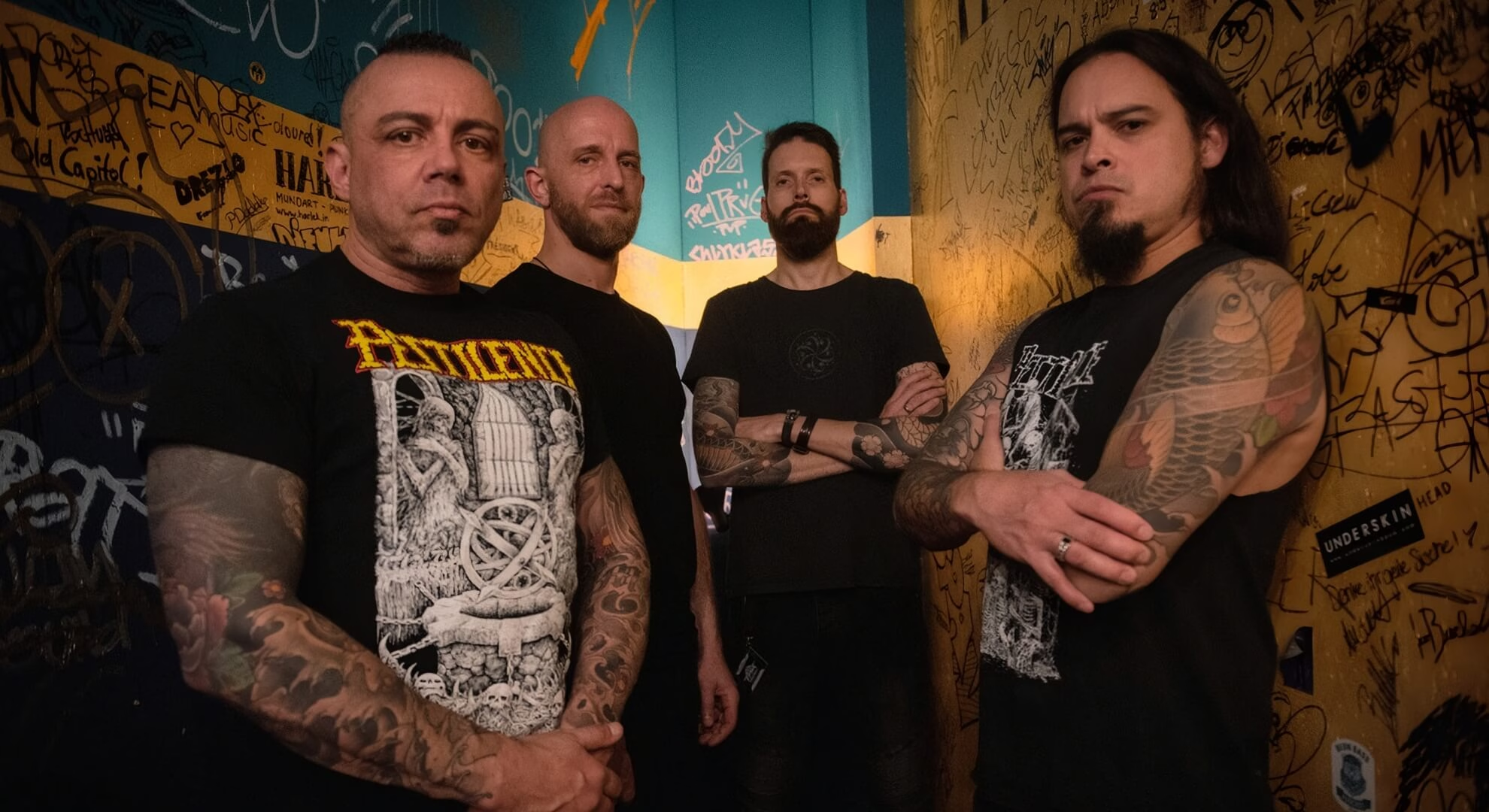


On February 22, 2024, Pestilence announced ‘Levels of Perception,’ a career retrospective on Agonia Records collecting twelve re-recorded tracks from the Dutch band’s 38-year history. The announcement arrived with a cover image that had not been commissioned from a human artist. Fans identified the image’s AI-generated origins within hours of publication.
The response from the band was immediate, unsigned, and framed as a generational question. “Are we so caught up in the past that we do not embrace technology?” the band posted to Facebook. “Is recording with tape better than digital DAWs? Is taking a Polaroid picture better than the newest tech phone? It’s still about the music and lyrics and that’s REAL!!!” The post was not an explanation. It was a confrontation.
Pestilence was founded in Enschede, Netherlands, in 1986, and by 1991 had released three albums that placed it alongside Death, Cynic, and Atheist in what the metal press designates death metal’s technical “big four.” The visual record of that period was inseparable from the band’s critical identity.
‘Consuming Impulse’ (1989) and ‘Testimony of the Ancients’ (1991) arrived with cover imagery that matched the music’s density and deliberateness. For a band whose institutional identity rests on records made between 1988 and 1993, the question of how cover art is produced is not a secondary concern.
The ‘Hadeon’ Plagiarism and What It Established
The 2024 controversy was not Pestilence’s first experience with a retracted cover. In October 2017, while preparing the release of ‘Hadeon,’ the band’s eighth studio album on Hammerheart Records, Pestilence and the label unveiled artwork commissioned from Santiago Francisco Jaramillo, operating as Triple Seis Designs, an Ecuador-based operation with a prior record of work for metal bands.
Within days of publication, the blog Sad But True: Plagiarism in Heavy Metal Art identified that multiple elements of the image had been lifted directly from concept art for Fallen Skies, a video game.
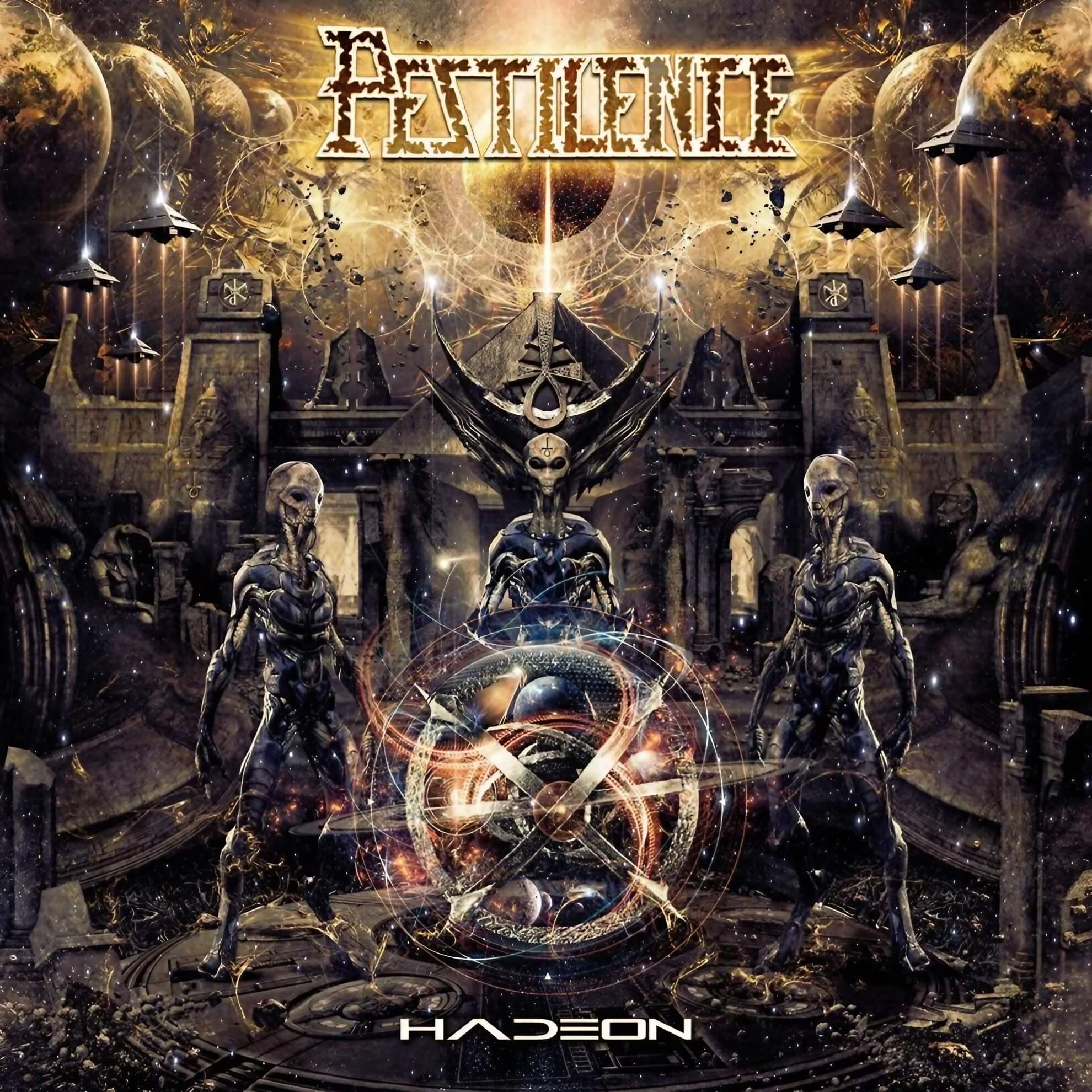
Hammerheart Records and Pestilence issued a joint statement condemning the plagiarism, severing ties with Jaramillo, and committing to a replacement commission. The replacement was created by Michal “Xaay” Loranc, a Polish illustrator whose prior work included covers for Behemoth, Nile, and Vader.
Pestilence’s posture in 2017 was direct: it had been defrauded, it said so publicly, and it made the necessary correction. It did not publicly address why it had retained an artist with a prior record of plagiarism incidents, which the Sad But True blog documented alongside its original report.
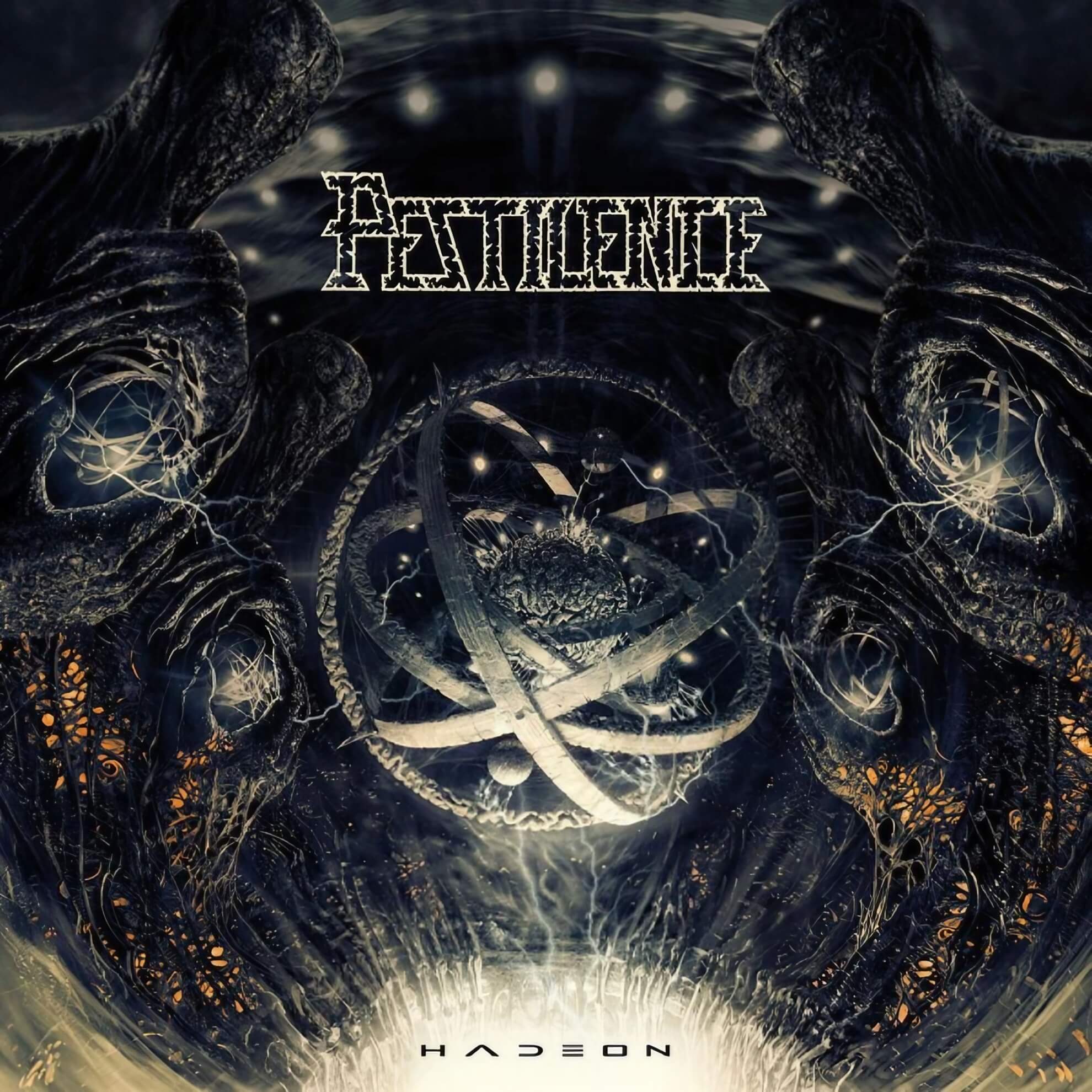
The 2017 episode established a baseline. When a cover controversy was unambiguously the fault of a third party, Pestilence corrected it without ambiguity. The 2024 controversy tested what the band would do when the cover decision was its own.
The AI Cover and the First Defense
When the AI-generated cover for ‘Levels of Perception’ drew criticism in February 2024, the band’s initial Facebook defense was characterized by multiple metal press outlets as presenting a false equivalence between adopting digital recording tools and replacing commissioned human artwork with AI generation.
The distinction—contested by Mameli, accepted by critics—is that digital recording is a change in medium requiring comparable levels of craft, while AI image generation replaces the labor of the artist whose output it reproduces. The Metal Archives entry for ‘Levels of Perception’ records that the original cover was made with generative AI and was changed after criticism.
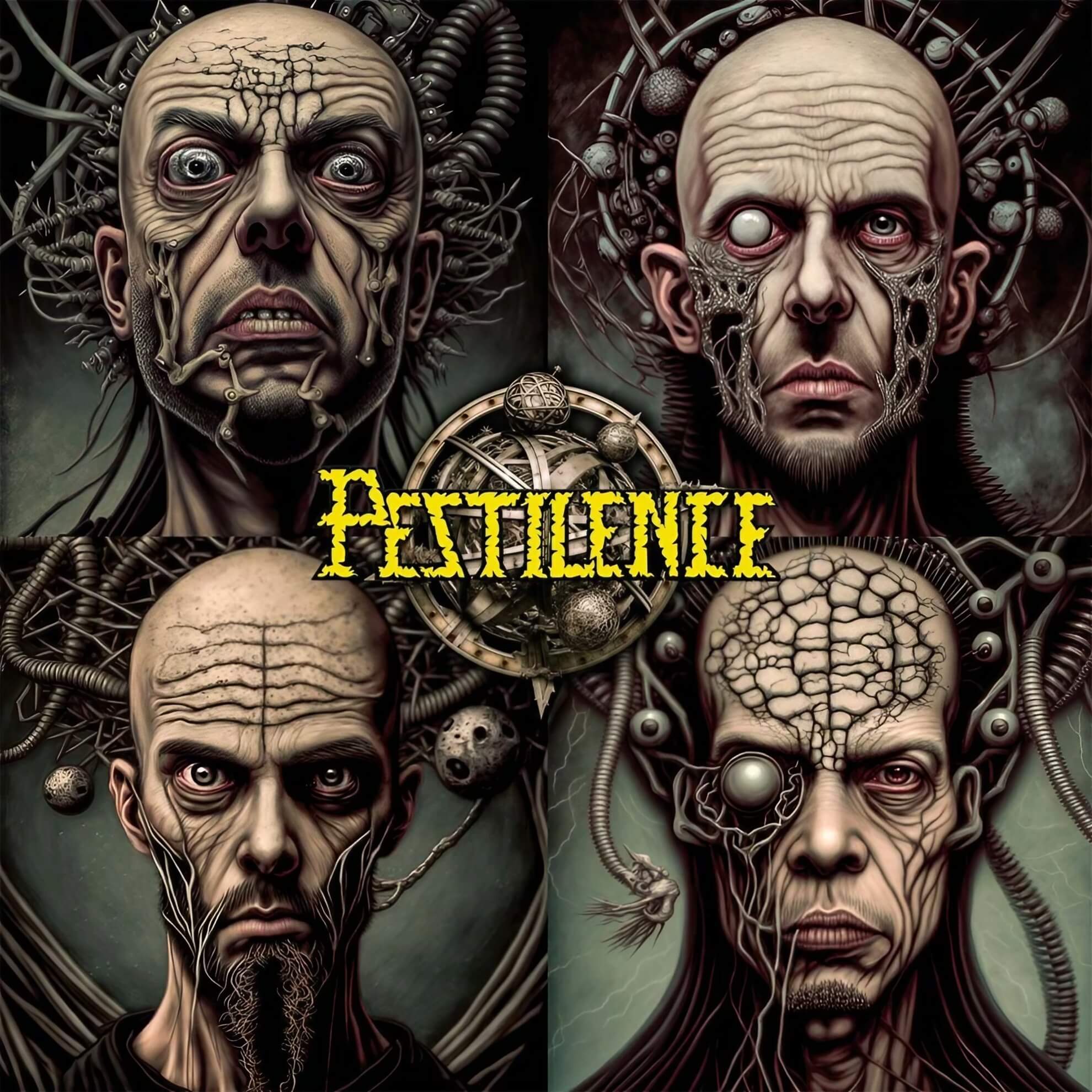
The replacement cover, a performance photograph credited to Peter Suchy, was announced approximately two weeks after the initial backlash. Mameli’s announcement of the replacement was not a withdrawal of the original decision.
“First off, let me be absolutely clear about the fact that both band and record company still love the initial cover,” Mameli stated. He characterized the AI-generation as not “just AI in the real sense,” noting that the creator had “used multiple methods to come to this result.”
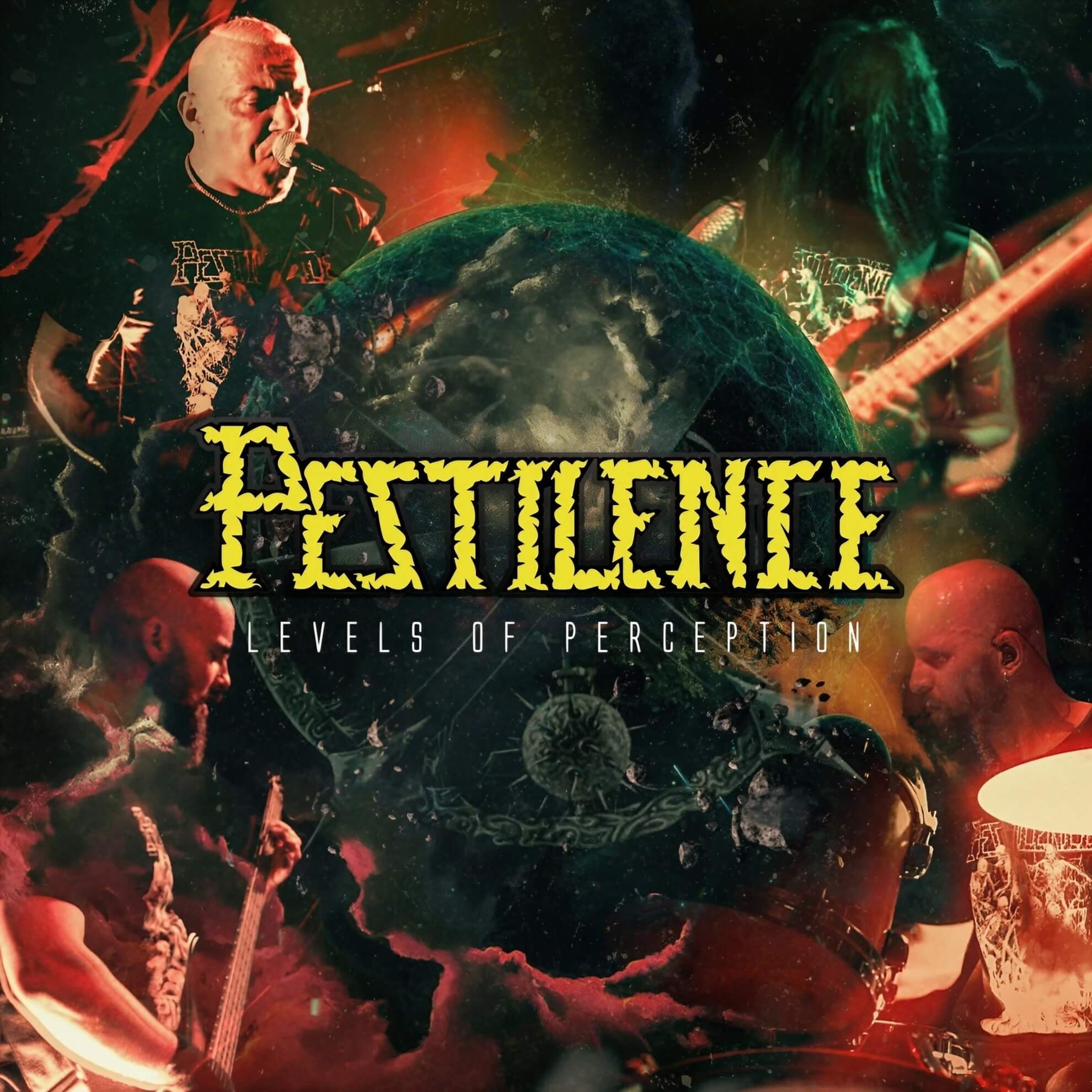
The replacement was framed as a commercial calculation. “I will not risk all the work we have put into this release just to push the cover,” Mameli wrote. “We care a lot about our fans and we do not want this product to become unsuccessful just because we want to push our ideas regarding AI.”
The phrase “push our ideas regarding AI” characterized the band’s position as a considered stance that it was temporarily declining to impose—not as an error it was correcting.
Nine Months Later, the Position Doubled
On December 29, 2024, nine months after ‘Levels of Perception’ was released with its replacement cover, Mameli returned to the subject on the band’s official Facebook page. The post argued that large commissioned-painting budgets are “a thing of the past,” that the era of extreme gore as a visual language was “also a thing of the past for Pestilence,” and that survival in the current industry required adaptation. Mameli referenced an AI-generated image from his personal Facebook, describing it as “an amazing piece of art.”
The December post also addressed the fan reception of ‘Levels of Perception’ more broadly. “When we released ‘Levels of Perception,’ that was aimed to revisit the demo style recording, that was asked for by many fans,” Mameli wrote. “They didn’t like the production they asked for themselves.”
The argument folded the AI artwork controversy and the critical reception of the re-recordings into a single diagnosis: the audience’s objections are internally contradictory and therefore unreliable. The post closed by directing its audience to “start embracing the future of music that is Pestilence.”
The post represented the third documented public statement on AI artwork from Mameli across the calendar year. Each statement moved further from accommodation and closer to advocacy: the first defended the cover while replacing it, the second explained the economics of AI art, the third dismissed critics as preoccupied with the past.
‘Bangkok Bloodshed’ and the Fourth Iteration
In May 2026, Pestilence announced ‘Bangkok Bloodshed,’ a live album recorded on May 16, 2025, at Mr. Fox Live House in Bangkok during the band’s Asia Tour, scheduled for release on June 19, 2026, through Blue-Line Records.
The announcement arrived with cover artwork bearing the same visual characteristics that had drawn identification as AI-generated in 2024: anatomically improbable forms, textures that do not occur in hand-painted or photographed imagery, and the particular flatness of spatial logic that generative tools consistently produce.
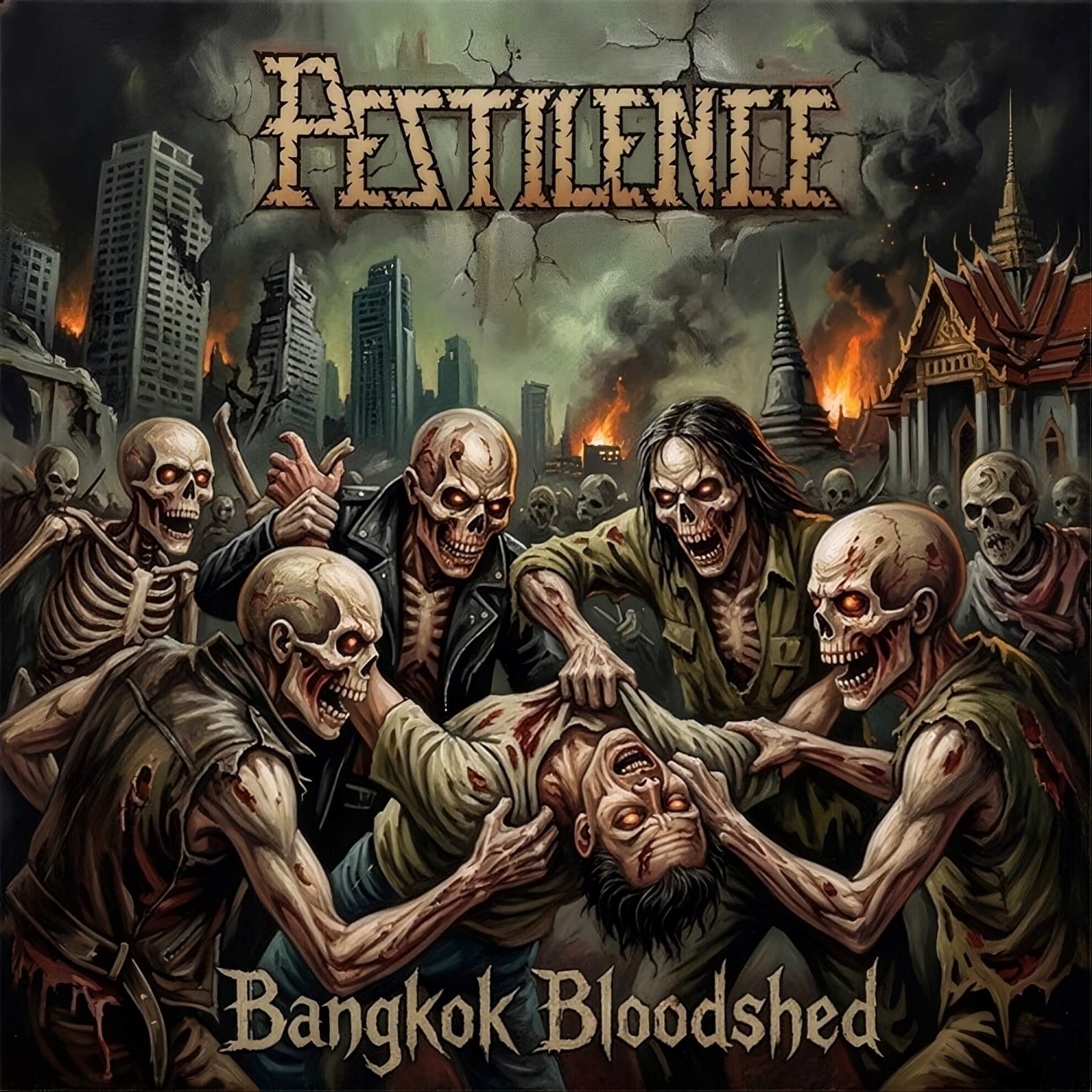
The announcement was met with renewed criticism from the band’s audience. The sequence—AI cover announced, backlash received, no public declaration of correction issued at the time of this revision—follows the pattern of February 2024 in its opening stages. What distinguishes the ‘Bangkok Bloodshed’ situation is context: the band had already defended AI artwork publicly in December 2024, had dismissed its critics as concerned with the “40× past,” and had committed, in Mameli’s documented words, to following “our own path.”
The cover for ‘Bangkok Bloodshed’ is therefore not the result of a policy that was still forming. It is the result of a policy that had been stated explicitly, defended publicly, and reapplied.
In 2024, the replacement of the ‘Levels of Perception’ cover was framed as a concession to fans whose support the release depended on. By December of that year, the concession had been recharacterized as a temporary one.
The ‘Bangkok Bloodshed’ announcement suggests it was not a concession at all—that the policy Mameli described as the future of Pestilence would simply be applied where the band judged the commercial stakes to be tolerable. For a live album on a smaller label with a narrower commercial window than a career retrospective, those stakes may have been calculated differently.
What Dan Seagrave Drew and What AI Generates
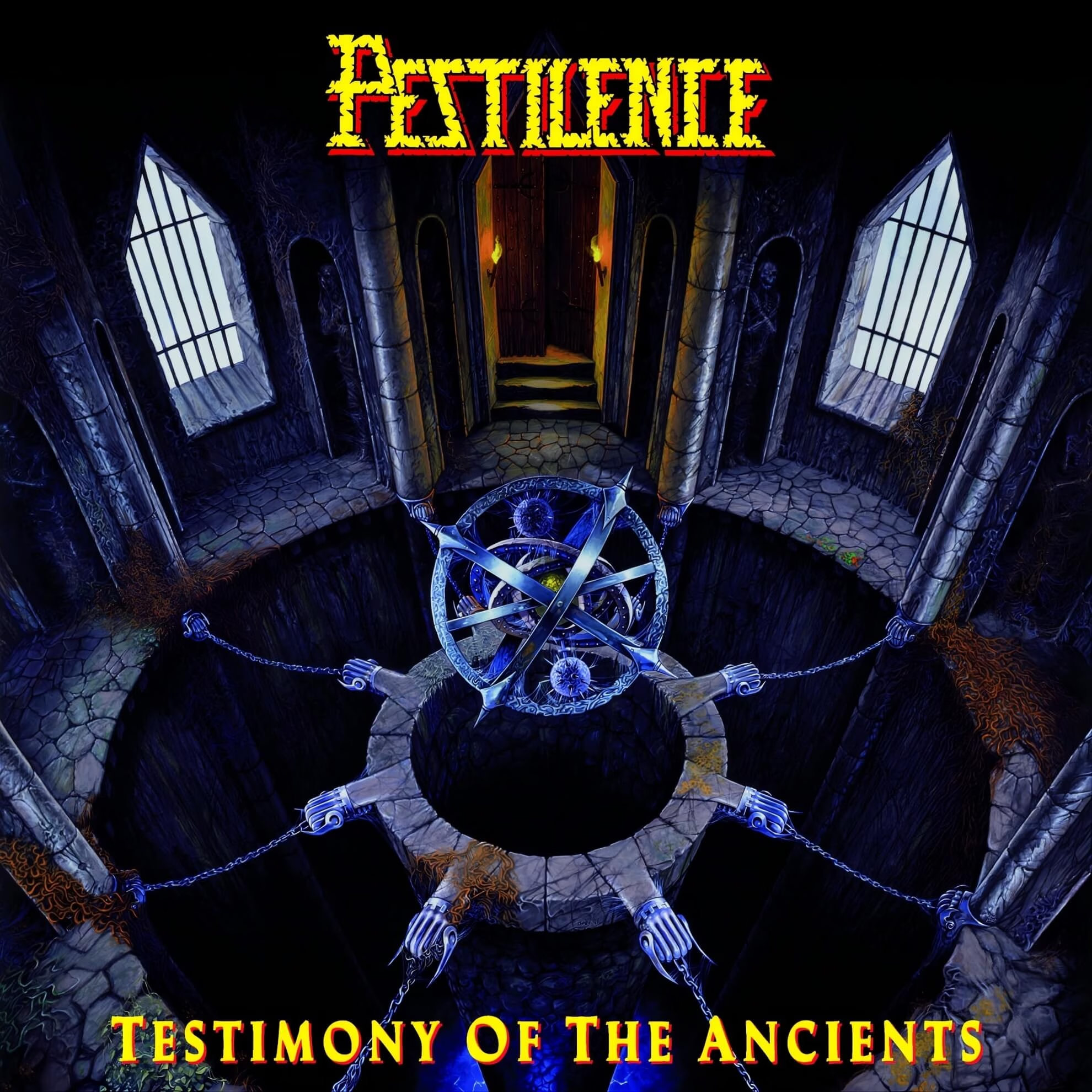
Dan Seagrave’s cover for ‘Testimony of the Ancients’ (1991) depicts a vaulted stone chamber viewed from above: a chained mechanical sphere suspended at its center, torch-lit archways receding toward a threshold, skeletal figures occupying the peripheral darkness. The image has a specific spatial logic—light sources that create shadow, perspective that implies depth, compositional choices that create tension between the sphere’s weight and the chamber’s symmetry.
It was made by a person who understood what the music was doing and translated that understanding into image. The cover is inseparable from the record’s critical standing because it was produced by the same kind of deliberate intelligence that produced the music itself.
What AI generation produces is the statistical prediction of what an image should look like given a prompt—assembled from the aggregated patterns of images ingested without the consent or compensation of the artists who made them. The result tends toward coherence-at-a-glance and incoherence under examination: figures whose anatomy is plausible from a distance and wrong up close, textures that suggest material without being any specific material, spatial relationships that resemble depth without having been constructed through it.
The ‘Levels of Perception’ original cover displayed all of these properties. So does the ‘Bangkok Bloodshed’ cover. The Seagrave image displays none of them, because none of them are properties of work made by a human artist who has thought about what an image is for.
Mameli’s December post stated that “huge budgets for real paintings are a thing of the past.” Seagrave’s record of commissions across that same era—covers for Death, Morbid Angel, Dismember, Obituary, Entombed, and Benediction among others—constitutes a documented counter-argument in the form of an existing body of work.
Those images are not products of large budgets alone. They are products of a sustained working relationship between music and visual art that treated the cover as an extension of the record’s meaning. The argument that this relationship is economically impossible in the contemporary industry does not account for the bands that continue to commission it, nor for the fact that Pestilence itself commissioned human artists for every release between 1988 and 2022 without treating the practice as financially unsustainable.
The Band’s Economic Argument and What It Does Not Address
Mameli’s economic argument has a factual context. Budget constraints for commissioned metal artwork are documented across the industry, and the contention that a recording’s audio craftsmanship should be evaluated independently of its visual presentation is a position some in the death metal community have consistently held.
Responses to the December 2024 post included a documented range of reactions, with supporters of Mameli’s position present alongside critics. The ‘Bangkok Bloodshed’ announcement indicates that argument has since been extended from a theoretical defense to an operational policy applied to new releases.
What the argument does not address—across any of its documented iterations since February 2024—is the specific objection that AI generative tools derive their outputs from the ingested work of human artists who have received no consent, credit, or compensation for the training data their work constitutes. This argument was present in the original backlash, was raised in press coverage of both the February and December 2024 controversies, and does not appear in any of Mameli’s published responses.
The band’s documented counterargument has addressed the economics of album cover production, the aesthetics of AI imagery, fan loyalty, and the generational dynamics of technology adoption. It has not addressed the labor question on which the majority of the criticism has rested.
What the Documented Record Establishes
Four separate visual controversies across eight years have produced three retractions and a consistent public posture from Pestilence. In 2017, a plagiarized cover was pulled and blame was correctly assigned to the contracted artist. In 2024, an AI-generated cover was pulled, with Mameli stating publicly that both the band and label still loved it and framing the withdrawal as a commercial concession rather than a correction.
Nine months later, a formal defense of AI-generated cover art was published on the band’s official channel, characterizing critics as dwelling in the past. In May 2026, ‘Bangkok Bloodshed’ was announced on Blue-Line Records with cover artwork bearing the same AI-generated characteristics as the ‘Levels of Perception’ original—without a declared intention to replace it.
In three of four cases, the cover changed. The position did not. The material limitation of this investigation regarding ‘Bangkok Bloodshed’ is that no established metal press outlet had confirmed the AI-generated status of its cover artwork or documented a response from Pestilence to the associated backlash at the time of this revision, the announcement being less than 24 hours old. Whether further documentation of the backlash and any band response will alter the current record is not established at the time of this revision.
What the current record does establish is a pattern in which visual art has been treated as subordinate to Mameli’s documented position on what Pestilence should be permitted to present, and in which the public response to criticism has consistently redirected responsibility toward the audience—rather than engaging the specific argument those audiences have made.
Given that Pestilence’s public statements have defended each original visual decision after replacing the corresponding artwork, do those replacements constitute a genuine response to the concerns of human visual artists and fans, or do they function solely as commercial concessions that leave the underlying institutional position unchanged?



Leave a Reply