


Dream-logic fiction has always unsettled the boundary between the visionary and the unwell, asking readers to accept as real what a waking mind would dismiss as delirium. Colombian readers, trained by a national literature that treats the miraculous as documentary fact, encounter this material with less resistance than most audiences do. A guest list that places a committed gnostic novelist inside a free, family-facing book fair is less an anomaly than a confirmation of something the country’s reading culture had already decided.
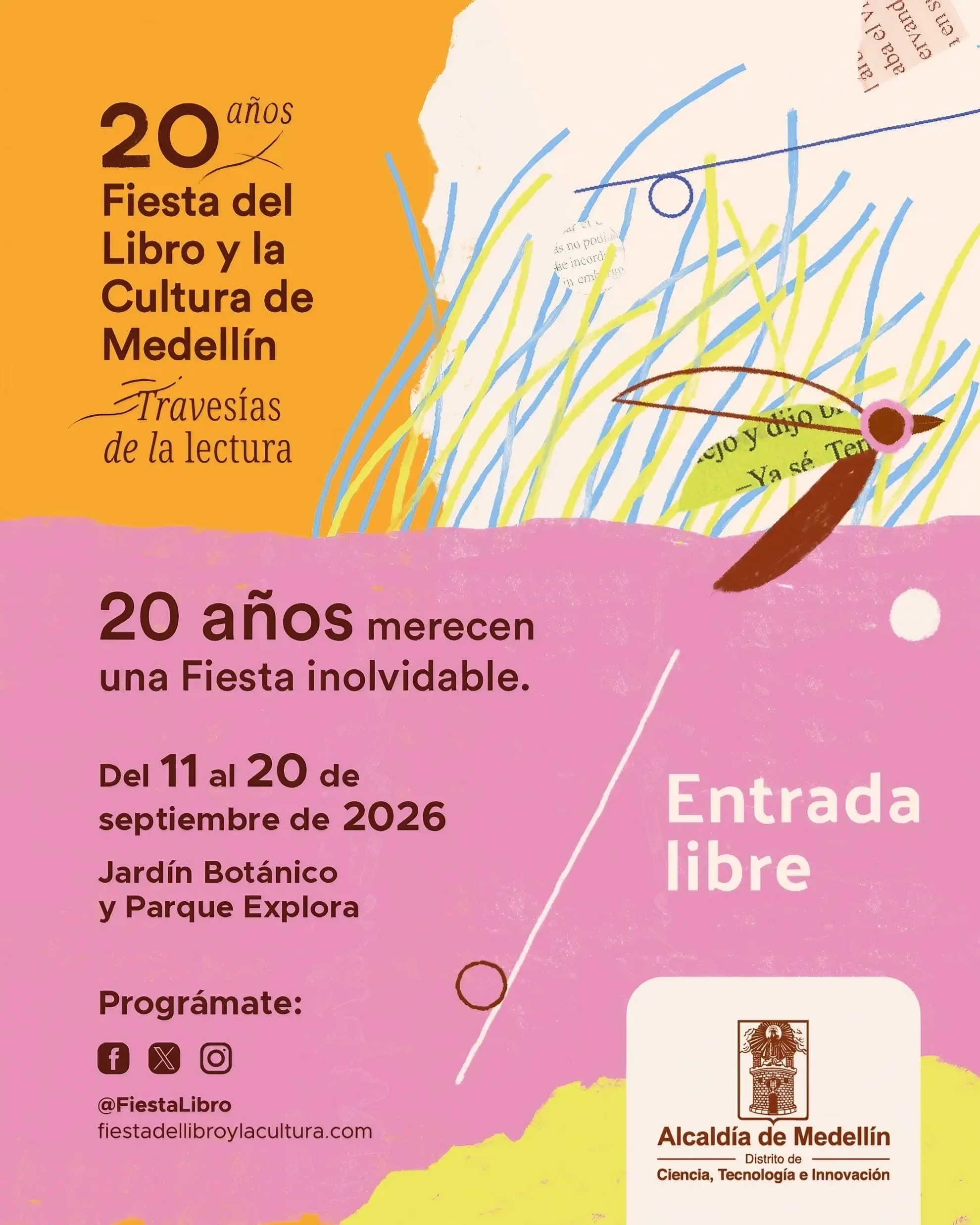
Mircea Cărtărescu appears at the Jardín Botánico this September as one of the marquee names of the twentieth Fiesta del Libro y la Cultura, the Medellín institution running from September 11th through September 20th, 2026, under the banner ‘Travesías de la Lectura.’ His presence beside Argentina’s Selva Almada, Spain’s Luna Miguel, and a Mexican delegation anchored by the publisher Almadía turns a municipal celebration into an argument about where unsettling literature now sits in the region’s reading habits.
A Civic Stage, Not a Sideshow
The Fiesta del Libro y la Cultura belongs to Colombia’s civic tier of literary festivals, the register the Feria Internacional del Libro de Bogotá occupies at the national capital: publicly convened, free of charge, and built to absorb a mass audience rather than a self-selecting readership.
This year’s edition is projected to draw close to 500,000 visitors and stages more than 3,600 activities across the Jardín Botánico, Parque Explora, and the city’s northern precinct, with every session carrying free admission.
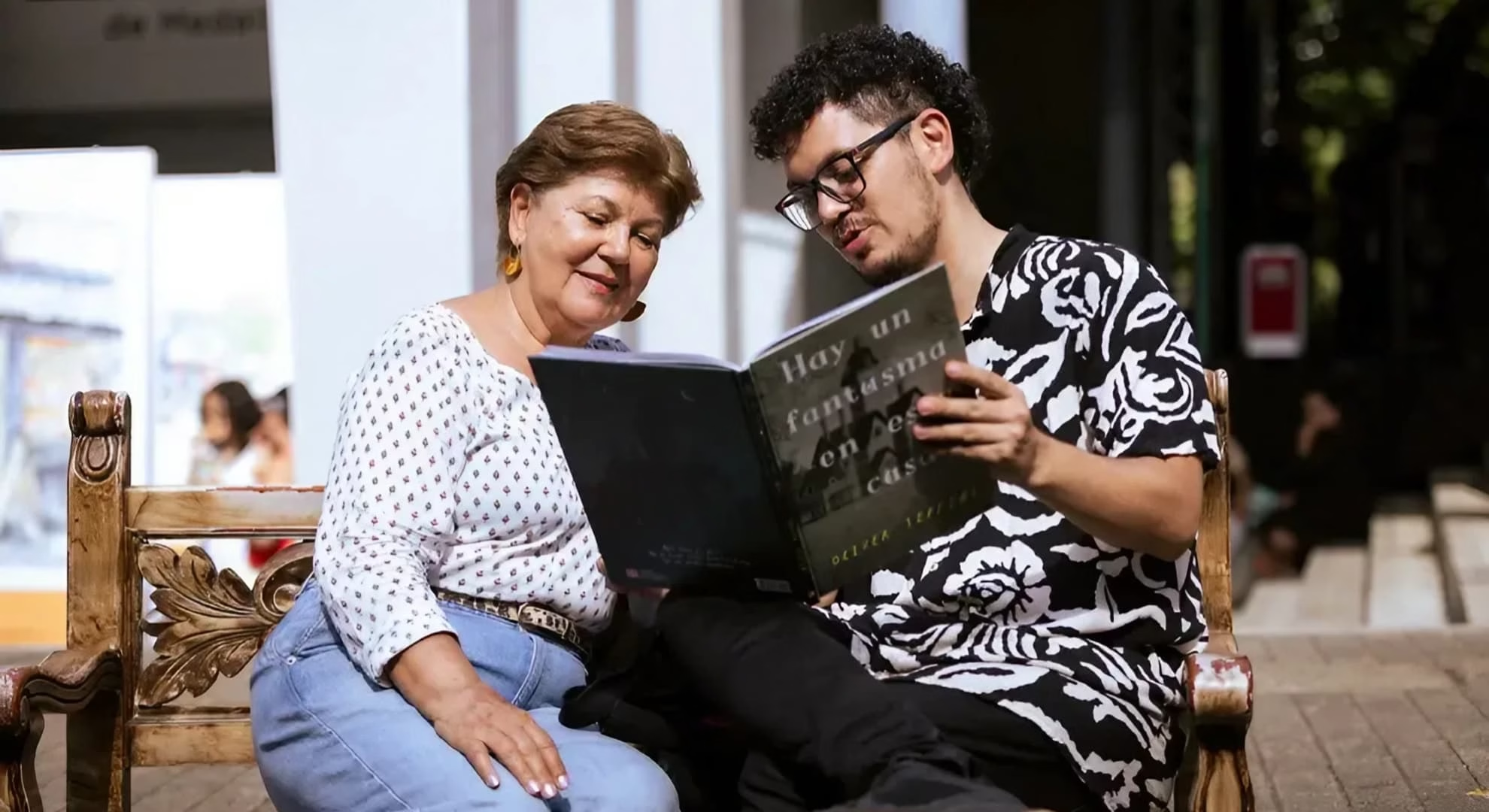
Institutional backing from EPM and the compensation funds Comfama and Comfenalco Antioquia marks this as infrastructure the city treats as civic obligation rather than boutique curation. A specialist genre festival booking a gnostic novelist would be unsurprising; a general-public fair built around family attendance doing so signals that the material has moved past the festival circuit’s niche audience and into programming aimed at the broadest possible public.
The Programme’s Central Argument
Cărtărescu built his reputation first as a leader of Romania’s postmodern “Generation of the 1980s” poets before turning to the prose that would define his international standing: ‘Nostalgia’ in 1989, the three-volume ‘Orbitor’ (published in English as ‘Blinding’) across 1996 to 2007, and ‘Solenoid’ in 2015, translated into English by Sean Cotter only in 2022.
That body of work treats the visible world as a flawed shell concealing another, truer order accessible only through dream, hallucination, or bodily rupture1 — a cosmology closer to ancient gnostic doctrine than to conventional horror mechanics.

Read against Colombia’s own literary inheritance, that cosmology is less foreign than the festival’s marketing copy suggests. The hallucinatory realism that Gabriel García Márquez naturalized for Spanish-language readers already asked audiences to accept visions, plagues, and the dead’s persistence among the living as continuous with ordinary experience2, which is precisely the contract Cărtărescu’s fiction also demands. His booking reads as continuity with a domestic tradition rather than an import requiring translation of sensibility.
The programme reinforces that continuity beyond its single headline name. Anne de Marcken, representing the United States delegation, appears on the strength of ‘It Lasts Forever and Then It’s Over,’ a co-winner of the 2022 Novel Prize narrated by a decomposing, newly undead protagonist who loses pieces of her body and her memory in equal measure across the novel’s length.
A zombie narrator staffing a literary-prize-winning meditation on grief, placed on the same circuit as a European gnostic, argues that speculative and dark tropes are being read for their philosophical payload rather than quarantined as genre entertainment.
Selva Almada completes that triangulation. Her fiction and documented nonfiction return repeatedly to unresolved violence against women in rural Argentina, sharing dark literature’s preoccupation with unpunished harm without adopting its supernatural machinery.
Placing her beside Cărtărescu and de Marcken suggests a curatorial thread built around unease itself, indifferent to whether it is dressed as ghost, corpse, or documented crime.
Twenty Years of Travesías
Two decades of continuous operation is itself the loudest argument this edition makes. The Fiesta del Libro y la Cultura has grown from a municipal reading initiative into the occasion Medellín is using to announce its own transition: the city takes over as UNESCO World Book Capital beginning April 23rd, 2027, succeeding Rabat and following Bogotá, which held the same title in 2007.
Rather than survey its own past, the organizers marked the anniversary by naming South Korea and the Oaxacan publisher Almadía as honorees and distributing 4,000 copies of a new translation of the Korean classic ‘Chunhyangjeon,’ arguing that the festival understands its authority as forward-looking rather than commemorative.
Beyond the Marquee Names
The edition’s most telling gesture sits furthest from its international guests. Organizers are distributing 40,000 free copies of ‘Cuentico Amarillo #19,’ the latest installment in the ‘El Quijote de Barriada’ collection written by Gilmer Mesa and illustrated by Laura Ospina, built to bring literature into neighborhoods the international programming rarely reaches on its own.
Placed against a Nobel Prize candidate and a Novel Prize-winning American author, that free pamphlet run reveals a festival unwilling to let international ambition eclipse a domestic literacy mission. None of Cărtărescu, de Marcken, or Almada is marketed by genre label in the festival’s materials, a diffusion that argues for the mainstreaming of dark material rather than its containment inside a separate track.
A Necropolis Turned Museum
A short ride from the Jardín Botánico stands the Cementerio de San Pedro, founded in 1842 by a group of Antioquian families seeking a burial ground of their own and declared a national cultural heritage site in 1999 after its earlier designation as a museum in 1998. Its mausoleums, carved by sculptors including Marco Tobón Mejía, hold industrialists, artists, and politicians whose names still anchor the city’s civic memory.
The site periodically hosts a nocturnal program pairing guided tours of its mausoleums with poetry recitals and storytelling, a pairing of literary voice and funerary stone that predates this year’s festival by decades. A novelist who writes the material world as a shell over a truer order, and an undead narrator who catalogues the pieces of herself she has lost, both find an unlikely companion piece in a cemetery the city itself chose to preserve as a museum rather than let fall into disuse.
The Argument Outlives September
A festival’s programme is a statement about what a city believes its readers are ready for, and Medellín’s twentieth Fiesta del Libro y la Cultura states that readiness plainly. Placing a gnostic novelist, an undead narrator, and a chronicler of unresolved rural violence inside a free public fair aimed at 500,000 visitors argues that unsettling literature has already migrated from the genre shelf into the general reading public’s expectations.
The pamphlets distributed to neighborhoods and the international names sharing a single stage are not competing priorities but the same claim made twice: that difficult, dark, and gnostic material belongs to everyone who walks through the Jardín Botánico’s gates, not to a specialist audience elsewhere. Twenty years in, that claim has become the institution’s clearest inheritance.
Does a general-public book fair booking gnostic and speculative fiction alongside its most traditional programming signal that dark literature has entered the Colombian literary mainstream, or does it risk diluting the specific reading experience such work demands?
Tourism Partnership
We reach an audience that travels with intention — drawn to documented history, dark heritage, and the cultural weight of the places they seek out. If you operate tours, cultural experiences, accommodation, or heritage sites aligned with that ethos, we would like to hear from you. We consider partnerships with tour operators, travel agencies, hostels, hotels, museums, and any organization whose work engages seriously with dark tourism, gothic culture, or historical travel. We do not promote services we cannot stand behind editorially. Reach us through our Contact page.
References
- Hans Jonas, ‘The Gnostic Religion: The Message of the Alien God and the Beginnings of Christianity’ (Boston: Beacon Press, 1958), 33–37. ↩︎
- Gene H. Bell-Villada, ‘García Márquez: The Man and His Work’ (Chapel Hill: University of North Carolina Press, 1990), 101–104. ↩︎




Leave a Reply