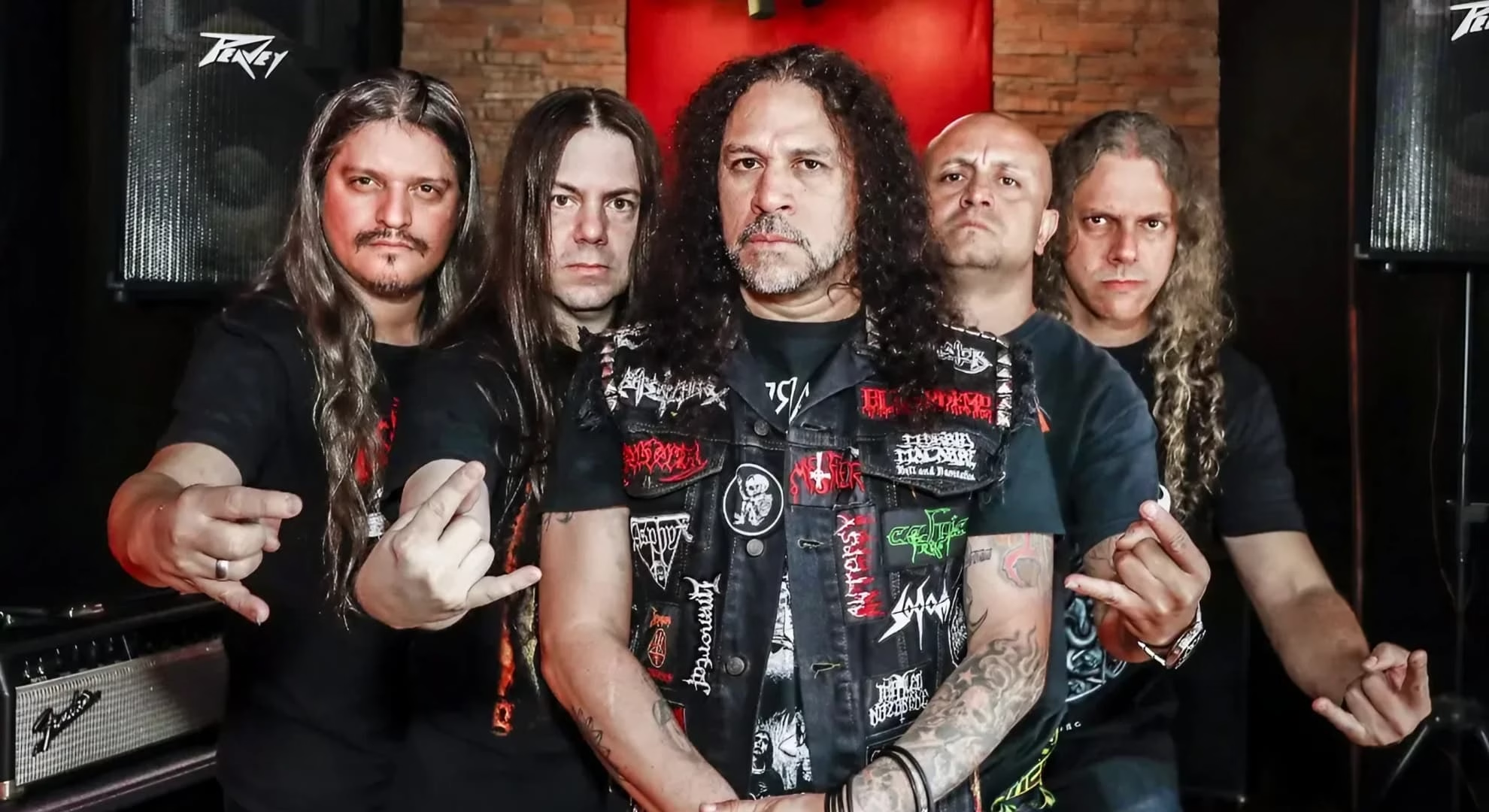


Few genres carry their national accents as audibly as death metal, where the distance between a Stockholm studio and a São Paulo rehearsal room registers immediately in tone, tempo, and intent. The Sickening Latin America Tour, threading through five countries this September, stages that contrast directly by pairing two bands whose relationship to the genre’s history diverges sharply.
On September 6th, 2026, Bogotá’s Capital Live Concerts, at Carrera 13 #48-90 in the Chapinero district, receives the tour’s opening date, with Sweden’s Bloodbath headlining a bill supported by Brazil’s NervoChaos. The show marks Bloodbath’s first confirmed performance in Colombia, a distinction that carries weight for a band with a nearly three-decade standing as a death metal institution. NervoChaos, by contrast, returns to a city where its name already carries a documented history.
Medellín’s First Answer
Every international bill visiting Bogotá needs a Colombian act to share the stage with, but this one did not need to search far. Masacre, on this bill, does not merely support Bloodbath and NervoChaos; it represents Colombia in the most literal sense the genre allows, standing in for a national scene it helped originate before that scene had international visitors to receive.
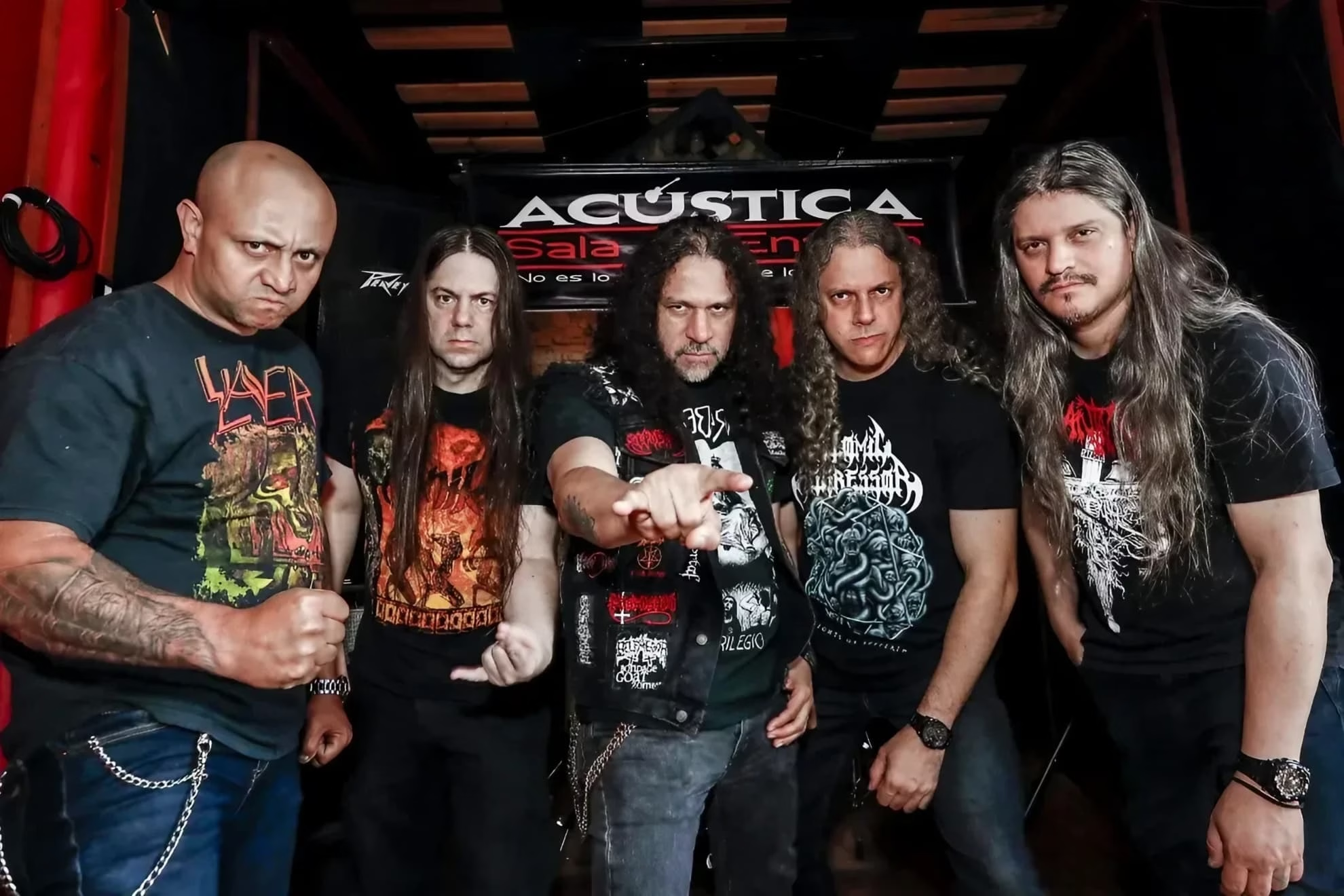
Masacre formed in Medellín in 1988, assembling around vocalist Alex Oquendo during a period when the city’s cartel wars had turned extreme metal into one of the only vocabularies capable of matching the violence outside.
The band emerged from the same Ultra Metal current that had already produced Parabellum and Reencarnación earlier in the decade, inheriting a regional sound shaped by raw distortion and confrontational subject matter rather than technical polish. Where Bloodbath reassembles the genre’s Swedish and Florida-scene origins from a position of established comfort, Masacre lived the conditions its earliest lyrics described.
The band’s 1989 demo, ‘Colombia: Imperio del Terror,’ and its 1991 debut full-length, ‘Reqviem,’ released through the French label Osmose Productions, carried Medellín’s testimony to an international underground that had almost no other channel for hearing it.
Distribution ran through hand-delivered flyers and word of mouth rather than any formal industry structure, yet the record reached listeners across Latin America and Europe regardless. Masacre’s catalogue, extending through ‘Sacro’ in 1996, ‘Muerte Verdadera Muerte’ in 2001, and ‘Total Death’ in 2004, has kept the same commitment to chronicling Colombian conflict directly rather than dressing it in the genre’s more common horror-fiction imagery.
Now fronted by Oquendo alongside Jorge Londoño, Juan Carlos Gómez, Álvaro Álvarez, and Wilson Henao, Masacre continues to tour internationally, from Maryland Deathfest to the 70,000 Tons of Metal cruise, while remaining rooted in the city that produced it.
Sharing the Lourdes Music Hall bill with Bloodbath and NervoChaos, places a band assembled to revive genre history alongside a band that helped originate part of that history. The September 6th pairing carries a depth that a straightforward international package could not offer on its own.
Stockholm’s Elder Guard
Bloodbath formed in Stockholm in 1998 as a supergroup assembled from musicians already established elsewhere, among them Jonas Renkse and Anders Nyström of Katatonia, Mikael Åkerfeldt of Opeth, and Dan Swanö of Edge of Sanity.
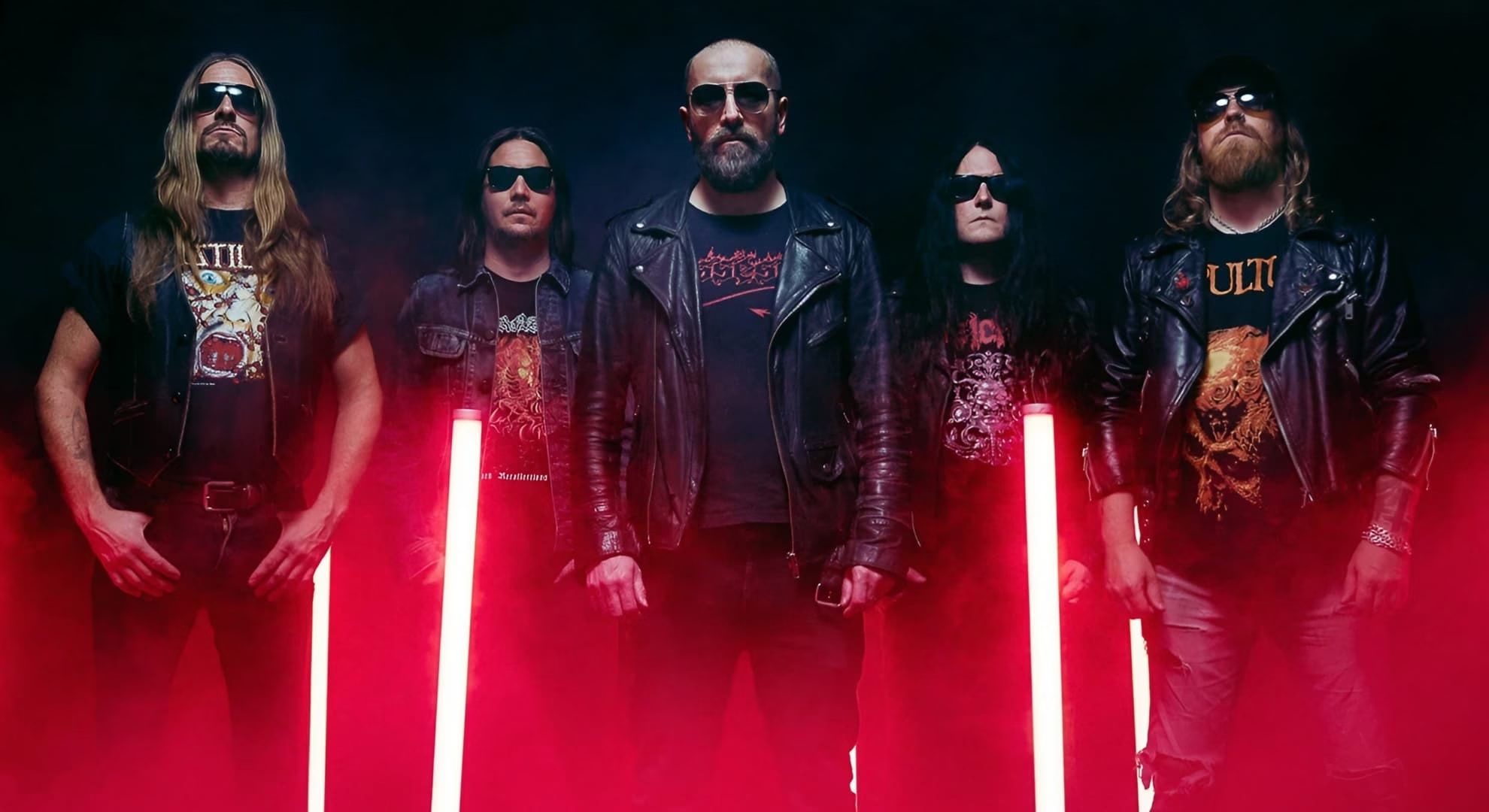
The project’s stated purpose, reviving the vocabulary of the genre’s Swedish and Florida-scene originators, has held steady even as its lineup evolved. Since 2014 the band has been fronted by Nick Holmes of Paradise Lost, a pairing that struck longtime followers as unlikely given Holmes’ own trajectory away from death metal’s rawest register.
That commitment to genre orthodoxy is not incidental; it is the band’s entire argument. Extreme metal scholarship has long identified the genre’s deliberate cultivation of transgressive, taboo-adjacent lyrical content as a structural feature rather than an ornamental one, a mechanism through which the music stages confrontations with mortality and horror that mainstream culture prefers to keep at a remove.1
Bloodbath’s sixth full-length, ‘Survival of the Sickest,’ released in 2022, continues that lineage without concession, and its arrival in Bogotá completes a route the band has never previously traveled to Colombian soil.
The Return of São Paulo
NervoChaos formed in São Paulo in 1996, emerging from a Brazilian extreme metal infrastructure that an earlier generation, Sepultura and Vulcano chief among them, had assembled out of almost nothing during the previous decade.
Where Bloodbath’s history is one of established musicians formalizing a tribute, NervoChaos earned its reputation from the ground up through demo tapes, underground touring, and an extensive discography spanning three decades. The band’s most recent record, ‘Transmogrified Epiphany,’ released in 2024, extends a run that also includes 2023’s ‘Chthonic Wrath,’ and has aged into genuine authority rather than mere longevity.
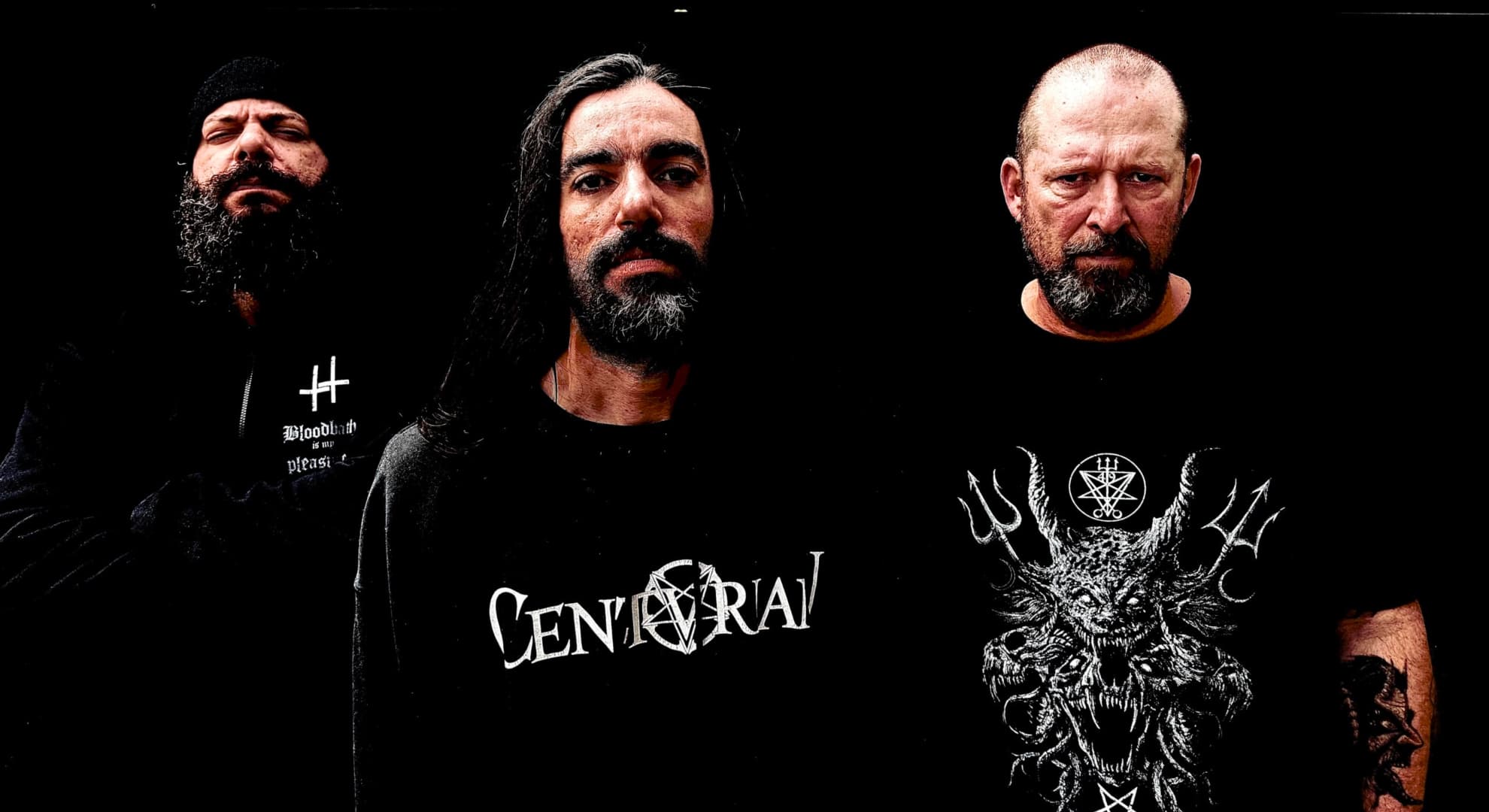
Unlike Bloodbath, NervoChaos returns to Bogotá rather than arriving for the first time. The band shared a bill with fellow Brazilians Krisiun at a Colombian date in 2017, and returned in June 2022 as part of a four-band bill alongside Belphegor, Krisiun, and Crypta.
Global metal scholarship has noted that touring circuits of this kind function as genuine infrastructure for scenes located outside the genre’s traditional European and North American centers, rather than as peripheral afterthoughts to a tour’s main circuit.2
A Bill Without Precedent
The contrast the tour advertises plays out with particular clarity in Bogotá, a city whose relationship to extreme metal has never been passive consumption. Attendance here has historically demanded real financial sacrifice relative to local wages, a fact that transforms a night like this one from casual entertainment into a deliberate act of participation.
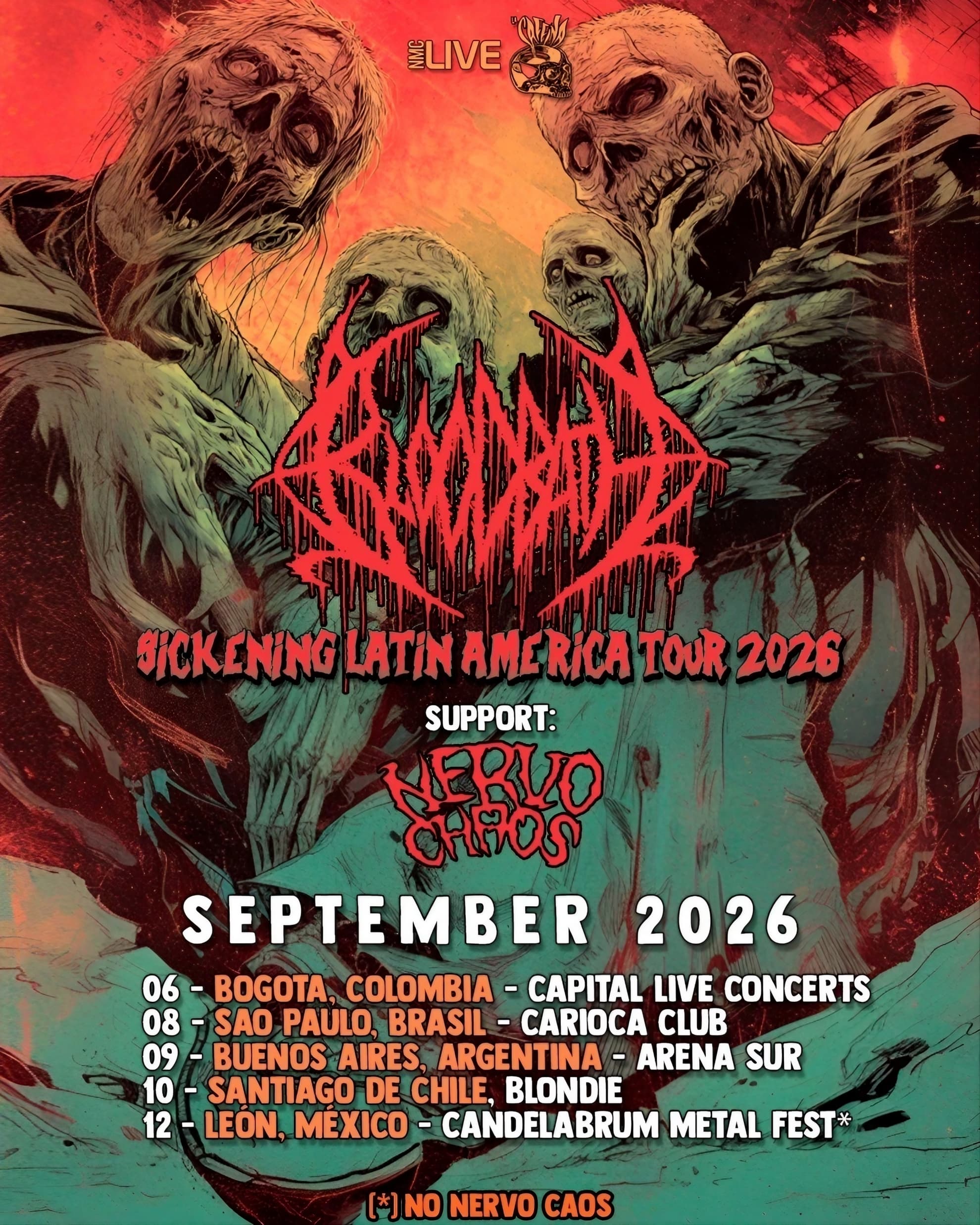
Doors for the September 6th performance open at 5:40 PM, according to information distributed through the tour’s official ticketing channels.
First-stage tickets for the Bogotá date are listed at 140,000 COP (approximately $45 USD), according to the tour’s official ticketing channels. NervoChaos appears on the bill as confirmed support for the full Latin American run, with the sole exception of the tour’s closing date at Mexico’s Candelabrum Metal Fest, where Bloodbath performs an extended set alone. The Bogotá show, positioned as the tour’s opening night, therefore presents both bands at full strength before either has adjusted its set to the fatigue of the road.
Where the Room Turns Loud
Lourdes Music Hall, at Carrera 13 No. 64-56 in Chapinero, is a modern room equipped with current sound, lighting, and screen technology, with a listed capacity of 2,000 across its main floor.
The venue’s booking calendar runs across genres rather than specializing in any single one, hosting everything from DJ sets to Latin rock acts in the weeks surrounding the September 6th date. For a bill pairing polished Scandinavian production with Masacre’s rawer, historically rooted aggression, a room without a fixed genre identity offers neutral ground rather than a pre-set sonic expectation.
The venue’s placement on Carrera 13 sits two blocks south of the Teatro Royal Center, positioning it inside the same Chapinero corridor that has absorbed the bulk of Bogotá’s touring extreme metal traffic in recent years. That density is not simply logistical convenience; it reflects a neighborhood that assembled the infrastructure for accessible, technically capable rooms well before international promoters began routing major tours through Bogotá at the current pace.
Bloodbath, NervoChaos, and Masacre inherit that infrastructure rather than creating it, arriving into a corridor the city’s own underground spent decades preparing.
The Basilica One Block South
One block south along Carrera 13 from Lourdes Music Hall stands the Basílica Menor de Nuestra Señora de Lourdes, the first neo-Gothic church raised in Bogotá and, after the city’s Catedral Primada, its second-largest religious building.
Commissioned in 1875 by Archbishop Vicente Arbeláez and designed by Julián Lombana, the church took over two decades to complete and now anchors Chapinero’s central plaza with a bell tower that rises to 65 meters. The venue itself carries the church’s name, a choice that makes the proximity impossible to treat as coincidence.
Its pointed arches, ribbed vaulting, and German-manufactured stained glass place it squarely within the Gothic Revival tradition that extreme metal has drawn upon in both image and theme since the genre’s earliest years, a visual language meant to inspire awe through scale and shadow long before any band adopted similar tools.
The church was elevated to the status of Minor Basilica in 2016, formal recognition of a structure that has served as Chapinero’s central landmark since long before the neighborhood acquired its current identity as a hub for touring metal acts. Attendees making their way to Lourdes Music Hall along Carrera 13 pass directly beneath its towers before the doors even open.
What the Night Leaves Behind
What the September 6th bill offers Bogotá is not a single narrative but two intertwined ones, resolved only by the shared stage. Bloodbath completes, at last, a geographic gap that has persisted through nearly three decades of touring elsewhere, while Masacre reminds the room that Colombian death metal did not wait for that visit to exist. Neither band needs the other to justify its presence, and that independence is precisely what gives the pairing its force.
The city’s extreme metal audience has spent decades assembling the infrastructure, both physical and cultural, that makes a night like this legible rather than novel. When the two bands take the stage at Lourdes Music Hall, the room they fill will already understand exactly what each act represents, without requiring either to explain itself.
Which of the two death metal histories converging at Lourdes Music Hall speaks more directly to what draws you back to extreme music, Stockholm’s cultivated tribute or Medellín’s lived original?
If you are a band, artist, label, or promoter navigating the dark and independent scene, you need press materials that speak the language — not generic copy. Our Studio writes press releases, EPKs, bios, and website content for the underground and the vanguard alike. Plans start at $150, with turnaround as fast as 2 days.
References
- Natalie J. Purcell, ‘Death Metal Music: The Passion and Politics of a Subculture’ (Jefferson: McFarland, 2003), 39–42. ↩︎
- Giovanni Hortúa Vargas, ‘Bullets, Drugs, and Rock and Roll: Colombian Punk Rock, Heavy Metal Culture in a Time of Revolt and Terrorism, 1979–1995’ (PhD diss., University of California, Irvine, 2013). ↩︎

Leave a Reply