


University student unions once anchored a version of British nightlife built around cheap drink and a captive summer audience, but few of the club nights born from that arrangement survived once the union stopped covering the losses. Infest Festival did survive, if not always in the shape its founders expected.
The industrial, EBM, and darkwave gathering that began inside a Bradford students’ union bar in 1998 enters its 28th year in August 2026, back at Manchester Academy from August 21st through 23rd for a second consecutive edition since its 2025 departure from West Yorkshire.
A Second August in Manchester
The 2026 edition unfolds across three days and two live stages inside the University of Manchester Students’ Union on Oxford Road, the same complex that hosted the festival’s first Manchester edition the previous August.
A Thursday, August 20th warm-up party precedes the main run, extending 2025’s compressed two-day weekend into a fuller four-night stretch, while an all-ages policy until 11:00 p.m., followed by an 18-plus late slot, carries over unchanged from Bradford.
Beyond the two headline slots covered below, Modulate, Potochkine, Aux Animaux, Lovelorn Dolls, Bein-E, and Ghostbells fill out the two stages, alongside DJ sets and a market for independent clothing and accessory traders that has followed Infest since its Bradford years.
From Bradford to Oxford Road
Infest’s founding owed less to curatorial ambition than to a students’ union entertainment manager’s need to fill a quiet summer bar. Three Bradford students, Gareth Harvey, Chris Molyneux, and Max Niblock, organized a first one-day show in 1998, booking Alien Sex Fiend for an audience of roughly four hundred.
By 2000, the students’ union could no longer cover the shortfall, and promoter Mark Guy, operating as Terminal Productions, took over bookings and steered the festival from its goth-rock opening toward the EBM, rhythmic noise, and electro-industrial acts that have defined it since, a pivot situating Infest within industrial music’s documented movement from confrontational art provocation toward sequencer-driven, danceable repetition.1
The festival operated at the University of Bradford for twenty-five consecutive in-person editions before relocating to Manchester Academy in 2025, a move organizers attributed to rising costs and the Bradford venue’s own operational limits rather than any decline in the festival’s following.
A second consecutive Manchester edition tests something the first one could not: whether the relocation represents a lasting home or a stopgap. The 2026 bill’s return to a full three-day format, alongside the Thursday warm-up party absent from 2025’s compressed schedule, reads as evidence that organizers consider Manchester more than a temporary landing spot.
The Bill as Argument
Chris Corner’s IAMX project headlines Friday, closing out a European run billed as the Recollections Tour that has paired festival stops with headline shows since March 2026.
Corner, who began the project in 2004 after Sneaker Pimps’ hiatus, built IAMX’s reputation on synth-pop, dark cabaret, and industrial textures delivered with elaborate stagecraft; the Manchester date follows the May 22nd digital release of ‘UNMASK’ and ‘IAMIXED,’ reworkings of his two ‘Fault Lines’ albums that had circulated only as physical tour exclusives until that point.
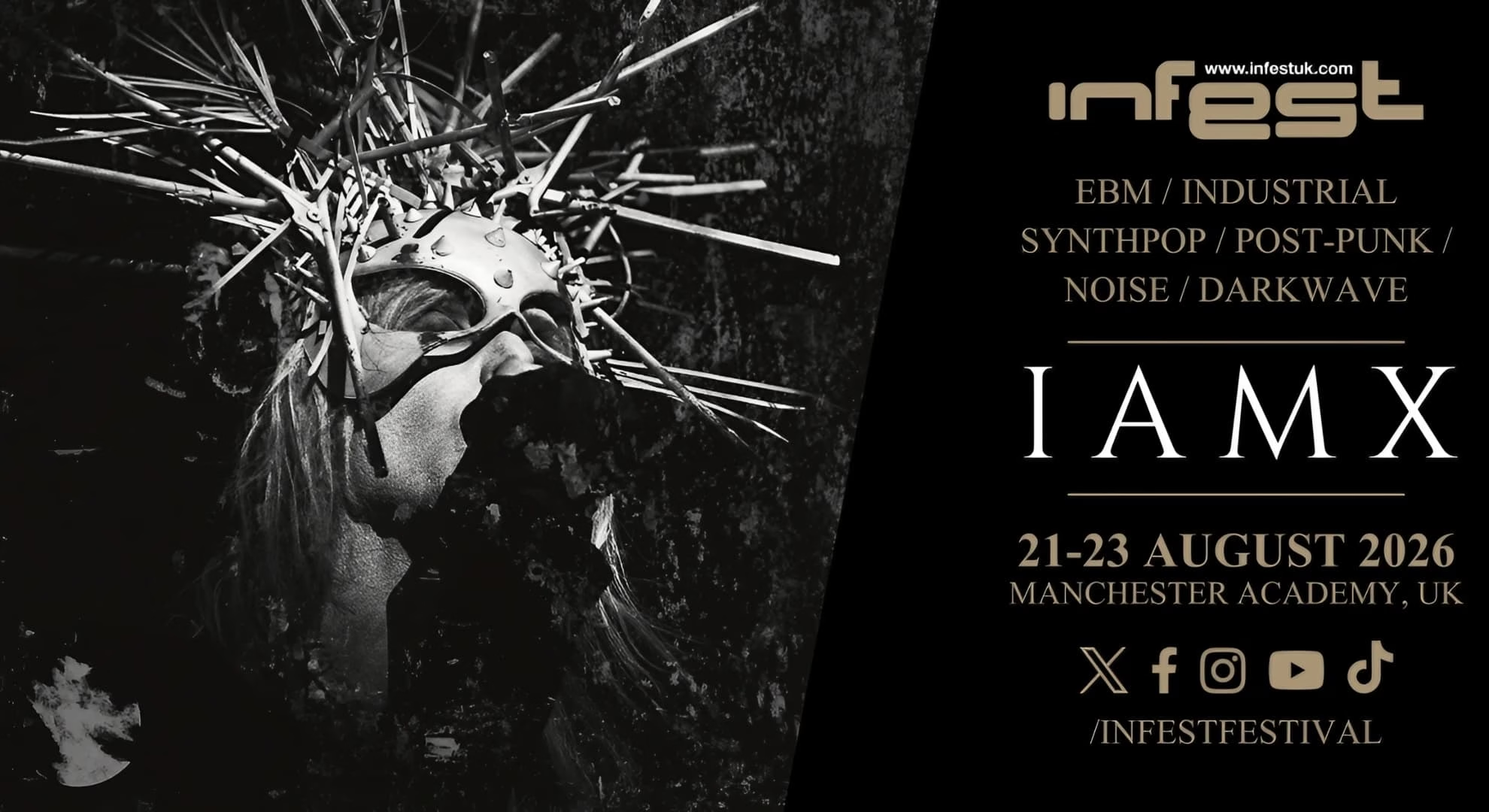
Corner’s only previous Infest appearances came during the festival’s two pandemic-era online editions, making Manchester his first time performing for an in-person Infest audience.
Utah Saints headline Saturday for a first appearance in the festival’s history, arriving less from industrial or EBM roots than from early-1990s UK sampling culture. Jez Willis and Tim Garbutt built the duo’s run of UK Top 40 hits, including their reworking of Kate Bush’s ‘Cloudbusting,’ after Willis’s earlier stint in Cassandra Complex, a Leeds EBM act, and the pairing reads as a curatorial argument: that Infest’s founding genres share more with the sampling-driven rave culture Utah Saints helped popularize than either audience typically acknowledges.
The booking follows the duo’s most recent public appearance, a June 2026 orchestral Club Classical show in Leeds, a considerable distance from Infest’s usual territory.
Under the Headline Tier
Beneath the two headline slots, The Gospel and OWLS anchor Infest’s youngest booking tier, and both represent first appearances at the festival.
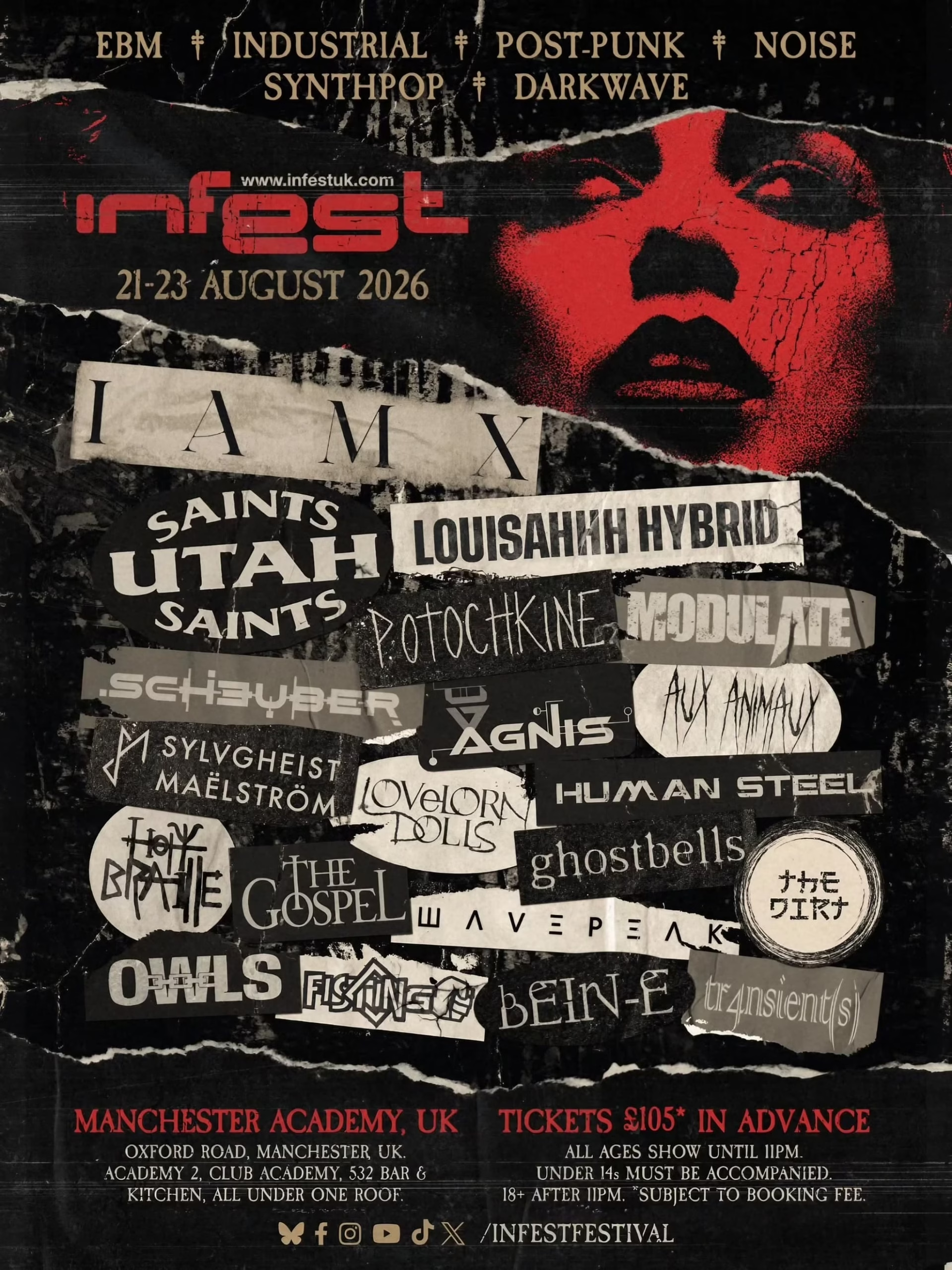
The Gospel, a Manchester act fronted by Jimmy Sweet with an all-female backing lineup, work a cinematic strain of goth rock built from 1970s analogue synthesizer textures, positioned somewhere between Nick Cave’s theatrical rock and Goldfrapp’s electronic pop. The band’s most recent releases came in April 2025, with two singles preceding a first UK headline date and a supporting tour with Lene Lovich that May.
OWLS, the Longford, Ireland-based producer working under a self-described macabre synthpunk tag, released the debut album ‘Death Games’ on Negative Gain Records in June 2025 and has a second album in preparation for 2026. His post-punk, goth, and darkwave-inflected sound extends an Irish post-punk lineage dating to the Virgin Prunes’ 1977 Dublin formation, credited with shaping gothic rock’s early vocabulary.2
South of the Chapels
Three miles south of Oxford Road, Southern Cemetery occupies grounds first consecrated in September 1879 across nearly one hundred acres of Chorlton-cum-Hardy parkland. It remains the largest municipal cemetery in the United Kingdom and the second-largest in Europe, four of its six listed buildings raised as chapels in a neo-Gothic style that predates any genre performed at Infest by more than a century.
The cemetery’s scale reflects a distinctly Victorian anxiety: overcrowded inner-city churchyards had become a documented public-health concern by the 1870s, prompting Manchester Corporation to commission a burial ground meant for permanence. That tension between confronting mortality directly and containing it within civic structure sits alongside the EBM and darkwave repertoire Infest programs each August, though the cemetery’s history stands independent of any festival calendar.
Southern Cemetery remains an active burial ground rather than a preserved ruin, reachable from Oxford Road by tram and bus within roughly twenty minutes, a detail separating its character from sites built explicitly around historical remembrance.
The Price of a Weekend
Admission for the full 2026 weekend already reflects Infest’s growing footing in its new home. Both cheapest weekend tiers, a Super Early Bird at £90.10 with fees (approx. COP 384,000) and an Early Bird at £100.70 with fees (approx. COP 429,000), had sold through by midsummer, leaving only the Advance tier at £111.30 with fees (approx. COP 475,000) on sale ahead of a Walk Up tier at £121.90 with fees (approx. COP 520,000) opening August 20th.
Single-day tickets remain available: Friday at £53.00 in advance (approx. COP 226,000) or £63.60 at the door (approx. COP 271,000), Saturday at the same £63.60 advance rate rising to £74.20 at the door (approx. COP 316,000), and Sunday at £58.30 in advance (approx. COP 249,000) or £68.90 at the door (approx. COP 294,000).
A Second Year’s Verdict
A festival’s second edition in a new city carries less romance than its debut but more evidentiary weight. Infest’s expanded schedule and a bill pairing a former EBM band member with two acts making first festival appearances suggest organizers are working toward permanence in Manchester rather than treating the city as a placeholder.
Twenty-eight years after three students filled a quiet Bradford summer with a one-day show, the festival’s survival still depends less on any single lineup than on whether a new host city keeps saying yes.
At what point does a relocated festival stop being judged against its old home and start being judged only on its own terms?
Tourism Partnership
We reach an audience that travels with intention — drawn to documented history, dark heritage, and the cultural weight of the places they seek out. If you operate tours, cultural experiences, accommodation, or heritage sites aligned with that ethos, we would like to hear from you. We consider partnerships with tour operators, travel agencies, hostels, hotels, museums, and any organization whose work engages seriously with dark tourism, gothic culture, or historical travel. We do not promote services we cannot stand behind editorially. Reach us through our Contact page.
References
- S. Alexander Reed, ‘Assimilate: A Critical History of Industrial Music’ (New York: Oxford University Press, 2013), 210–214. ↩︎
- Paul Hodkinson, ‘Goth: Identity, Style and Subculture’ (Oxford: Berg, 2002), 34–37. ↩︎




Leave a Reply