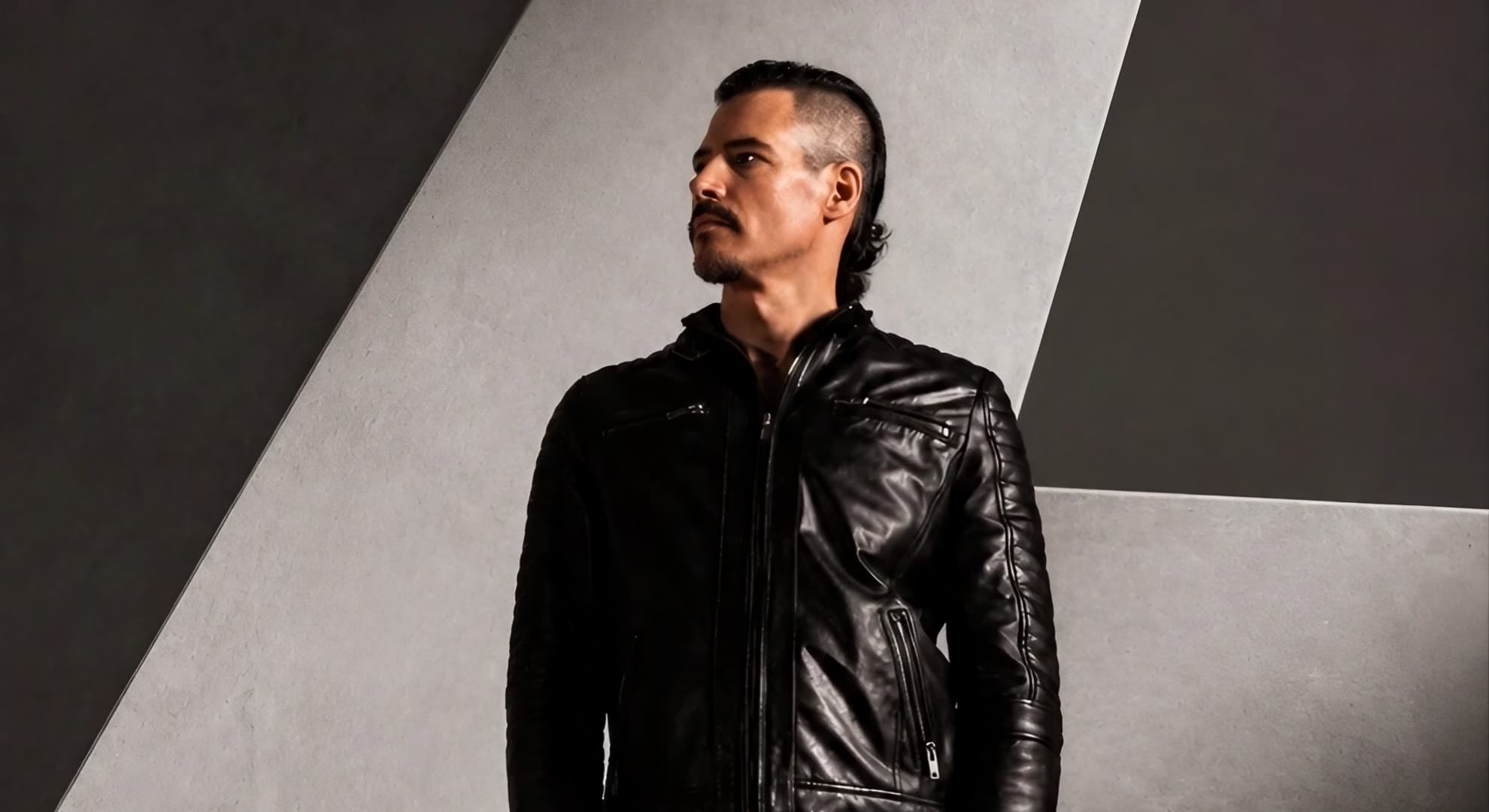


A synthesizer bassline can carry an argument before a single word appears. In Austin, Texas, where the guitar has historically dominated the city’s musical self-image, a small circuit of artists has spent the past decade assembling a counter-tradition out of drum machines, minor-key melodies, and deliberate shadow.
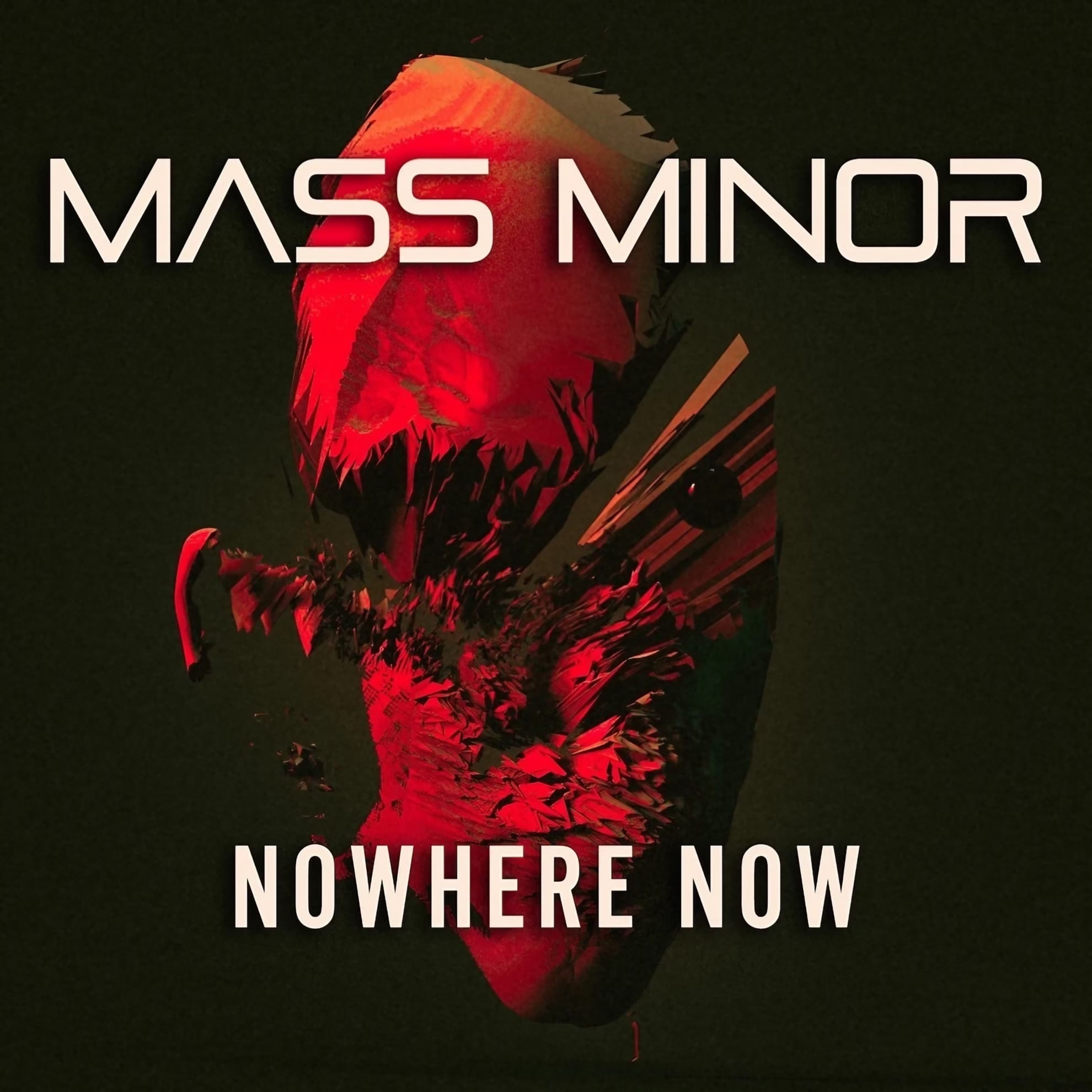
Mass Minor belongs to that circuit, and on July 31st, 2026, the project released ‘Nowhere Now,’ a single that pulls a pulsating synth-bass line taut against distorted electric guitar until the two textures compete for the same register.
The song functions as the first evidence of ‘Beyond the Edge of Reason,’ the sophomore full-length from Mass Minor, scheduled for release through Metropolis Records in the first weeks of November 2026. An exact release date, along with the album’s physical format plans, had not been confirmed at the time of publication.
What the single does confirm is a project six years removed from its recorded debut, working through a public reckoning with self-deception and the difficulty of releasing a cause that was never legitimately held in the first place.
‘Nowhere Now’ is available now through Metropolis Records’ Bandcamp page and standard digital retailers. No vinyl or CD edition of the single has been announced, and physical format details for the forthcoming album remain unconfirmed at the time of publication.
A Distorted Bassline Breaks the Surface
Confirmed advance singles carry the full weight of critical engagement available to a record that has not yet been heard in its entirety, and ‘Nowhere Now’ rewards that scrutiny.
The track opens on a pulsating synth-bass figure, an instrument choice that has signified interiority and unease in dark electronic music since the genre’s earliest post-punk practitioners began using synthesizers not for their novelty but for their capacity to sound cold, controlled, and slightly wrong.1
Distorted bass guitar joins the synth line before the arrangement admits electric guitar, an instrument the song withholds until the rhythmic foundation has fully set. The sequencing is not incidental. It stages a contest between the mechanical and the human that mirrors the song’s narrative core: a narrator questioning whether the position he has spent years defending was ever genuinely his to defend.
Martin, credited within the band’s own production notes under the initials AJMJR, described the song as centered on the space between who a person is and who that person has been persuaded to become. He explained that the track turns on a recurring question about whether the thing being fought for was ever legitimately held, and that its words trace self-deception, personal transformation, and the slow work of release.
The account matches a pattern documented in recent scholarship on confessional pop, where the perceived intimacy of first-person songwriting is read by audiences as a marker of psychological honesty even as it operates within a highly mediated, commercially produced form.
Whether ‘Nowhere Now’ resolves that tension or simply names it remains, appropriately, an open question the song itself does not answer in four minutes.
The producer and recording studio behind ‘Nowhere Now’ had not been confirmed through official channels at the time of publication.
Four Musicians, One Recording Signal
Mass Minor’s public catalogue begins with ‘Become Each Other,’ a nine-track debut released independently on August 28th, 2020, and recorded at AustinSignal Studios in Austin. The album credits Martin as songwriter and primary producer alongside Benjamin A. Post, who served as executive producer and co-arranger, with additional performances from musicians credited as Filius Dex and H. Dean.
Tim Palmer, a producer and mixer whose credits extend across several decades of alternative and rock recordings, contributed additional production, arrangement, and mixing on two of the album’s nine tracks, while engineer Daniel Stapleton produced and mixed a third.
The credits describe a project organized less around a single frontman than around a rotating circle of collaborators working under Martin’s songwriting, a distinction worth making plainly rather than flattening into the shorthand of a solo act.
The six years between ‘Become Each Other’ and ‘Nowhere Now’ were not quiet ones. Mass Minor issued the single ‘Prisoner’ in 2023, followed by ‘Lying’ and the extended play ‘Vast Reflections’ in 2024, then a companion release, ‘Dark Mode,’ that reworked several of the same songs into alternate mixes at the close of that year.
Two further stand-alone singles, ‘Dark Skies’ and ‘The Mountain,’ followed across the fall of 2025, the latter supported by a music video directed by Simon Mars and Beau Jason Loy. Taken together, the run reads less like a series of disconnected releases than a five-year rehearsal for the two-album arc that ‘Beyond the Edge of Reason’ is now positioned to complete.
That rehearsal has extended to the stage as well as the studio. Mass Minor has played Austin’s Paramount Theatre twice in 2026 alone, sharing bills with a Strangelove tribute act and the band Weird Wolves, and Martin’s creative output outside the group includes an original score for an independent short film, evidence of a working composer’s sensibility feeding directly into the project’s cinematic, guitar-and-synth songwriting.
Austin’s Apprenticeship in Dark Sound
Austin promotes itself internationally as a live music capital, a reputation established overwhelmingly on guitar-based rock, blues, and country traditions. Beneath that reputation sits a smaller and older dark-music current, one that developed its own local character rather than functioning as an imported novelty.
Scholarship on American goth subculture has specifically located Austin among a handful of cities, alongside Los Angeles, Leeds, London, Buffalo, and Sydney, where the genre took root outside its country of origin and grew a lasting regional identity of its own.2
That regional identity is distinct in kind from the genre’s British point of origin, which emerged from the specific conditions of late-1970s post-punk and the damp, deindustrializing towns of northern England. Austin’s version, formed decades later and an ocean away, answers to different pressures and a different climate, even as it borrows the same minor keys and mechanical rhythms.
Mass Minor’s catalogue sits inside that Austin current rather than apart from it. Live engagements documented across the past year place the project alongside other acts working the same regional circuit, including a shared bill with the Texas darkwave act Urban Heat at Portland’s Crystal Ballroom in the fall of 2025.
That kind of touring pairing, between two bands drawing on the same minor-key, drum-machine vocabulary and playing to the same rooms, offers firmer evidence of a functioning local scene than any single band’s biography could on its own.
A Showcase Reaching Beyond Austin
The second axis of Mass Minor’s moment concerns who receives this music once it leaves Austin. The project held an official 2026 South by Southwest showcase on March 16th at Elysium, a booking that places Mass Minor inside a festival apparatus designed specifically to draw international press, booking agents, and touring audiences into the city rather than the reverse.
That apparatus matters for a genre whose commercial and critical infrastructure has rarely organized itself along strictly national lines. Recent scholarship on synth-pop frames the genre’s development as an international circuit rather than a set of parallel national scenes, tracing overlapping activity across the United States and the United Kingdom alongside more recent scenes in Poland, Spain, Japan, and beyond.3
Mass Minor’s SXSW showcase, and the Metropolis Records release that follows it, place the project inside exactly that circuit. A regional Texas act, formed around a single songwriter’s persistent return to the same handful of collaborators, now reaches listeners whose own frame of reference for the genre took shape in cities the band has never played. The song traveling furthest in that circuit right now is ‘Nowhere Now,’ a track assembled from Austin’s specific version of a genre that has never belonged to any one country.
A Lyric Turning on Doubt
‘Nowhere Now’ functions as more than a stand-alone release. Martin has described it as an introduction to the thematic ground ‘Beyond the Edge of Reason’ will occupy across its full running time, though the album’s other songs remain unheard and therefore outside the bounds of critical judgment here.
What can be said with confidence is that the single’s central tension, between an inherited sense of self and a chosen one, extends a thread already visible across Mass Minor’s recent singles, from the isolation named directly in ‘Emptiness’ to the deception implied by the title ‘Lying.’ Whether that thread sustains across a full album’s running order, and what shape it takes once heard in sequence rather than as a single advance song, is a question only the November release can answer.
The Weight Carried Into November
Six years separate ‘Become Each Other’ from the album now approaching release, and the interval shows in the confidence of ‘Nowhere Now,’ a single shaped by a rotating circle of collaborators who have spent that time performing for festival crowds and regional audiences rather than retreating from either.
‘Beyond the Edge of Reason’ inherits both halves of that history: a songwriting practice tested across five years of stand-alone singles, and a regional dark-music circuit, anchored in Austin but reaching well past it, that has proven durable enough to outlast any single scene’s fashions. What the album does with that inheritance, once its full track list is heard rather than inferred from a single advance song, remains the question November will settle.
For audiences tracking the project’s trajectory since ‘Become Each Other,’ ‘Nowhere Now’ poses an inquiry durable enough to outlast its four-minute runtime: how much of the territory a person occupies—whether defined by a partnership, a conviction, or an internal identity—was ever legitimately held by them to begin with?
References
- Nick Wilson, ed., ‘Interpreting the Synthesizer: Meaning Through Sonics’ (Newcastle upon Tyne: Cambridge Scholars Publishing, 2020). ↩︎
- Lauren M. E. Goodlad and Michael Bibby, eds., ‘Goth: Undead Subculture’ (Durham: Duke University Press, 2007). ↩︎
- Geoff Stahl, Nabeel Zuberi, and Holly Kruse, eds., ‘Synth-Pop and Its Repercussions’ (New York: Bloomsbury Academic, 2026). ↩︎

Leave a Reply