

A band that moves its synthesizer programming from a single credited specialist to a full instrumental credit shared across the entire lineup, over the course of three records, is arguing something specific about where the human performer ends and the machine begins, and Zyklon made that argument in three progressively explicit steps before closing the file.
Formed in Notodden in 1998 by two musicians still nominally employed by a black metal institution already running out of road, Zyklon spent nine years and three studio albums converting the exhausted vocabulary of Norwegian black metal’s second wave into a disciplined, mechanized idiom that neither black metal nor death metal, on their own terms, had fully worked out how to build.
The Bounded Experiment
Zyklon is best read not as a band that outgrew black metal but as a controlled experiment with a fixed number of trials. Samoth and Trym Torson, both still credited members of Emperor when Zyklon’s first material took shape, built the project around a specific technical premise, one the band’s own liner credits would take two albums to fully realize: that synthesizer arrangement and programming should not sit in a mix as decorative texture, added after the fact by a producer, but should be credited as an instrument in its own right — a credit initially concentrated in Trym Torson’s programming work on the debut, and extended to every performing member from Aeon onward.
This is a narrow claim, and it is meant to be. It does not argue that Zyklon invented industrial-inflected extreme metal, nor that the band’s commercial reach matched its technical ambition.
It argues that across exactly three albums, released in 2001, 2003, and 2006, Zyklon ran a single sustained inquiry into what happens when a black metal lineage stops treating the machine as an enemy of authenticity and starts treating it as a fourth member of the band, and that the project was structured, from its first lineup change to its final box set, to close itself rather than to run indefinitely.
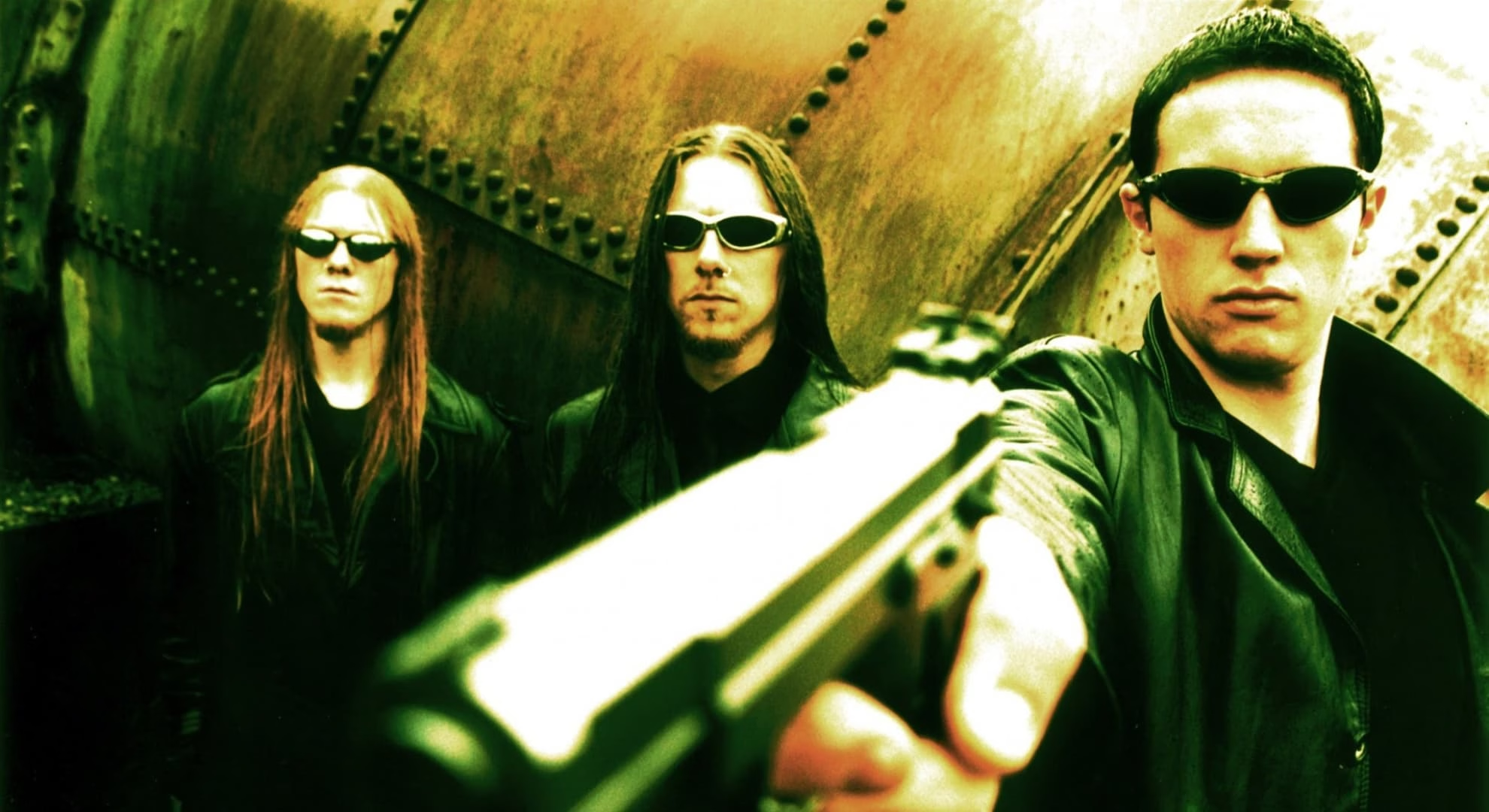
The evidence for a bounded rather than an open-ended project is structural. Zyklon never rotated through eras or reinvented its lineup in the manner of a band settling in for a long career; the four-person configuration that recorded ‘Aeon’ and ‘Disintegrate’ held from 2001 until the band’s final show, and when it stopped, it stopped cleanly, with a compiled retrospective box set standing in for further studio work rather than a slow trickle of farewell singles.
The scholar Daniel Lukes has argued that industrial black metal, far from being a marginal subgenre, is where black metal’s ordinarily disavowed relationship to machinic noise becomes explicit, a critique of what he terms machine society conducted from inside the genre’s own instrumentation.1
Zyklon’s discography supplies a compact, chronologically legible case study for that claim: a band that began in the vocabulary of blast-beat extremity and ended, three records later, having made the machine’s presence a matter of formal songwriting credit rather than atmosphere. What follows treats that trajectory as the article’s central, falsifiable claim: that Zyklon’s three albums constitute a closed and complete demonstration of a specific technical model, not an interrupted or unfinished band.
Notodden and the End of a Sentence
Emperor, the Norwegian black metal institution from which Zyklon’s founding members came, had by the late 1990s reached the end of what its own catalog could argue. ‘IX Equilibrium,’ released in 1999, was widely understood within the band and its audience as a culmination rather than a new direction, and Emperor formally announced its dissolution in 2001.
Samoth and drummer Trym Torson began Zyklon in 1998, while Emperor was still nominally active, which places the new project’s origin not after the parent band’s collapse but inside its final, exhausted stretch — an escape hatch opened before the door it led away from had actually closed.
The scholar Michelle Phillipov has characterized Norwegian black metal’s early-1990s notoriety as bound up with claims to transcendent, sacralized violence that the scene’s own subsequent professionalization steadily eroded;2 by 1998, the musicians who had built that scene’s reputation were negotiating a considerably more mediated, internationally touring, commercially structured version of the genre than the one the mythology described.
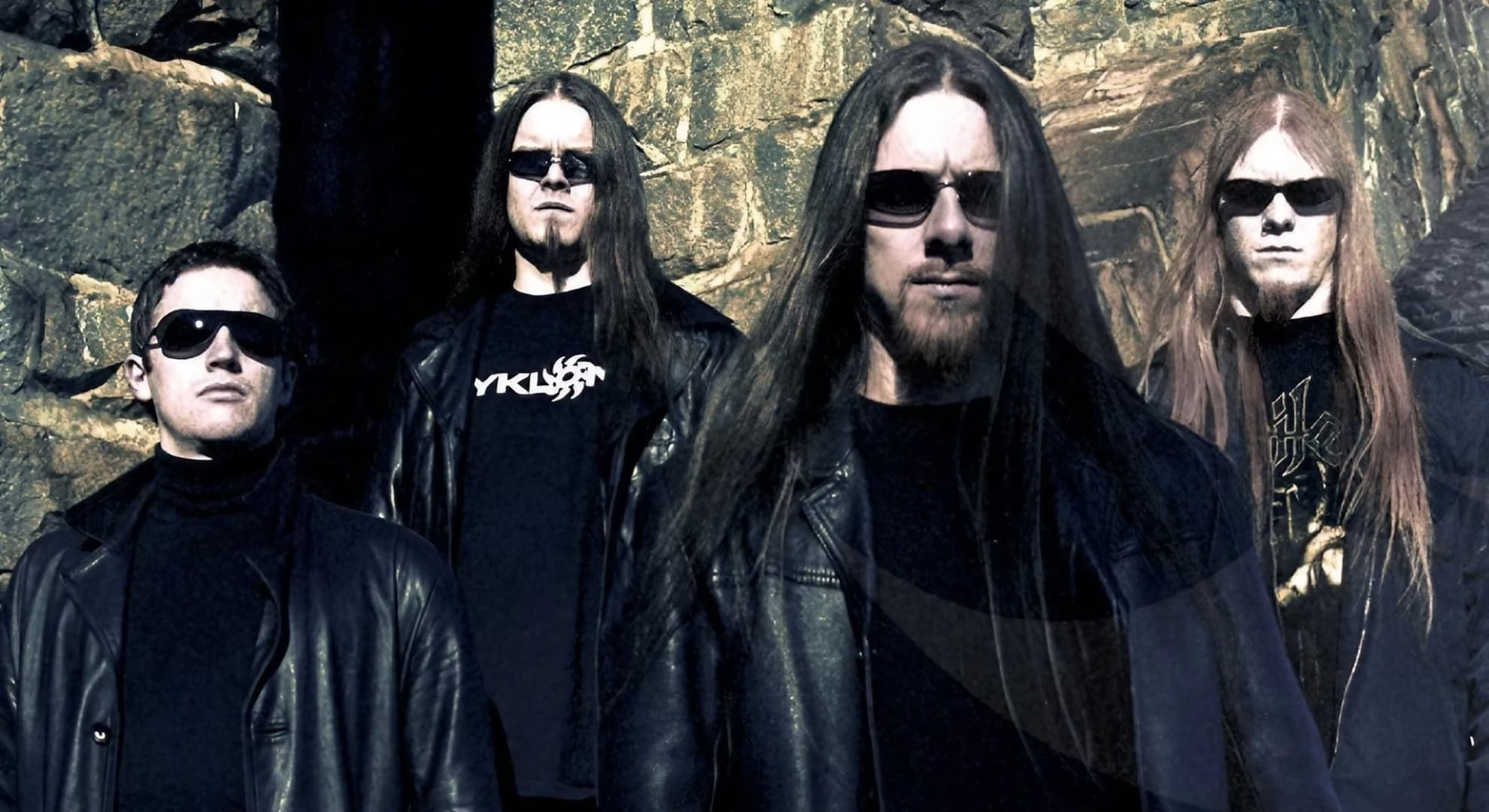
Zyklon’s early lineup — Samoth and Trym joined by guitarist Destructhor, formerly of Myrkskog, and vocalist Daemon, on loan from Limbonic Art — assembled around Notodden, in Telemark, the same regional base from which Emperor itself had operated, and recorded the material that became the band’s debut at Akkerhaugen Lydstudio in July and September of 2000.
All of Zyklon’s lyrics, across all three albums, were written by Bård “Faust” Eithun, Emperor’s former drummer. Eithun was serving a prison sentence for a 1992 killing when ‘World ov Worms’ was recorded and released, and was not released until 2003, the same year ‘Aeon’ appeared; his lyrical contributions to Zyklon were therefore produced and delivered from outside the band’s own touring and recording circuit for the first half of its active life, a biographical fact directly relevant to how the band’s lyrical program — explicitly framed around political and technological, rather than the older occult and pastoral, black metal themes — was actually assembled.
The historian K. Hoffin has situated this period of the Norwegian scene’s development as the point at which the mythologized “second wave” gave way to a more diffuse set of individual career trajectories, no longer organized around a single shared aesthetic program;3 Zyklon’s formation is a specific, datable instance of exactly that diffusion, in which two of the scene’s most visible former members chose not silence, and not a repetition of Emperor’s own model, but a redirection into a genre space — blackened death metal with a mechanized, programmed layer — that Emperor’s own catalog had never fully entered.
‘World ov Worms’ and the First Machine
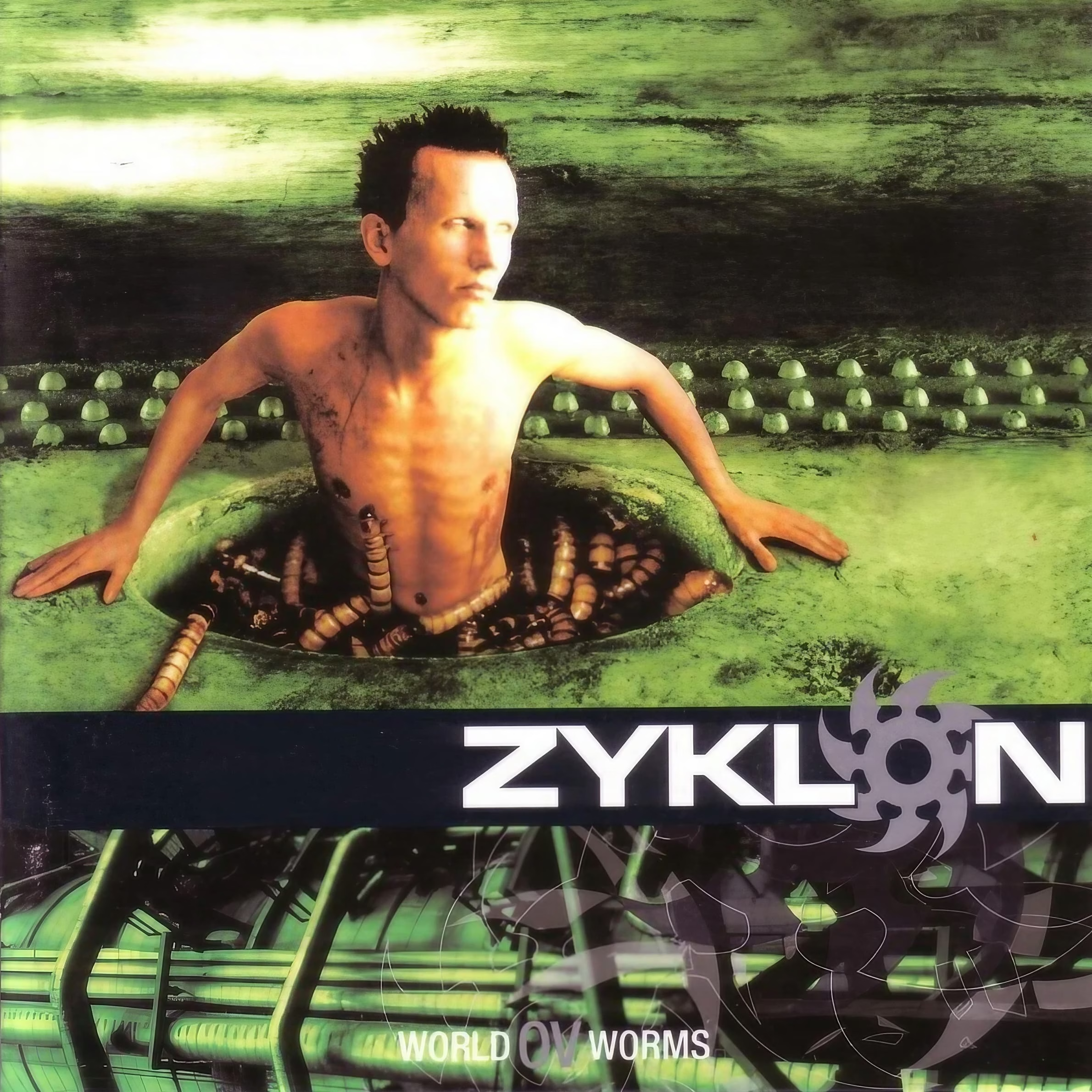
‘World ov Worms’ was released on the twelfth of February, 2001, through Candlelight Records, catalog number CANDLE061CD, and remains the clearest evidence that Zyklon’s founding musicians understood the project from its outset as a formal departure rather than a side outlet for unused Emperor material.
Where Emperor’s late catalog had folded synthesizer texture into an increasingly orchestral, symphonic frame, ‘World ov Worms’ strips the arrangement back to blast-beat density and close-miked, mechanical-sounding riffing, credited across eight tracks to a lineup functioning as a tight technical unit rather than a scene supergroup trading on pedigree.
The album’s second track, ‘Deduced to Overkill,’ later appeared on a Kerrang! compilation disc, a detail that matters less as a commercial footnote than as evidence of how quickly the record was absorbed into extreme metal’s mainstream critical apparatus, at a moment when black metal proper remained substantially harder for mainstream metal press to engage with on its own aesthetic terms.
What ‘World ov Worms’ establishes, and what the two subsequent albums build on rather than revise, is a specific division of labor: guitar-driven riff construction inherited directly from both Emperor’s technical vocabulary and Myrkskog’s death metal attack, paired with a synthesizer and programming credit concentrated, on this first record, in Trym Torson alone rather than distributed across the lineup.
That concentration places the debut closer to the model most contemporaneous industrial-facing extreme metal acts were using, where electronic elements were typically the domain of a single dedicated member or an outside producer brought in after the fact — the difference is that Zyklon would go on, over its next two records, to move that credit out of a single specialist’s hands and into the full band’s, rather than leaving it there.
Robert Walser’s foundational account of heavy metal’s relationship to virtuosity and instrumental control frames the genre’s guitar tradition as one preoccupied with audible technical mastery as a marker of authenticity;4 ‘World ov Worms’ complicates that framework only in embryonic form: the album’s liner credits extend the same structural weight to Trym Torson’s programming as to the guitar work around it, but that mastery was not yet distributed beyond a single member of the band. It is a small credit-sheet decision that Zyklon would expand, rather than abandon, across the two records that followed.
‘Aeon’ and the Grammar of the Machine
‘Aeon,’ recorded sporadically at Akkerhaugen Lydstudio between February and April of 2003, mixed at Studio Fredman in Gothenburg by Fredrik Nordström, and released later that year through Candlelight, is the album on which Zyklon’s founding premise becomes explicit rather than merely structural.
By this point the band’s lineup had stabilized around Samoth, Trym Torson, Destructhor, and new vocalist and bassist Secthdamon, formerly of Myrkskog, and every one of the four is credited on the album’s liner notes with synthesizer arrangement and programming in addition to their principal instrument — a full-lineup credit the debut had not yet established; ‘World ov Worms’ credited only drummer Trym Torson with synthesizer and programming work.
Two of the record’s nine tracks, ‘Core Solution’ and ‘Psyklon Aeon,’ received music videos, a promotional step Zyklon’s debut had not been afforded and one that exposed the album to a considerably wider extreme metal audience than the band’s earlier work had reached.
The album’s most structurally telling track, ‘An Eclectic Manner,’ credits outside contributor Ofu Kahn on lead vocals and a musician working under the name Lrz on additional drones and programming, both appearing courtesy of the Norwegian industrial project Red Harvest — a direct, credited, and dated collaboration between Zyklon and one of Norway’s own industrial metal acts, rather than a generalized stylistic resemblance.
Deena Weinstein’s account of heavy metal’s internal genre logic describes the music’s subgenres as governed by a continual pressure toward further differentiation, in which established vocabularies are periodically stripped down and rebuilt around a single intensified variable;5 ‘Aeon’ is a compact illustration of that pressure operating on a four-person unit in real time, isolating “the programmed machine layer” as the variable to intensify and assembling an entire album’s structural identity around making that layer as technically legible, and as fully credited, as the guitar work surrounding it.
Where ‘World ov Worms’ had argued its premise mostly through arrangement, ‘Aeon’ argues it through explicit collaboration and formal crediting, recruiting musicians from Norway’s own industrial scene rather than treating electronic texture as an in-house afterthought.
The album is, on the terms the band itself set out, the clearest single-record statement of Zyklon’s founding technical claim, and it is the record most directly responsible for the wider critical audience the band would carry into its final album three years later.
The Cover Art of a Cyclone
Zyklon’s visual identity is organized, with unusual consistency for a band of its scale, around the pun embedded in its own name: syklon is the Norwegian word for cyclone, and the band’s cover artwork across its studio releases repeatedly stages storm, vortex, and mechanized-weather imagery rather than the corpsepaint-and-forest iconography still standard across the Norwegian scene the band’s founders had come from.
‘World ov Worms’ pairs a biomechanical, worm-and-machinery composition with the album’s industrial-death sound; ‘Disintegrate’ carries the visual language into a more explicitly weathered, corroded register consistent with the album’s title.
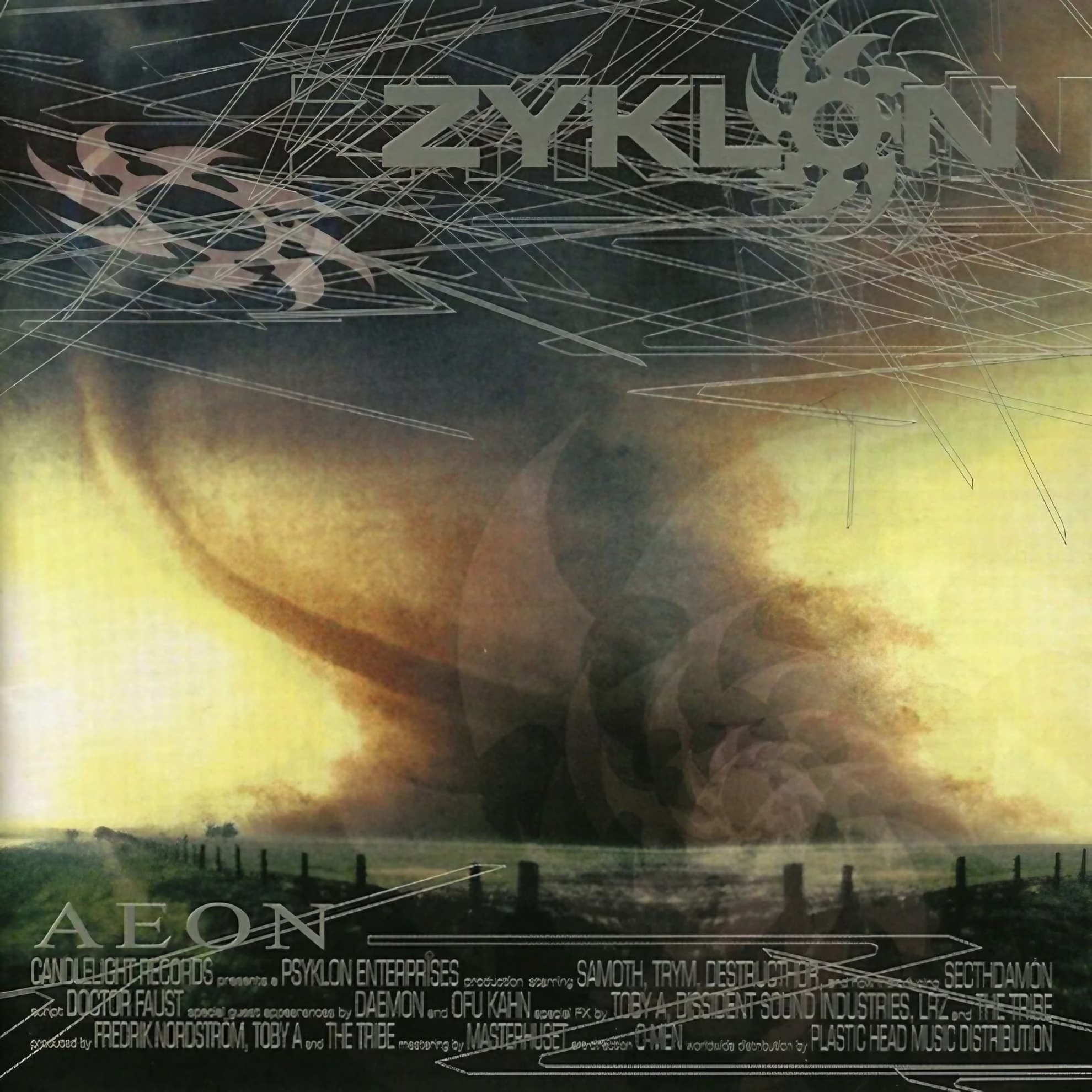
‘Aeon’’s cover is the visual identity’s most evidentially significant single artifact: its design is credited, in the album’s official release documentation, to Stephen O’Malley, working under the imprint of his own Ideologic Organ, a designer and musician whose own project, Sunn O))), operates at the far end of extreme music’s engagement with drone, minimalism, and post-industrial visual language.
O’Malley’s involvement is a specific, dated, and documented point of contact between Zyklon and a wider underground aesthetic economy built around exactly the machine-and-atmosphere sensibility the band’s music was pursuing — placing the album’s visual identity in direct, credited conversation with the same industrial-adjacent underground that supplied ‘Aeon’’s musical collaborators.
This is a visual identity built to reinforce the band’s technical argument rather than to decorate it: a tornado is, among natural phenomena, one of the few whose destructive force is inseparable from its mechanical, rotational regularity, and Zyklon’s cover art across three albums returns to that same image of ordered, patterned violence — the aesthetic equivalent of the credit-sheet decision to treat programming as a disciplined instrument rather than chaotic noise.
‘Disintegrate’ and the Third Trial
‘Disintegrate,’ recorded at Akkerhaugen Lydstudio in November and December of 2005 and released on the fifteenth of May, 2006, is Zyklon’s longest album at just over forty-five minutes and its most structurally settled: the lineup of Samoth, Trym Torson, Destructhor, and Secthdamon that had recorded ‘Aeon’ returns unchanged, and the record’s ten tracks extend rather than revise the machine-credited arrangement model the two previous albums had built.
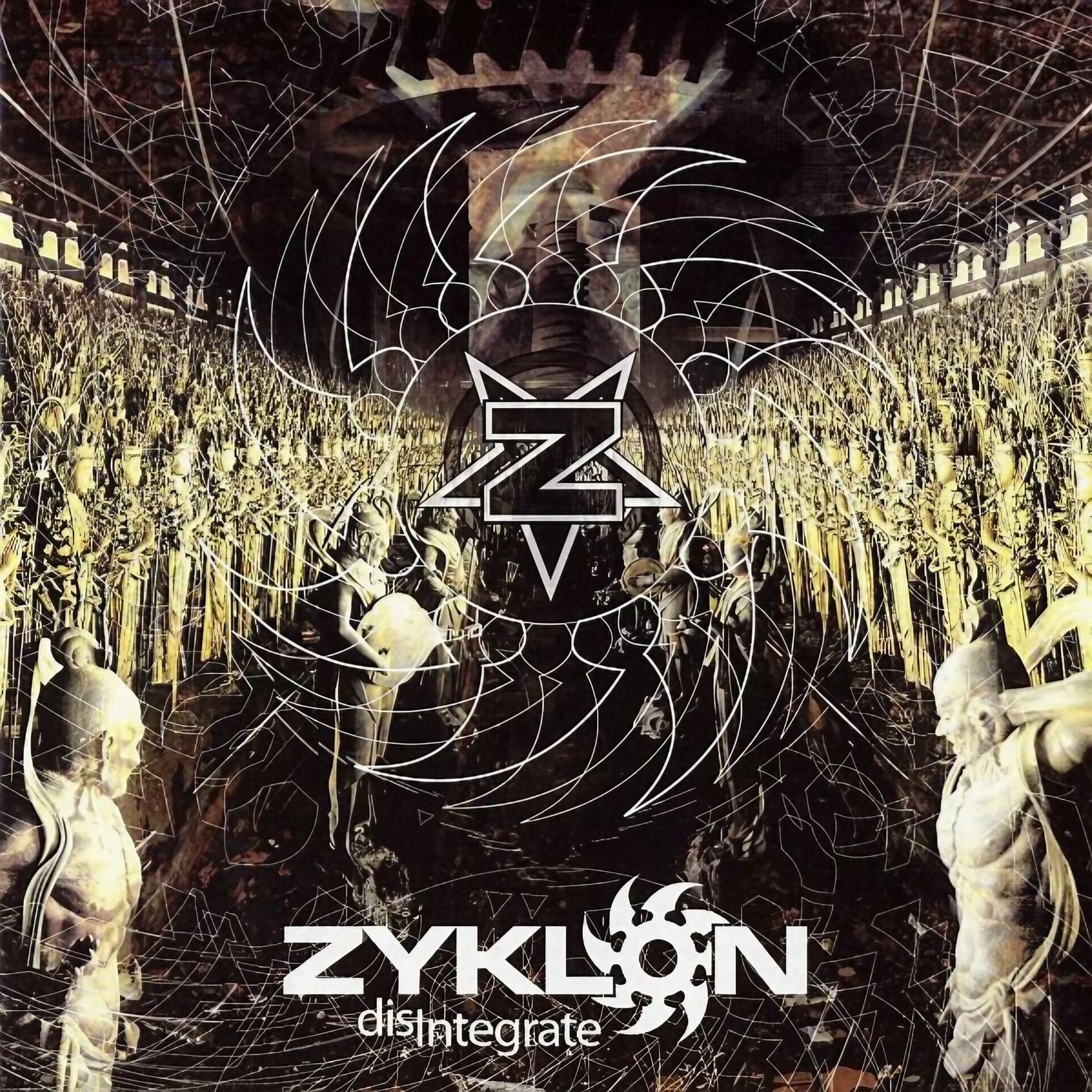
Where ‘Aeon’ had argued its premise through outside collaboration, ‘Disintegrate’ is the most self-contained of the three records, produced by the band alongside Thorbjørn Akkerhaugen and mixed at Studio Fredman by Patrik J. and Fredrik Nordström, with mastering handled by Peter In de Betou at Tailor Maid.
The album’s supporting release cycle included ‘Storm Detonation Live,’ a DVD issued through Candlelight in March of 2006 documenting a 2004 performance at Germany’s Party.San Open Air Festival, giving the band’s final studio statement a companion document of the live show built around the same three-album catalog.
Karl Spracklen, Caroline Lucas, and Mark Deeks have argued that extreme metal bands construct identity through heritage narratives that selectively organize a catalog’s internal logic after the fact, retroactively framing a discography’s evolution as a coherent arc rather than an accumulation of unrelated choices;6 ‘Disintegrate’ is the album that makes such a retrospective framing straightforward, since its closing position in the catalog, its unchanged lineup, and its consolidation rather than revision of the machine-credited model give the three-album run a legible beginning, middle, and end without requiring later reinterpretation to supply one.
Read against the two records that preceded it, ‘Disintegrate’ completes rather than extends Zyklon’s technical argument. It does not introduce a new variable the way ‘Aeon’ had introduced formal outside collaboration; it demonstrates that the model established across the first two albums could sustain a full-length record without further innovation, which is itself the strongest evidence that the band understood its own project as complete rather than as the opening statement of a longer career.
The Slow Shutdown in Tokyo
Zyklon played its final concert in Tokyo, Japan, on the twenty-eighth of September, 2007. The band entered what Encyclopaedia Metallum’s own archival record dates precisely as an official hold beginning on the twenty-second of October, 2007, a formal internal pause rather than an ambiguous drift into inactivity.
Samoth confirmed, in a statement issued to the press, that all four members remained musically active elsewhere during the break: Destructhor continuing to tour with Morbid Angel, the band he had joined that same year and would remain with until 2015; Destructhor and Secthdamon still intending to complete further work as Myrkskog; and Samoth himself already in the studio developing the material that would become his debut album as The Wretched End.
The formal end came more than two years later. On the seventh of January, 2010, Samoth issued a statement confirming that Zyklon was disbanding outright, framing the announcement explicitly as a matter of making formal what had already become functionally true rather than allowing the band to, in his own phrase, descend into nothingness without a clear closing statement.
As a final release, Candlelight Records issued ‘The Storm Manifesto,’ a box set compiling all three studio albums alongside additional material, giving the band’s catalog a single, deliberately assembled closing document rather than a posthumous best-of compiled without the band’s involvement.
The documented sequence — a final show, a dated formal hold, a two-year gap, and then an explicit closing statement paired with a compiled retrospective release — is unusually well recorded for a band of Zyklon’s commercial scale, and it supports treating the band’s ending not as an ambiguous fade but as a confirmed, sourced cessation consistent with the bounded-project reading advanced earlier in this piece. There is no contested account of Zyklon’s disbandment to weigh against Samoth’s statement; the record is uncommonly clean.
Where the Machine Model Resurfaced
Zyklon’s most immediately traceable line of influence runs through its own membership rather than through a broader cohort of imitators, and that fact is itself evidentially significant: Destructhor’s 2008 recruitment into Morbid Angel, one of death metal’s most institutionally established acts, carried the specific technical hybrid Zyklon had spent three albums developing directly into a band with no prior history of programmed machine elements as a formal instrumental credit, demonstrating that the model Zyklon had built was portable into an entirely different institutional context rather than idiosyncratic to the band that originated it.
Within extreme metal’s own critical apparatus, Zyklon has continued to function as a named coordinate rather than a forgotten catalog entry: reviewers assessing blackened death metal releases in the years after the band’s split have specifically invoked Zyklon, by name, as a reference point for the particular combination of technical death metal riffing and mechanized atmosphere the band pioneered, a pattern of citation that would not persist a decade and more after a band’s dissolution if the technical model itself had not remained legible and distinct enough to be worth naming.
At the level of academic theorization, Lukes’s 2013 argument that industrial black metal constitutes a coherent critical category, rather than a marginal curiosity, was written from inside the same decade during which Zyklon was actively recording and touring, and the band’s catalog belongs squarely within the practical corpus — bands treating machinic and industrial elements as structurally central rather than decorative — that made such a theorization possible in the first place.
Zyklon’s own visibility within that corpus remains modest relative to acts more frequently cited in the specialist literature, and this article does not claim otherwise; the honest influence map here is one of a working technical model, carried forward by the individual musicians who built it and legible as a named reference point in specialist criticism, rather than one of a band whose name recurs as a fixture of the peer-reviewed metal studies canon.
The Diaspora Zyklon Left Behind
Each of Zyklon’s four core members carried the band’s technical vocabulary into subsequent, individually documented projects rather than abandoning it at the point of dissolution.
Samoth’s debut album as The Wretched End, developed alongside Cosmocrator of Mindgrinder during the band’s own hiatus period, extended the deathrash and industrial-adjacent vocabulary Zyklon had built rather than returning to Emperor’s earlier symphonic black metal template; Samoth’s continued, occasional participation in Emperor’s live reunion performances in the years since has functioned as a separate, distinct thread from Zyklon’s own catalog, and the two should not be conflated.
Destructhor’s move into Morbid Angel, discussed above as the clearest single instance of the band’s technical model migrating into a new institutional context, ran alongside his continued work in Myrkskog with Secthdamon, the two picking up a collaboration that predated Zyklon itself and that survived the larger band’s closure intact.
Trym Torson’s post-Zyklon career has been the least publicly documented of the four, split between tattoo work and occasional guest and session appearances, including reported involvement in a project alongside former Emperor bandmate Ihsahn.
The catalog’s own afterlife has been managed with the same deliberateness that characterized the band’s closing statement: ‘The Storm Manifesto’ stood as the band’s sanctioned final word in 2010, and ‘World ov Worms’ received a further vinyl reissue through Candlelight and Spinefarm in 2017, keeping the debut album in print in physical format nearly two decades after its original release.
None of this constitutes a reactivation; Zyklon has issued no new recorded material and played no further live shows since its 2007 final performance, and its catalog’s afterlife has been strictly custodial rather than generative — precisely consistent with a band whose own founders had already declared, in 2010, that the project’s account was closed.
None of the four men who passed through Zyklon’s lineup have described the band, in any interview located during research for this piece, as an unfinished project or a casualty of circumstance rather than a deliberate choice. That absence of a competing narrative matters: bands that disband under external pressure — financial collapse, label disputes, unresolved internal conflict — typically generate at least one member’s dissenting account of what the group might otherwise have become.
Zyklon’s documented record contains no such account, which is itself a form of evidence for the closed-project reading advanced throughout this piece rather than a gap in the research.
The Cyclone That Did Not Return
Zyklon’s own name supplies the fairest verdict on its nine-year run: a cyclone is a bounded meteorological event with a beginning, a period of sustained and legible intensity, and a dissipation, not an ongoing weather system that persists indefinitely.
Read against that structure, the band’s three albums, unchanging core lineup, and unusually well-documented, deliberately staged closure describe a project that did precisely what it set out to do and then declined to manufacture a reason to continue. That restraint, more than any single riff or programmed passage, is the most disciplined thing about a catalog built on the idea that discipline, not chaos, was what the machine had to offer black metal in the first place.
For the audience tracing a path back from Morbid Angel’s later technicality or Samoth’s institutional legacy in Emperor, the question remains whether Zyklon’s profile shifts when its three-album run is situated as a finished, self-contained engineering project rather than a biographical bridge between two larger extreme metal histories.
References
- Daniel Lukes, ‘Black Metal Machine: Theorizing Industrial Black Metal,’ in ‘Helvete: A Journal of Black Metal Theory, Issue 1: Incipit’ (Brooklyn: Punctum Books, 2013), 87–111. ↩︎
- Michelle Phillipov, ‘Extreme Music for Extreme People? Norwegian Black Metal and Transcendent Violence,’ Popular Music History 6, no. 1 (2012): 150–163. ↩︎
- K. Hoffin, ‘The Norwegian Black Metal Second Wave,’ in ‘Music in Crime, Resistance, and Identity,’ ed. E. Peters (Abingdon: Routledge, 2023), 27–38. ↩︎
- Robert Walser, ‘Running with the Devil: Power, Gender, and Madness in Heavy Metal Music’ (Hanover: Wesleyan University Press, 1993), 108–112. ↩︎
- Deena Weinstein, ‘Heavy Metal: The Music and Its Culture,’ rev. ed. (Boston: Da Capo Press, 2000), 288–292. ↩︎
- Karl Spracklen, Caroline Lucas, and Mark Deeks, ‘The Construction of Heavy Metal Identity through Heritage Narratives: A Case Study of Extreme Metal Bands in the North of England,’ Popular Music and Society 37, no. 1 (2014): 48–64. ↩︎


Leave a Reply