


Lower Saxony offers little in the way of natural gothic atmosphere, a stretch of flat agricultural country better suited to wheat than to ritual. Yet for two days each August, a decommissioned airfield north-northwest of Hildesheim absorbs one of Europe’s largest gatherings of gothic rock, electronic body music, and industrial sound, drawing a crowd whose scale has nothing to do with the region’s own character and everything to do with 26 years of accumulated habit.
The festival that occupies Flugplatz Drispenstedt each summer began in 2000 and has grown into a fixture the scene now measures its own year against. Its 26th edition, running August 8th and 9th, 2026, arrives with a bill of nearly 40 confirmed acts spanning four decades of the genre’s documented history, from gothic rock’s founding generation to symphonic metal’s arena-scale present.
An Airfield Becomes a Stage
Wave-Gotik-Treffen, the Leipzig gathering held each Pentecost weekend, distributes its programming across roughly 50 of that city’s churches, theaters, and clubs, an arrangement that turns the holiday into a scavenger hunt for the committed. M’era Luna takes the opposite approach. The festival concentrates its entire program on one flat, open site, building its stages against a single hangar complex rather than scattering performances through a host city’s existing architecture.

That structural choice produces a specific kind of audience. The festival’s documented capacity of approximately 25,000 attendees fills the airfield with a density Wave-Gotik-Treffen’s dispersed venues do not attempt, and a crowd that camps for the weekend behaves less like a rotating series of niche gatherings than like one sustained congregation, an audience whose loyalty compounds edition over edition rather than resetting each year.1
The two festivals now function as the genre’s remaining large-scale outdoor poles, one historical and dispersed, the other concentrated and amplified, and M’era Luna’s 26 consecutive years on the same airfield argue that scale, not scattering, has been its own durable strategy.
The Weight of Thirty Years
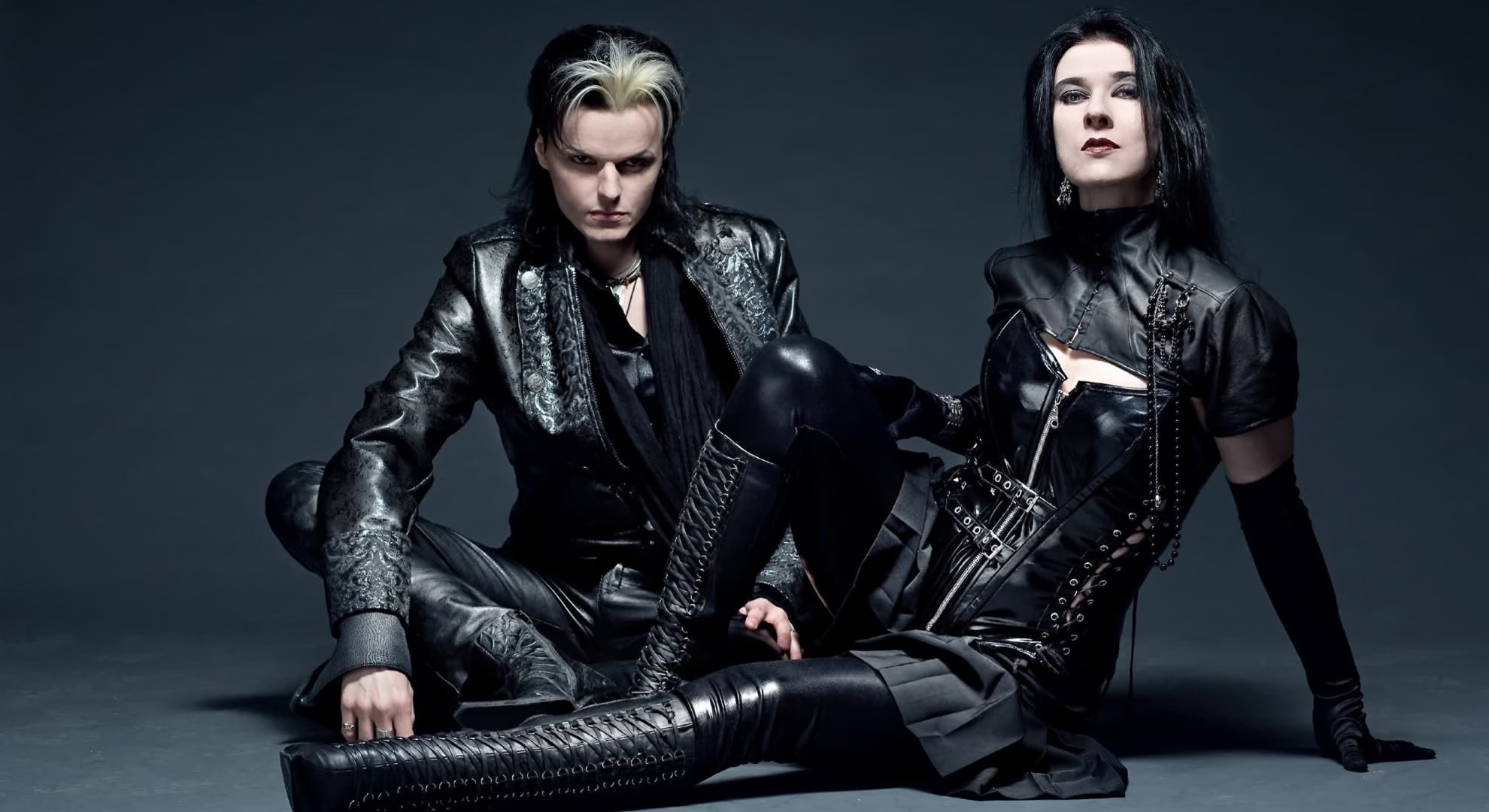
Lacrimosa, the duo of Tilo Wolff and Anne Nurmi founded in 1990, headlines a Sunday bill built around a sound that has no close equivalent elsewhere on the circuit: gothic rock’s minor-key vocabulary set against full orchestration and operatic vocal production, a combination the pair has sustained without significant stylistic reversal for three and a half decades.
Their standing as a recurring M’era Luna act across multiple editions places this booking inside a continuity rather than a rediscovery.
Within Temptation, the Dutch band fronted by Sharon den Adel, occupies the opposite pole of the same weekend. Where Lacrimosa’s orchestration serves an intimate, chamber-scaled register, Within Temptation’s symphonic metal was built for arena production from the outset, and its Saturday headline slot documents how thoroughly that arena-facing strand of the genre has folded into a festival whose origins sit closer to club-based EBM and industrial sound.
In Extremo’s booking completes the weekend’s range. The German medieval-rock band, built around electric bagpipes and hurdy-gurdy set against standard rock instrumentation, represents a folk-facing lineage with almost no overlap in instrumentation with either headliner, and its presence on the same bill as Lacrimosa and Within Temptation documents how wide a net M’era Luna now casts under a single festival identity.
Where the Bill Diversifies
Beneath the headline tier, the booking of Combichrist, the Norwegian-American aggrotech project fronted by Andy LaPlegua, keeps the festival’s harder EBM and industrial identity audible against a bill that otherwise leans toward orchestration and arena rock.
Combichrist’s confrontational tempo and industrial-club roots represent the strand of the genre M’era Luna was built on in 2000, a strand that has not disappeared from the program even as the festival’s headline tier has drifted toward more commercially legible sounds.2
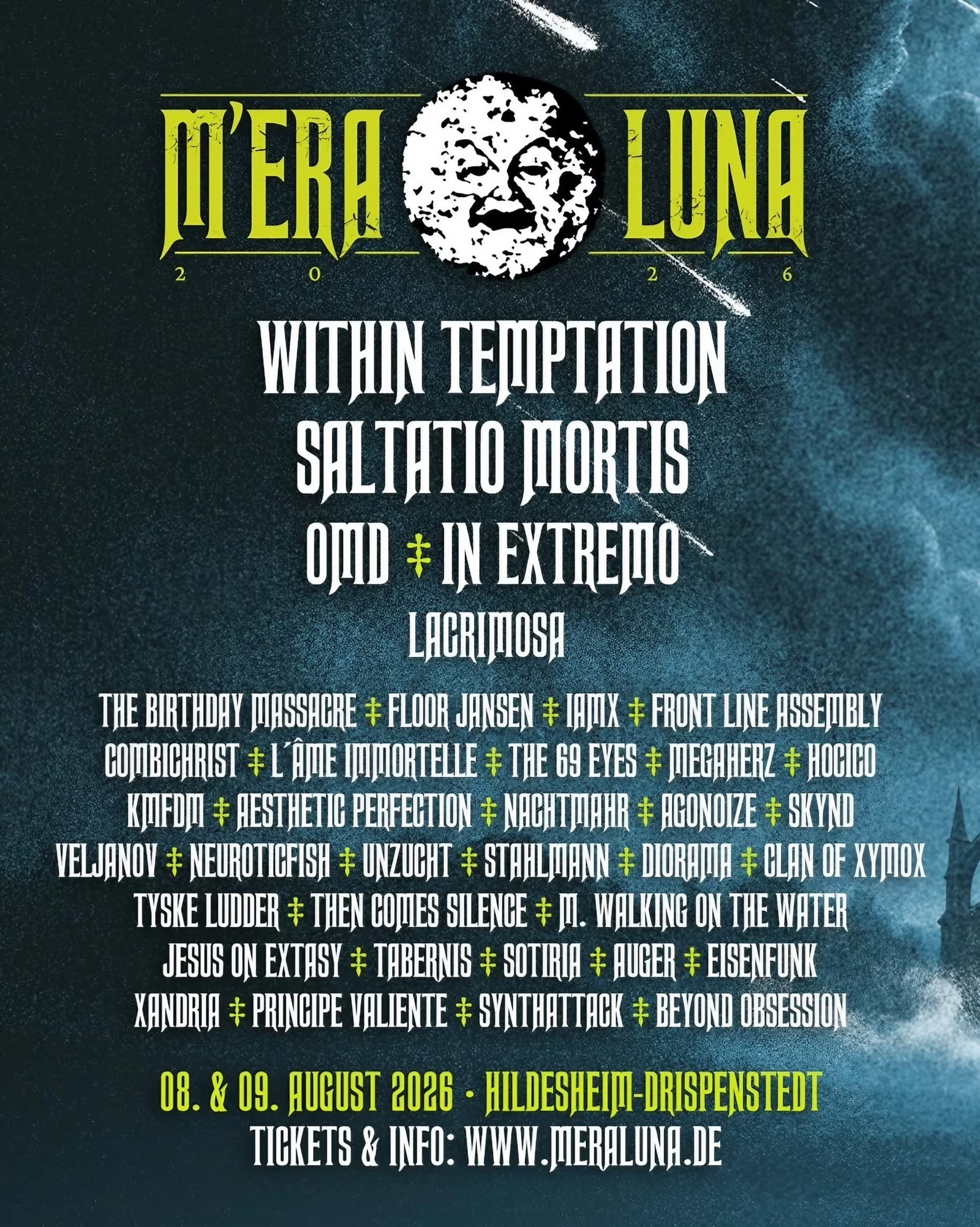
Floor Jansen’s appearance as a solo act, apart from her work fronting Nightwish, and Saltatio Mortis’s confirmed booking, a German medieval folk-rock band with no prior industrial or EBM lineage, both extend the festival’s reach further from its founding genre core than in past editions.
Clan of Xymox, active under various names since 1981, and IAMX, the electro-industrial project Chris Corner built after Sneaker Pimps, anchor the older post-punk and darker electronic ends of that same expanding bill.
Access at the Airfield
M’era Luna’s 2026 ticket structure runs across four named tiers priced in ascending order as the on-sale period advances, with on-site camping bundled into every tier rather than reserved for one.
The Neumond, or New Moon, tier opened at 139 euros (approx. COP 505,000), followed by the Halbmond, or Half Moon, tier at 149 euros (approx. COP 541,000), the Vollmond, or Full Moon, tier at 159 euros (approx. COP 577,000), and the Blutmond, or Blood Moon, tier at 169 euros (approx. COP 613,000). No campsite outside the festival’s own on-site camping exists near the airfield, a consequence of Flugplatz Drispenstedt’s position outside Hildesheim’s built-up center.
The First Gothic Stone
Hildesheim Cathedral’s cloister, on the eastern edge of the city center, encircles a burial ground known as St. Anne’s Cemetery, where grave monuments date to the early medieval period and document the working lives of the cathedral’s canons and stonemasons across nearly a millennium.
At the center of that cloister courtyard stands St. Anne’s Chapel, built in 1321 and documented as the first purely Gothic structure raised in Hildesheim, its pointed arches marking a deliberate departure from the Romanesque forms of the cathedral surrounding it.
The chapel’s relationship to the festival across the city is one of vocabulary rather than proximity. Gothic rock borrowed its name and its visual grammar from precisely this architectural break, the same turn toward verticality, shadow, and pointed form that separates St. Anne’s Chapel from the Romanesque nave it sits beside.
Reaching the cathedral cloister from Flugplatz Drispenstedt requires a short trip into Hildesheim’s historic center, well within a single afternoon between festival sets.
A Field That Keeps Returning
What holds M’era Luna together across 26 editions is not stylistic narrowness but the opposite: a bill wide enough to seat Lacrimosa’s chamber gothic beside Within Temptation’s arena symphonics and Combichrist’s aggrotech without any one of them reading as the odd booking out.
The airfield south of Hildesheim has no gothic history of its own to draw on, and none of that has mattered. Twenty-six years of returning crowds have supplied the atmosphere the site itself never offered.
Whether that expanding range strengthens the festival’s identity or dilutes the industrial and EBM core it was founded on remains an open question the 2026 lineup does not settle on its own.
As M’era Luna’s bill continues to widen beyond its EBM and industrial origins toward orchestral and folk-adjacent acts, does that expansion strengthen the festival’s standing as a genre institution, or does it risk loosening the identity that first distinguished it from the broader festival circuit?
Tourism Partnership
We reach an audience that travels with intention — drawn to documented history, dark heritage, and the cultural weight of the places they seek out. If you operate tours, cultural experiences, accommodation, or heritage sites aligned with that ethos, we would like to hear from you. We consider partnerships with tour operators, travel agencies, hostels, hotels, museums, and any organization whose work engages seriously with dark tourism, gothic culture, or historical travel. We do not promote services we cannot stand behind editorially. Reach us through our Contact page.
References
- Paul Hodkinson, ‘Goth: Identity, Style and Subculture’ (Oxford: Berg, 2002), 45–49. ↩︎
- Michael Bibby and Lauren M. E. Goodlad, eds., ‘Goth: Undead Subculture’ (Durham: Duke University Press, 2007), 112–116. ↩︎

Leave a Reply