


A fluid slipdress cut on Edwardian lines, a hussar jacket, a pinstriped waistcoat hung with a watch chain, and references to John Steinbeck’s ‘East of Eden’ spelled out in embroidery: these were the garments with which Ann Demeulemeester signaled, in its Resort 2027 lineup, the period in which its next Paris runway is set.
Creative director Stefano Gallici conceived that pre-collection alongside the Spring/Summer 2027 show as a single narrative, one that moves the house out of the Victorian register of his recent seasons and into the opening decades of the twentieth century. For a label whose authority rests on black cloth, asymmetric drape, and literary citation, a change of century is a change of argument.
Ann Demeulemeester stepped back from her label in 2013, and the formal grammar she left behind, made of androgyny, verticality, black set against ivory, and text carried directly on cloth, has since passed through three creative directors. Gallici, who has held the post since 2023, inherited that grammar less as a house style than as a liturgy: a fixed order of forms that produces meaning through repetition.
Each of his seasons asks if that liturgy still carries weight without the person who composed it, or if it has hardened into costume. The runway on October 3rd, 2026, puts the question in its sharpest form yet.
A Wardrobe Leaves Mourning
No show notes have been released ahead of the Paris date. Gallici designed Resort 2027 as the prelude to the runway, and its references fix the setting in the early twentieth century: Steinbeck’s 1952 novel and Elia Kazan’s 1955 film adaptation starring James Dean, the aviator Amelia Earhart, and the dress of the Edwardian decades.
The choice of period carries historical weight. The elaborate system of Victorian mourning, with its prescribed fabrics, its graded stages of full and half mourning, and its social penalties for deviation, began to lose its hold in the early twentieth century and weakened further around the First World War.1 The Edwardian decades mark the point at which mourning black began its passage from obligation toward choice.
That passage is the house’s own history in miniature. Demeulemeester’s black never mourned a specific death; it borrowed the apparatus of grief, its severity and its veiling sheer layers, and wore it as a condition of sensibility. By moving the house into the decades when mourning dress ceased to be an instruction, Gallici makes explicit what the founder’s black always was: a chosen form of grief, detached from any particular loss.
The literary source sharpens the point. Steinbeck’s novel, set in California’s Salinas Valley between the turn of the century and the First World War, retells the story of Cain and Abel across two generations and turns on the Hebrew word timshel, which the book renders as “thou mayest”: the inherited curse is real, but the son is free to answer it. For a designer who has spent three years working inside another person’s name, the reference functions less as period color than as a statement of method. The inheritance is accepted; the answer to it is his own.
Earhart adds a second register. The aviator vanished over the Pacific in 1937 and was never found, which made her one of the century’s most famous losses without a body. She brought aviator jackets into the lineup, but the figure matters more than the garment: a woman in trousers and leather, dressed for a profession then coded as masculine, whose absence was never resolved into a grave. The house has dressed that kind of figure since 1985.
Rules Written in Antwerp
The rules Gallici inherited were written by a designer born Ann Verhelst in Waregem, Belgium, in 1959. She studied fashion at the Royal Academy of Fine Arts in Antwerp from 1978 to 1981 and founded her label in 1985 with her husband, the photographer Patrick Robyn.
She belonged to the cohort of Antwerp graduates later known as the Antwerp Six, alongside Dries Van Noten and Walter Van Beirendonck, and began showing in Paris in 1992.

Her sources were literary and musical before they were sartorial, from the poetry of Arthur Rimbaud to the songs of Patti Smith and PJ Harvey.
In her introduction to the designer’s 2014 monograph, Smith recalled that the teenage Demeulemeester fixed on the white shirt Smith wore on the cover of ‘Horses,’ her 1975 debut album, photographed by Robert Mapplethorpe. The designer later sent Smith white shirts tied with a black ribbon, a gesture that set the terms for decades of work: a masculine shirt, a trace of mourning, and a poet as the intended wearer.
The friendship became a collaboration. For Spring/Summer 2000, the designer named a collection ‘Woolgathering’ after Smith’s 1992 book of prose poems and embroidered excerpts from Smith’s writing onto sheer tulle layered over sharply tailored pieces. During the presentation of Autumn/Winter 2006–07, Smith walked the runway. The text on the tulle and the poet on the catwalk established the house’s most durable rule: literature was not a reference board but material carried on the body.
The formal rules were specific. The designer played against gravity through drapery, set loose ribbons and belts against closely fitted jackets, and cut asymmetric lines that made clothes appear to move while standing still. The feather, which recurred across her collections, stood for the sensitivity she paired with strength.
She stepped back in 2013. Sébastien Meunier, who had designed the men’s collections, led the house until July 2020, after which an in-house team designed it until Ludovic de Saint Sernin presented a single collection in March 2023. Gallici, born in 1996 in Teor, Italy, assisted Haider Ackermann in Antwerp before joining the house as menswear designer; he was promoted in 2023 and showed his first runway collection, Spring/Summer 2024, that autumn. For Fall/Winter 2026 he returned the show to the Couvent des Cordeliers, the founder’s Paris venue for years.
Slimmer Lines, Softer Black
The most consequential change in the prelude is the cut. Gallici moved away from the slouchy tailoring the house has long been known for and toward slimmer fits with subtle flared proportions. Slouch, in the founder’s system, was the posture of exhaustion, the body giving way to the weight of cloth. A slimmer line with a flare at the hem trades that collapse for verticality, and Gallici’s pinstriped double-breasted suits, chained waistcoats, and buttoned skirts take their proportions from Edwardian tailoring rather than from the archive. The question is if vulnerability survives once the body stops sagging into its clothes.

The slipdress carries the opposite charge. Cut in fluid satins and chiffons, it descends from an undergarment, and its presence on a runway always stages a small exposure: the layer closest to the skin worn as the outermost. The founder used sheer tulle to comparable ends in ‘Woolgathering,’ but laid it over tailoring. Gallici removes the tailoring beneath and lets the soft layer stand alone.
Against that softness, the prelude set hussar jackets, with the horizontal braiding across the chest that light cavalry wore through the nineteenth century. The cavalry uniform is the dress of an order the First World War was about to bury. A slipdress beside a hussar jacket sets intimacy next to the uniform of a world on the edge of mass mourning.
The palette confirms the move away from total black. Alongside the signature black, ivory, and chalk, the prelude introduced brown in leather jackets and suits and a powder pink in floral devoré shirts and sheer frocks. Devoré is the telling technique. A chemical paste dissolves one fiber of a blended cloth, and the pattern emerges from what is removed: opaque flowers left standing on a ground worn through to transparency. It is ornament produced by erosion. The memento mori survives the loss of black.
The embroidered references to ‘East of Eden’ continue the founder’s practice of placing text on cloth, with one difference. Smith was a living collaborator whose words the founder carried; Steinbeck is a borrowed author. The runway will reveal if the house’s literary citation still works as dialogue or has become a quotation drawn from a library.
Mourning Codes and Their Heirs
Caroline Evans identified in the experimental fashion of the 1990s, much of it from London and Antwerp, a sustained preoccupation with death, trauma, alienation, and decay.2 The founder’s work shared that preoccupation but did not stage the wound or the ruined body. Her collections dressed the survivor: the figure who has already lost something and wears the loss as posture, color, and cut.
Valerie Steele and Jennifer Park traced the endurance of gothic style in fashion to its fusion of the imagery of death with glamour and erotic allure.3 The founder’s designs appeared in the Museum at FIT exhibition the book accompanied. The house’s particular contribution was to make the erotic charge androgynous: the mourner in a man’s shirt and a long black coat, desirable because withheld.
Catherine Spooner argued that the Gothic has consistently expressed itself through clothing and surface, with the past returning as something put on the body rather than simply remembered.4 Every Ann Demeulemeester collection since 2013 has been a Gothic operation in this sense: the founder’s past returned as garments on other designers’ runways. The danger is that a past which is only worn becomes a disguise.
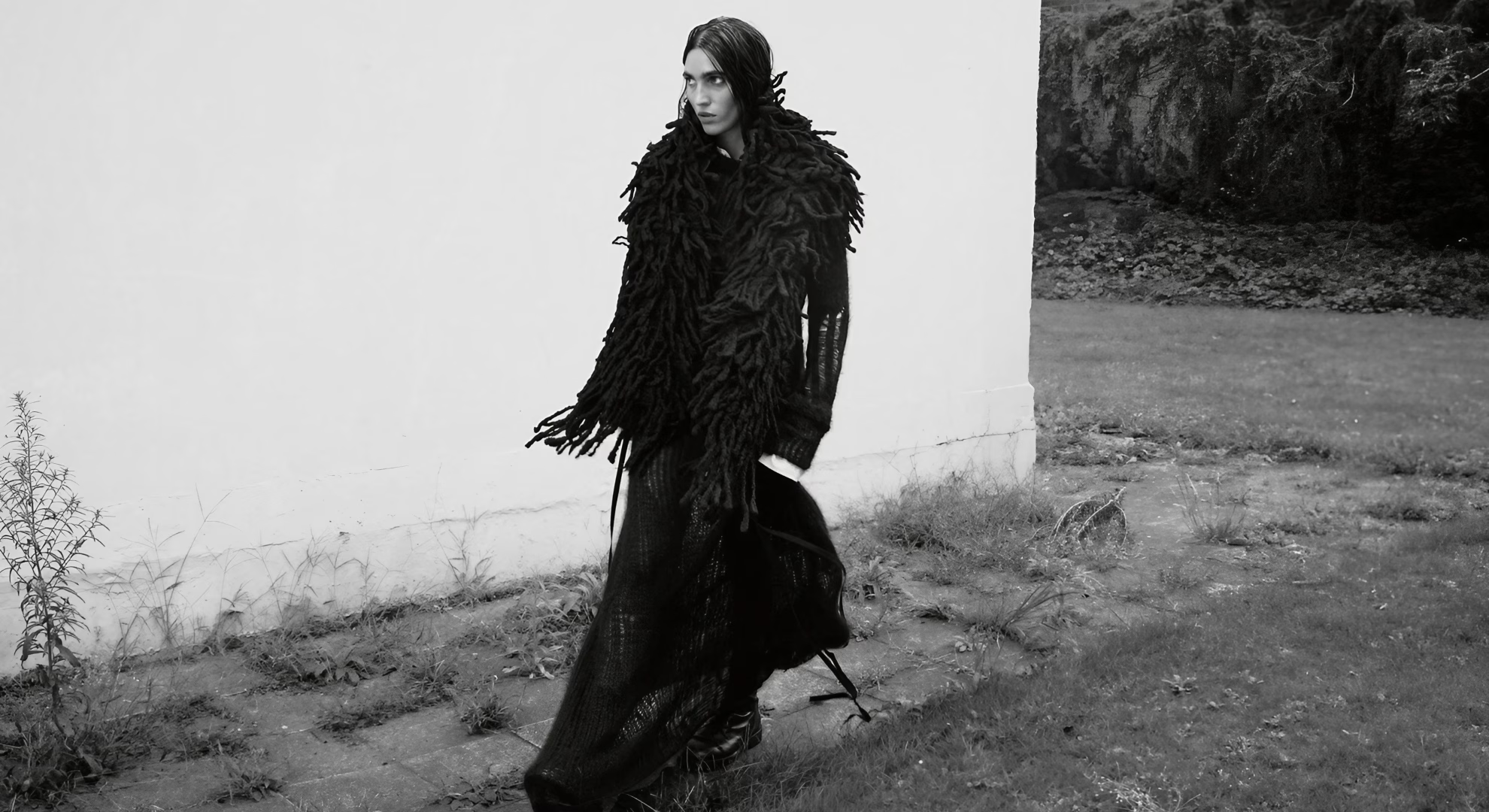
Mourning codes, in this line, function as a liturgy functions. A liturgy, however, depends on belief in what it commemorates. The founder believed in the poets she dressed, and her collections were addressed to Smith, to Rimbaud, and to a tradition of Romantic and Symbolist defiance. A successor who repeats the forms without that address produces ritual without a congregation.
The move into the early twentieth century is Gallici’s answer to that problem. By setting the liturgy in the decades when prescribed mourning dissolved, he places the house’s codes in the historical moment when they stopped being rules and became choices. The relocation concedes what a successor cannot claim, the founder’s authority, and offers what a successor can: a reason to keep choosing the forms.
Earlier that Saturday, Noir Kei Ninomiya and Comme des Garçons present black from the Tokyo avant-garde under their founders; Ann Demeulemeester closes the sequence with a founder’s codes carried entirely by another hand.
The Third of October in Paris
Ann Demeulemeester presents its Spring/Summer 2027 womenswear collection on Saturday, October 3rd, 2026, at 6:30 p.m. in Paris, on the official Paris Fashion Week calendar of the Fédération de la Haute Couture et de la Mode.
The womenswear week runs from September 28th to October 6th, 2026. The venue had not been publicly confirmed at the time of writing. It is Gallici’s seventh runway collection for the house.
A Liturgy Without Its Author
The founder’s rules were never neutral. They were the grammar of a sensibility addressed to specific poets, and for more than a decade the house has had to prove they could outlive the person who meant them. Spring/Summer 2027 attempts the proof by changing the ground beneath them, keeping the forms and moving them into a period in which black was chosen rather than assigned.
The collection succeeds if the slimmer cut, the lighter palette, and the borrowed authors still produce the house’s tension between strength and exposure. It fails if the Edwardian setting only supplies new props for an old ritual, with hussar braid and watch chains standing where feeling once stood. The difference will be visible in the cloth: in how the slipdresses move, and in how much the devoré leaves unerased.
A house founded on mourning has become, by its own history, a house in mourning for its founder. On October 3rd, it tests if that second grief can be worn as honestly as the first.
Can a design language grown from one designer’s private poetics remain a genuine memento mori once it passes to a successor, or does every inherited liturgy eventually become costume, however carefully it is worn?
References
- Lou Taylor, ‘Mourning Dress: A Costume and Social History’ (London: George Allen and Unwin, 1983), 266–273. ↩︎
- Caroline Evans, ‘Fashion at the Edge: Spectacle, Modernity and Deathliness’ (New Haven: Yale University Press, 2003), 4–9. ↩︎
- Valerie Steele and Jennifer Park, ‘Gothic: Dark Glamour’ (New Haven: Yale University Press, 2008), 1–8. ↩︎
- Catherine Spooner, ‘Fashioning Gothic Bodies’ (Manchester: Manchester University Press, 2004), 1–7. ↩︎




Leave a Reply