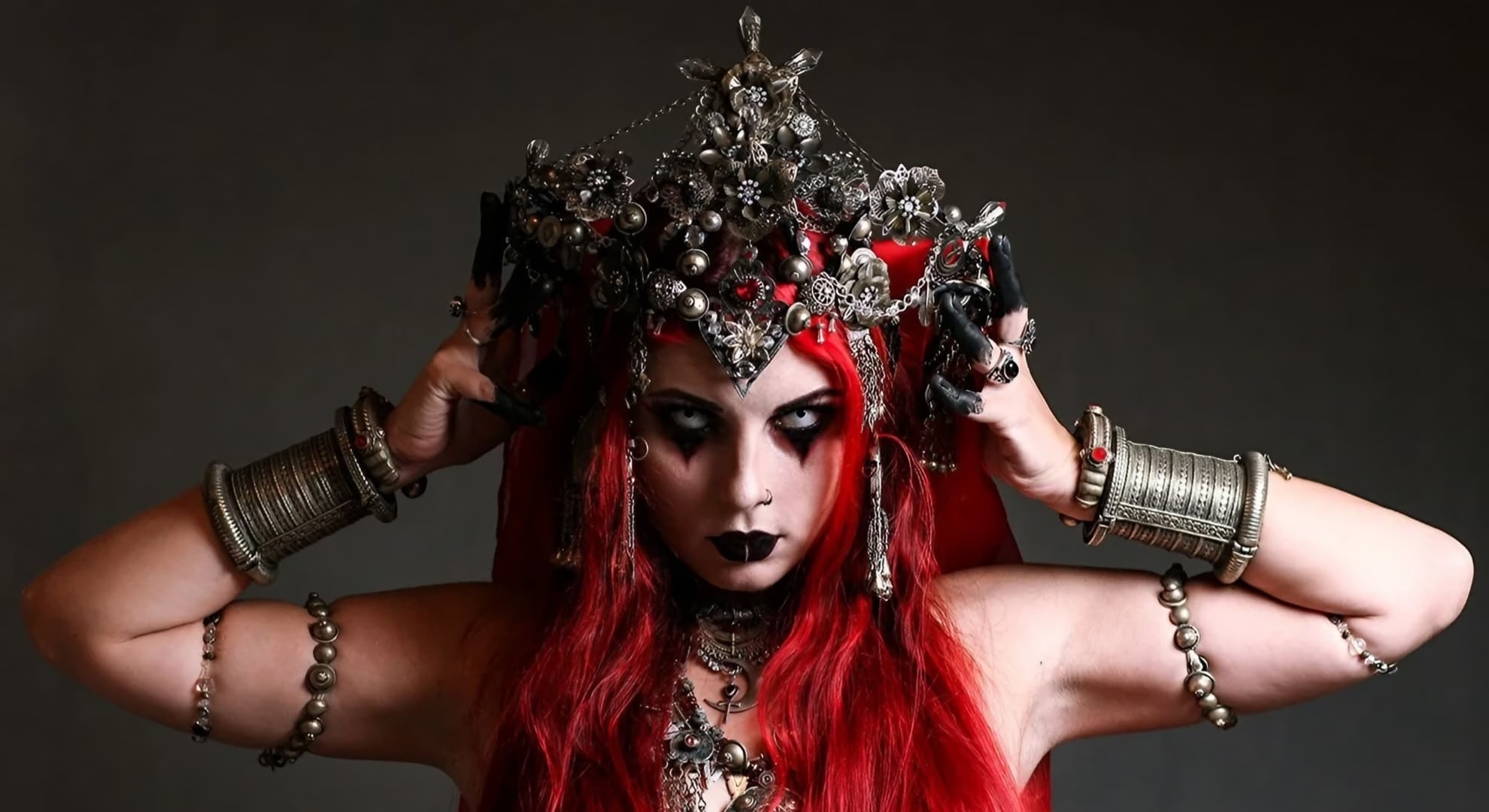


Gothic fusion belly dance did not descend from Cairo cabaret floors or Bedouin communal circles, whatever its borrowed hip drops and shimmies might suggest. It grew instead out of American Tribal Style’s late-twentieth-century laboratories in the San Francisco Bay Area, where dancers including Jill Parker and Rachel Brice split the improvisational vocabulary Jamila Salimpour built for her troupe Bal Anat into individualized, theatrical solo work, and where a further branch, Dark Fusion, developed by Ariellah Aflalo, pushed that vocabulary toward goth clubs, industrial soundtracks, and horror imagery.
Leicester’s Gothla UK, opening its twentieth edition on July 10th, 2026, sits inside that specific lineage, and its 2026 programme argues for a discipline that has moved past its subcultural novelty phase into something closer to a codified performance craft.
A Lineage Distinct From Cabaret
American Tribal Style began in 1968, when Jamila Salimpour founded the troupe Bal Anat around Algerian water-glass work, sword dance, and Tunisian pot dance, organized as a composite vocabulary rather than a single inherited form.
Tribal Fusion split from that base in the late 1990s and early 2000s, keeping the improvisational structure but opening the door to hip-hop, flamenco, and Indian classical influence; Jill Parker’s troupe Ultra Gypsy and Rachel Brice’s solo work established the sharp isolations and serpentine undulations later dancers treat as foundational technique.
Dark Fusion occupies the territory between Tribal Fusion and gothic belly dance proper, a position formalized by Ariellah Aflalo and treated by dancers and scholars as its own named branch. Gothic belly dance itself, sometimes catalogued as Gothic Tribal Fusion, emerged separately in the United States during the 1990s as dancers already embedded in goth subculture adapted tribal vocabulary to industrial and gothic rock music, corsetry, and darker theatrical staging.
The result is a discipline with two entry points, tribal technique moving toward darkness and goth performance culture moving toward dance, that converge without fully merging.
Academic attention to this convergence remains thin, which is itself a documented feature of the field. Melissa Dearey’s 2014 study in Dance, Movement and Spiritualities, built from six weeks of participant observation at workshops in the north of England, names gothic fusion belly dance the least studied style within belly dance scholarship, and uses Julia Kristeva’s writing on horror and the monstrous feminine to read the form’s staged darkness as a negotiation of difficult experience rather than ornamental menace.1
The discipline’s name has shifted from tribal fusion to dark fusion to gothic fusion, tracking a lineage of named practitioners rather than one evolving style.
Improvisational Tribal Style, the third technical strand inside this lineage, developed independently under Amy Sigil, who combined a team-based improvisational ethos with hula and hip-hop influence and positioned ITS as a sibling discipline to Tribal Fusion rather than a subset of it.
Gothla UK’s 2026 programme draws on all three branches, tribal-descended technique, dark fusion staging, and ITS improvisation, without treating any one as the house style.
Two Decades in Leicester
Gothla UK first ran in Leicester in June 2007 and has held its ground there for two decades, expanding into a weekend spanning three sites: the International Arts Centre on Garden Street for daytime workshops, The Y Theatre on East Street for the Friday night show, and the 2Funky Lounge on New Park Street for Saturday’s Open Stage.
Twenty consecutive years in one city, without relocating to a larger capital circuit, is itself a statement about where the festival believes its community actually lives.
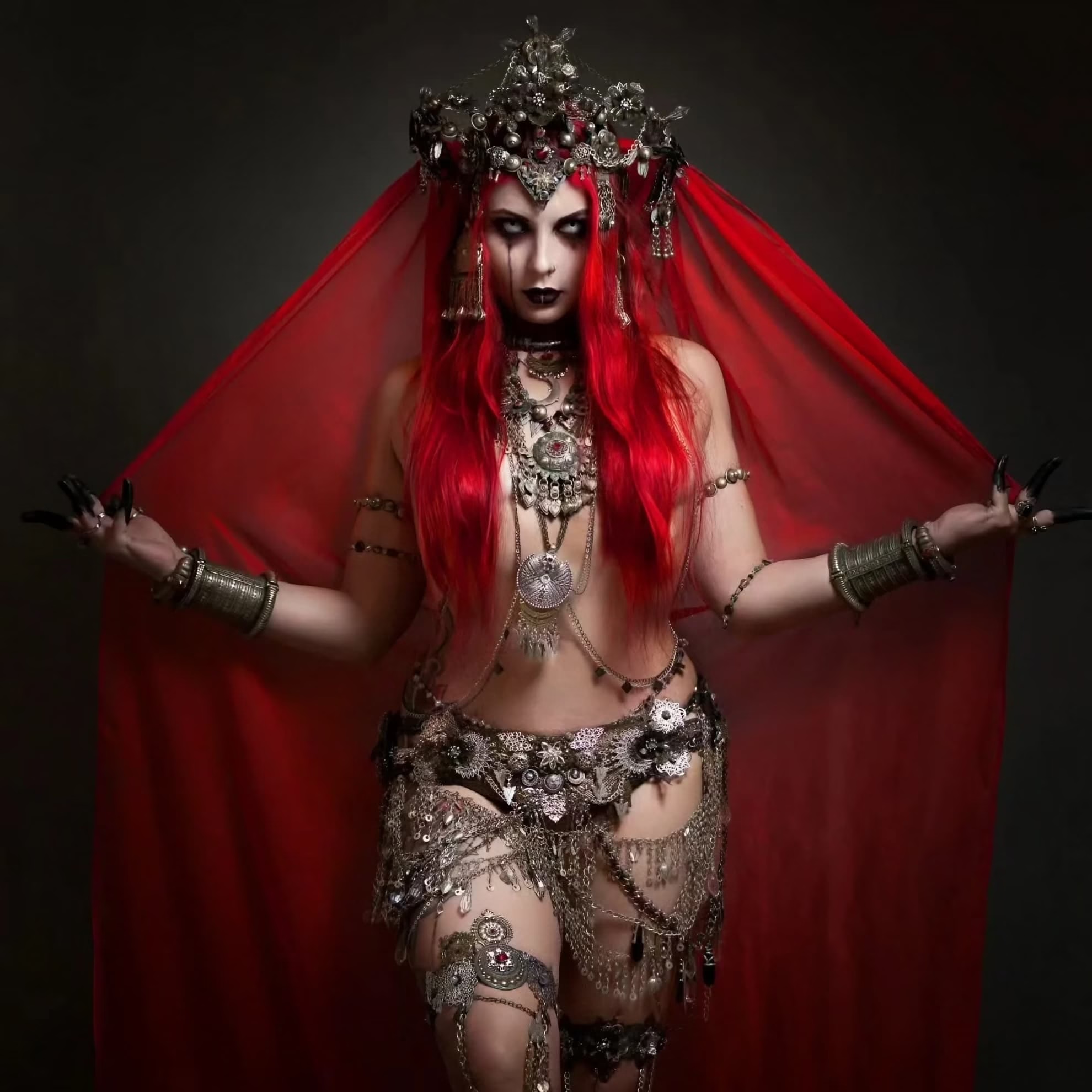
The 2026 roster reads less like a guest list than an index of the discipline’s named technical branches. Doe Demure teaches through her Glamour Ghoul School, developing this year’s Friday theatre piece, set to Meg Myers’ ‘Desire,’ around burlesque-fusion vocabulary and Elvira-referencing tassel work. Ida Mahin contributes a cyberpunk-inflected Open Stage showback, Gods of Chrome and Neon, and a Sunday session built around her own signature stylization.
Ethel AnimA teaches her own AnimA technique across the weekend, moving from layered emotional texture toward sword work and stage presence. Akasha runs Amy Sigil’s ITS format directly, treating her sessions as continuations of Sigil’s improvisational team-sync structure rather than adaptations of it.
Morgana, credited on the programme as one of the original pioneers of dark fusion and mythic dance, teaches Lotus and Dragon, an Eastern-inspired sequence incorporating Qi Gong Dance, before closing the weekend with Runes, a masterclass built around a named internal framework the programme calls Witch’s Anatomy, five symbolic systems intended to build a dancer’s stage interconnectivity and improvisational instinct.
Leanne Lucelia and Melissae round out the roster teaching, respectively, Belladonna Boheme’s Boho Blade Style and Melissae’s own Boho Skirt Style, two further named technique systems imported wholesale into the schedule.
None of these instructors is booked as a generalist. Each brings a specific, named, previously developed system, and the festival’s role is to host those systems in conversation with one another over a single weekend rather than to generate new material from scratch. That curatorial choice is evidence of how the wider discipline currently organizes authority, through named, transmissible technique lineages rather than a single central school.
Workshops as an Ongoing Argument
The weekend’s internal sequence argues that technique and performance are not separable strands. Friday pairs two performance intensives, Doe Demure’s burlesque-fusion piece and Ida Mahin’s layering-focused class, directly against the evening’s staged theatre show at The Y Theatre, so dancers learn material with a specific public performance already attached rather than banking technique for undefined future use.
Saturday multiplies that logic across five parallel workshops, from Leanne Lucelia’s sword-based Slay Your Shadows to Akasha’s ITS Flash Flock, each with an explicit route onto that night’s Open Stage at the 2Funky Lounge.
Sunday inverts the structure. Rather than adding new performance material, the day’s sessions, Ida Mahin’s Signature Moves, Melissae’s Shape Shifter skirt work, and Morgana’s Runes masterclass, are pitched at refinement, improvisation, and internal technique rather than a fresh showback. A festival that wanted only to fill a stage could have kept adding performance material through Sunday; instead, Gothla UK’s programme closes by turning inward, treating the weekend’s final day as consolidation rather than culmination.
That structure, intensive-into-show on Friday, workshop-into-open-stage on Saturday, refinement without performance pressure on Sunday, reads as an argument about what a mature gothic fusion belly dance gathering is for. It is not simply a venue for booking established names to perform, nor purely an instructional weekend divorced from staged work.
The programme treats technique acquisition and public performance as continuous, with Sunday functioning as the space where dancers process the weekend’s material without an immediate audience.
Dates, Venues, and Booking
Gothla UK’s twentieth edition runs July 10th to 12th, 2026, in Leicester, United Kingdom, across three confirmed venues: the International Arts Centre on Garden Street, The Y Theatre on East Street, and the 2Funky Lounge on New Park Street.
Tickets and the current schedule of available workshop and show combinations are listed on the festival’s official Tito booking page, described by organizers as the most current source for availability. Ticket pricing was not published in fixed form at the time of writing; the Tito listing reflects live availability rather than a posted flat rate, and attendees are directed to check current pricing directly on that platform before booking.
Dancers interested in performing on Saturday’s Open Stage register through a separate application form linked from the festival’s own site. Accessibility and other administrative queries go directly to the Gothla UK team by email, and the festival’s refund policy covers cancellation, relocation, or rescheduling by the organizers only, not change of mind or third-party purchases.
A Discipline No Longer Emerging
Twenty years in one mid-sized city, without a move to London or a rebrand toward a broader alternative-dance banner, has let Gothla UK hold onto something festivals chasing scale often lose: a roster built from named, traceable technique lineages rather than interchangeable performers.
Ariellah’s dark fusion, Amy Sigil’s ITS, Morgana’s mythic and Witch’s Anatomy framework, Belladonna Boheme’s Boho Blade Style, Melissae’s Boho Skirt Style, and Ethel AnimA’s own technique all arrive at the 2026 programme as distinct, attributable systems rather than a single house style diluted across instructors. A discipline whose scholarly literature is still counted in single studies has nonetheless built a structure in Leicester sturdy enough to hold that many named lineages in one weekend.
As gothic fusion belly dance’s technical branches continue to multiply, each carrying its own named originator, its own internal vocabulary, and its own transmission lineage, at what point does a subculture’s depth of documented technique begin to outpace the number of dancers who can move fluently between all of its named systems?
- Melissa Dearey, ‘‘Dark am I, yet lovely’: Tracing Diabolical Evil and Femininities in Gothic Fusion Tribal Belly Dance,’ Dance, Movement and Spiritualities 1, no. 3 (2014): 373–391. ↩︎


Leave a Reply