

The imagined North of atmospheric black metal — its frozen forests, its wind-scoured peaks, its winters without end — has never required its makers to live inside it. The genre trades in a wilderness of the mind, a terrain drawn from folklore and longing rather than latitude. That gap between a music and its setting is rarely as wide as it is for a band whose northern imagery is written at the bottom of the world.
Sojourner have spent more than a decade making Scandinavian-facing atmospheric metal from Dunedin, a New Zealand city nearer to Antarctica than to any fjord.
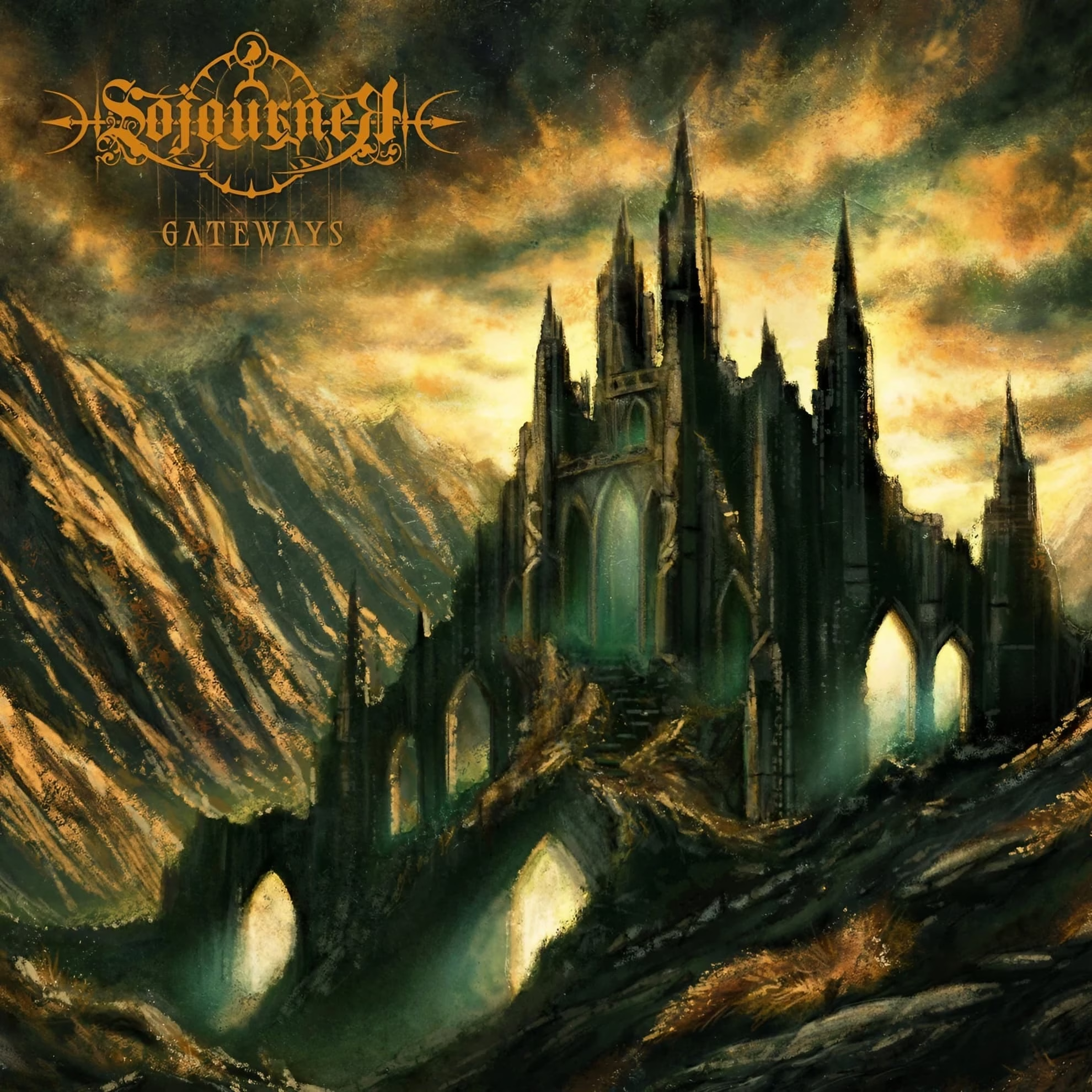
‘Gateways,’ the fourth Sojourner album, arrives July 10th, 2026, on the Italian label Avantgarde Music, after six years without a full-length. It reaches an underground that has learned to seek such records out rather than wait for them to surface.
A Silence Six Years Deep
The band’s third album, ‘Premonitions,’ appeared in May 2020 through Napalm Records, at the least opportune moment imaginable for a record made to be toured. What followed was less a hiatus than a scattering.
Mike Lamb, the guitarist who writes all of Sojourner’s music, has described the collapse without ornament. A 2019 European tour with Draconian and Harakiri for the Sky had gone well, but his Scottish visa expired, he returned to New Zealand, and years of focusing on a single project left him depleted.
He relocated to Sweden, then moved between Sweden, New Zealand, and Germany, before settling once more in Dunedin. In the interim he turned to other work, including the cosmic doom of Remina and the gothic doom of Light Field Reverie, both made with Heike Langhans.
The restart, when it arrived, was intentional rather than nostalgic. Lamb has said the aim was for Sojourner in 2026 to represent “who we are as people and musicians now rather than a sort of soulless facsimile of what we did before.”
Emilio Crespo, the vocalist who has stood beside Lamb since the band formed in 2014, framed his own share of the silence in domestic terms. “The biggest change for me was becoming a father which limited my time greatly,” he said.
The Voice That Completed It
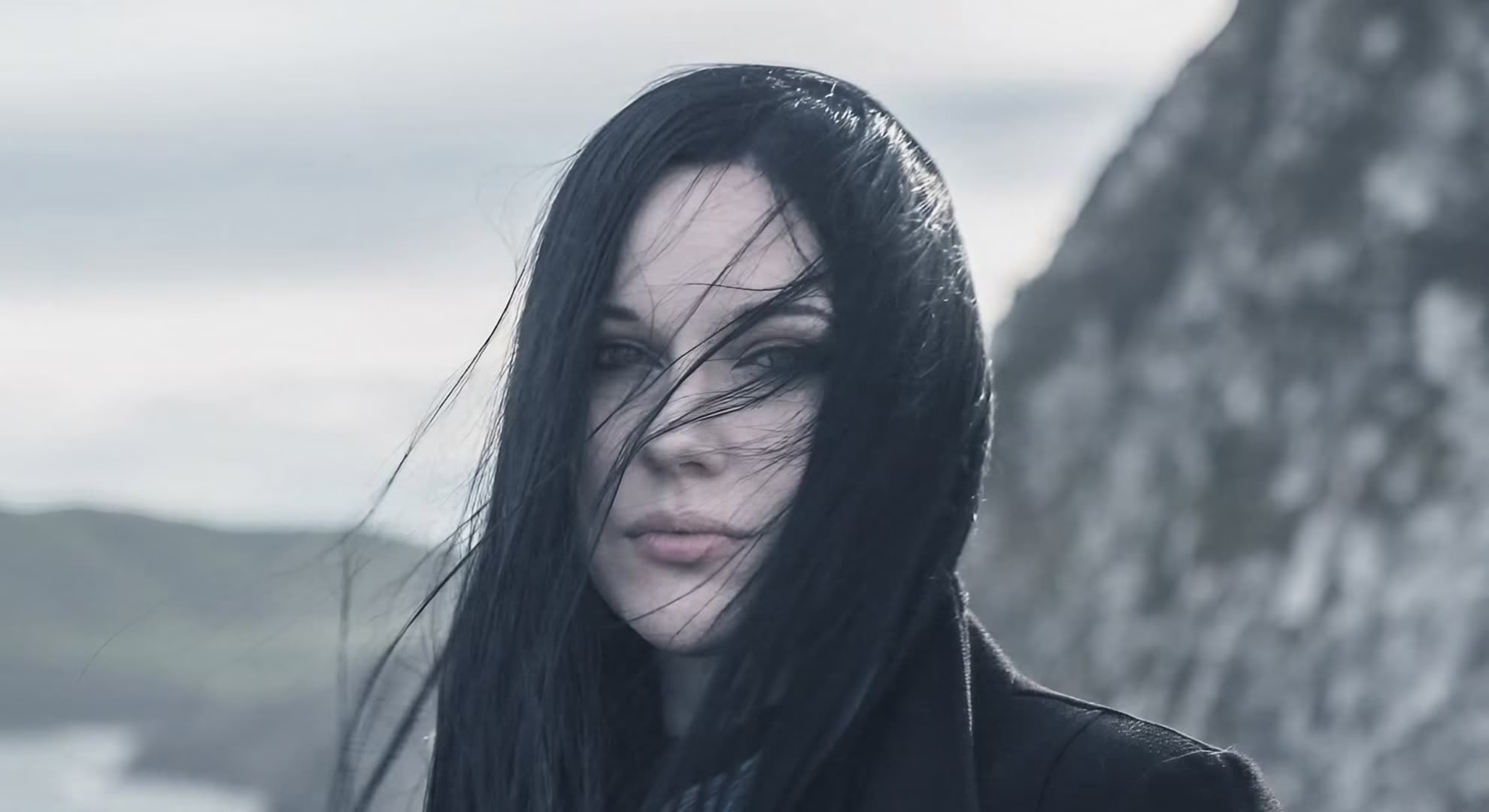
The most consequential change sits at the microphone. Lucia Amelia Emmanueli, who had held the female vocal role since 2021, departed in late 2024, and the band installed Heike Langhans in her place as a permanent co-vocalist.
Langhans is no stranger to Lamb’s orbit. The two have built Remina and Light Field Reverie together, and this publication followed her first fully solo statement earlier this year on the dark electronic project LOR3L3I.
A band assembled from New Zealand, Sweden, and Italy is less a local scene than an imagined community sustained across distance, its shared identity a matter of correspondence rather than proximity.1
Her arrival changes the grammar of the band’s voice. Where Sojourner once set Crespo’s harsh delivery against Chloe Bray’s folk-inflected clean singing, the contrast now runs between Crespo’s growl and the restrained, darkwave-schooled precision Langhans carries from two decades of other people’s records.
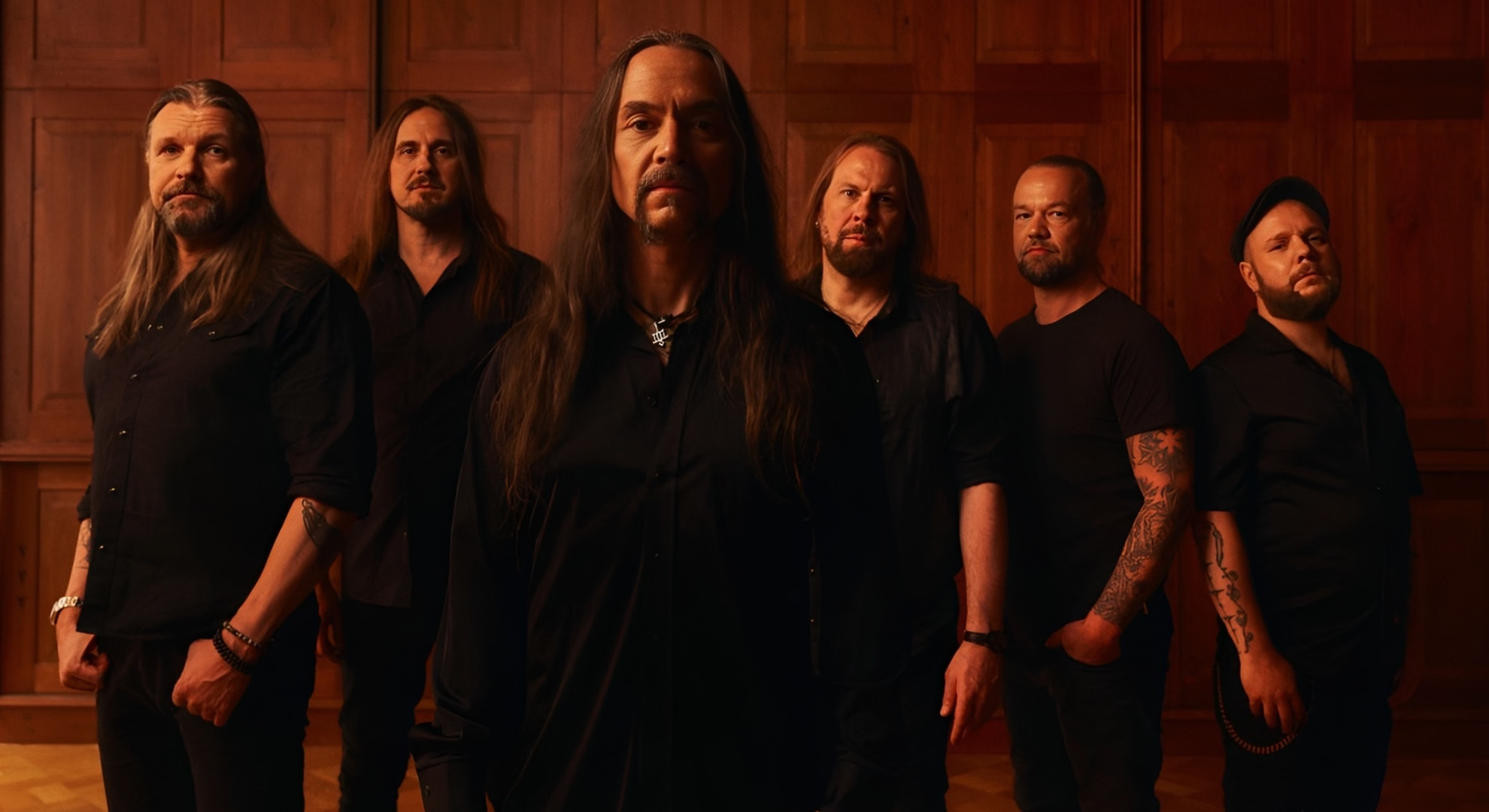
The band also welcomed back its original bassist, Mike Wilson, alongside the Italian drummer Riccardo Floridia. The lineup that made ‘Gateways’ is, in that sense, at once older and newer than the one that made ‘Premonitions.’
Langhans’s contribution reaches past the vocal booth. She wrote the lyric to the closing track, ‘The Road Ahead,’ and created all of the record’s artwork and layout.
Back to the Italian Home
The move from Napalm Records back to Avantgarde Music is a statement about scale and belonging. Avantgarde released Sojourner’s second album, ‘The Shadowed Road,’ in 2018, and the band regards the label as its original home.
Founded in Milan in 1994 by Roberto Mammarella out of the earlier Obscure Plasma Records, Avantgarde became an early home to some of the most searching black and doom metal of the nineties, Katatonia, Ulver, and Opera IX among them.
Its first release, Thergothon’s ‘Stream from the Heavens,’ effectively named funeral doom. Three decades on, its atmospheric sublabel Flowing Downward tends the same uncommercial ground.
That milieu suits a band whose closest label-mate is Saor, the Scottish project that folds Celtic folk into blackened atmosphere. Neither act is made for the recommendation engine.
Napalm, by contrast, offered the reach of a larger operation. The return to Avantgarde narrows the audience on purpose, trading breadth for a listenership that arrives deliberately.
Centralized Composition and Production
At its core, Sojourner remains a deeply personal endeavor. Every note is composed by Lamb, who also handles the production, recording, mixing, and mastering at Ghost Bird Studios in Dunedin. This singular creative vision ensures a coherent identity despite the band members being geographically dispersed. While vocal tracking for Crespo took place at Malm’o’s Arcane Studio and contributions from Wilson and Langhans were recorded in Dunedin, the final assembly occurred at Lamb’s console in the distant Pacific.
Lamb’s distinct production style, also present in his work with Light Field Reverie and Remina, prioritizes rich warmth and sonic weight rather than the abrasive, low-fidelity aesthetic typical of traditional black metal. In the new material, this approach reinforces a structural reliance on keyboards and folk instrumentation, treating them as foundational elements rather than mere decorative flourishes.
Initial Glimpses of the New Record
Ahead of the full release of ‘Gateways,’ two tracks have been made available to the public. ‘Epitaphs,’ a digital single from late 2024, marked the recording debut of Langhans with the group and established the album’s mournful tone. More recently, on Jun 30, 2026, the album’s opening track ‘Dawnrays’ was premiered. Lamb intended for this specific song to serve as a definitive statement on the current state of Sojourner in 2026, opting to showcase the band’s evolution rather than revisiting their earlier sound.
Sojourner is, at its center, an authored project. Lamb writes every note of the music and, at Ghost Bird Studios in Dunedin, produces, records, mixes, and masters the results himself, and that concentration of roles gives the band a consistency that survives its scattered membership. Crespo’s vocals were tracked at Arcane Studio in Malmö, Langhans’s and Wilson’s parts in Dunedin, and the pieces assembled at a single console at the far edge of the Pacific.
Lamb’s production hand is audible across the wider family of records he has shaped, from Remina to Light Field Reverie and session work for other atmospheric acts. His signature favors warmth and weight over the deliberately corroded fidelity of orthodox black metal, and on the two tracks already public, that signature positions ‘Gateways’ toward the same load-bearing arrangement the band has always favored, where folk instruments and keyboards carry structure rather than ornament it.
Two Tracks Point the Way
Two pieces of ‘Gateways’ can be heard before its release. ‘Epitaphs,’ issued digitally in late 2024, was the first Sojourner recording to feature Langhans, and its title fixes the record’s elegiac register before a word is parsed, and ‘Dawnrays,’ released as an advance track on June 30th, 2026, opens the album. Lamb has said he wanted it to “set the stage for 2026 Sojourner,” a song chosen to announce the band’s present rather than reprise its past.
Lamb describes the record as sadder and more melancholy than its predecessors, its long-standing undercurrents of doom and goth brought nearer the surface. Melancholy, treated as an aesthetic rather than a passing mood, carries a long history as a form that organizes a work rather than merely coloring it.2
The band’s subject matter holds to nature and fantasy. The tracklist runs to ‘Lunar Tear,’ ‘Occultation,’ and ‘Vvardenfell,’ the last borrowing the name of an imagined island from a role-playing world.
Such invented geographies are not escapism so much as a way of giving longing a shape, a function fantasy has served in modern culture for more than a century.3
The Distance the Music Crosses
A band with no home scene cannot be received as a local export. Sojourner belong to New Zealand, Sweden, and Italy at once, which is to say fully to none of them, and their listeners are scattered as widely as their members.
What travels intact is the imagery itself, the vast and uninhabited spaces the music conjures. The aesthetic of the infinite, of mountain and emptiness made beautiful precisely because they exceed the human scale, has moved across cultures since long before metal existed to carry it.4
‘Gateways’ reaches that audience mainly through Bandcamp and the label’s own mail order, sold on vinyl, compact disc, and a strictly limited cassette rather than pushed by algorithm, and for a listener far from Milan or Dunedin, a physical import or a lossless download can represent a real outlay, and that cost tends to select for commitment over convenience.
The reward for that effort is a record whose emotional information sits close to the surface, grief and awe rendered in melody and swell, legible even where the language of its lyrics is not.
Toward the Road Ahead
‘Gateways’ takes its title from a preoccupation with thresholds, and it arrives as one: between a six-year silence and whatever follows, between the band Sojourner were and the one they have chosen to become.
The closing track is called ‘The Road Ahead,’ the first Sojourner lyric written by Langhans, and its placement is not accidental. A project that once faced dissolution now hands its final word to its newest member.
On July 10th, 2026, a band stitched together across two hemispheres offers a record about passage to an underground defined by the same refusal to stand still. Whether its seven tracks hold the balance the two advance songs suggest is a question only the release itself will answer.
For those who have followed Sojourner’s imagined North from one album to the next, does a record made at the bottom of the world and handed, at its close, to a voice arriving from elsewhere deepen the music’s sense of passage, or does the band’s very homelessness become the truest subject of a project that has always sung about leaving?
References
- Benedict Anderson, ‘Imagined Communities: Reflections on the Origin and Spread of Nationalism,’ rev. ed. (London: Verso, 2006), 6–7. ↩︎
- Jennifer Radden, ed., ‘The Nature of Melancholy: From Aristotle to Kristeva’ (Oxford: Oxford University Press, 2000), 3–9. ↩︎
- Dimitra Fimi, ‘Tolkien, Race and Cultural History: From Fairies to Hobbits’ (Basingstoke: Palgrave Macmillan, 2009), 130–135. ↩︎
- Marjorie Hope Nicolson, ‘Mountain Gloom and Mountain Glory: The Development of the Aesthetics of the Infinite’ (Ithaca: Cornell University Press, 1959), 271–276. ↩︎

Leave a Reply