


Immunity is memory. The body learns to resist by surviving what once threatened it, holding the shape of a danger long after the danger has passed, and a record that takes its name from that process announces its subject before a note sounds. Endurance here is not a mood but a method, learned the hard way and kept.
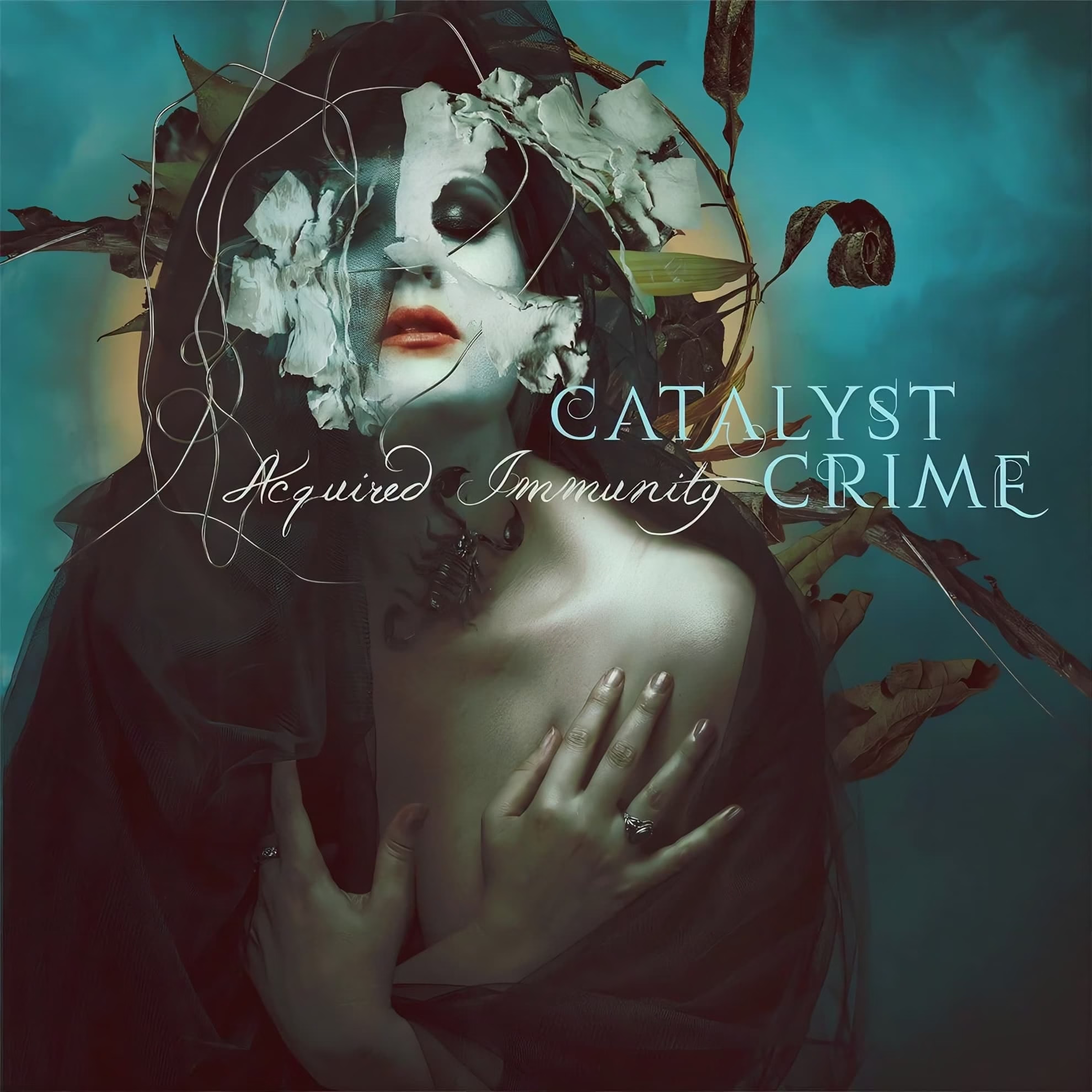
Catalyst Crime release their second album, ‘Acquired Immunity,’ on October 2nd, 2026, through Massacre Records. It is a record assembled from several nations at once, and it reaches toward an audience scattered just as widely.
A Band Without a Country
Catalyst Crime took shape in 2017 as a meeting of people who did not share a passport. The American vocalist and composer Zoe Marie Federoff started it with the German drummer Gerit Lamm, formerly of Xandria, and the Canadian guitarist Kaelen Sarakinis.
Around them gathered the keyboardist and orchestral composer Jonah Weingarten of Pyramaze, the guitarist Chena Roxx, and the bassist Matt Federoff, who happens to be the singer’s father. The lineup reads less like a national scene than a set of coordinates.
Their self-titled debut, released on October 22nd, 2021, established a working relationship with the German label Massacre Records. A first European tour followed in 2024, alongside the symphonic metal band Leaves’ Eyes.
Bands without a fixed home are no longer an anomaly in heavy music; they are increasingly its norm. The movement of musicians, files, and recordings across borders has produced ensembles whose identity is a network rather than a place.1
Catalyst Crime live inside that condition rather than resisting it. Their second album is the first to ask, at full length, what such a band has to say.
The Soprano and the Growl
Federoff did not arrive at symphonic metal by accident. She came up through the band Insatia and studied under Floor Jansen of Nightwish, training the kind of high, sustained voice that the genre treats as its spine.
From 2022 to 2025 she also held the female vocal and keyboard chair in the British extreme metal band Cradle of Filth, appearing on their 2025 album ‘The Screaming of the Valkyries.’ She and the guitarist Marek “Ashok” Šmerda, whom she married in January 2025, left that band the same year.
The operatic voice carries a particular charge. In opera, the high female voice marks the point where words give way to pure sound, where meaning dissolves into something the listener feels before understanding it.2
Symphonic metal inherited that effect and set it against distortion and blast. The soprano line and the death growl are not opposites in this music; they are the two poles between which its drama travels.
Catalyst Crime work that contrast deliberately. The same record that lifts Federoff into clean, sustained melody also drives her toward harsher attack, and the tension between the two is the band’s signature.
‘Cursebreaker’ and the Sealed Border
The first single, ‘Cursebreaker,’ arrived in November 2025 as a power ballad built on sweeping orchestration and a slow, deliberate climb.
Its subject is real, and this publication told that story in full on the single’s release — a resistance figure in then-Czechoslovakia and the banned literature she helped carry across a sealed border.
Heard now as the opening move of a longer sequence, the song reads less as biography than as a study in inherited memory, the Eastern Bloc surviving for those born outside it as a territory of secondhand recollection.3
‘Cursebreaker’ turns that condition into form. The orchestral build does not depict the resistance so much as the act of remembering it, the slow accumulation of a story told and retold until it becomes inheritance.
A Harder Second Statement
If ‘Cursebreaker’ looks inward, the second single looks outward and bares its teeth. ‘Acquired Immunity,’ which shares its name with the album, arrived in March 2026 and moved in the opposite direction entirely.
The track sets melodic death metal verses against cinematic orchestration and a high, clean chorus. It is the heaviest music the band has put forward, and it makes the orchestral elements work under pressure rather than above it.
Šmerda, newly free of Cradle of Filth, contributes a guest guitar solo. His presence ties the album to the British extreme metal tradition he spent more than a decade inside, and it folds the couple’s recent history directly into the music.
Federoff has described the song as a turning point, a step into greater complexity as the band leans fully into its cinematic identity. The two singles together sketch a record pulled between tenderness and force.
Neither single resolves how the full sequence will balance those impulses. That balance is the question the album holds, and it cannot be answered before October 2nd, 2026.
Krull and the Stuttgart Console
The album was made with Alexander Krull at Mastersound Studios near Stuttgart, the room and the hands behind much of German symphonic metal’s modern sound.
Krull fronts the death metal band Atrocity and co-founded Leaves’ Eyes, the band Catalyst Crime have repeatedly toured beside. He has spent decades pairing orchestral arrangement with extreme vocals, and his studio was built for exactly that collision.
His involvement is not incidental to the record’s character. A producer who treats the orchestra as a structural element rather than decoration is the precondition for music that calls itself cinematic.
Film music works by binding emotion to image, guiding what a viewer feels without ever announcing itself as argument, the score shaping response from beneath the surface while seeming merely to accompany.4
Catalyst Crime want that same submerged power, but with no film to serve. The orchestration must carry the narrative weight on its own, and Krull’s console is where that weight is balanced.
Krull also directs videos for the bands he records, extending his control from sound into image. For a group that describes itself as cinematic, a producer fluent in both is a structural choice, not an incidental hire.
Where the Cinematic Travels
Music this grand has an advantage in crossing borders. Its emotional information sits on the surface, in melody and orchestral swell, where it can be felt without translation, and for listeners far from any European festival field, that legibility matters. A symphonic metal chorus communicates its scale before a single lyric is parsed, which is part of why the genre has found devoted audiences across continents that share little else.
Catalyst Crime are unusually suited to that reach precisely because they have no home crowd to address. They were never the property of a single city or country, and so they arrive everywhere as something other than a foreign import, and the cost of access is not evenly distributed. In much of the world a physical record or a premium subscription represents a real sacrifice, and the audiences who pay it tend to listen with a seriousness that casual markets rarely match.
The two singles are available digitally through Massacre Records, with the album to follow on the same label. For the underground that takes this music seriously, the grandeur is not spectacle for its own sake; it is a language that asks to be met halfway.
The Defenses It Carries
An album titled ‘Acquired Immunity’ names a kind of strength that is learned rather than given. The body builds its defenses by surviving what tried to harm it, and the metaphor sits close to the resistance story at the record’s heart.
Catalyst Crime have spent the years since their debut absorbing exactly that kind of experience, including a turbulent passage through one of extreme metal’s best-known bands. What returns to this record is not damage but resistance, carried in the music itself.
On October 2nd, 2026, a band of no fixed nationality offers a record about endurance to an audience defined by the same refusal to belong to one place. Whether the full sequence holds the two singles’ opposing charges in balance is the open matter that the release itself stands to settle.
For a band that answers to no single country, the memory it carries across borders is Czech, the producer is German, the voice is North American, and the audience is everywhere at once. When a record about resistance and endurance reaches you from no fixed home, does its rootlessness let the story travel further, or does something essential stay behind at the border it crossed?
References
- Ulf Hannerz, ‘Transnational Connections: Culture, People, Places’ (London: Routledge, 1996), 17–22. ↩︎
- Michel Poizat, ‘The Angel’s Cry: Beyond the Pleasure Principle in Opera,’ trans. Arthur Denner (Ithaca: Cornell University Press, 1992), 40–45. ↩︎
- Svetlana Boym, ‘The Future of Nostalgia’ (New York: Basic Books, 2001), 51–55. ↩︎
- Claudia Gorbman, ‘Unheard Melodies: Narrative Film Music’ (Bloomington: Indiana University Press, 1987), 70–75. ↩︎


Leave a Reply