

In the early nineteenth century, two brothers walking the wooded hill country of Hesse and Westphalia set about collecting the stories rural Germans told about the forest at the edge of the village: tales in which the trees held a memory and a law older than the church spire visible from among them. Jacob and Wilhelm Grimm treated the forest not as scenery but as a boundary, a place where the ordered world gave way to something that predated it.
That same forest tradition survives, four hundred kilometers to the southwest, under its own regional name. The Schwarzwald, the Black Forest, is a range of wooded ridges in Baden-Württemberg whose darkness gave a band formed there in 2004 its name directly.
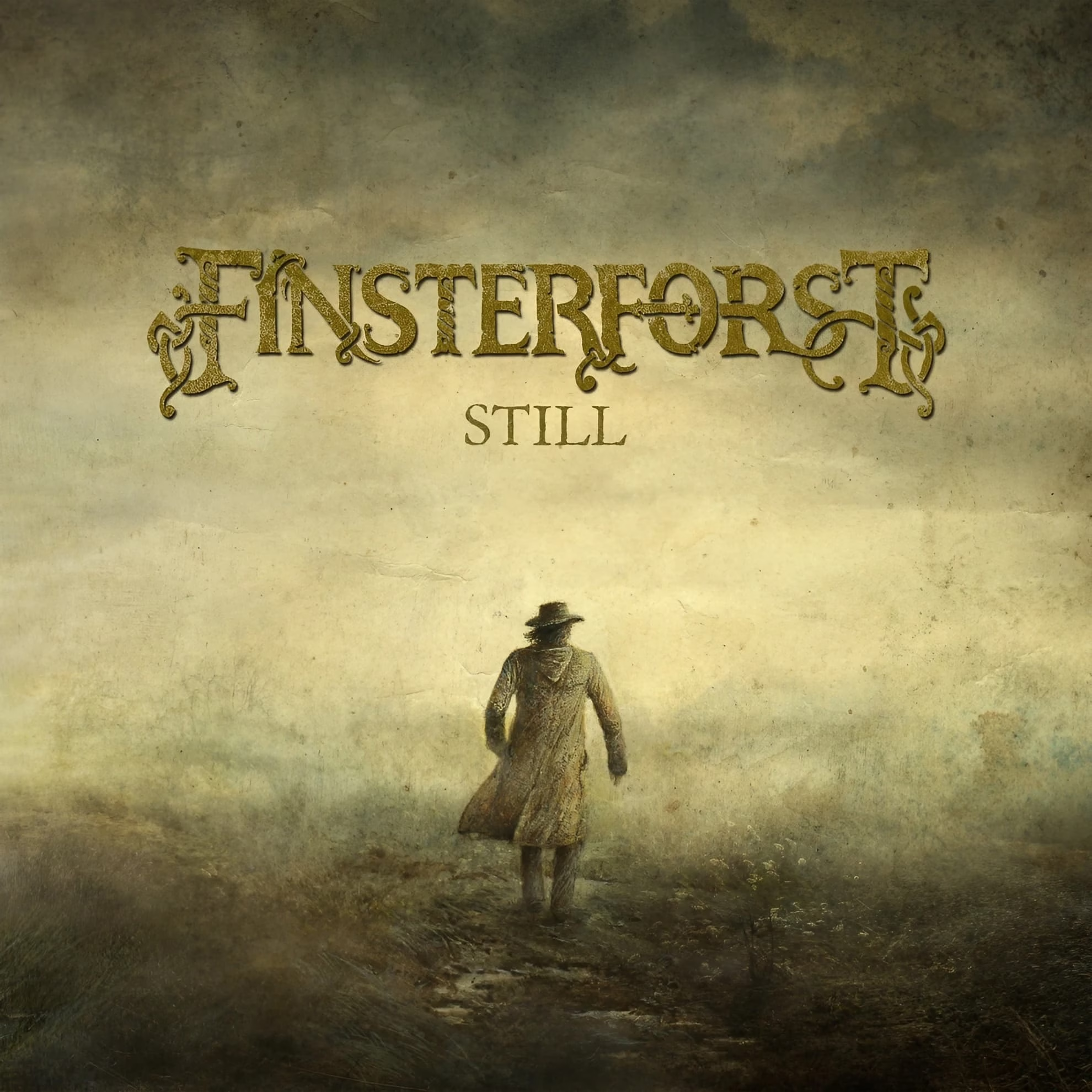
Finsterforst, dark forest, translates the region’s oldest association into a genre signature without metaphor. On July 31st, 2026, the band release ‘Still,’ their sixth full-length album, through AOP Records, extending two decades of work built around one wooded coordinate in southwestern Germany.
A Name Drawn From the Forest
Finsterforst formed at the end of 2004 in Freiburg im Breisgau, the city that sits at the edge of the Schwarzwald and has remained the band’s home base ever since. The name itself, dark forest, sits inside a much older German literary habit of treating the deep forest as a place that keeps its own law, a habit documented at length in the nineteenth-century folklore collections that first gathered the region’s oral tradition into print.1
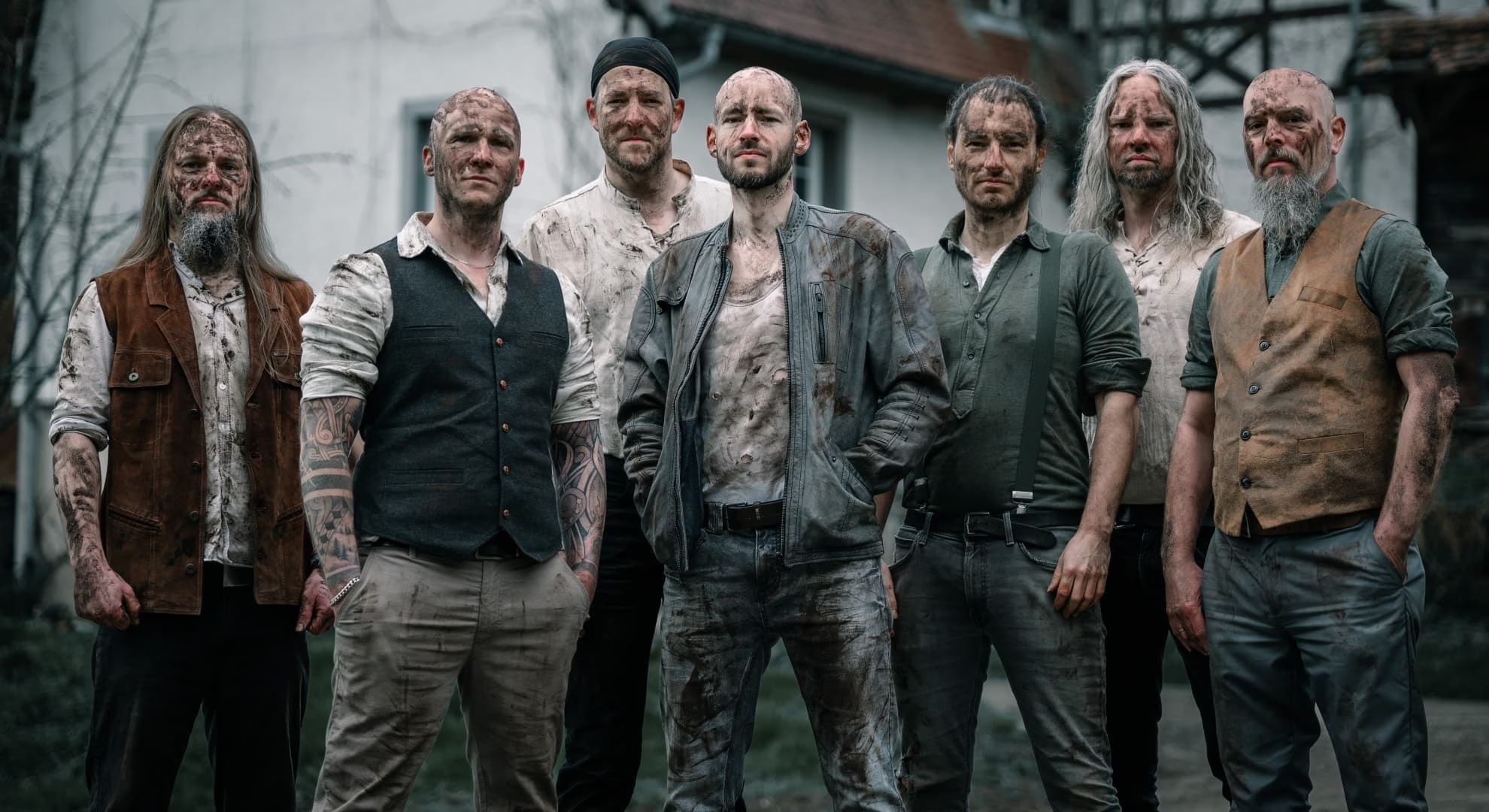
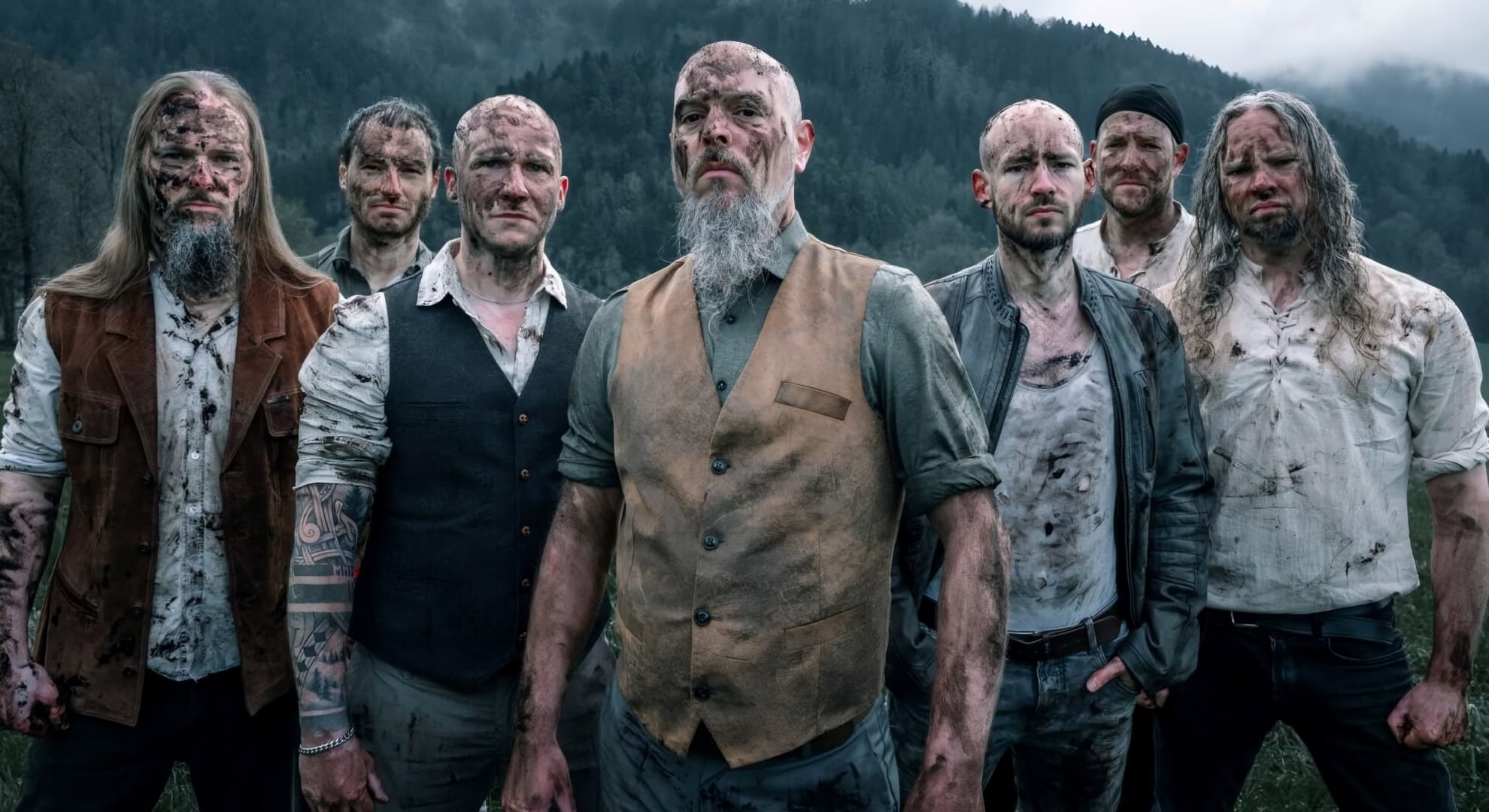
Simon Schillinger founded the band directly at the end of 2004 together with Tobias Weinreich, Sebastian Scherrer, and Marco Schomas, with no earlier solo project operating under the Finsterforst name.
Accordionist Johannes Joseph arrived in 2005, and second guitarist David Schuldis followed shortly after, fixing the instrumentation that has defined the band since: guitar, bass, and drums carrying the metal, accordion and acoustic guitar carrying the folk element that keeps the band’s harshest passages tethered to a specific regional sound rather than to a generic extremity.
The band has settled, in interviews, on a name for that sound: Black Forest Metal, a self-applied tag that founding member Simon Käflein has described as carrying its own wink, given the band’s early years inside the broader European pagan folk metal wave of drinking horns and borrowed Viking imagery.
The regional attachment underneath the joke is not incidental; scholarship on popular music has long argued that a genre’s claim to a specific place, rather than an imagined or borrowed one, changes how that music is heard by the audience that already lives there and by the audience that does not.
Käflein, in the same conversation, traced the band’s stylistic movement away from that early pagan-folk mood: the songs grew heavier, more structurally demanding, and considerably longer, incorporating keyboard textures, orchestral passages, and choral vocals alongside the accordion that had always set the band apart from its peers. That accumulation of scale, not a single stylistic pivot, is what six studio albums and one mini-album have built.
Two Decades Without Leaving the Trees
The catalogue that leads to ‘Still’ runs in a fairly direct line. ‘Weltenkraft’ (2007) and ‘…zum Tode hin’ (2009) established the band inside the pagan folk metal current of the period. ‘Urwerk’ (2010) and ‘Rastlos’ (2012) extended the band’s compositional ambition, and ‘Mach Dich Frei’ (2015) marked a turn toward heavier, more black-metal-inflected material.
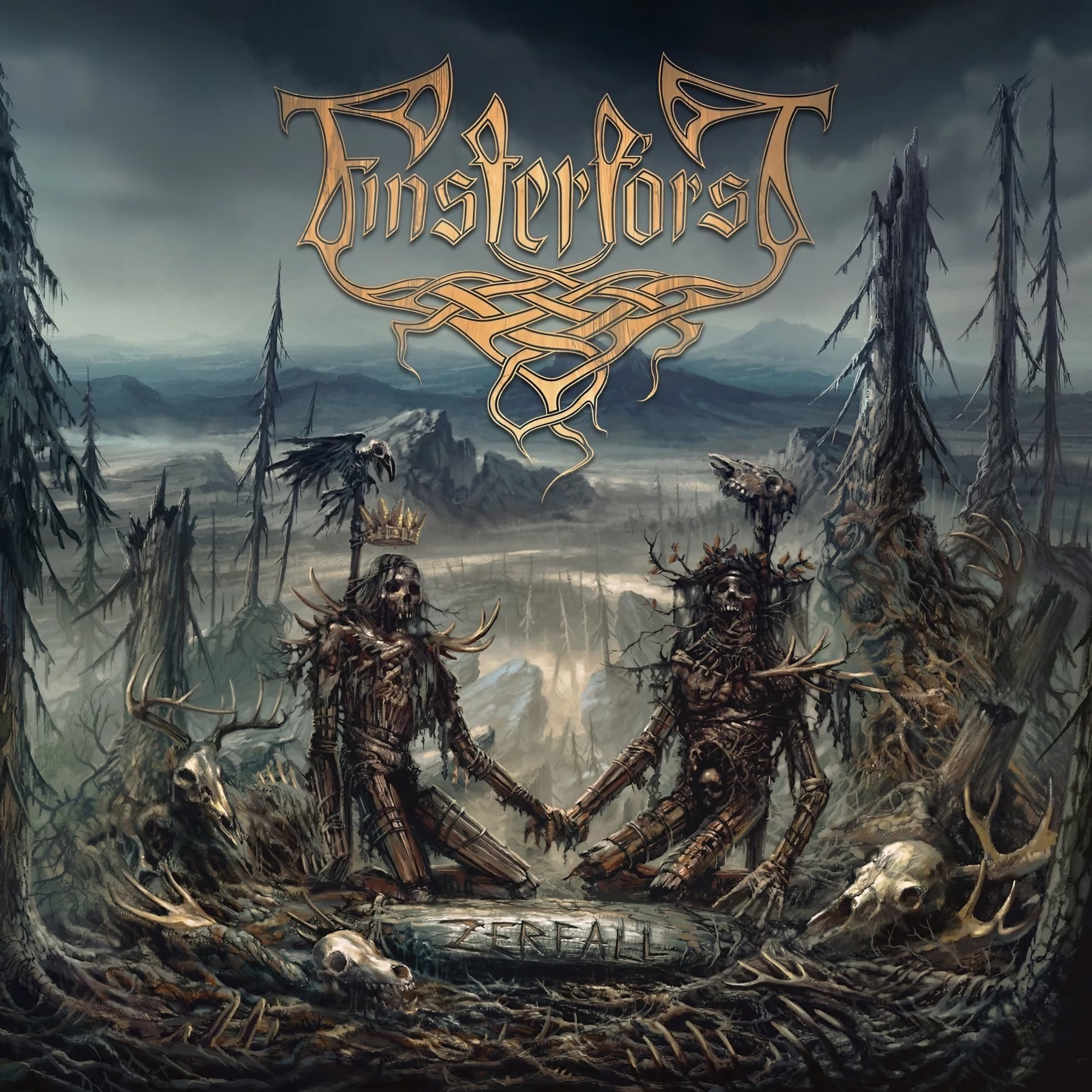
The compilation ‘#YØLØ’ (2016) served as an interlude before ‘Zerfall,’ released in 2019 through Napalm Records, which remains the band’s most extensively developed full-length statement: an album of nearly 80 minutes whose track ‘Ecce Homo’ alone runs 36 minutes, built from the kind of extended riff cycles and shifting sections that had become the band’s compositional signature.
Between ‘Zerfall’ and ‘Still’ sits ‘Jenseits,’ released in 2023 as a mini-album rather than a full studio statement. Where ‘Zerfall’ distributed its ambition across a conventional tracklist, ‘Jenseits’ concentrated the entire release into a single composition of nearly 40 minutes, divided into four internal suites. It was the most formally uncompromising structure the band had attempted, a record built for continuous listening rather than individual songs, and it left open the question of what a subsequent full-length would do with that accumulated structural appetite.
‘Still’ answers that question by reversing course rather than extending it. The nine tracks confirmed for the new album return to discrete, individually titled songs after ‘Jenseits’ had dissolved song form into a single continuous suite, while the album’s overall run time, at 78 minutes, preserves the scale the band has carried since ‘Zerfall.’
The result positions ‘Still’ as a synthesis rather than a departure: the structural discipline of individual songs restored, without a retreat from the length and internal complexity that ‘Jenseits’ had pushed to its furthest point.
Brandes and the Iguana Sessions
‘Still’ was produced and mixed by Christoph Brandes together with band member Simon Käflein, and recorded and mastered by Brandes at Iguana Studios, a facility near Freiburg im Breisgau that has served the regional extreme metal underground for more than two decades.
Brandes’s documented credits extend well beyond Finsterforst’s immediate circle: he engineered Necrophagist’s ‘Onset of Putrefaction,’ the German technical death metal band’s debut, in its original 1999 recording and its expanded 2004 reissue, a record widely credited with helping define the technical death metal vocabulary that followed it.
His subsequent work has run through a string of German extreme metal projects recorded at Iguana, giving the studio itself a documented institutional history rather than a generic one.
That the album was made close to home, by an engineer whose reputation was built inside the same regional underground the band emerged from, is a structural detail rather than an incidental one. It ties ‘Still’ to a documented local infrastructure instead of an imported one, consistent with a band whose entire genre label names its own region.
Three Dispatches Before the Forest
Three advance singles preceded the album’s release, spaced across three months. ‘Stille Nacht,’ released May 21st, 2026, with an accompanying video, introduced the record and doubles as the album’s fifth track. ‘Obduktion,’ the album’s opening track, followed on June 18th, 2026. ‘Im Wind,’ the fourth song on the record, followed as the third single on July 9th, 2026, closer to the album’s release date than either of its predecessors.
The sequencing of the singles, spanning tracks one, four, and five of a nine-song album, gives listeners access to roughly half the record’s structure ahead of the full release, an unusually generous advance window for a band whose songs have historically run long enough that a single track can stand as a substantial listening commitment on its own.
What the sequence cannot yet confirm is how those pieces resolve against the album’s back half, including ‘Leere,’ the track the band has singled out in its own materials as the record’s longest and most structurally ambitious entry.
Two Borrowed Voices
The album’s eighth track is a cover of Immortal’s ‘Beyond the North Waves,’ originally released on the Norwegian band’s 2002 album ‘Sons of Northern Darkness.’ Immortal built their catalogue around Blashyrkh, an invented frozen realm that exists as the band’s own artistic mythology rather than a documented folk tradition, a fictional cosmology distinct from the genuine Old Norse mythological corpus that later black metal bands would draw upon more directly.2
Finsterforst’s choice to cover a Norwegian band rather than a German one is worth pausing on. The Schwarzwald paganism the band claims as its own regional inheritance is Alemannic and Central European, distinct from the Norse frost imagery Immortal invented for their own catalogue; the cover borrows a specific sonic register, icy, wind-driven, propulsive, rather than a shared mythological source. It sits inside the record as an act of genre homage rather than a thematic extension of the band’s own Black Forest material.
The album’s closing track takes a different kind of borrowed voice: a cover of Pink Floyd’s ‘Another Brick in the Wall, Pt. II,’ the 1979 single built around a children’s chorus rejecting rote schooling and institutional control. Cover versions function, across popular music scholarship, as a form of claimed lineage, an artist’s public statement of where their own work sits inside a wider tradition, made audible rather than merely asserted.3
Placed at the close of a record steeped in Black Forest folklore and Alemannic paganism, the choice of a British art-rock anthem about institutional confinement reads less as tonal contradiction than as the band’s own account of where its influences actually range, well beyond the regional folk-metal frame the album’s other eight tracks otherwise establish.
The Forest Heard Elsewhere
A record built this specifically around one wooded region of southwestern Germany travels outward under a different logic than music that trades in a more generalized extremity.
Listeners with no tie to the Schwarzwald do not recognize the specific folklore Finsterforst draws from, but they recognize the underlying claim: that a specific terrain carries an inherited spiritual grammar worth setting to music, a claim the global metal underground has made repeatedly from different starting points, whether in the frost mythology of Scandinavian black metal or the industrial ruin of British doom’s working-class origins.
Each of those claims is grounded in a documented, specific place rather than an imported aesthetic, and that specificity is precisely what separates a genuine regional inheritance from costume.
AOP Records, the Seesen-based independent that releases ‘Still,’ operates inside that same underground infrastructure, its roster running through atmospheric and melodic black metal acts that share little beyond a refusal of major-label promotional machinery.
The label’s involvement here is a factual credit rather than an argument in its own right; the record’s reach depends on the same underground circuits, direct sales, and word of mouth that have carried Finsterforst’s catalogue since 2004.
The physical release is the definitive version of ‘Still’: a gatefold double LP pressed on peppermint splatter vinyl, alongside a standard compact disc edition, both available for pre-order through the label’s own channels. Digital access exists as a secondary format only, through the label’s Bandcamp page, and carries none of the collectible weight the vinyl edition holds for the underground audience most likely to seek this record out.
The Trees Keep Their Names
23 years after a solo demo project took its name from a regional forest, Finsterforst reach a sixth full-length that neither abandons the scale ‘Zerfall’ established nor repeats the singular structural experiment ‘Jenseits’ attempted. ‘Still’ restores the discrete song as its basic unit while keeping the extended runtime that has defined the band’s ambition since 2019, produced inside the same regional infrastructure, at the same studio, near the same city, that the band has never left.
What travels furthest from that arrangement is not the specific folklore of the Schwarzwald, which remains legible mainly to those who already know it, but the underlying premise that a single wooded region can sustain two decades of increasingly ambitious music without needing to borrow a foreign mythology to justify its own weight. Whether ‘Still’ proves the most complete statement of that premise is a question the album’s full nine tracks, heard together, will settle on July 31st.
When a band builds two decades of increasingly ambitious music around a single, specifically named regional forest rather than an imported mythology, does the resulting record travel further for having stayed so precisely put, or does its meaning change once it reaches listeners for whom the Schwarzwald is simply an unfamiliar name?
References
- Jacob Grimm, trans. James Steven Stallybrass, ‘Teutonic Mythology, vol. 1’ (London: George Bell and Sons, 1883), 55–60. ↩︎
- H.R. Ellis Davidson, ‘Gods and Myths of Northern Europe’ (Harmondsworth: Penguin Books, 1964), 27–32. ↩︎
- George Plasketes, ed., ‘Play It Again: Cover Songs in Popular Music’ (Farnham: Ashgate, 2010), 12–17. ↩︎

Leave a Reply