

In Mexican colloquial Spanish, a woman who is “bruja” is not necessarily a witch. The Real Academia Española records the expression “estar bruja,” to be penniless, as a usage of Mexico, Cuba, and Puerto Rico, listed beside the older senses of the word: a person credited with magical powers obtained from the devil, a woman who seems to foresee what is coming, and the barn owl.1 Poverty, prophecy, and a nesting bird share one noun, and a debut novel publishing this autumn puts all three to work at once.
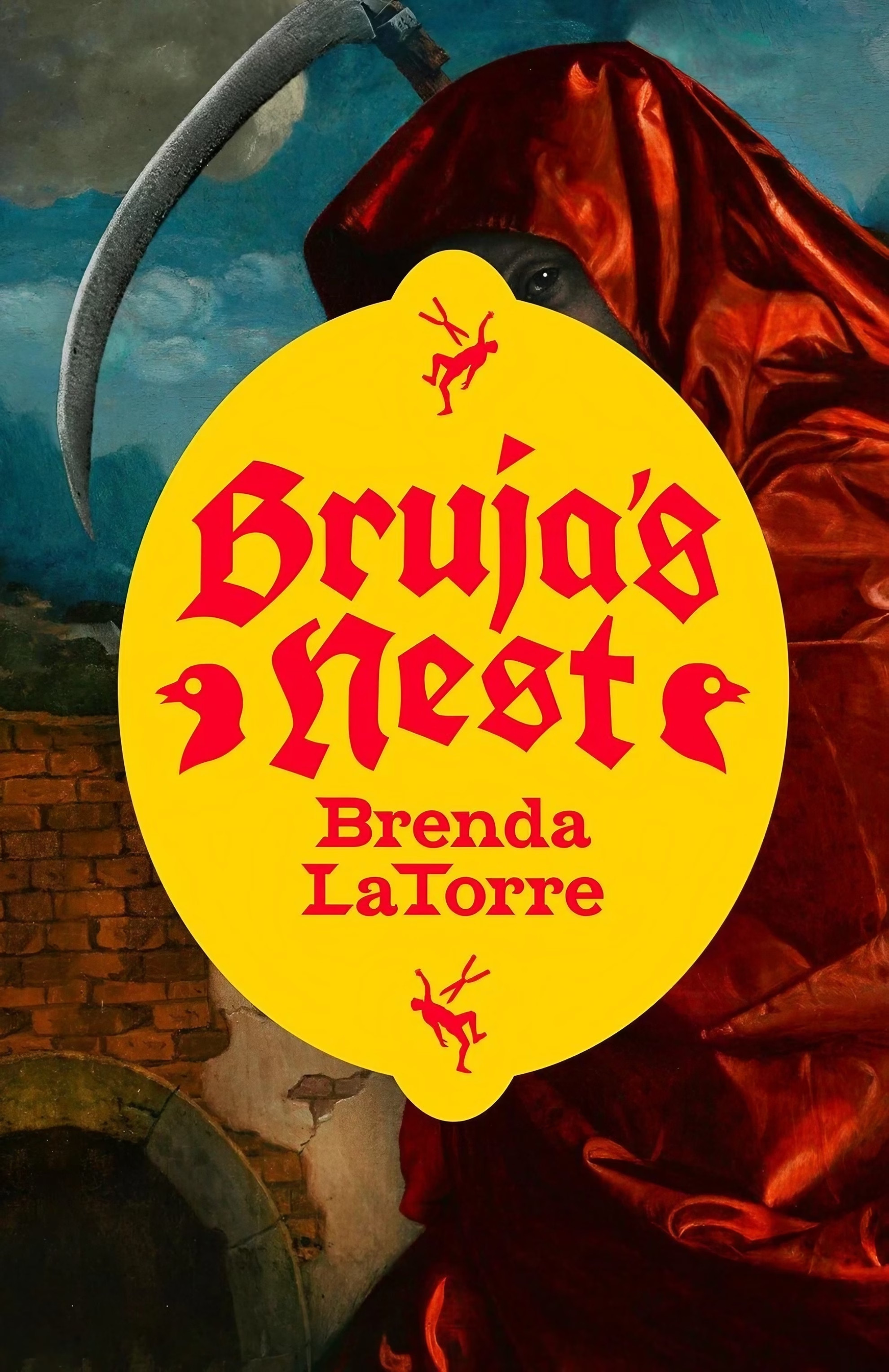
‘Bruja’s Nest,’ the first novel by Mexico City native Brenda LaTorre, reaches readers on October 6th, 2026, as a 278-page trade paperback from Creature Publishing (ISBN 978-1-951971-57-1), with an ebook edition listed alongside it. Its premise is compact and grotesque.
Yolanda, a young woman raised amid poverty, alcoholism, and sexual abuse, is sent to work as an indentured servant on the Fernández De la Rosa estate, where she resolves to become the lady of the house by conceiving a child with the family’s naive son. The instrument she chooses is a fertility spell from the local bruja, a rite that requires her to pierce her own flesh and place a rooster’s heart inside her body.
The pregnancy that follows swells and seethes with infection and ends in the delivery of a massive egg under the watch of Santa Muerte, the Mexican folk saint of death. The rest of the novel turns on a mother’s determination to protect what hatches, even as the household insists the child is a monster.
A Mexico City Debut
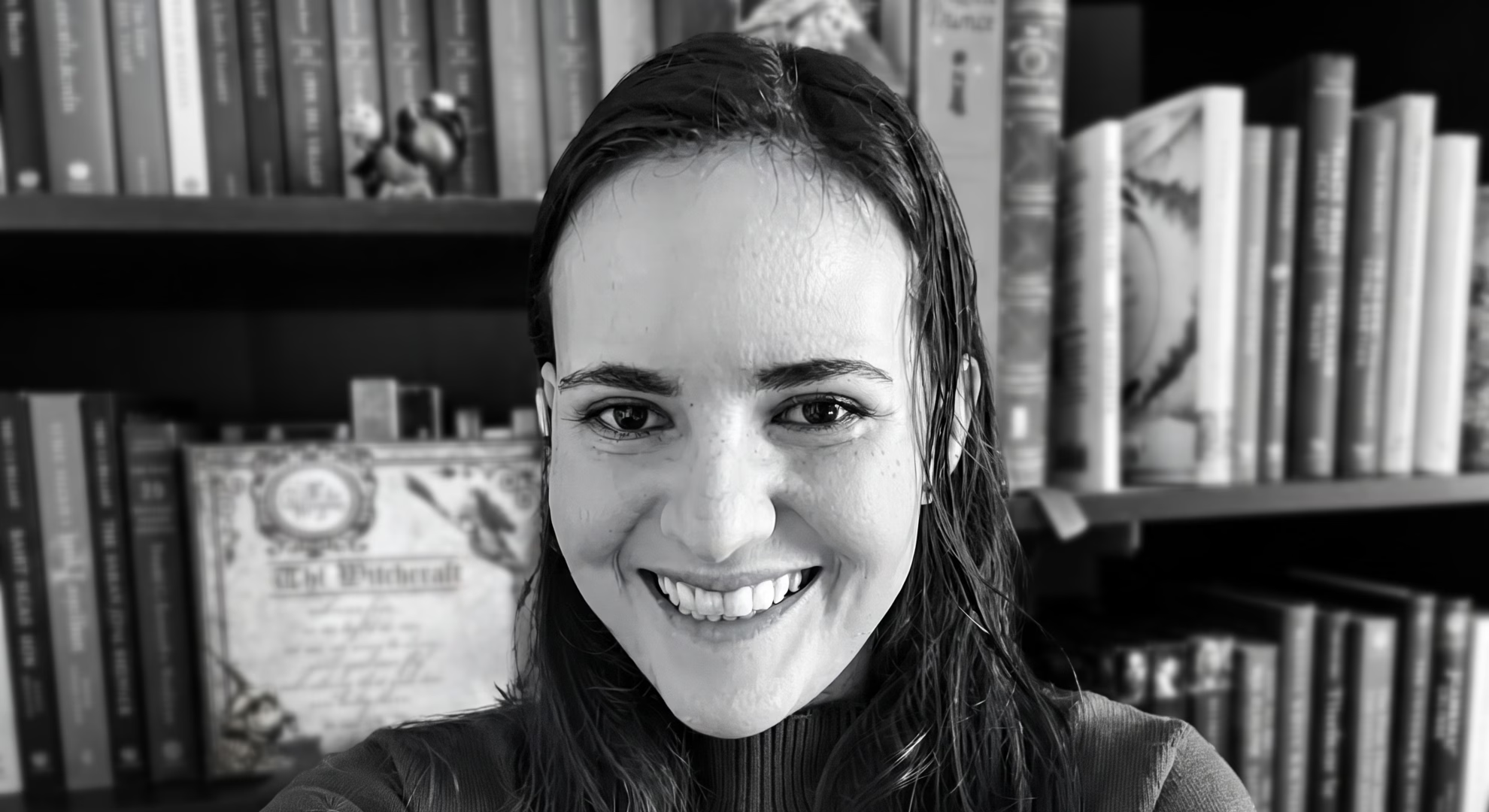
LaTorre’s route into the genre began, on her own account, before dawn. At seven, she has recalled, she crept into the family living room at five in the morning to play ‘Goosebumps’ on the television, and at 12 she wrote her first horror story, ‘Magia Negra,’ about a girl undone by reading the ‘Necronomicon,’ a plain debt to Lovecraft.2
In the same October 2025 statement, written for librarian Becky Spratford’s RA for All: Horror during a week devoted to Creature’s authors, she described the gap that shaped her early fiction. An aunt asked why the boy in that first story was named Josh, and LaTorre came to see that she had absorbed an assumption that successful horror had to be masculine and oriented toward Anglo culture, largely because the genre fiction on sale in Spanish-language bookstores reached her in translation.
The correction came first through a university course in the literature of immigration, where she found writers working in English who kept their mother tongue threaded between their lines, and then through two books she names as her first mentors. Gabino Iglesias’s ‘The Devil Takes You Home’ showed her the folk-Catholic object turned to horror, in its “milagrito” offered to the Virgin that proves to be a boy’s finger rather than a cheap metal charm; Mariana Enriquez’s ‘Things We Lost in the Fire’ gave her, in the story ‘The Dirty Kid,’ a model of horror drawn from middle-class guilt and indifference.
From those readings LaTorre took a permission she describes in specific terms: to write with a Spanglish lyricism, to look at the superstitions of her childhood as an outsider would, and to stop erasing from her fiction the love of telenovelas and romance she had treated as incompatible with the genre. That last permission is the one ‘Bruja’s Nest’ exercises most visibly.
Her formal training runs through a Creative Writing Certificate from the University of California San Diego and an MFA from the University of Southern Maine, completed through its Stonecoast program in 2025, where she served as Editor of Popular Fiction for the Stonecoast Review. She now mentors emerging writers through the WriteHive Mentorship Program.
Before the novel, LaTorre worked in short forms across small-press magazines and anthologies. Her published record opens in 2021 with ‘Things that Happen at Dawn’ for Collective Tales Publishing and continues through ‘Quetzal Feathers’ (Ravens and Roses Publishing, 2022), ‘Mamá’s Tamales’ in Pyre Magazine (2023), ‘Insects Don’t Bleed’ in Moth Eaten Magazine (2024), and ‘Franchesca’s Garden’ in Polymorphic Magazine (2024).
One title in that record points directly toward the novel: ‘When La Muerte Visits,’ published in 2023 in the anthology ‘Voices From the Mausoleum,’ already names death as a personified visitor three years before Santa Muerte presides over Yolanda’s labor.
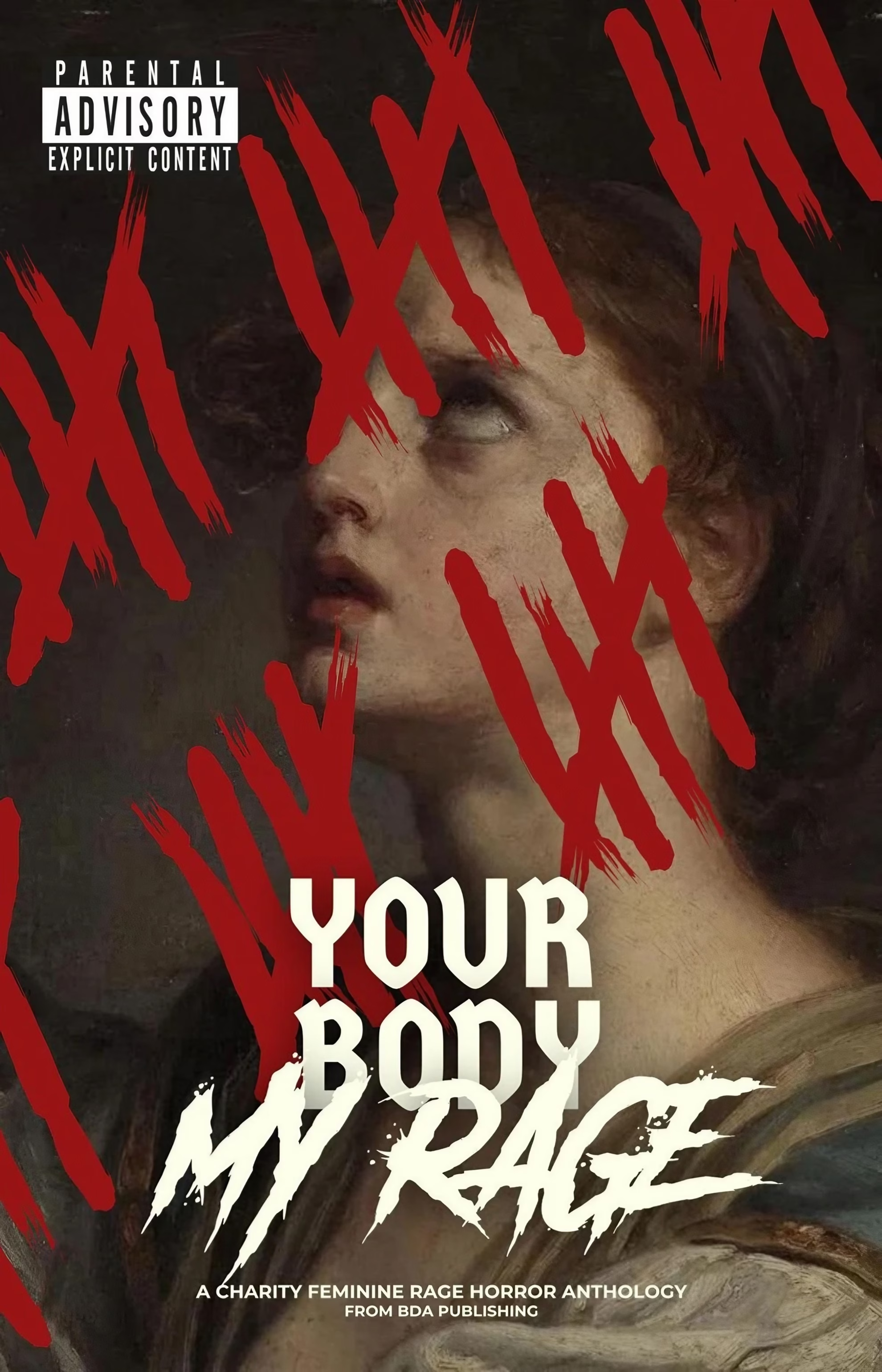
Her most recent short fiction, ‘Things We Lost While Scrubbing’ (BDA Publishing, 2025), carries a title that nods by its own wording to the Enriquez collection she credits as formative, while naming the domestic labor her novel now places at its center. In April 2026 she added a nonfiction piece for NightTide Magazine, ‘Female Doubles: The Familiar Melts Into Its Opposite,’ on a figure with a long Mexican gothic pedigree.
A Rooster’s Heart, an Egg
The novel’s working vocabulary comes from the author’s own experience of motherhood. Speaking in an interview published May 8th, 2026, LaTorre said that becoming a mother admitted her to what she called a “secret club of mothers,” in which women confessed their exhaustion and the parts of the role they hated, and that the experience persuaded her motherhood was far more nuanced than she had anticipated.3
She drafted Yolanda’s pregnancy around a cultural asymmetry she stated directly: “Sons carry the family’s lineage, so they’re seen as more important,” while daughters, she added, must be perfect, must not have sexual desire, and must become good wives and mothers.
That asymmetry organizes the book’s cast of mothers. Yolanda’s own mother, in LaTorre’s account, punishes her daughter for the abuse she suffered at her brother’s hands by sending her out of the family home into servitude, an act the author frames as misguided care from a woman she called “an enabler of the patriarchy” rather than as simple cruelty. Odette, a woman marked by repeated miscarriages and by the dismissal of her husband and family, carries what LaTorre calls an imagined motherhood, an idealized role whose cost she never pays.
Yolanda begins as the self-absorbed heroine of her own private telenovela, treating a child as a ladder, and ends, in the author’s phrase, recognizing that “if she doesn’t protect him, no one will,” even as the child scars her body in his hunger for blood and flesh.
Amanda Manns, Creature’s cofounder and publisher, framed the same material more bluntly in that October 2025 series, describing the novel’s focus on female rage and postpartum depression as “brutally direct.” Between the author’s account and the publisher’s, the book’s horror has a precise location: not the monster alone, but the distance between the child a woman is expected to produce and the one her circumstances actually deliver.
Saint Death Before Tepito
Santa Muerte, whose gaze governs the delivery, is not ornament borrowed from the Día de los Muertos but a devotion with its own documented and contested history. Many devotees and some commentators trace her to Mictecacihuatl, the Mexica lady of the underworld who ruled Mictlan, the realm of the dead, with her consort Mictlantecuhtli.
The religious historian R. Andrew Chesnut places her primary origin instead in La Parca, the skeletal Grim Reaper of Spanish Catholicism carried to New Spain by evangelizing friars, where it met Indigenous traditions of death veneration and was absorbed into them.4 The earliest documented reference to her by name comes from Inquisition records of 1797, which describe Indigenous devotees in central Mexico gathering around a skeletal figure they called Santa Muerte, and punished for it.
The devotion then all but disappears from the written record until the nineteen-forties, when anthropologists found her invoked chiefly as a saint of love magic, petitioned to return straying husbands and lovers. Her public cult belongs to the twenty-first century.
In 2001, Enriqueta Romero, known as Doña Queta, placed a life-size image of the saint outside her home in Tepito, a working-class neighborhood of central Mexico City, and the monthly rosary she began leading there the following year now draws thousands. Chesnut has called the devotion the fastest-growing new religious movement in the Americas.
Its practice borrows directly from Catholic form, including rosaries, novenas, and votive candles, while sorting petitions by color: red for love and passion, gold for money and prosperity, white for purification, green for justice.
Official condemnation followed the growth rather than preceding it. Mexican bishops rejected the devotion repeatedly through the first decade of this century, and in 2013 Cardinal Gianfranco Ravasi, president of the Pontifical Council for Culture, denounced it during a visit to Mexico as blasphemy against religion.
That chronology sharpens what the novel does with her. A saint whose earliest recorded devotees were punished by an ecclesiastical court, whose modern shrine rose in one of the capital’s poorest barrios, and whose votive colors sort petitions into love and money is the exact figure to preside over a servant’s bid for a rich man’s name.
The novelist Cynthia Pelayo, in her endorsement of the book, describes its Santa Muerte draped in red and gold, the two colors of precisely the bargains Yolanda is making. Folk devotion in this novel is the contract the plot executes.
Servants of the Hacienda
The house Yolanda enters belongs to an institution with its own long record of servitude. The Mexican hacienda took form in the colonial period, when Spanish land grants and the absorption of Indigenous lands produced vast rural estates worked by resident laborers, and by the late nineteenth century, under the regime of Porfirio Díaz, the largest estates held much of the country’s arable land.
The historian Friedrich Katz, in a foundational study of labor on Porfirian haciendas, showed how widely conditions varied by region.5 In the southeast, debt peonage bound workers to estates through advances they could never repay, often administered through the tienda de raya, the estate store.
In the center, resident peons known as acasillados exchanged labor for housing, rations, and a precarious security, while seasonal workers carried the greatest exposure. The system’s legal foundation collapsed after the Revolution that began in 1910. Article 27 of the 1917 Constitution established the basis for land redistribution, and the ejido reform carried out under Lázaro Cárdenas between 1934 and 1940 divided estates on a scale Mexico had never attempted.
The publisher’s materials do not fix the decade in which ‘Bruja’s Nest’ takes place, and Yolanda’s telenovela fantasies place her long after the great estates lost their legal basis. That distance is the point. Hacienda Cantera, as the estate is named, survives as the residue of an older order, a house full of blasphemies, secrets, and bodies, held by a family loyal, in the publisher’s phrase, only to wealth and power.
The arrangement that brings Yolanda through its door still carries the vocabulary of indenture. A young woman placed in service by a mother who will not keep her is living inside the afterlife of the acasillado bargain, shelter traded for a life, and her fertility rite is an attempt to convert the only asset the estate recognizes in her, her body, into the one asset it respects: a claim on the family name.
Witch, Owl, and Nest
The title compresses that economy into three words. Bruja, whose Castilian form the Real Academia traces tentatively to a pre-Roman root, and which lives on in its Iberian cognates, the Portuguese and Galician bruxa and the Catalan bruixa, names the woman in whose house the rite takes place.
The novelist Elizabeth Searle, in her endorsement, describes Yolanda stumbling into the notorious “nest” of the local bruja, setting the word apart in quotation marks as if borrowed from the book itself, which places the nest in the witch’s dwelling.
The possessive does the rest of the work. A nest is where an egg is laid and warmed, and the novel’s central birth is precisely an egg. The Academia’s gloss of bruja as barn owl supplies a bird to occupy it, and the Mexican idiom that makes bruja a synonym for broke names the condition Yolanda is trying to escape.
LaTorre’s published interviews do not address the title’s origin, but its three senses meet in the premise without strain: the poor woman’s refuge, the witch’s workshop, and the place where something is incubated that no one in the house can control.
The Monstrous-Feminine
Creature’s description of the book names three registers, body horror, class war, and monstrous motherhood, and the last carries a documented critical lineage. The film scholar Barbara Creed introduced the term the monstrous-feminine in her 1993 study of the same name, arguing that horror cinema repeatedly represents woman as monstrous specifically through her reproductive body.6
Creed drew on Julia Kristeva’s ‘Powers of Horror’ (1980), which defined the abject as whatever disturbs the boundary between self and other, including blood, bodily fluids, and the corpse, and located its earliest experience in the infant’s separation from the maternal body.
From that foundation Creed identified several faces of the monstrous-feminine, among them the archaic mother and the monstrous womb, and read films such as Ridley Scott’s ‘Alien’ (1979) and David Cronenberg’s ‘The Brood’ (1979) as horror generated by gestation itself. In ‘The Brood,’ a woman’s rage takes physical form as children born from an external womb, the nearest cinematic precedent for a novel in which a woman’s ambition and injury literally incubate as offspring.
The framework clarifies where ‘Bruja’s Nest’ departs from its predecessors. Creed’s monstrous mothers are, for the most part, projections of male dread observed from outside; LaTorre keeps the mother at the center, her infected, swelling body presented as the cost of a plan she chose, and her attachment to the creature she delivers undiminished when the household names it a monster. The abject here is not a threat the heroine repels but a child she defends.
Mexican Gothic Lineage
Assessment of the novel’s prose must rest on what its publisher and author have confirmed, and the confirmed materials describe a deliberate formal wager: the grafting of telenovela convention onto body horror. The servant who marries the heir is among the oldest engines of Mexican television melodrama.
The novel enters a Mexican gothic tradition that has long located horror in the great house and in the woman who works magic inside it. Juan Rulfo’s ‘Pedro Páramo’ (1955) made the hacienda of the Media Luna the seat of a cacique whose appetite for land and women leaves Comala a village of murmuring dead, so that the estate owner is himself the curse.
Carlos Fuentes’s ‘Aura’ (1962) moved the rite indoors, into a decaying house in Mexico City’s historic center where the aged widow Consuelo sustains a younger double through herbs, sacrifice, and will, the same female double LaTorre took up in her NightTide piece.
Fernanda Melchor’s ‘Hurricane Season’ (2017; English translation by Sophie Hughes, 2020) opens on the corpse of the woman the village of La Matosa called the Witch, whose house served local women as a place of remedies and terminations, and whose murder exposes the violence of the community around her. LaTorre’s bruja belongs to Melchor’s line more than to Fuentes’s: a village practitioner consulted by women with nowhere else to turn, rather than an aristocrat preserving her own youth.
The contemporary field around the novel is equally specific. Silvia Moreno-Garcia’s ‘Mexican Gothic’ (2020) placed its horror in High Place, a mining estate in Hidalgo held by an English family, so that the house’s rot was also a foreign import; Hacienda Cantera belongs to a Mexican family, which moves predation from the outsider to the national elite and the servant beneath it.
Gerardo Sámano Córdova’s ‘Monstrilio’ (2023), which Creature invokes in its own description of the book, follows a mother who raises a creature grown from her dead son’s lung, monstrous motherhood as grief, where LaTorre makes it ambition. Within Creature’s own list, V. Castro’s ‘Goddess of Filth’ (2021), a Bram Stoker Award finalist in which the Aztec deity Tlazolteotl possesses a teenage girl, had already established that the press would publish Mexican and Mexican American sacred material as a source of female power rather than as exotic menace.
A Feminist Horror Press
Creature Publishing is a small press with a clearly stated founding impulse. Cofounded in 2019 by Amanda Manns and Olivia Batker Pritzker, and now based in Virginia with roots in New York, it describes itself simply as a feminist horror press. Manns has traced its origin to a specific set of works: Carmen Maria Machado’s ‘Her Body and Other Parties,’ Han Kang’s ‘The Vegetarian,’ Oyinkan Braithwaite’s ‘My Sister, the Serial Killer,’ Ana Lily Amirpour’s film ‘A Girl Walks Home Alone at Night,’ and the short films of the Final Girls Berlin Film Festival.7
The press was formed, in her words, as a home for “works of social commentary and catharsis,” stories that could be called horror or could be called the lives of women and the underrepresented. Batker Pritzker left the press in October 2023, and Manns continues as publisher.
Its list has given that brief a concrete shape. Beside ‘Goddess of Filth,’ Creature published EV Knight’s ‘Three Days in the Pink Tower,’ a Bram Stoker Award finalist that uses autofiction and the mythology of the tarot to reclaim power after abuse; Lindsay Merbaum’s ‘The Gold Persimmon,’ a Foreword INDIES finalist composed of twin tales of hotel horror; Jacquelyn Stolos’s ecohorror ‘Edendale’; and Meg Ripley’s ‘Necrology’ (2024), a feminist folk horror set in an alternate upstate New York after the Salem witch trials.
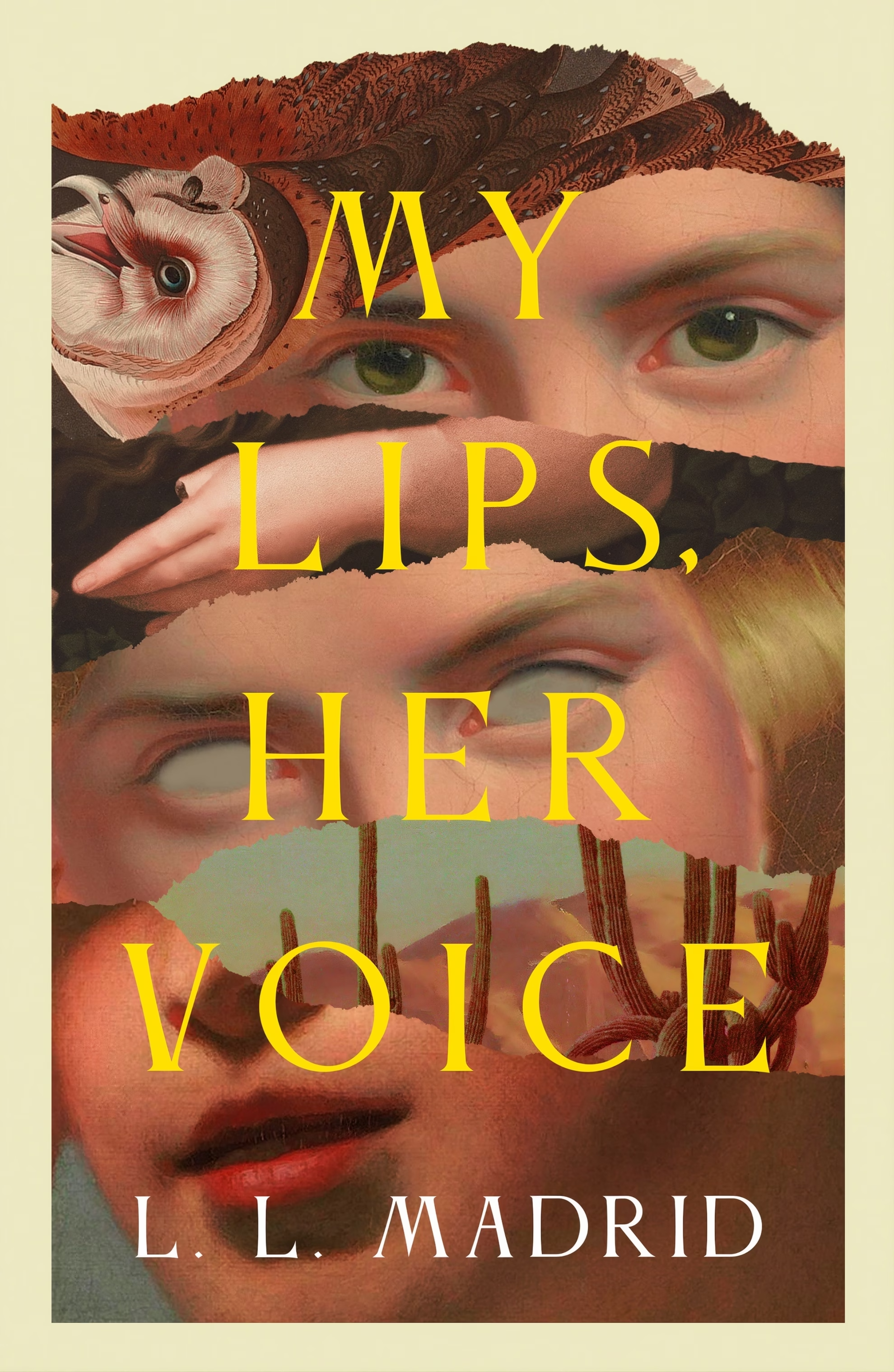
L.L. Madrid’s ‘My Lips, Her Voice’ appeared on the preliminary ballot for the 2025 Bram Stoker Awards. Every Creature book carries the press’s spine illustration, which it describes as a mark of its books as living creatures with desires of their own. A debut that makes a servant’s body the site of a bargain with a folk saint, and treats the resulting monster as a child to be defended, extends the direction ‘Goddess of Filth’ opened and ‘Necrology’ continued: folk magic as the instrument of women whom every other institution has failed.
The Price of the Egg
Mexican horror written in English has often been presented to its readers across a line drawn between ritual and grotesquerie, with sacred imagery on one side and gore on the other. ‘Bruja’s Nest’ erases that line at the level of plot. The saint who watches the birth, the rite that causes it, and the hacienda that rejects the child are one system, and it runs on the currency, love and money in the colors of a votive candle, that decided who owned the house and who scrubbed its floors long before the Revolution.
LaTorre’s debut lets a poor woman’s devotion be what devotion is for the devout, a working technology with a price paid in the body, and in doing so it places a Mexican folk saint where the genre’s mothers have always stood: at the precise point where the household’s power meets the flesh it consumes.
Beyond Rulfo, Fuentes, Melchor, and Moreno-Garcia, which Mexican or Mexican diaspora horror writers, whether in Spanish, in translation, or writing in English, would you set beside ‘Bruja’s Nest,’ and which of them deserve more attention in these pages?
References
- Real Academia Española, ‘brujo, ja,’ Diccionario de la lengua española, 23rd ed. ↩︎
- Brenda LaTorre, ‘31 Days of Horror: Day 16 — Why I Love Horror, Creature Publishing Week Edition Featuring Brenda LaTorre,’ RA for All: Horror, ed. Becky Spratford, October 16th, 2025. ↩︎
- Grace Daly, ‘Motherhood is a Multifaceted and Transformative State in Bruja’s Nest by Brenda LaTorre,’ The Lineup, May 8th, 2026. ↩︎
- R. Andrew Chesnut, ‘Devoted to Death: Santa Muerte, the Skeleton Saint’ (New York: Oxford University Press, 2012). ↩︎
- Friedrich Katz, ‘Labor Conditions on Haciendas in Porfirian Mexico: Some Trends and Tendencies,’ Hispanic American Historical Review 54, no. 1 (1974): 1–47. ↩︎
- Barbara Creed, ‘The Monstrous-Feminine: Film, Feminism, Psychoanalysis’ (London: Routledge, 1993). ↩︎
- Amanda Manns, ‘Member Spotlight: Creature Publishing,’ Community of Literary Magazines and Presses, December 13th, 2023. ↩︎



Leave a Reply